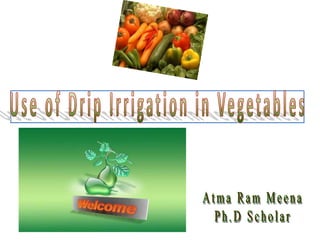
The scarcity and excess of water can have large,
immeasurable & negative impacts……..
Contents
Introduction
Advantages
Disadvantages
Comparison
Components
Design
Study
Conclusion
Introduction
Irrigation is an artificial applicationof waterto the
soil through various systems of tubes, pumps, and
sprays.
 Irrigation is normally used in areas where rainfall is
low ordry conditions.
Drip Irrigation
 Drip irrigation is a micro irrigation method in which the
rate of water application is very low and without any
pressure. i.e. drop by drop
 Drip irrigation is based on the basic concept of irrigation
only the roots zone of crop , rather than the entire land
surface on which the crop is grow.
 The soil moisture content of the crop root zone is
maintain at near optimum level to facilate optimum crop
growth and production.
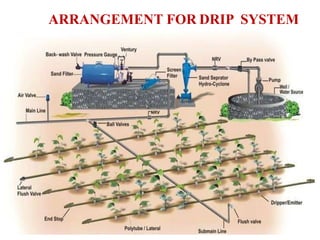
ARRANGEMENT FOR DRIP SYSTEM
Principles of Micro Irrigation
 Water is applied directly to the root zone of the
plants.
 Water is applied at frequent intervals at precise
quantities based on crop water requirements.
 Water is applied through a low-pressure pipe
network comprising Mains, Submains, laterals
and Emitting Devices
Drip irrigation is use in different crops
 Fruit crops:
 Banana, Grapes, Citrus, Pomegranate, Papaya, Pineapple,
Watermelon, Sweet lime, Mango, Kinnow, Mosambi.
 Vegetable crops:
 Cole crops , Okra, Tomato, Potato, Onion, Chillis, Radish,
Brinjal, Capsicum, Bhindi, Beans, Carrots, Cucumber, gourds.
 Commercial crops :
 Sugarcane, Cotton, Ground nut, Chickpea.
Advantages of Drip Irrigation
 Less requirement of irrigationwater
 Water logging is avoided
 High yield
 Over irrigation isavoided
 Reduced labour cost
 Weed control
 Highly uniform distribution of water i.e. Controlled by output of each
nozzle
 No soil erosion
 Suitable for any topography
 Maintenance of high surface temperature
 Tolerance to windy atmospheric condition
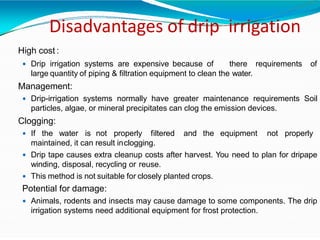
Disadvantages of drip irrigation
High cost :
 Drip irrigation systems are expensive because of there requirements of
large quantity of piping & filtration equipment to clean the water.
Management:
 Drip-irrigation systems normally have greater maintenance requirements Soil
particles, algae, or mineral precipitates can clog the emission devices.
Clogging:
 If the water is not properly filtered and the equipment not properly
maintained, it can result inclogging.
 Drip tape causes extra cleanup costs after harvest. You need to plan for dripape
winding, disposal, recycling or reuse.
 This method is not suitable for closely planted crops.
Potential for damage:
 Animals, rodents and insects may cause damage to some components. The drip
irrigation systems need additional equipment for frost protection.
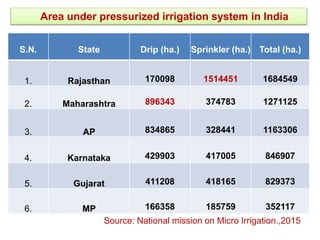
Area under pressurized irrigation system in India
S.N. State Drip (ha.) Sprinkler (ha.) Total (ha.)
1. Rajasthan 170098 1514451 1684549
2. Maharashtra 896343 374783 1271125
3. AP 834865 328441 1163306
4. Karnataka 429903 417005 846907
5. Gujarat 411208 418165 829373
6. MP 166358 185759 352117
Source: National mission on Micro Irrigation.,2015
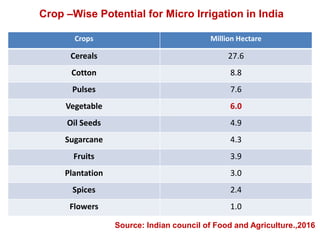
Crop –Wise Potential for Micro Irrigation in India
Crops Million Hectare
Cereals 27.6
Cotton 8.8
Pulses 7.6
Vegetable 6.0
Oil Seeds 4.9
Sugarcane 4.3
Fruits 3.9
Plantation 3.0
Spices 2.4
Flowers 1.0
Source: Indian council of Food and Agriculture.,2016
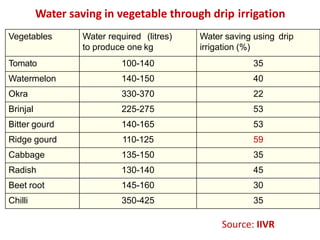
Water saving in vegetable through drip irrigation
Vegetables Water required (litres)
to produce one kg
Water saving using drip
irrigation (%)
Tomato 100-140 35
Watermelon 140-150 40
Okra 330-370 22
Brinjal 225-275 53
Bitter gourd 140-165 53
Ridge gourd 110-125 59
Cabbage 135-150 35
Radish 130-140 45
Beet root 145-160 30
Chilli 350-425 35
Source: IIVR
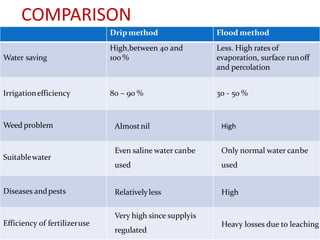
COMPARISON
Dripmethod Flood method
Water saving
High,between 40 and
100 %
Less. High rates of
evaporation, surface runoff
and percolation
Irrigationefficiency 80 – 90 % 30 - 50 %
Weed problem Almostnil High
Suitablewater
Even saline water canbe
used
Only normal water canbe
used
Diseases andpests Relativelyless High
Efficiency of fertilizeruse
Very high since supplyis
regulated
Heavy losses due to leaching
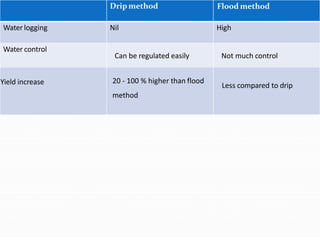
Yield increase
Dripmethod Flood method
Water logging Nil High
Water control
Can be regulated easily Not much control
20 - 100 % higher than flood
method
Less compared to drip
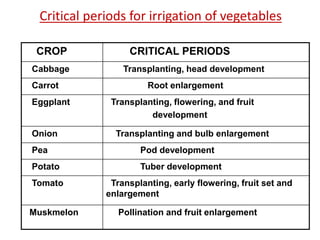
CROP CRITICAL PERIODS
Cabbage Transplanting, head development
Carrot Root enlargement
Eggplant Transplanting, flowering, and fruit
development
Onion Transplanting and bulb enlargement
Pea Pod development
Potato Tuber development
Tomato Transplanting, early flowering, fruit set and
enlargement
Muskmelon Pollination and fruit enlargement
Critical periods for irrigation of vegetables
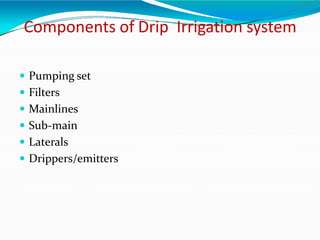
Components of Drip Irrigation system
 Pumping set
 Filters
 Mainlines
 Sub-main
 Laterals
 Drippers/emitters
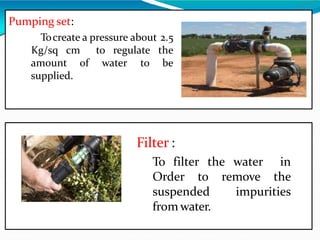
Pumping set:
Tocreate a pressure about 2.5
Kg/sq cm to regulate the
to beamount of water
supplied.
Filter :
To filter the water in
Order to remove the
suspended impurities
from water.
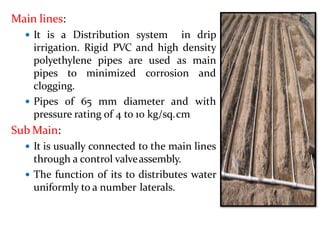
Main lines:
 It is a Distribution system in drip
irrigation. Rigid PVC and high density
polyethylene pipes are used as main
pipes to minimized corrosion and
clogging.
 Pipes of 65 mm diameter and with
pressure rating of 4 to 10 kg/sq.cm
Sub Main:
 It is usually connected to the main lines
through a control valveassembly.
 The function of its to distributes water
uniformly to a number laterals.
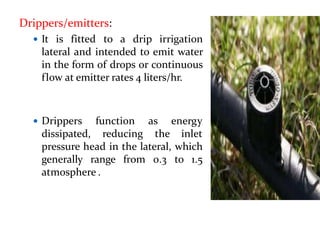
Drippers/emitters:
 It is fitted to a drip irrigation
lateral and intended to emit water
in the form of drops or continuous
flow at emitter rates 4 liters/hr.
 Drippers
dissipated,
function
reducing
as energy
the inlet
pressure head in the lateral, which
generally range from 0.3 to 1.5
atmosphere .
CASE STUDY
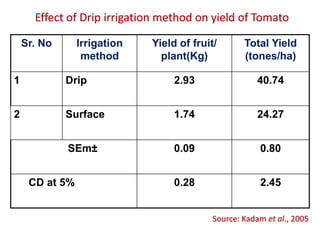
Source: Kadam et al., 2005
Effect of Drip irrigation method on yield of Tomato
Sr. No Irrigation
method
Yield of fruit/
plant(Kg)
Total Yield
(tones/ha)
1 Drip 2.93 40.74
2 Surface 1.74 24.27
SEm± 0.09 0.80
CD at 5% 0.28 2.45
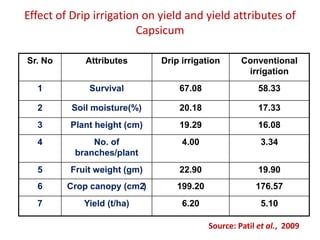
Sr. No Attributes Drip irrigation Conventional
irrigation
1 Survival 67.08 58.33
2 Soil moisture(%) 20.18 17.33
3 Plant height (cm) 19.29 16.08
4 No. of
branches/plant
4.00 3.34
5 Fruit weight (gm) 22.90 19.90
6 Crop canopy (cm2) 199.20 176.57
7 Yield (t/ha) 6.20 5.10
Effect of Drip irrigation on yield and yield attributes of
Capsicum
Source: Patil et al., 2009
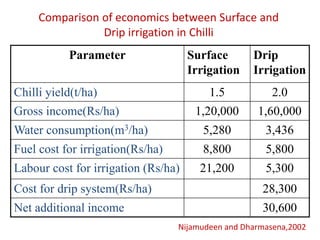
Parameter Surface
Irrigation
Drip
Irrigation
Chilli yield(t/ha) 1.5 2.0
Gross income(Rs/ha) 1,20,000 1,60,000
Water consumption(m3/ha) 5,280 3,436
Fuel cost for irrigation(Rs/ha) 8,800 5,800
Labour cost for irrigation (Rs/ha) 21,200 5,300
Cost for drip system(Rs/ha) 28,300
Net additional income 30,600
Comparison of economics between Surface and
Drip irrigation in Chilli
Nijamudeen and Dharmasena,2002
Treatment
Plant
height
(cm)
Branches
/ plant
Fruit
length
(cm)
Fruit
diamete
r
(cm)
Fruit
weight
(g)
Fruits/
plant
Fruit
yield/
plant
(kg)
Fruit
Yield
(q/ha
)
Increas
e in
yield
(% )
Irrigation regimes
Surface irrigation 83.9 9.8 4.3 3.9 60.1 29.1 2.4 546.5 -
Drip irrigation (100%
ET) 86.4 10.5 4.6 4.1 68.4 36.5 2.9 780.2 42.8
Drip irrigation (85%
ET) 88.9 10.7 4.8 4.2 68.6 36.8 3.0 788.9 44.3
Drip irrigation (70%
ET) 85.8 10.5 4.7 4.2 66.9 35.8 2.7 748.4 36.9
Drip irrigation (55%
ET) 84.5 10.3 4.6 4.1 64.8 33.8 2.6 684.5 25.2
SEm± 1.24 0.09 0.07 0.05 0.65 0.52 0.062 5.54
CD (0.05) 3.1 0.2 0.2 0.1 1.7 1.3 0.1 13.3
Mulches
No mulch 83.4 10.1 4.4 3.9 61.7 30.1 2.4 579.8 -
Black Polyethylene 86.4 10.3 4.6 4.1 66.4 34.6 2.7 717.3 23.7
Organic mulch 88.1 10.7 4.8 4.3 69.2 38.5 3.0 832.1 43.5
SEm± 0.92 0.09 0.05 0.04 0.48 0.48 0.042 3.42
CD (0.05) 2.5 0.2 0.2 0.1 1.2 1.1 0.1 8.9
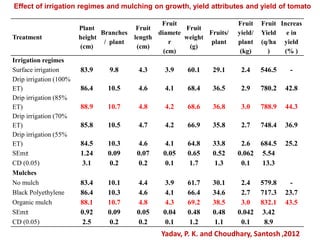
Effect of irrigation regimes and mulching on growth, yield attributes and yield of tomato
Yadav, P. K. and Choudhary, Santosh ,2012
40 x 20 cm 75 x 40 cm 40 x 20 cm 75 x 40 cm 40 x 20 cm 75 x 40
cm
Irrigation
Surface (1.0 V) 47.3 52.3 52.3 57.6 56.4 60.8
Drip irrigation (1.0
V)
43.9 49. 49.1 53.5 52.4 56.2
Drip irrigation (0.8
V)
41.7 46.3 46.9 51.3 48.8 53.4
Drip irrigation (0.6
V)
41.1 45.5 45.6 49.5 48.3 52.7
CD (0.05) 1.9 1.6 2.1 1.9 2.6 2.5
Cultivar
‘Arka Anamika’ 47.8 52.8 52.3 57.7 56.3 60.1
‘Tulsi’ 39.2 43.7 44.7 48.2 46.7 51.5
CD (0.05) 0.8 0.7 0.9 0.7 1.7 0.9
Mulch
No mulch 44.4 49.2 49.8 54.3 53.1 57.4
Organic mulch 42.7 47.2 46.6 51.7 49.8 54.3
Black polythene 43.5 48.5 49.1 52.9 51.7 55.63
CD (0.05) 0.7 0.6 0.8 0.6 1.4 0.5
Mean 43.5 48.3 48.5 53.1 51.5 55.8
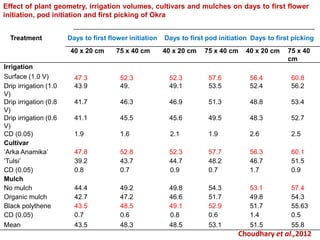
Effect of plant geometry, irrigation volumes, cultivars and mulches on days to first flower
initiation, pod initiation and first picking of Okra
Choudhary et al.,2012
Treatment Days to first flower initiation Days to first pod initiation Days to first picking
40 x 20 cm 75 x 40 cm 40 x 20 cm 75 x 40 cm 40 x 20 cm 75 x 40
cm
Irrigation
Surface (1.0 V) 103.82 123.78 124.2 106.07 5.6 4.7
Drip irrigation (1.0
V)
120.49 138.76 157.61 140.09 5.1 3.9
Drip irrigation (0.8
V)
138.14 158.25 172.68 154.86 3.2 2.6
Drip irrigation (0.6
V)
145.99 168.42 185.49 165.18 1.5 1.5
CD (0.05) 5.64 4.32 7.59 2.16 1.6 0.7
Cultivar
‘Arka Anamika’ 111.63 131.12 132.01 113.04 3.9 3.4
‘Tulsi’ 142.59 163.49 187.97 170.06 3.7 2.9
CD (0.05) 1.77 2.22 5.26 3.12 NS NS
Mulch
No mulch 119.83 138.05 147.49 127.97 4.8 4.2
Organic mulch 135.14 157.19 174.06 155.98 2.7 2.1
Black polythene 126.36 146.67 158.43 140.69 3.9 3.1
CD (0.05) 2.50 2.98 3.82 2.89 0.8 0.8
Mean 127.11 147.31 159.99 141.55 3.8 3.2
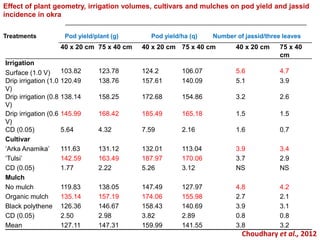
Treatments Pod yield/plant (g) Pod yield/ha (q) Number of jassid/three leaves
Effect of plant geometry, irrigation volumes, cultivars and mulches on pod yield and jassid
incidence in okra
Choudhary et al., 2012
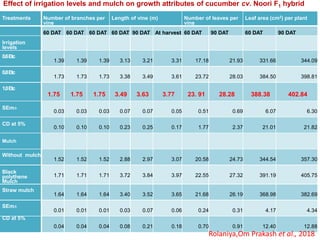
Treatments Number of branches per
vine
Length of vine (m) Number of leaves per
vine
Leaf area (cm2) per plant
60 DAT 60 DAT 60 DAT 60 DAT 90 DAT At harvest 60 DAT 90 DAT 60 DAT 90 DAT
Irrigation
levels
0.6Etc
1.39 1.39 1.39 3.13 3.21 3.31 17.18 21.93 331.66 344.09
0.8Etc
1.73 1.73 1.73 3.38 3.49 3.61 23.72 28.03 384.50 398.81
1.0Etc
1.75 1.75 1.75 3.49 3.63 3.77 23. 91 28.28 388.38 402.84
SEm±
0.03 0.03 0.03 0.07 0.07 0.05 0.51 0.69 6.07 6.30
CD at 5%
0.10 0.10 0.10 0.23 0.25 0.17 1.77 2.37 21.01 21.82
Mulch
Without mulch
1.52 1.52 1.52 2.88 2.97 3.07 20.58 24.73 344.54 357.30
Black
polythene
Mulch
1.71 1.71 1.71 3.72 3.84 3.97 22.55 27.32 391.19 405.75
Straw mulch
1.64 1.64 1.64 3.40 3.52 3.65 21.68 26.19 368.98 382.69
SEm±
0.01 0.01 0.01 0.03 0.07 0.06 0.24 0.31 4.17 4.34
CD at 5%
0.04 0.04 0.04 0.08 0.21 0.18 0.70 0.91 12.40 12.88
Effect of irrigation levels and mulch on growth attributes of cucumber cv. Noori F1 hybrid
Rolaniya,Om Prakash et al., 2018
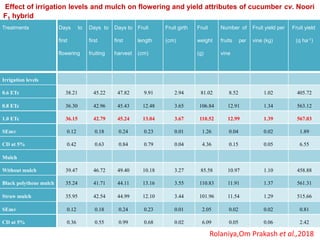
Treatments Days to
first
flowering
Days to
first
fruiting
Days to
first
harvest
Fruit
length
(cm)
Fruit girth
(cm)
Fruit
weight
(g)
Number of
fruits per
vine
Fruit yield per
vine (kg)
Fruit yield
(q ha-1)
Irrigation levels
0.6 ETc 38.21 45.22 47.82 9.91 2.94 81.02 8.52 1.02 405.72
0.8 ETc 36.30 42.96 45.43 12.48 3.65 106.84 12.91 1.34 563.12
1.0 ETc 36.15 42.79 45.24 13.04 3.67 110.52 12.99 1.39 567.03
SEm± 0.12 0.18 0.24 0.23 0.01 1.26 0.04 0.02 1.89
CD at 5% 0.42 0.63 0.84 0.79 0.04 4.36 0.15 0.05 6.55
Mulch
Without mulch 39.47 46.72 49.40 10.18 3.27 85.58 10.97 1.10 458.88
Black polythene mulch 35.24 41.71 44.11 13.16 3.55 110.83 11.91 1.37 561.31
Straw mulch 35.95 42.54 44.99 12.10 3.44 101.96 11.54 1.29 515.66
SEm± 0.12 0.18 0.24 0.23 0.01 2.05 0.02 0.02 0.81
CD at 5% 0.36 0.55 0.99 0.68 0.02 6.09 0.05 0.06 2.42
Effect of irrigation levels and mulch on flowering and yield attributes of cucumber cv. Noori
F1 hybrid
Rolaniya,Om Prakash et al.,2018
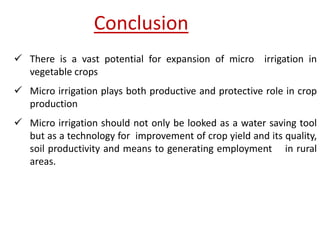
Conclusion
 There is a vast potential for expansion of micro irrigation in
vegetable crops
 Micro irrigation plays both productive and protective role in crop
production
 Micro irrigation should not only be looked as a water saving tool
but as a technology for improvement of crop yield and its quality,
soil productivity and means to generating employment in rural
areas.
Thank you

Use drip irrigation in vegetables

  • 2.
    The scarcity andexcess of water can have large, immeasurable & negative impacts……..
  • 3.
  • 4.
    Introduction Irrigation is anartificial applicationof waterto the soil through various systems of tubes, pumps, and sprays.  Irrigation is normally used in areas where rainfall is low ordry conditions.
  • 5.
    Drip Irrigation  Dripirrigation is a micro irrigation method in which the rate of water application is very low and without any pressure. i.e. drop by drop  Drip irrigation is based on the basic concept of irrigation only the roots zone of crop , rather than the entire land surface on which the crop is grow.  The soil moisture content of the crop root zone is maintain at near optimum level to facilate optimum crop growth and production.
  • 6.
  • 7.
    Principles of MicroIrrigation  Water is applied directly to the root zone of the plants.  Water is applied at frequent intervals at precise quantities based on crop water requirements.  Water is applied through a low-pressure pipe network comprising Mains, Submains, laterals and Emitting Devices
  • 8.
    Drip irrigation isuse in different crops  Fruit crops:  Banana, Grapes, Citrus, Pomegranate, Papaya, Pineapple, Watermelon, Sweet lime, Mango, Kinnow, Mosambi.  Vegetable crops:  Cole crops , Okra, Tomato, Potato, Onion, Chillis, Radish, Brinjal, Capsicum, Bhindi, Beans, Carrots, Cucumber, gourds.  Commercial crops :  Sugarcane, Cotton, Ground nut, Chickpea.
  • 9.
    Advantages of DripIrrigation  Less requirement of irrigationwater  Water logging is avoided  High yield  Over irrigation isavoided  Reduced labour cost  Weed control  Highly uniform distribution of water i.e. Controlled by output of each nozzle  No soil erosion  Suitable for any topography  Maintenance of high surface temperature  Tolerance to windy atmospheric condition
  • 10.
    Disadvantages of dripirrigation High cost :  Drip irrigation systems are expensive because of there requirements of large quantity of piping & filtration equipment to clean the water. Management:  Drip-irrigation systems normally have greater maintenance requirements Soil particles, algae, or mineral precipitates can clog the emission devices. Clogging:  If the water is not properly filtered and the equipment not properly maintained, it can result inclogging.  Drip tape causes extra cleanup costs after harvest. You need to plan for dripape winding, disposal, recycling or reuse.  This method is not suitable for closely planted crops. Potential for damage:  Animals, rodents and insects may cause damage to some components. The drip irrigation systems need additional equipment for frost protection.
  • 11.
    Area under pressurizedirrigation system in India S.N. State Drip (ha.) Sprinkler (ha.) Total (ha.) 1. Rajasthan 170098 1514451 1684549 2. Maharashtra 896343 374783 1271125 3. AP 834865 328441 1163306 4. Karnataka 429903 417005 846907 5. Gujarat 411208 418165 829373 6. MP 166358 185759 352117 Source: National mission on Micro Irrigation.,2015
  • 12.
    Crop –Wise Potentialfor Micro Irrigation in India Crops Million Hectare Cereals 27.6 Cotton 8.8 Pulses 7.6 Vegetable 6.0 Oil Seeds 4.9 Sugarcane 4.3 Fruits 3.9 Plantation 3.0 Spices 2.4 Flowers 1.0 Source: Indian council of Food and Agriculture.,2016
  • 13.
    Water saving invegetable through drip irrigation Vegetables Water required (litres) to produce one kg Water saving using drip irrigation (%) Tomato 100-140 35 Watermelon 140-150 40 Okra 330-370 22 Brinjal 225-275 53 Bitter gourd 140-165 53 Ridge gourd 110-125 59 Cabbage 135-150 35 Radish 130-140 45 Beet root 145-160 30 Chilli 350-425 35 Source: IIVR
  • 14.
    COMPARISON Dripmethod Flood method Watersaving High,between 40 and 100 % Less. High rates of evaporation, surface runoff and percolation Irrigationefficiency 80 – 90 % 30 - 50 % Weed problem Almostnil High Suitablewater Even saline water canbe used Only normal water canbe used Diseases andpests Relativelyless High Efficiency of fertilizeruse Very high since supplyis regulated Heavy losses due to leaching
  • 15.
    Yield increase Dripmethod Floodmethod Water logging Nil High Water control Can be regulated easily Not much control 20 - 100 % higher than flood method Less compared to drip
  • 16.
    CROP CRITICAL PERIODS CabbageTransplanting, head development Carrot Root enlargement Eggplant Transplanting, flowering, and fruit development Onion Transplanting and bulb enlargement Pea Pod development Potato Tuber development Tomato Transplanting, early flowering, fruit set and enlargement Muskmelon Pollination and fruit enlargement Critical periods for irrigation of vegetables
  • 17.
    Components of DripIrrigation system  Pumping set  Filters  Mainlines  Sub-main  Laterals  Drippers/emitters
  • 18.
    Pumping set: Tocreate apressure about 2.5 Kg/sq cm to regulate the to beamount of water supplied. Filter : To filter the water in Order to remove the suspended impurities from water.
  • 19.
    Main lines:  Itis a Distribution system in drip irrigation. Rigid PVC and high density polyethylene pipes are used as main pipes to minimized corrosion and clogging.  Pipes of 65 mm diameter and with pressure rating of 4 to 10 kg/sq.cm Sub Main:  It is usually connected to the main lines through a control valveassembly.  The function of its to distributes water uniformly to a number laterals.
  • 20.
    Drippers/emitters:  It isfitted to a drip irrigation lateral and intended to emit water in the form of drops or continuous flow at emitter rates 4 liters/hr.  Drippers dissipated, function reducing as energy the inlet pressure head in the lateral, which generally range from 0.3 to 1.5 atmosphere .
  • 21.
  • 22.
    Source: Kadam etal., 2005 Effect of Drip irrigation method on yield of Tomato Sr. No Irrigation method Yield of fruit/ plant(Kg) Total Yield (tones/ha) 1 Drip 2.93 40.74 2 Surface 1.74 24.27 SEm± 0.09 0.80 CD at 5% 0.28 2.45
  • 23.
    Sr. No AttributesDrip irrigation Conventional irrigation 1 Survival 67.08 58.33 2 Soil moisture(%) 20.18 17.33 3 Plant height (cm) 19.29 16.08 4 No. of branches/plant 4.00 3.34 5 Fruit weight (gm) 22.90 19.90 6 Crop canopy (cm2) 199.20 176.57 7 Yield (t/ha) 6.20 5.10 Effect of Drip irrigation on yield and yield attributes of Capsicum Source: Patil et al., 2009
  • 24.
    Parameter Surface Irrigation Drip Irrigation Chilli yield(t/ha)1.5 2.0 Gross income(Rs/ha) 1,20,000 1,60,000 Water consumption(m3/ha) 5,280 3,436 Fuel cost for irrigation(Rs/ha) 8,800 5,800 Labour cost for irrigation (Rs/ha) 21,200 5,300 Cost for drip system(Rs/ha) 28,300 Net additional income 30,600 Comparison of economics between Surface and Drip irrigation in Chilli Nijamudeen and Dharmasena,2002
  • 25.
    Treatment Plant height (cm) Branches / plant Fruit length (cm) Fruit diamete r (cm) Fruit weight (g) Fruits/ plant Fruit yield/ plant (kg) Fruit Yield (q/ha ) Increas e in yield (%) Irrigation regimes Surface irrigation 83.9 9.8 4.3 3.9 60.1 29.1 2.4 546.5 - Drip irrigation (100% ET) 86.4 10.5 4.6 4.1 68.4 36.5 2.9 780.2 42.8 Drip irrigation (85% ET) 88.9 10.7 4.8 4.2 68.6 36.8 3.0 788.9 44.3 Drip irrigation (70% ET) 85.8 10.5 4.7 4.2 66.9 35.8 2.7 748.4 36.9 Drip irrigation (55% ET) 84.5 10.3 4.6 4.1 64.8 33.8 2.6 684.5 25.2 SEm± 1.24 0.09 0.07 0.05 0.65 0.52 0.062 5.54 CD (0.05) 3.1 0.2 0.2 0.1 1.7 1.3 0.1 13.3 Mulches No mulch 83.4 10.1 4.4 3.9 61.7 30.1 2.4 579.8 - Black Polyethylene 86.4 10.3 4.6 4.1 66.4 34.6 2.7 717.3 23.7 Organic mulch 88.1 10.7 4.8 4.3 69.2 38.5 3.0 832.1 43.5 SEm± 0.92 0.09 0.05 0.04 0.48 0.48 0.042 3.42 CD (0.05) 2.5 0.2 0.2 0.1 1.2 1.1 0.1 8.9 Effect of irrigation regimes and mulching on growth, yield attributes and yield of tomato Yadav, P. K. and Choudhary, Santosh ,2012
  • 26.
    40 x 20cm 75 x 40 cm 40 x 20 cm 75 x 40 cm 40 x 20 cm 75 x 40 cm Irrigation Surface (1.0 V) 47.3 52.3 52.3 57.6 56.4 60.8 Drip irrigation (1.0 V) 43.9 49. 49.1 53.5 52.4 56.2 Drip irrigation (0.8 V) 41.7 46.3 46.9 51.3 48.8 53.4 Drip irrigation (0.6 V) 41.1 45.5 45.6 49.5 48.3 52.7 CD (0.05) 1.9 1.6 2.1 1.9 2.6 2.5 Cultivar ‘Arka Anamika’ 47.8 52.8 52.3 57.7 56.3 60.1 ‘Tulsi’ 39.2 43.7 44.7 48.2 46.7 51.5 CD (0.05) 0.8 0.7 0.9 0.7 1.7 0.9 Mulch No mulch 44.4 49.2 49.8 54.3 53.1 57.4 Organic mulch 42.7 47.2 46.6 51.7 49.8 54.3 Black polythene 43.5 48.5 49.1 52.9 51.7 55.63 CD (0.05) 0.7 0.6 0.8 0.6 1.4 0.5 Mean 43.5 48.3 48.5 53.1 51.5 55.8 Effect of plant geometry, irrigation volumes, cultivars and mulches on days to first flower initiation, pod initiation and first picking of Okra Choudhary et al.,2012 Treatment Days to first flower initiation Days to first pod initiation Days to first picking
  • 27.
    40 x 20cm 75 x 40 cm 40 x 20 cm 75 x 40 cm 40 x 20 cm 75 x 40 cm Irrigation Surface (1.0 V) 103.82 123.78 124.2 106.07 5.6 4.7 Drip irrigation (1.0 V) 120.49 138.76 157.61 140.09 5.1 3.9 Drip irrigation (0.8 V) 138.14 158.25 172.68 154.86 3.2 2.6 Drip irrigation (0.6 V) 145.99 168.42 185.49 165.18 1.5 1.5 CD (0.05) 5.64 4.32 7.59 2.16 1.6 0.7 Cultivar ‘Arka Anamika’ 111.63 131.12 132.01 113.04 3.9 3.4 ‘Tulsi’ 142.59 163.49 187.97 170.06 3.7 2.9 CD (0.05) 1.77 2.22 5.26 3.12 NS NS Mulch No mulch 119.83 138.05 147.49 127.97 4.8 4.2 Organic mulch 135.14 157.19 174.06 155.98 2.7 2.1 Black polythene 126.36 146.67 158.43 140.69 3.9 3.1 CD (0.05) 2.50 2.98 3.82 2.89 0.8 0.8 Mean 127.11 147.31 159.99 141.55 3.8 3.2 Treatments Pod yield/plant (g) Pod yield/ha (q) Number of jassid/three leaves Effect of plant geometry, irrigation volumes, cultivars and mulches on pod yield and jassid incidence in okra Choudhary et al., 2012
  • 28.
    Treatments Number ofbranches per vine Length of vine (m) Number of leaves per vine Leaf area (cm2) per plant 60 DAT 60 DAT 60 DAT 60 DAT 90 DAT At harvest 60 DAT 90 DAT 60 DAT 90 DAT Irrigation levels 0.6Etc 1.39 1.39 1.39 3.13 3.21 3.31 17.18 21.93 331.66 344.09 0.8Etc 1.73 1.73 1.73 3.38 3.49 3.61 23.72 28.03 384.50 398.81 1.0Etc 1.75 1.75 1.75 3.49 3.63 3.77 23. 91 28.28 388.38 402.84 SEm± 0.03 0.03 0.03 0.07 0.07 0.05 0.51 0.69 6.07 6.30 CD at 5% 0.10 0.10 0.10 0.23 0.25 0.17 1.77 2.37 21.01 21.82 Mulch Without mulch 1.52 1.52 1.52 2.88 2.97 3.07 20.58 24.73 344.54 357.30 Black polythene Mulch 1.71 1.71 1.71 3.72 3.84 3.97 22.55 27.32 391.19 405.75 Straw mulch 1.64 1.64 1.64 3.40 3.52 3.65 21.68 26.19 368.98 382.69 SEm± 0.01 0.01 0.01 0.03 0.07 0.06 0.24 0.31 4.17 4.34 CD at 5% 0.04 0.04 0.04 0.08 0.21 0.18 0.70 0.91 12.40 12.88 Effect of irrigation levels and mulch on growth attributes of cucumber cv. Noori F1 hybrid Rolaniya,Om Prakash et al., 2018
  • 29.
    Treatments Days to first flowering Daysto first fruiting Days to first harvest Fruit length (cm) Fruit girth (cm) Fruit weight (g) Number of fruits per vine Fruit yield per vine (kg) Fruit yield (q ha-1) Irrigation levels 0.6 ETc 38.21 45.22 47.82 9.91 2.94 81.02 8.52 1.02 405.72 0.8 ETc 36.30 42.96 45.43 12.48 3.65 106.84 12.91 1.34 563.12 1.0 ETc 36.15 42.79 45.24 13.04 3.67 110.52 12.99 1.39 567.03 SEm± 0.12 0.18 0.24 0.23 0.01 1.26 0.04 0.02 1.89 CD at 5% 0.42 0.63 0.84 0.79 0.04 4.36 0.15 0.05 6.55 Mulch Without mulch 39.47 46.72 49.40 10.18 3.27 85.58 10.97 1.10 458.88 Black polythene mulch 35.24 41.71 44.11 13.16 3.55 110.83 11.91 1.37 561.31 Straw mulch 35.95 42.54 44.99 12.10 3.44 101.96 11.54 1.29 515.66 SEm± 0.12 0.18 0.24 0.23 0.01 2.05 0.02 0.02 0.81 CD at 5% 0.36 0.55 0.99 0.68 0.02 6.09 0.05 0.06 2.42 Effect of irrigation levels and mulch on flowering and yield attributes of cucumber cv. Noori F1 hybrid Rolaniya,Om Prakash et al.,2018
  • 30.
    Conclusion  There isa vast potential for expansion of micro irrigation in vegetable crops  Micro irrigation plays both productive and protective role in crop production  Micro irrigation should not only be looked as a water saving tool but as a technology for improvement of crop yield and its quality, soil productivity and means to generating employment in rural areas.
  • 31.