BREEDING
FOR DEVELOPMENT OF
IMPROVED OKRA
1
PRESENTD BY:
PAPON KUMAR KUNDU
REG: 14-05817
MOSHIUR RAHMAN
REG: 14-05938
MD SHAFIQUL ISLAM
REG:11-04498
2
INTRODUCTION
 Perennial plant but mostly cultivated as annual.
 Popular summer vegetables in Bangladesh.
 Green seed pods are eaten as vegetable.
 Young aged okra can be used as salad.
 Allopolyploid.
3
BENEFITS OF OKRA
 Significant amounts of vital nutrients- Protein,
Fiber, Calcium, Iron and Zinc.
 Prevents Liver Disease.
 Boosts Immunity.
 Improves Eyesight.
 Help to Loss Weight.
 Okra Seeds can delay Fatiguing.
4
Kingdom: Plantae
Division: Magnoliophyta
Class: Magnoliopsida
Order: Malvales
Family: Malvaceae
Genus: Abelmoschus
Species: Abelmoschus esculentus
TAXONOMY
5
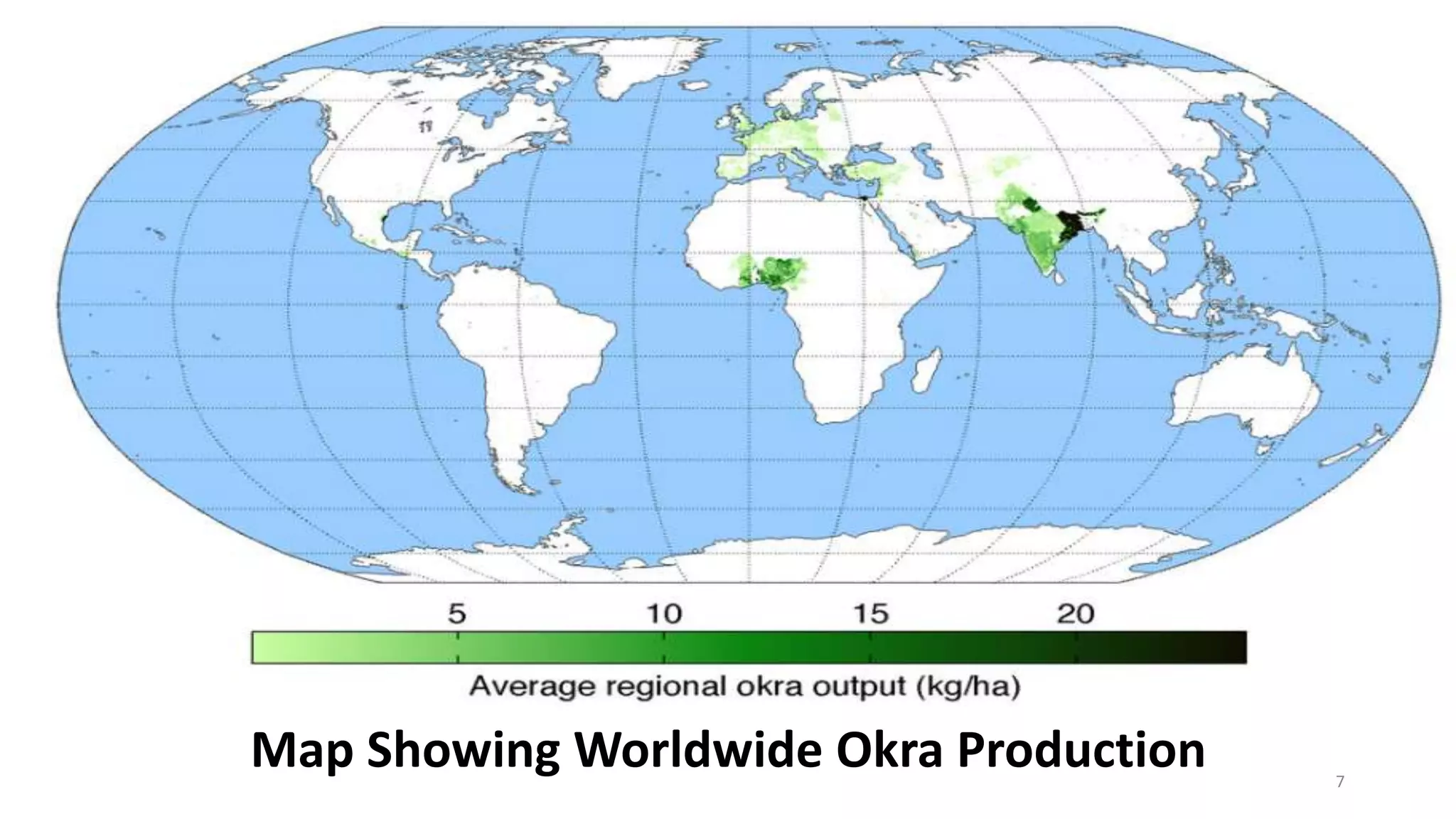
Tropical, Subtropical and Warm Temperate Regions
around the World.
Major Okra Growing Countries
 India
 Sudan
 Pakistan
 Ghana
 Nigeria
 Iraq
 Cameroon
 Egypt
6
Map Showing Worldwide Okra Production 7
Origin Of Okra
 Tropical Asia and Africa
 Two wild species are originated from Asia
 Crinitus
 A. angulosus
 Primary Center of Origin
 Central Asia, Near East
 Secondary Center of Origin
 Africa
8
Okra is an herbaceous annual plant.
Stem: Small and Erect.
Leaves: Heart shaped, Alternate,10–20 cm
long.
Hight: 1.2–1.8 m tall.
Propagation: Typically propagated from seed.
Chromosome Number: 2n = 130 and 2n = 72
BOTANICAL DESCRIPTIONS
9
10
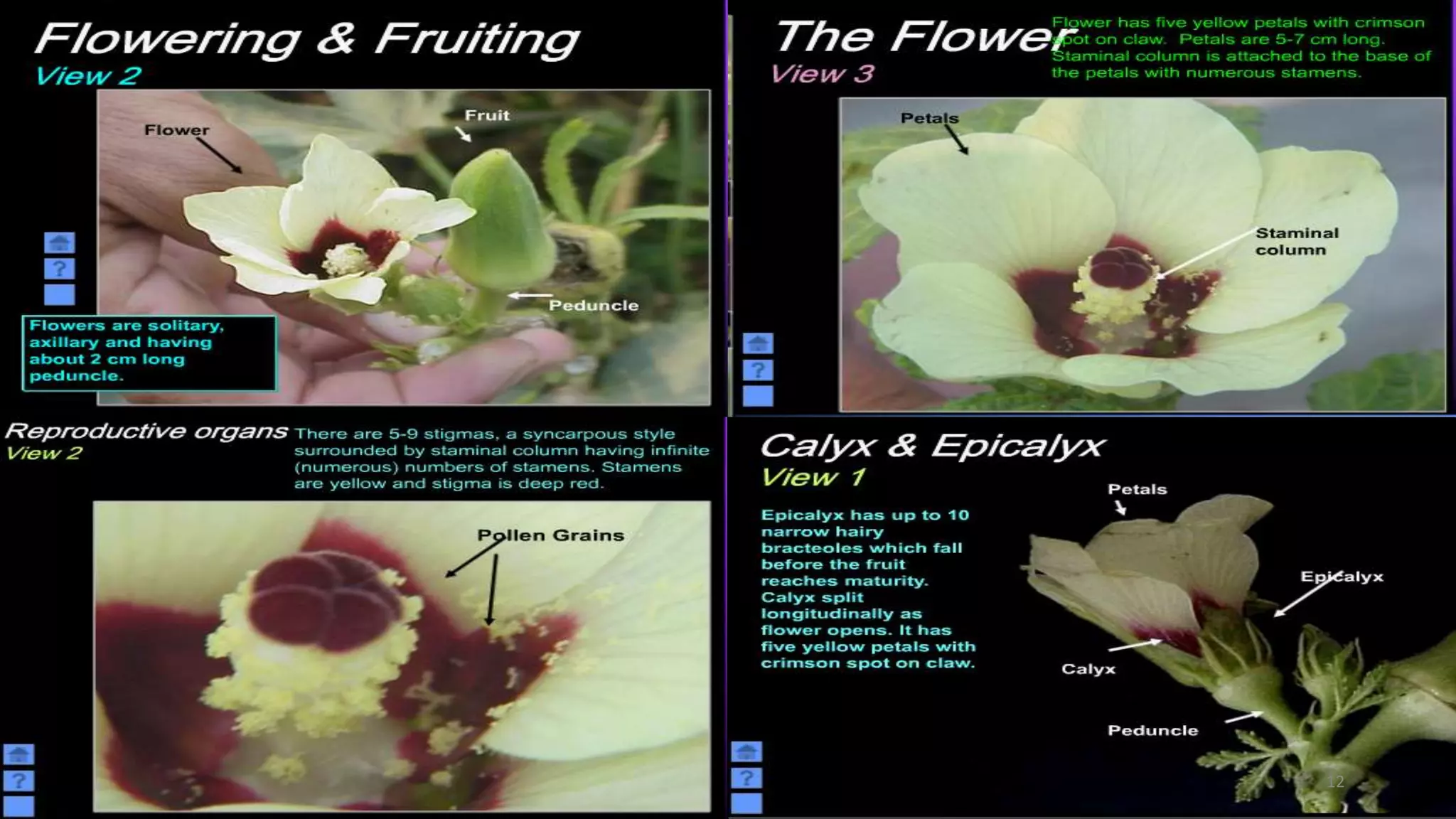
FLORAL BIOLOGY
FLOWER: Solitary, long pedancle
EPICALYX: Long , narrow hairy
CALYX: Splits longitudinally as the flower open
PETALS: 5, yellow in color
STAMENS: Staminal column is united to base of Petal
with many stamens
OVERY : Superior
FRUITS: Capsule
POLLEN VIABILITY: 55 days
PROTOGYNY: Allogamy, but out cross by insect 19%
11
12
Types Of Okra
 Spineless Okra
 Dwarf Okra
 Giant Okra
 Round-Pod Okra
 Star-Pod Okra
13
Variety and cultivar
 Clemson Spineless
 Chinese Okra
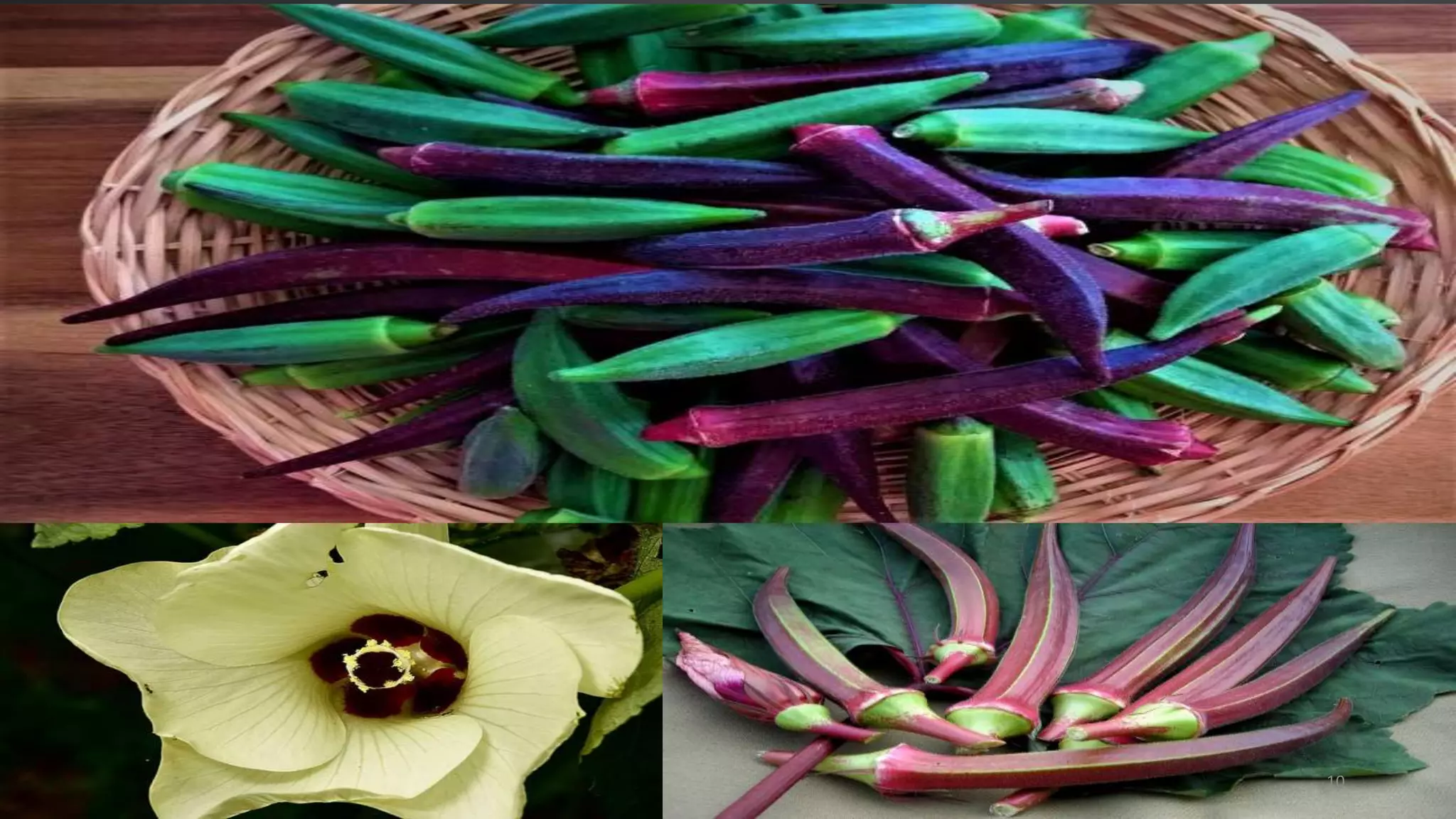
 Purple Okra
 Punjab-8
 BARI Dherosh-1
 BARI Dherosh-2
14
BREEDING OBJECTIVES
To study the every part of the okra cultivation
and management practices.
To evaluate the yield of the crop.
To analyze the cost benefit.
To identify the problems during the crop
management.
To propose the suggestions for the problems.
15
Breeding Methods
Pure-line Selection
Pedigree Method
Mutation Breeding
Heterosis Breeding
16
 Large numbers of plants are selected from a self-
pollinated crop and is harvested individually. Then the
individual plant progenies from them are evaluated
separately and the best one is released as pure line
variety.
 The pure line becomes genetically variable with time,
due to mechanical mixture, mutation, etc.
 Superior line is used as variety.
PURE-LINE SELECTION
17
18
 Maximum possible improvement
 Extremely uniform
 Easy Method
 Required Less Skill
 Used to Develop Inbreed and Pure lines
Advantages
19
 This method is applicable to the segregating
generations after hybridization between
desirable promising donors.
 The individual plant selection starts in the F2
generation and continues till F5 or F6.
PEDIGREE METHOD
20
21
 Mutation breeding is the process of exposing seeds to
chemicals or radiation in order to generate mutants
with desirable traits to be breed with other cultivars.
 There are different kinds of mutagenic breeding such
as using chemical mutagens like ethyl methane
sulfonate and dimethyl sulfate, radiation and
transposons are used to generate mutants.
MUTATION BREEDING
22
23
 Improves Morphological And Physiological Characters
Of Plant.
 Improves Disease Resistant Plant Crops
 To Create High Yielding Variety
 To Disseminate Undesirable Characters From Plant
Quantitative Characteristics Of Plant Including Yield Can
Be Improved.
Advantages
24
 Improved Quality of progeny over its parents is called
heterosis.
 Heterosis in okra has been reported for various economic
traits, viz. early and late flowering, plant height, number,
weight and size of pods, number of ridges, marketable and
total yield.
 Using hand emasculation and pollination, commercial hybrids
are developed.
HETEROSIS BREEDING
25
Hand emasculation is the removal
of stamens from Bi-sexual flowers.
HYBRID SEED PRODUCTION
26
Pollen from freshly open bud which are previously bagged
from the male parent line is collected in the morning.
Pollen is dusted directly on stigma of the emasculated flower
of the female parents with the help of camel hair brush.
For selfing, cover the individual flower with the butter paper
bag.
POLLINATION
27
CONSTRAINTS OF OKRA PRODUCTION
 Seeds do not germinate; Plants do not emerge. Soil
temperature must be at least 70°F for okra to germinate. Seeds
are needed to be pre-soaked in water for 24 hours before
sowing.
 Flowers and buds drop before pods set. Temperatures greater
than 95°F also Temperatures too cool can cause flower and bud
drop.
 Heat and cold can interfere with pollinations. Pollination will be
poor if temperatures rise above 90°F or drop below 55°F. Too
little light, water stress, and excess nitrogen also inhibit pod
formation. 28
Deformed pods. Bug sucks sap from leaves and
pods causing them to become twisted and
deformed. Spraying with insecticidal soap and
Dusting with sabadilla can be useful.
Pods are woody and tough. Okra should be
picked just a few days after flowering.
29
 Lack of breeding knowledge
 Lack of field
 Abiotic stress
 Lack of proper management practices
 Standing of water
Others:
30
31
 In Bangladesh vegetable production is not uniform
round the year. Vegetables are plenty in winter, but
are lower in summer. Though it is popular in the
country, its production is mainly concentrated during
summer. So, as vegetable okra can get an
importance in summer.
Okra is one vegetable crop where heterosis has been
exploited successfully.
CONCLUSION
32
 Yield plateau seems to have been reached in heterotic
hybrids. In order to break this barrier there is a need to
develop truly potential inbred lines which in
combination can produce really novel hybrids with
desirable maximum heterosis.
 Among the various approaches for developing inbred
lines, selection in potential segregating populations is an
important one. But then, the key to success lies in
developing the really promising potential segregating
populations.
33
34

Okra Breeding Techniques

  • 1.
  • 2.
    PRESENTD BY: PAPON KUMARKUNDU REG: 14-05817 MOSHIUR RAHMAN REG: 14-05938 MD SHAFIQUL ISLAM REG:11-04498 2
  • 3.
    INTRODUCTION  Perennial plantbut mostly cultivated as annual.  Popular summer vegetables in Bangladesh.  Green seed pods are eaten as vegetable.  Young aged okra can be used as salad.  Allopolyploid. 3
  • 4.
    BENEFITS OF OKRA Significant amounts of vital nutrients- Protein, Fiber, Calcium, Iron and Zinc.  Prevents Liver Disease.  Boosts Immunity.  Improves Eyesight.  Help to Loss Weight.  Okra Seeds can delay Fatiguing. 4
  • 5.
    Kingdom: Plantae Division: Magnoliophyta Class:Magnoliopsida Order: Malvales Family: Malvaceae Genus: Abelmoschus Species: Abelmoschus esculentus TAXONOMY 5
  • 6.
    Tropical, Subtropical andWarm Temperate Regions around the World. Major Okra Growing Countries  India  Sudan  Pakistan  Ghana  Nigeria  Iraq  Cameroon  Egypt 6
  • 7.
    Map Showing WorldwideOkra Production 7
  • 8.
    Origin Of Okra Tropical Asia and Africa  Two wild species are originated from Asia  Crinitus  A. angulosus  Primary Center of Origin  Central Asia, Near East  Secondary Center of Origin  Africa 8
  • 9.
    Okra is anherbaceous annual plant. Stem: Small and Erect. Leaves: Heart shaped, Alternate,10–20 cm long. Hight: 1.2–1.8 m tall. Propagation: Typically propagated from seed. Chromosome Number: 2n = 130 and 2n = 72 BOTANICAL DESCRIPTIONS 9
  • 10.
  • 11.
    FLORAL BIOLOGY FLOWER: Solitary,long pedancle EPICALYX: Long , narrow hairy CALYX: Splits longitudinally as the flower open PETALS: 5, yellow in color STAMENS: Staminal column is united to base of Petal with many stamens OVERY : Superior FRUITS: Capsule POLLEN VIABILITY: 55 days PROTOGYNY: Allogamy, but out cross by insect 19% 11
  • 12.
  • 13.
    Types Of Okra Spineless Okra  Dwarf Okra  Giant Okra  Round-Pod Okra  Star-Pod Okra 13
  • 14.
    Variety and cultivar Clemson Spineless  Chinese Okra  Purple Okra  Punjab-8  BARI Dherosh-1  BARI Dherosh-2 14
  • 15.
    BREEDING OBJECTIVES To studythe every part of the okra cultivation and management practices. To evaluate the yield of the crop. To analyze the cost benefit. To identify the problems during the crop management. To propose the suggestions for the problems. 15
  • 16.
    Breeding Methods Pure-line Selection PedigreeMethod Mutation Breeding Heterosis Breeding 16
  • 17.
     Large numbersof plants are selected from a self- pollinated crop and is harvested individually. Then the individual plant progenies from them are evaluated separately and the best one is released as pure line variety.  The pure line becomes genetically variable with time, due to mechanical mixture, mutation, etc.  Superior line is used as variety. PURE-LINE SELECTION 17
  • 18.
  • 19.
     Maximum possibleimprovement  Extremely uniform  Easy Method  Required Less Skill  Used to Develop Inbreed and Pure lines Advantages 19
  • 20.
     This methodis applicable to the segregating generations after hybridization between desirable promising donors.  The individual plant selection starts in the F2 generation and continues till F5 or F6. PEDIGREE METHOD 20
  • 21.
  • 22.
     Mutation breedingis the process of exposing seeds to chemicals or radiation in order to generate mutants with desirable traits to be breed with other cultivars.  There are different kinds of mutagenic breeding such as using chemical mutagens like ethyl methane sulfonate and dimethyl sulfate, radiation and transposons are used to generate mutants. MUTATION BREEDING 22
  • 23.
  • 24.
     Improves MorphologicalAnd Physiological Characters Of Plant.  Improves Disease Resistant Plant Crops  To Create High Yielding Variety  To Disseminate Undesirable Characters From Plant Quantitative Characteristics Of Plant Including Yield Can Be Improved. Advantages 24
  • 25.
     Improved Qualityof progeny over its parents is called heterosis.  Heterosis in okra has been reported for various economic traits, viz. early and late flowering, plant height, number, weight and size of pods, number of ridges, marketable and total yield.  Using hand emasculation and pollination, commercial hybrids are developed. HETEROSIS BREEDING 25
  • 26.
    Hand emasculation isthe removal of stamens from Bi-sexual flowers. HYBRID SEED PRODUCTION 26
  • 27.
    Pollen from freshlyopen bud which are previously bagged from the male parent line is collected in the morning. Pollen is dusted directly on stigma of the emasculated flower of the female parents with the help of camel hair brush. For selfing, cover the individual flower with the butter paper bag. POLLINATION 27
  • 28.
    CONSTRAINTS OF OKRAPRODUCTION  Seeds do not germinate; Plants do not emerge. Soil temperature must be at least 70°F for okra to germinate. Seeds are needed to be pre-soaked in water for 24 hours before sowing.  Flowers and buds drop before pods set. Temperatures greater than 95°F also Temperatures too cool can cause flower and bud drop.  Heat and cold can interfere with pollinations. Pollination will be poor if temperatures rise above 90°F or drop below 55°F. Too little light, water stress, and excess nitrogen also inhibit pod formation. 28
  • 29.
    Deformed pods. Bugsucks sap from leaves and pods causing them to become twisted and deformed. Spraying with insecticidal soap and Dusting with sabadilla can be useful. Pods are woody and tough. Okra should be picked just a few days after flowering. 29
  • 30.
     Lack ofbreeding knowledge  Lack of field  Abiotic stress  Lack of proper management practices  Standing of water Others: 30
  • 31.
  • 32.
     In Bangladeshvegetable production is not uniform round the year. Vegetables are plenty in winter, but are lower in summer. Though it is popular in the country, its production is mainly concentrated during summer. So, as vegetable okra can get an importance in summer. Okra is one vegetable crop where heterosis has been exploited successfully. CONCLUSION 32
  • 33.
     Yield plateauseems to have been reached in heterotic hybrids. In order to break this barrier there is a need to develop truly potential inbred lines which in combination can produce really novel hybrids with desirable maximum heterosis.  Among the various approaches for developing inbred lines, selection in potential segregating populations is an important one. But then, the key to success lies in developing the really promising potential segregating populations. 33
  • 34.