Submitted To: Dr. P.K. Yadav
Dept. of Horticulture
CollegeofAgriculture,Bikaner
Submitted By: AtmaRamMeena
Dept. of Horticulture
CollegeofAgriculture,Bikaner
FIG ( Ficus carica L.)
Scientific Classification
 KINGDOM:
 PHYLUM :
 ORDER:
 FAMILY :
 TRIBE :
 GENUS :
 SPECIES :
PLANTAE
ANGIOSPERMAE
ROSALES
MORACEAE
FICEACE
FICUS
FICUS CARICA L.
NOMENCLATURE
 English
 French
 German
 Italian and Portuguese
 Spanish
 Urdu
common fig or fig
figue
feige
figo
higo or brevo
anjeer
ORIGION AND DISTRIBUTION
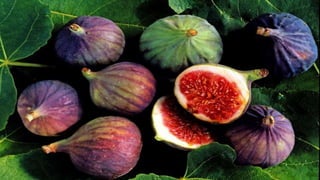
 The fig is believed to be indigenous to Western Asia and to have been
distributed by man throughout the Mediterranean area.
 It has been cultivated for thousands of years, remnants of figs having been
found in excavations of Neolithic sites traced to at least 5,000 B.C.
 Figs are a beloved, popular fruit in India. They grow well in several
states including Karnataka, Tamil Nadu, Maharashtra, Gujarat and Uttar
Pradesh. Though there are approximately 800 varieties of figs in the
world, the poona is the most popular cultivar in India
HISTORY AND IMPORTANCE
 There was a fig tree in the garden of Heaven, and for different reasons the fig
is the most discussed fruit in the Bible. According to Biblical literature a fig
tree provided the first clothing.
 Also, the word sycophant, meaning an informer and one who seeks favors by
flattering the powerful, comes from Greek and means "to show the fig",
because when the valuable and sacred figs were stolen for export purposes,
someone revealed the figs, accused the robbers and was therefore a "fig
shower".
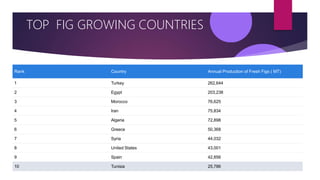
TOP FIG GROWING COUNTRIES
Rank Country Annual Production of Fresh Figs ( MT)
1 Turkey 262,644
2 Egypt 203,238
3 Morocco 76,625
4 Iran 75,834
5 Algeria 72,898
6 Greece 50,368
7 Syria 44,032
8 United States 43,001
9 Spain 42,856
10 Tunisia 25,786
FIG PRODUCTION IN INDIA
 In India, fig is considered to be a minor fruit crop and the
commercial cultivation of common (edible) fig is mostly
confined to Western Parts of Maharashtra, Gujarat, Uttar
Pradesh (Lucknow & Saharanpur) Karnataka (Bellary,
Chitradurga & Srirangapatna) and Tamilnadu (Coimbatore).
PLANT DISCRIPTION
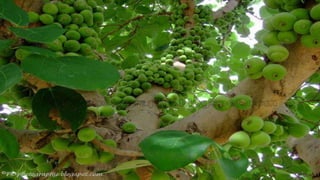
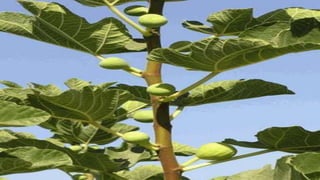
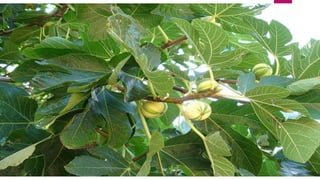
 Ficus carica is a gynodioecious , deciduous tree or large shrub, growing
to a height of 10–30 ft.
 Smooth white bark and fragrant broad, rough leaves.
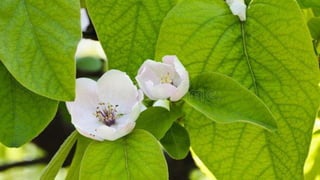
 The complex inflorescence consists of a hollow fleshy structure called
the syconium, which is lined with numerous unisexual flowers.
 The small orifice (ostiole) visible on the middle of the fruit is a narrow
passage, which allows the specialized fig wasp (Blastophaga psenes) to
enter the fruit and pollinate the flower, where after the fruit grows
seeds.
 Climacteric fruit
 False fruit or multiple fruit
Conti…
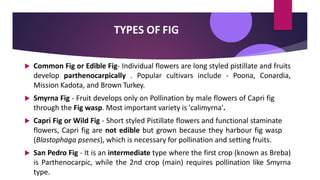
TYPES OF FIG
 Common Fig or Edible Fig- Individual flowers are long styled pistillate and fruits
develop parthenocarpically . Popular cultivars include - Poona, Conardia,
Mission Kadota, and Brown Turkey.
 Smyrna Fig - Fruit develops only on Pollination by male flowers of Capri fig
through the Fig wasp. Most important variety is 'calimyrna'.
 Capri Fig or Wild Fig - Short styled Pistillate flowers and functional staminate
flowers, Capri fig are not edible but grown because they harbour fig wasp
(Blastophaga psenes), which is necessary for pollination and setting fruits.
 San Pedro Fig - It is an intermediate type where the first crop (known as Breba)
is Parthenocarpic, while the 2nd crop (main) requires pollination like Smyrna
type.
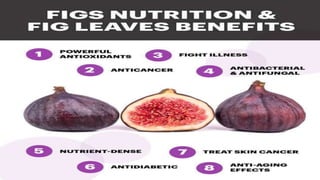
HEALTH BENEFITS AND USES
 Improves digestion
 Helps in weight loss
 Prevents hypertension
 Rich in antioxidants
 Prevents heart disease
 Prevents cancer
 Strengthens your bones
 Good for diabetes
 Anti-aging effects
CLIMATE
 Fig being a deciduous and sub tropical tree, prefers areas having arid or semiarid
environment, high summer temperature, plenty of sunshine and moderate water
 Although the plants can survive temperature as high 450C, the fruit quality deteriorates
beyond 390C. Though the mature tree can withstand low temperature up to 40C, it makes
good growth when the temperature is above 15 - 210C.
The size, shape, colour of the skin and pulp quality are markedly affected by climate. But
quality figs are produced in the region with dry climate especially at the time of fruit
development and maturity.
 High humidity coupled with low temperature usually results in fruit splitting and low fruit
quality.
SOIL
 The fig can be grown on a wide range of soils; light sand, rich loam, heavy clay or
limestone, providing there is sufficient depth and food drainage.
 Sandy soil that is medium-dry and contains a good deal of lime is
preferred when the crop is intended for drying.
 Highly acid soils are unsuitable.
 The pH should be between 6.0 and 6.5.
PROPAGATION
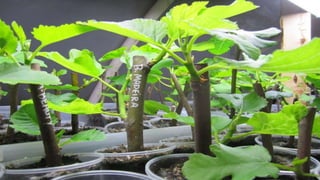
 Rooting of hard wood cuttings is the common method of propagation in fig. Rooting
was the best in cuttings from 3 year old wood with 30 - 40 cm length and 1.5 cm dia.
 Cuttings from the base of the shoot and lower part of crown have to be used as they
root better.
 Cuttings are raised in nursery beds and are set out in the field after 12 or 15 months.
 Cuttings are taken during January –February.
 Fig can also be propagated by air layering, shield or patch budding and side grafting
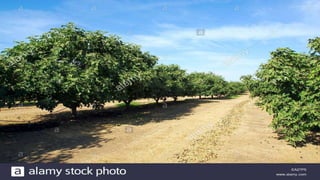
PLANTING
 Fig is planted in square system of planting at a spacing of 5 x 5 m accommodating
about 160 plants per acre.
 Pits of 0.6 cu.m are dug for planting the cuttings.
 Planting time is JAN-FEB. or AUG-SEP.
SEASON OF FRUITING
 Fig trees usually bear 2 crops a year, the early season fruits being inferior and
frequently too acid, and only those of the second, or main, crop of actual value.
 Some fruits are borne throughout the year but there are 2 principal crops, one in
May and June and the other in December and January.
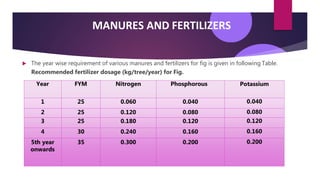
MANURES AND FERTILIZERS
 The year wise requirement of various manures and fertilizers for fig is given in following Table.
Potassium
0.040
0.080
0.120
0.160
Recommended fertilizer dosage (kg/tree/year) for Fig.
Year FYM Nitrogen Phosphorous
1 25 0.060 0.040
2 25 0.120 0.080
3 25 0.180 0.120
4 30 0.240 0.160
5th year 35 0.300 0.200
onwards
0.200
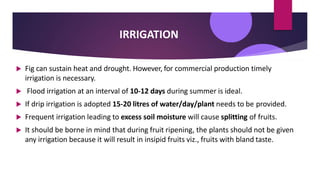
IRRIGATION
 Fig can sustain heat and drought. However, for commercial production timely
irrigation is necessary.
 Flood irrigation at an interval of 10-12 days during summer is ideal.
 If drip irrigation is adopted 15-20 litres of water/day/plant needs to be provided.
 Frequent irrigation leading to excess soil moisture will cause splitting of fruits.
 It should be borne in mind that during fruit ripening, the plants should not be given
any irrigation because it will result in insipid fruits viz., fruits with bland taste.
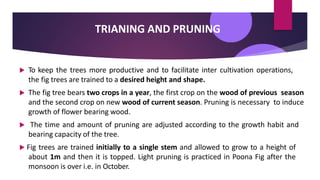
TRIANING AND PRUNING
 To keep the trees more productive and to facilitate inter cultivation operations,
the fig trees are trained to a desired height and shape.
 The fig tree bears two crops in a year, the first crop on the wood of previous season
and the second crop on new wood of current season. Pruning is necessary to induce
growth of flower bearing wood.
 The time and amount of pruning are adjusted according to the growth habit and
bearing capacity of the tree.
 Fig trees are trained initially to a single stem and allowed to grow to a height of
about 1m and then it is topped. Light pruning is practiced in Poona Fig after the
monsoon is over i.e. in October.
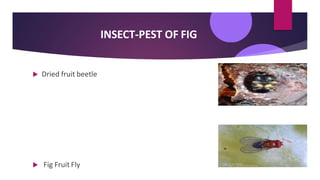
INSECT-PEST OF FIG
 Dried fruit beetle
 Fig Fruit Fly
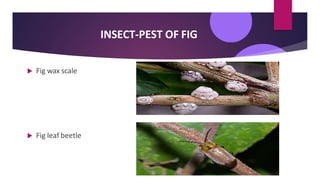
INSECT-PEST OF FIG
 Fig wax scale
 Fig leaf beetle
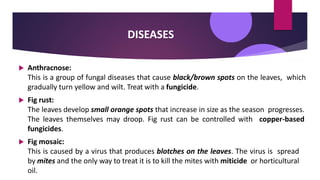
DISEASES
 Anthracnose:
This is a group of fungal diseases that cause black/brown spots on the leaves, which
gradually turn yellow and wilt. Treat with a fungicide.
 Fig rust:
The leaves develop small orange spots that increase in size as the season progresses.
The leaves themselves may droop. Fig rust can be controlled with copper-based
fungicides.
 Fig mosaic:
This is caused by a virus that produces blotches on the leaves. The virus is spread
by mites and the only way to treat it is to kill the mites with miticide or horticultural
oil.
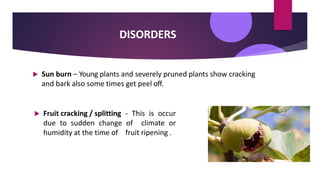
DISORDERS
 Sun burn – Young plants and severely pruned plants show cracking
and bark also some times get peel off.
 Fruit cracking / splitting - This is occur
due to sudden change of climate or
humidity at the time of fruit ripening .
PLANT PROTECTION
 The major pests of fig are beetles and fig flies. The fig fly can be
controlled by Demecron (0.05% spray).
 Important disease of fig is rust which is caused by Cerotelium fici.
 It can be controlled by dusting with sulphur or spraying with Blitox
or Dithane M-45 and Dithane Z-78.
FRUIT SET
 It has been observed even in common fig or Adriatic fig, the phenomenon of
parthenocarpy is altered by climatic condition of a particular location. Hence
there is a possibility of failure of furit set by a particular variety in a particular
location.
 The parthenocarpic fruit set can be enhanced by spraying 25 ppm o f NAA or
IBA on the flowers.
 To promote proper shoot growth and to prevent fruit drop in fig, growth
regulators like Gibberellic Acid (GA) @ 30 ml / liter of water is used.
VARIETIES OF FIG
 Black Mission
 Brown Turkey
 Sierra
 Calimyrna
 King
 Kadota
 Poona Fig (Mostly grown in India)
HARVESTING
 Though fig starts bearing fruits from the second year, commercial harvesting
is done from the third year. The yield increases with increase in canopy size of
the tree and stabilizes during eighth year.
 The economic life of the plant is about 35 years. The harvesting season
starts in February - March and is over by May - June.
 The fruits are harvested in 2-3 day intervals manually. The fruits should be
picked when they are soft and wilt at the neck. If the fruits are picked before
proper maturity, milky latex exudes.
YIELD
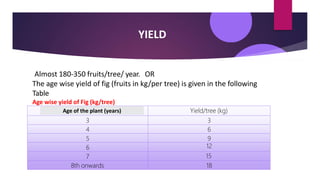
Almost 180-350 fruits/tree/ year. OR
The age wise yield of fig (fruits in kg/per tree) is given in the following
Table
Age wise yield of Fig (kg/tree)
Yield/tree (kg)
3 3
4 6
5 9
6 12
7 15
8th onwards 18
Age of the plant (years)
1. fig ppt

1. fig ppt

  • 1.
    Submitted To: Dr.P.K. Yadav Dept. of Horticulture CollegeofAgriculture,Bikaner Submitted By: AtmaRamMeena Dept. of Horticulture CollegeofAgriculture,Bikaner FIG ( Ficus carica L.)
  • 2.
    Scientific Classification  KINGDOM: PHYLUM :  ORDER:  FAMILY :  TRIBE :  GENUS :  SPECIES : PLANTAE ANGIOSPERMAE ROSALES MORACEAE FICEACE FICUS FICUS CARICA L.
  • 3.
    NOMENCLATURE  English  French German  Italian and Portuguese  Spanish  Urdu common fig or fig figue feige figo higo or brevo anjeer
  • 5.
    ORIGION AND DISTRIBUTION The fig is believed to be indigenous to Western Asia and to have been distributed by man throughout the Mediterranean area.  It has been cultivated for thousands of years, remnants of figs having been found in excavations of Neolithic sites traced to at least 5,000 B.C.  Figs are a beloved, popular fruit in India. They grow well in several states including Karnataka, Tamil Nadu, Maharashtra, Gujarat and Uttar Pradesh. Though there are approximately 800 varieties of figs in the world, the poona is the most popular cultivar in India
  • 6.
    HISTORY AND IMPORTANCE There was a fig tree in the garden of Heaven, and for different reasons the fig is the most discussed fruit in the Bible. According to Biblical literature a fig tree provided the first clothing.  Also, the word sycophant, meaning an informer and one who seeks favors by flattering the powerful, comes from Greek and means "to show the fig", because when the valuable and sacred figs were stolen for export purposes, someone revealed the figs, accused the robbers and was therefore a "fig shower".
  • 7.
    TOP FIG GROWINGCOUNTRIES Rank Country Annual Production of Fresh Figs ( MT) 1 Turkey 262,644 2 Egypt 203,238 3 Morocco 76,625 4 Iran 75,834 5 Algeria 72,898 6 Greece 50,368 7 Syria 44,032 8 United States 43,001 9 Spain 42,856 10 Tunisia 25,786
  • 8.
    FIG PRODUCTION ININDIA  In India, fig is considered to be a minor fruit crop and the commercial cultivation of common (edible) fig is mostly confined to Western Parts of Maharashtra, Gujarat, Uttar Pradesh (Lucknow & Saharanpur) Karnataka (Bellary, Chitradurga & Srirangapatna) and Tamilnadu (Coimbatore).
  • 10.
    PLANT DISCRIPTION  Ficuscarica is a gynodioecious , deciduous tree or large shrub, growing to a height of 10–30 ft.  Smooth white bark and fragrant broad, rough leaves.  The complex inflorescence consists of a hollow fleshy structure called the syconium, which is lined with numerous unisexual flowers.
  • 11.
     The smallorifice (ostiole) visible on the middle of the fruit is a narrow passage, which allows the specialized fig wasp (Blastophaga psenes) to enter the fruit and pollinate the flower, where after the fruit grows seeds.  Climacteric fruit  False fruit or multiple fruit Conti…
  • 14.
    TYPES OF FIG Common Fig or Edible Fig- Individual flowers are long styled pistillate and fruits develop parthenocarpically . Popular cultivars include - Poona, Conardia, Mission Kadota, and Brown Turkey.  Smyrna Fig - Fruit develops only on Pollination by male flowers of Capri fig through the Fig wasp. Most important variety is 'calimyrna'.  Capri Fig or Wild Fig - Short styled Pistillate flowers and functional staminate flowers, Capri fig are not edible but grown because they harbour fig wasp (Blastophaga psenes), which is necessary for pollination and setting fruits.  San Pedro Fig - It is an intermediate type where the first crop (known as Breba) is Parthenocarpic, while the 2nd crop (main) requires pollination like Smyrna type.
  • 16.
    HEALTH BENEFITS ANDUSES  Improves digestion  Helps in weight loss  Prevents hypertension  Rich in antioxidants  Prevents heart disease  Prevents cancer  Strengthens your bones  Good for diabetes  Anti-aging effects
  • 18.
    CLIMATE  Fig beinga deciduous and sub tropical tree, prefers areas having arid or semiarid environment, high summer temperature, plenty of sunshine and moderate water  Although the plants can survive temperature as high 450C, the fruit quality deteriorates beyond 390C. Though the mature tree can withstand low temperature up to 40C, it makes good growth when the temperature is above 15 - 210C. The size, shape, colour of the skin and pulp quality are markedly affected by climate. But quality figs are produced in the region with dry climate especially at the time of fruit development and maturity.  High humidity coupled with low temperature usually results in fruit splitting and low fruit quality.
  • 19.
    SOIL  The figcan be grown on a wide range of soils; light sand, rich loam, heavy clay or limestone, providing there is sufficient depth and food drainage.  Sandy soil that is medium-dry and contains a good deal of lime is preferred when the crop is intended for drying.  Highly acid soils are unsuitable.  The pH should be between 6.0 and 6.5.
  • 20.
    PROPAGATION  Rooting ofhard wood cuttings is the common method of propagation in fig. Rooting was the best in cuttings from 3 year old wood with 30 - 40 cm length and 1.5 cm dia.  Cuttings from the base of the shoot and lower part of crown have to be used as they root better.  Cuttings are raised in nursery beds and are set out in the field after 12 or 15 months.  Cuttings are taken during January –February.  Fig can also be propagated by air layering, shield or patch budding and side grafting
  • 23.
    PLANTING  Fig isplanted in square system of planting at a spacing of 5 x 5 m accommodating about 160 plants per acre.  Pits of 0.6 cu.m are dug for planting the cuttings.  Planting time is JAN-FEB. or AUG-SEP.
  • 25.
    SEASON OF FRUITING Fig trees usually bear 2 crops a year, the early season fruits being inferior and frequently too acid, and only those of the second, or main, crop of actual value.  Some fruits are borne throughout the year but there are 2 principal crops, one in May and June and the other in December and January.
  • 27.
    MANURES AND FERTILIZERS The year wise requirement of various manures and fertilizers for fig is given in following Table. Potassium 0.040 0.080 0.120 0.160 Recommended fertilizer dosage (kg/tree/year) for Fig. Year FYM Nitrogen Phosphorous 1 25 0.060 0.040 2 25 0.120 0.080 3 25 0.180 0.120 4 30 0.240 0.160 5th year 35 0.300 0.200 onwards 0.200
  • 28.
    IRRIGATION  Fig cansustain heat and drought. However, for commercial production timely irrigation is necessary.  Flood irrigation at an interval of 10-12 days during summer is ideal.  If drip irrigation is adopted 15-20 litres of water/day/plant needs to be provided.  Frequent irrigation leading to excess soil moisture will cause splitting of fruits.  It should be borne in mind that during fruit ripening, the plants should not be given any irrigation because it will result in insipid fruits viz., fruits with bland taste.
  • 29.
    TRIANING AND PRUNING To keep the trees more productive and to facilitate inter cultivation operations, the fig trees are trained to a desired height and shape.  The fig tree bears two crops in a year, the first crop on the wood of previous season and the second crop on new wood of current season. Pruning is necessary to induce growth of flower bearing wood.  The time and amount of pruning are adjusted according to the growth habit and bearing capacity of the tree.  Fig trees are trained initially to a single stem and allowed to grow to a height of about 1m and then it is topped. Light pruning is practiced in Poona Fig after the monsoon is over i.e. in October.
  • 30.
    INSECT-PEST OF FIG Dried fruit beetle  Fig Fruit Fly
  • 31.
    INSECT-PEST OF FIG Fig wax scale  Fig leaf beetle
  • 32.
    DISEASES  Anthracnose: This isa group of fungal diseases that cause black/brown spots on the leaves, which gradually turn yellow and wilt. Treat with a fungicide.  Fig rust: The leaves develop small orange spots that increase in size as the season progresses. The leaves themselves may droop. Fig rust can be controlled with copper-based fungicides.  Fig mosaic: This is caused by a virus that produces blotches on the leaves. The virus is spread by mites and the only way to treat it is to kill the mites with miticide or horticultural oil.
  • 33.
    DISORDERS  Sun burn– Young plants and severely pruned plants show cracking and bark also some times get peel off.  Fruit cracking / splitting - This is occur due to sudden change of climate or humidity at the time of fruit ripening .
  • 34.
    PLANT PROTECTION  Themajor pests of fig are beetles and fig flies. The fig fly can be controlled by Demecron (0.05% spray).  Important disease of fig is rust which is caused by Cerotelium fici.  It can be controlled by dusting with sulphur or spraying with Blitox or Dithane M-45 and Dithane Z-78.
  • 35.
    FRUIT SET  Ithas been observed even in common fig or Adriatic fig, the phenomenon of parthenocarpy is altered by climatic condition of a particular location. Hence there is a possibility of failure of furit set by a particular variety in a particular location.  The parthenocarpic fruit set can be enhanced by spraying 25 ppm o f NAA or IBA on the flowers.  To promote proper shoot growth and to prevent fruit drop in fig, growth regulators like Gibberellic Acid (GA) @ 30 ml / liter of water is used.
  • 36.
    VARIETIES OF FIG Black Mission  Brown Turkey  Sierra  Calimyrna  King  Kadota  Poona Fig (Mostly grown in India)
  • 37.
    HARVESTING  Though figstarts bearing fruits from the second year, commercial harvesting is done from the third year. The yield increases with increase in canopy size of the tree and stabilizes during eighth year.  The economic life of the plant is about 35 years. The harvesting season starts in February - March and is over by May - June.  The fruits are harvested in 2-3 day intervals manually. The fruits should be picked when they are soft and wilt at the neck. If the fruits are picked before proper maturity, milky latex exudes.
  • 38.
    YIELD Almost 180-350 fruits/tree/year. OR The age wise yield of fig (fruits in kg/per tree) is given in the following Table Age wise yield of Fig (kg/tree) Yield/tree (kg) 3 3 4 6 5 9 6 12 7 15 8th onwards 18 Age of the plant (years)