Targeted Mutagenesis and Mutation In
Crop Improvement
CREDIT SEMINAR
ON
PRESENTED BY
Sourav Ranjan Nanda
M.Sc. Scholar
1
Global
warming
Recurrent
floods
Drought
Disturb
Rainfall
Abiotic stress
Biotic stress
2
Absolute yield
Stability of yield
Improved quality
3
MUTATION-Sudden heritable change in genetic material
or character of an organism
MUTANT- Individuals showing mutation
VARIANT -An individual showing an altered phenotype
due to mutation.
MUTAGEN -Factor or agents causing mutation are
known as mutagen.
Gene mutation/Point mutation- Mutation which
causes changes in base sequence
4
1791 Seth Wrigh mutation first time male lamb with unusual short legs
1900 Hugo de Vries Term mutation Oenothera lamarckiana.
1910 T.H.Morgan Systematic study of mutation white eye mutant of Drosophila
1927 induced mutation by using x ray
H. J. Muller
Drosophila
1928 ,L.J. Stadler barley and maize.
induced mutation by using x ray
1939
R.A. Steinberg
Aspergillus
Induction of mutations by chemicals
1946 C. Auerbach and
J.N. Robson
Induction of mutations by chemicals in Drosophila.
5
6
Lethal mutation DEATH 100%
Sub lethal mutation DEATH 90%
Sub vital mutation DEATH <90%
Vital mutation DEATH 0%
Super vital mutation SURVIVAL Enhance
Based on the survival of an individual.
7
Based on causes of mutation
• occurs naturally
• Eukaryotes>prokaryotes
Spontaneous
Mutation
• either a chemical or physical agent
• Use of induced mutation for crop
improvement program is known as
mutation breeding.
Induced
Mutation
8
Based on tissue of origin
• somatic cell
•Transmit to progeny
Somatic
mutation
• Gametic cells or
reproductive cells
•It is not transmitted
Germinal
Mutation
9
Normal/wild type
Mutant allele
Forward
mutation
Backward
mutation
Based on direction of mutation
10
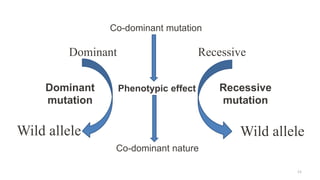
Dominant Recessive
Wild allele
Dominant
mutation
Recessive
mutation
Phenotypic effect
Wild allele
Co-dominant mutation
Co-dominant nature
11
• Chromosome Mutations may Involve: –Changing the structure of a
chromosome due to loss or gain of part of a chromosome
12
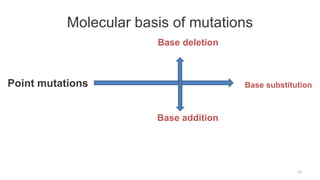
Molecular basis of mutations
Point mutations Base substitution
Base deletion
Base addition
13
Base substitution:-
14
Base deletion
Base addition
• .
15
16
Mutations in case of Crop Improvement
Spontaneous
mutations
Due to error during DNA replication
Due to mutagenic effect of natural
environment
occur naturally
17
Crop
Rice
Wheat
Groundnut
Sorghum
Variety
GEB-24
Norin
TMV-10
Co-4
18
Artificial induction of mutations: Mutations can be induced
artificially using
1. Physical mutagens or radiations
2. Chemical agents
Physical mutagens:-
Ionizing
radiations:
Non-particulate
Produce free
radicle
Example-X-rays and 𝛾 −
𝑟𝑎𝑦𝑠
Particulate
Ionization and
Excitation
Eg :,𝛼 − 𝑟𝑎𝑦, 𝛽 −
𝑟𝑎𝑦, 𝐹𝑎𝑠𝑡 𝑛𝑒𝑢𝑡𝑟𝑜𝑛
Non-ionizing
radiations.
Pyrimidine dimer
Example: UV
rays.
19
20
Chemical
mutagens
Alkylating
agents
Dimethyl sulphonate (DMS), Ethyl methane sulphonate
(EMS),Nitroso methyl Urea (NMU), Nitroso ethyl Urea
(NEU), Methyl methane sulphonate (MMS).
Acridine
dyes
proflavine, acriflavine,
Acridine orange,
Deamination Nitrous acid
Base
analogues 5– bromouracil, 3-bromodeoxy
uridine, 2 -amino purine.
21
Mainly three types screening/selection techniques are
used in M2 and subsequent generation.
• Visual: Most effective and efficient method for identifying
mutant phenotypes.
• Mechanical/Physical: Very efficient for seed size, shape,
weight, density, etc. using appropriate sieving machinery.
• Other methods: Low alkaloid content mutants can be
selected using colorimetric tests. Chromatographic or
electrophoresis techniques may be used to select isolate
protein variants.
22
Handling of segregating generations
Dose of mutagen
Part of the Plant to be Treated
Choice of mutagen
Choice of material
Procedures of Mutation Breeding
23
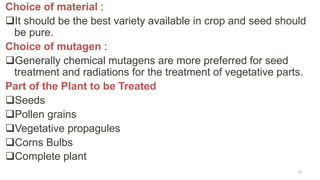
Choice of material :
It should be the best variety available in crop and seed should
be pure.
Choice of mutagen :
Generally chemical mutagens are more preferred for seed
treatment and radiations for the treatment of vegetative parts.
Part of the Plant to be Treated
Seeds
Pollen grains
Vegetative propagules
Corns Bulbs
Complete plant
24
Dose of mutagen
• Mutagens generally induce a high frequency of chromosomal changes meiotic and mitotic
irregularities.
• Optimum mutagen dose is one, which produces maximum frequency of mutations and causes
the minimum killing.
• Close to LD50 dose is optimum.
• LD50 is the dose of mutagen that kills 50% of the treated individuals.
• EXAMPLE:- EMS – 0.3-1.5 %, for 2-6 hours
Handling of segregating generations
• Mutation breeding for oligogenic traits
• Mutation breeding for polygenic traits
25
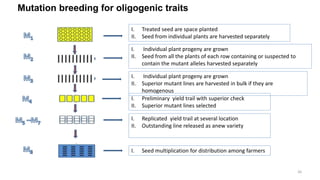
Mutation breeding for oligogenic traits
I. Treated seed are space planted
II. Seed from individual plants are harvested separately
I. Individual plant progeny are grown
II. Seed from all the plants of each row containing or suspected to
contain the mutant alleles harvested separately
I. Individual plant progeny are grown
II. Superior mutant lines are harvested in bulk if they are
homogenous
I. Preliminary yield trail with superior check
II. Superior mutant lines selected
I. Replicated yield trail at several location
II. Outstanding line released as anew variety
I. Seed multiplication for distribution among farmers
26
Mutation breeding for Polygenic traits
I. Treated seed are space planted
II. Seed from individual plants are harvested separately
I. Individual plant progeny are grown
II. Fertility,vigrous,normal looking plant harvested separately
I. Individual plant progeny are grown
II. Superior mutant lines are harvested in bulk if they are homogenous
I. Preliminary yield trail with superior check
II. Superior mutant lines selected
I. Replicated yield trail at several location
II. Outstanding line released as anew variety
I. Seed multiplication for distribution among farmers
I. Individual plant progeny are grown
II. Superior plants selected from superior progenies showing segregation
III. Homogenous mutant progenies harvested in bulk
27
28
GENETIC ENHANCEMENT OF RICE
29
KT 20-74
SH 30-21
China 1957
Semi dwarf
mutant Reimei
Japan
lodging resistance
first rice varieties
Crop Mutant variety Released year Mutagen
Cotton MA-9 1948 Gamma rays
Wheat NP-836 1961 X-rays
Sugarcane Co-6608 1966 Gamma rays
castor Aruna 1969 Neutron
Black gram Co-04 1978 MMS
SESAMUM KALIKA 1980 EMS
LENTIL S-256 1981 Gamma rays
COWPEA V-16 AMBA 1981 DMS
MUNG BEAN TAP-7 1981 Gamma rays
CHICKPEA Pusa-408 1985 Gamma rays
30
means to synthesize something
31
32
Random mutagenesis-
mutation can be generated , at any
region of DNA sequence, randomly
Targeted Mutagenesis
Targeted mutagenesis is a molecular
biology method that is used to make
specific and intentional mutating changes
to the DNA sequence of a gene and
any gene product
Targeted Mutagenesis
• Targeted mutagenesis is a molecular biology method that is used to make specific
and intentional mutating changes to the DNA sequence of a gene and any gene
product.
• Gene targeting is mostly achieved by homologous recombination or non-homologous
end joining.
• The efficiency of non-homologous end joining is better than homologous
recombination for gene targeting.
• Some strategies have been developed to enhance the homologous recombination by
overexpression of RAD54, recA and ruvA proteins which are involved in
homologous recombination.
• Nucleases induce the double-strand break at the target site which is then repaired by
homologous recombination or non-homologous end joining, depending on the type of
mutation to be introduced (insertion or deletion)
33
Targeted
Mutagenesis
Transcription
activator-like effector
nucleases (TALENs)
Oligonucleotide
-directed gene
targeting
CRISPR /cas 9
ZINC
FINGER
NUCLEASES
(ZFNS)
34
• To study changes in protein activity
Change in codon change in Amino Acid Change in
protein structure
• To introduce or remove restriction endonuclease sites or tags.
• To select the mutations that have desired property.
35
36
ZINC FINGER NUCLEASES
(ZFNs)
37
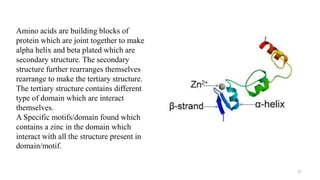
Amino acids are building blocks of
protein which are joint together to make
alpha helix and beta plated which are
secondary structure. The secondary
structure further rearranges themselves
rearrange to make the tertiary structure.
The tertiary structure contains different
type of domain which are interact
themselves.
A Specific motifs/domain found which
contains a zinc in the domain which
interact with all the structure present in
domain/motif.
38
39
WHAT IS ZFN TECHNOLOGY??
 A class of engineered DNA-binding proteins
 Facilitate targeted editing of the genome by creating double-strand breaks in DNA at user-specified
locations.
Double-strand breaks are important for site-specific mutagenesis.
Stimulate the cell's natural DNA-repair processes, namely homologous recombination and non-
homologous end joining (NHEJ).
Generate precisely targeted genomic edits, resulting in cell lines with targeted gene deletions,
integrations, or modifications.
Zinc fingers were first discovered in the African clawed toad (Xenopus laevis) in 1985.
40
WHAT ARE ZINC FINGER NUCLEASES?
HIGHLY-SPECIFIC GENOMIC SCISSORS
Consists of two functional domains:
a) A DNA-binding domain
b) A DNA-cleaving domain comprised of the nuclease domain of Fok I.
41
42
DNA CLEAVAGE DOMAIN
• FokI, naturally found in Flavobacterium okeankoites
• It is a bacterial type II restriction endonucleases consisting of an N-terminal DNA binding domain
and a C-terminal non specific DNA cleavage domain.
• FokI functions as adimer, so a set of two ZFNs are used to bind to the target DNA
• Results in a unique combinatio of 18 nucleotides.
• After its binding to the cell DNA ,the FokI domain (with digests the DNA at specific site and
creates a double-stand break and triggered the cell’s repair mechanism.
• Break is repaired by HR or NHEJ leads to deletion or insertion mutations at the repair site.
• ZFN target sites consist of two zinc-finger binding sites separated by a 5 to 7bp spacer sequence.
• This spacer is recognised by the FokI cleavage domain
43
Repair outcomes of a genetic double strand break in case of ZFN cleavage
ZINC FINGERS CAN BE INTRODUCED INTO AN ORGANISM IN VARIOUS WAYS
Introduce zincfingers in the form of a recombinant protein (still under
development)
The gene that codes for the zinc finger effector protein can be introduced
into the cell
The most commonly used vectors are plasmids and attenuated viruses
Agrobacterium mediated transfer
Particle bombardment method (direct DNA transfer)
Injecting ZFN mRNAs and donor DNA into embryos
45
VARIOUS USES OF TECHNIQUE:
 Repairing mutations
 Insertion of a gene or DNA fragment at a specific
site
 Repair or replace aberrant genes
 Disabling an allele
 Allele editing
 Applications in the medical sector
 Gene therapy
 Treatment of HIV
TALENS-TRANSCRIPTION ACTIVATOR
LIKE EFFECTOR NUCLEASES
47
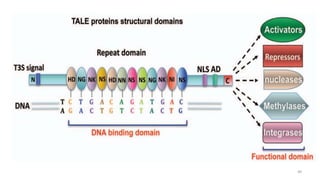
TALES: TRANSCRIPTION ACTIVATOR LIKE EFFECTOR
In 2011, named the methods of the year
TALEs are naturally occuring proteins from the plant pathogenic bacteria
Xanthomonas.
These bacteria secrete effector proteins (transcription activator like
effectors, TALEs) to increase its susceptibility to the pathogen.
These effector are capable of DNA binding and activating the
expression of their target genes by mimicking the eukaryotic transription
factors.
48
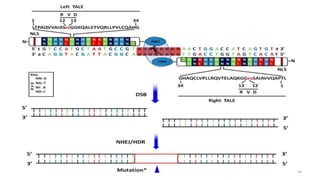
Transcription activator-like effector nucleases (TALEN) are restriction enzymes that can be
engineered to cut specific sequences of DNA.
 They are made by fusing:
( TAL effector) DNA-binding domain
 DNA cleavage domain (the catalytic domain of RE FokI).
TALENs can be engineered to bind to practically any desired DNA to cut at specific locations.
49
50
51
APPLICATIONS:
 Application in Gene Therapy
 To efficiently modify plant genomes
 To correct the genetic errors that underlie disease
 TALEN can be used as tools to harness the immune system to fight
cancers
 TALEN mediated targeting can generate T cells that are resistant to
chemotherapeutic drugs and show anti-tumor activity
52
This technique was first develop by the Eric Kmiec at
Thomas Jefferson University
What is chimeraplast?
Chimeraplasty-mediated modification of a target
sequence is accomplished using an exogenous
polynucleotide, the so-called chimeraplast
Chimeraplast may be a DNA / RNA
The original chimeraplast ranged between 68 and 88
nucleotides in length and comprised both DNA and 20
-O-methylmodified RNA residues
53
54
Crispr /cas 9 technique
56
RERPEATS
SPACER
57
58
59
Distict type of CRISPR identified so far
60
• Protospacer adjacent motifs
• Crisper RNA(cr RNA)
• Transactivating crispr
RNA(tracer RNA)
Guide RNA
61
CRISPR/CAS SYSTEM IN PROKARYOTES
• It is the part of the adaptive immune system of bacteria and archaea, protecting them
against invading nucleic acids such as viruses by cleaving the foreign DNA
 CRISPR (clustered regularly interspaced short palindromic repeats) loci
 Cas(CRISPR aasociated) protein that can target and cleave invading DNA in sequence specific
manner
 A crispr array is composed of a series of repeats interspersed by spacer sequences acquired from
invadig genome
 The immunity is acquired by the integration of these short fragments of the invading DNA
(spacers) between two adjacent repeats of a CRISPR locus present in host genome
 The most widely used system in the type II (CRIPSR)/Cas9 system from Streptococcus pyrogenes.
62
A proto spacer adjacent motif (PAM) is a 2–6-base pair DNA sequence immediately following the DNA
sequence targeted by the Cas9 nuclease in the CRISPR bacterial adaptive immune system.
 The PAM is a component of the invading virus or plasmid, but is not found in the bacterial host genome and
hence is not a component of the bacterial CRISPR locus.
 Cas9 will not successfully bind to or cleave the target DNA sequence if it is not followed by the PAM sequence.
PAM is an essential targeting component which distinguishes bacterial self from non-self DNA, thereby
preventing the CRISPR locus from being targeted and destroyed by the CRISPR-associated nuclease
WHY PAM SEQUENCE IS PREREQUISITE FOR CLEAVAGE?
64
•Nuclease induced double strand breaks(DSBs)
can be repaired by non homologous end joining
(HDR) pathways.
•Imprecise NHEJ mediated repair can produce
insertion and /pr deletion mutations of variable
length at the site of the DSB
• HDR-mediated repair can introduce precise
point mutations or insertions from a single
stranded or double stranded DNA donor
template
65
• Domestication of crop
• Remove undesirable traits from
cassava
• remove gladin in wheat
• Resistance to fusarium-Head
blight
Thinopyran detoxify vominotoxin
66
Induced phenotypic diversity in the mutagenized populations
of faba bean using physical and chemical mutagenesis.
A study was conducted by using physical and chemical mutagen in fababeans to induced
phenotypic diversity .physical mutagen like gamma rays and chemical muatagen EMS is used.
Different treatment of physical and chemical mutagen is used on faba beans seeds of Vikrant
and PRT-12 to know the phenotypic diversity.
CASE STUDY 1-
67
Mutagens used-
Gamma rays (c rays)- Dry seeds of each variety, with moisture content 12%, were irradiated with 100,
200, 300 and 400 Gy of gamma rays with a radioisotope 60CO source
Ethyl methane sulphonate (EMS)- For EMS treatments, healthy seeds of uniform size of each variety
were presoaked for 9 h in distilled water and treated with 0.01, 0.02, 0.03 and 0.04% of EMS for 6 h
with intermittent shaking at room temperature of 22 ± 1 C. The solution of EMS was prepared in the
phosphate buffer of pH 7.
Combination treatment: Gamma rays + EMS-Dry seeds of each variety were first irradiated with
gamma rays at 100, 200, 300 and 400 Gy doses and then treated with 0.01, 0.02, 0.03 and 0.04%
EMS. (i.e. 100 Gy gamma rays + 0.01% EMS, 200 Gy gamma rays + 0.02% EMS, 300 Gy gamma
rays + 0.03% EMS and 400 Gy gamma rays + 0.04% EMS).
68
These morphological mutation observed in plant either
by the physical and chemical or combination of both
• Tall mutants
• Dwarf mutants
• Bushy mutant
• Broad leaves mutant
• Narrow leaves mutants
• Opposite leaves mutants
• Bilobed leaves mutant
• Trilobed leaves mutant
• Elongated leaves mutant
• Trifoliate leaves mutant
• Fused leaflets mutant
• Single flower mutant
• Four flowers mutant
• Five flowers mutant
• Pink flower mutants
• Vegetative mutants
69
In this study, we have demonstrated that TALENs and the CRISPR/Cas system are able
to induce targeted mutagenesis in Zea mays with high and comparable efficiencies.
Although TALENs are effective tools for genome editing, there are some limitations
regarding the potential target sites, such as the need for T at position − (and the fact
that some TALENs fail to cause mutations. The recently developed CRISPR/Cas
system seems to provide a complementary approach to TALENs, as it only requires
the PAM (NGG) motif preceding the recognition sequence.
70
In addition, the CRISPR/Cas system has great advantages in terms of easy 150 cloning and multiplex
genome editing. However, the high-frequency of off-target Transcription activator-like effector
nucleases (TALENs) and clustered regularly interspaced short palindromic repeats (CRISPR)/ CRISPR-
associated (Cas) systems have emerged as powerful tools for genome editing in a variety of species.
Here, They report, for the first time, targeted mutagenesis in Zea mays using TALENs and the 17
CRISPR/Cas system. We designed five TALENs targeting 4 genes, namely ZmPDS, 18 ZmIPK1A, ZmIPK,
ZmMRP4, and obtained targeting efficiencies of up to 23.1% in 19 protoplasts, and about 13.3% to
39.1% of the transgenic plants were somatic 20 mutations. Also, we constructed two gRNAs targeting
the ZmIPK gene in maize 21 protoplasts, at frequencies of 16.4% and 19.1%, respectively. In addition
the 22 CRISPR/Cas system induced targeted mutations in Zea mays protoplasts with 23 efficiencies
(13.1%) similar to those obtained with TALENs (9.1%). Our results show 24 that both TALENs and the
CRISPR/Cas system can be used for genome modification
71
72
73

TARGETED MUTAGENESIS

  • 1.
    Targeted Mutagenesis andMutation In Crop Improvement CREDIT SEMINAR ON PRESENTED BY Sourav Ranjan Nanda M.Sc. Scholar 1
  • 2.
  • 3.
    Absolute yield Stability ofyield Improved quality 3
  • 4.
    MUTATION-Sudden heritable changein genetic material or character of an organism MUTANT- Individuals showing mutation VARIANT -An individual showing an altered phenotype due to mutation. MUTAGEN -Factor or agents causing mutation are known as mutagen. Gene mutation/Point mutation- Mutation which causes changes in base sequence 4
  • 5.
    1791 Seth Wrighmutation first time male lamb with unusual short legs 1900 Hugo de Vries Term mutation Oenothera lamarckiana. 1910 T.H.Morgan Systematic study of mutation white eye mutant of Drosophila 1927 induced mutation by using x ray H. J. Muller Drosophila 1928 ,L.J. Stadler barley and maize. induced mutation by using x ray 1939 R.A. Steinberg Aspergillus Induction of mutations by chemicals 1946 C. Auerbach and J.N. Robson Induction of mutations by chemicals in Drosophila. 5
  • 6.
  • 7.
    Lethal mutation DEATH100% Sub lethal mutation DEATH 90% Sub vital mutation DEATH <90% Vital mutation DEATH 0% Super vital mutation SURVIVAL Enhance Based on the survival of an individual. 7
  • 8.
    Based on causesof mutation • occurs naturally • Eukaryotes>prokaryotes Spontaneous Mutation • either a chemical or physical agent • Use of induced mutation for crop improvement program is known as mutation breeding. Induced Mutation 8
  • 9.
    Based on tissueof origin • somatic cell •Transmit to progeny Somatic mutation • Gametic cells or reproductive cells •It is not transmitted Germinal Mutation 9
  • 10.
  • 11.
    Dominant Recessive Wild allele Dominant mutation Recessive mutation Phenotypiceffect Wild allele Co-dominant mutation Co-dominant nature 11
  • 12.
    • Chromosome Mutationsmay Involve: –Changing the structure of a chromosome due to loss or gain of part of a chromosome 12
  • 13.
    Molecular basis ofmutations Point mutations Base substitution Base deletion Base addition 13
  • 14.
  • 15.
  • 16.
  • 17.
    Mutations in caseof Crop Improvement Spontaneous mutations Due to error during DNA replication Due to mutagenic effect of natural environment occur naturally 17
  • 18.
  • 19.
    Artificial induction ofmutations: Mutations can be induced artificially using 1. Physical mutagens or radiations 2. Chemical agents Physical mutagens:- Ionizing radiations: Non-particulate Produce free radicle Example-X-rays and 𝛾 − 𝑟𝑎𝑦𝑠 Particulate Ionization and Excitation Eg :,𝛼 − 𝑟𝑎𝑦, 𝛽 − 𝑟𝑎𝑦, 𝐹𝑎𝑠𝑡 𝑛𝑒𝑢𝑡𝑟𝑜𝑛 Non-ionizing radiations. Pyrimidine dimer Example: UV rays. 19
  • 20.
  • 21.
    Chemical mutagens Alkylating agents Dimethyl sulphonate (DMS),Ethyl methane sulphonate (EMS),Nitroso methyl Urea (NMU), Nitroso ethyl Urea (NEU), Methyl methane sulphonate (MMS). Acridine dyes proflavine, acriflavine, Acridine orange, Deamination Nitrous acid Base analogues 5– bromouracil, 3-bromodeoxy uridine, 2 -amino purine. 21
  • 22.
    Mainly three typesscreening/selection techniques are used in M2 and subsequent generation. • Visual: Most effective and efficient method for identifying mutant phenotypes. • Mechanical/Physical: Very efficient for seed size, shape, weight, density, etc. using appropriate sieving machinery. • Other methods: Low alkaloid content mutants can be selected using colorimetric tests. Chromatographic or electrophoresis techniques may be used to select isolate protein variants. 22
  • 23.
    Handling of segregatinggenerations Dose of mutagen Part of the Plant to be Treated Choice of mutagen Choice of material Procedures of Mutation Breeding 23
  • 24.
    Choice of material: It should be the best variety available in crop and seed should be pure. Choice of mutagen : Generally chemical mutagens are more preferred for seed treatment and radiations for the treatment of vegetative parts. Part of the Plant to be Treated Seeds Pollen grains Vegetative propagules Corns Bulbs Complete plant 24
  • 25.
    Dose of mutagen •Mutagens generally induce a high frequency of chromosomal changes meiotic and mitotic irregularities. • Optimum mutagen dose is one, which produces maximum frequency of mutations and causes the minimum killing. • Close to LD50 dose is optimum. • LD50 is the dose of mutagen that kills 50% of the treated individuals. • EXAMPLE:- EMS – 0.3-1.5 %, for 2-6 hours Handling of segregating generations • Mutation breeding for oligogenic traits • Mutation breeding for polygenic traits 25
  • 26.
    Mutation breeding foroligogenic traits I. Treated seed are space planted II. Seed from individual plants are harvested separately I. Individual plant progeny are grown II. Seed from all the plants of each row containing or suspected to contain the mutant alleles harvested separately I. Individual plant progeny are grown II. Superior mutant lines are harvested in bulk if they are homogenous I. Preliminary yield trail with superior check II. Superior mutant lines selected I. Replicated yield trail at several location II. Outstanding line released as anew variety I. Seed multiplication for distribution among farmers 26
  • 27.
    Mutation breeding forPolygenic traits I. Treated seed are space planted II. Seed from individual plants are harvested separately I. Individual plant progeny are grown II. Fertility,vigrous,normal looking plant harvested separately I. Individual plant progeny are grown II. Superior mutant lines are harvested in bulk if they are homogenous I. Preliminary yield trail with superior check II. Superior mutant lines selected I. Replicated yield trail at several location II. Outstanding line released as anew variety I. Seed multiplication for distribution among farmers I. Individual plant progeny are grown II. Superior plants selected from superior progenies showing segregation III. Homogenous mutant progenies harvested in bulk 27
  • 28.
  • 29.
    29 KT 20-74 SH 30-21 China1957 Semi dwarf mutant Reimei Japan lodging resistance first rice varieties
  • 30.
    Crop Mutant varietyReleased year Mutagen Cotton MA-9 1948 Gamma rays Wheat NP-836 1961 X-rays Sugarcane Co-6608 1966 Gamma rays castor Aruna 1969 Neutron Black gram Co-04 1978 MMS SESAMUM KALIKA 1980 EMS LENTIL S-256 1981 Gamma rays COWPEA V-16 AMBA 1981 DMS MUNG BEAN TAP-7 1981 Gamma rays CHICKPEA Pusa-408 1985 Gamma rays 30
  • 31.
    means to synthesizesomething 31
  • 32.
    32 Random mutagenesis- mutation canbe generated , at any region of DNA sequence, randomly Targeted Mutagenesis Targeted mutagenesis is a molecular biology method that is used to make specific and intentional mutating changes to the DNA sequence of a gene and any gene product
  • 33.
    Targeted Mutagenesis • Targetedmutagenesis is a molecular biology method that is used to make specific and intentional mutating changes to the DNA sequence of a gene and any gene product. • Gene targeting is mostly achieved by homologous recombination or non-homologous end joining. • The efficiency of non-homologous end joining is better than homologous recombination for gene targeting. • Some strategies have been developed to enhance the homologous recombination by overexpression of RAD54, recA and ruvA proteins which are involved in homologous recombination. • Nucleases induce the double-strand break at the target site which is then repaired by homologous recombination or non-homologous end joining, depending on the type of mutation to be introduced (insertion or deletion) 33
  • 34.
  • 35.
    • To studychanges in protein activity Change in codon change in Amino Acid Change in protein structure • To introduce or remove restriction endonuclease sites or tags. • To select the mutations that have desired property. 35
  • 36.
  • 37.
    37 Amino acids arebuilding blocks of protein which are joint together to make alpha helix and beta plated which are secondary structure. The secondary structure further rearranges themselves rearrange to make the tertiary structure. The tertiary structure contains different type of domain which are interact themselves. A Specific motifs/domain found which contains a zinc in the domain which interact with all the structure present in domain/motif.
  • 38.
  • 39.
    39 WHAT IS ZFNTECHNOLOGY??  A class of engineered DNA-binding proteins  Facilitate targeted editing of the genome by creating double-strand breaks in DNA at user-specified locations. Double-strand breaks are important for site-specific mutagenesis. Stimulate the cell's natural DNA-repair processes, namely homologous recombination and non- homologous end joining (NHEJ). Generate precisely targeted genomic edits, resulting in cell lines with targeted gene deletions, integrations, or modifications. Zinc fingers were first discovered in the African clawed toad (Xenopus laevis) in 1985.
  • 40.
    40 WHAT ARE ZINCFINGER NUCLEASES? HIGHLY-SPECIFIC GENOMIC SCISSORS Consists of two functional domains: a) A DNA-binding domain b) A DNA-cleaving domain comprised of the nuclease domain of Fok I.
  • 41.
  • 42.
    42 DNA CLEAVAGE DOMAIN •FokI, naturally found in Flavobacterium okeankoites • It is a bacterial type II restriction endonucleases consisting of an N-terminal DNA binding domain and a C-terminal non specific DNA cleavage domain. • FokI functions as adimer, so a set of two ZFNs are used to bind to the target DNA • Results in a unique combinatio of 18 nucleotides. • After its binding to the cell DNA ,the FokI domain (with digests the DNA at specific site and creates a double-stand break and triggered the cell’s repair mechanism. • Break is repaired by HR or NHEJ leads to deletion or insertion mutations at the repair site. • ZFN target sites consist of two zinc-finger binding sites separated by a 5 to 7bp spacer sequence. • This spacer is recognised by the FokI cleavage domain
  • 43.
    43 Repair outcomes ofa genetic double strand break in case of ZFN cleavage
  • 44.
    ZINC FINGERS CANBE INTRODUCED INTO AN ORGANISM IN VARIOUS WAYS Introduce zincfingers in the form of a recombinant protein (still under development) The gene that codes for the zinc finger effector protein can be introduced into the cell The most commonly used vectors are plasmids and attenuated viruses Agrobacterium mediated transfer Particle bombardment method (direct DNA transfer) Injecting ZFN mRNAs and donor DNA into embryos
  • 45.
    45 VARIOUS USES OFTECHNIQUE:  Repairing mutations  Insertion of a gene or DNA fragment at a specific site  Repair or replace aberrant genes  Disabling an allele  Allele editing  Applications in the medical sector  Gene therapy  Treatment of HIV
  • 46.
  • 47.
    47 TALES: TRANSCRIPTION ACTIVATORLIKE EFFECTOR In 2011, named the methods of the year TALEs are naturally occuring proteins from the plant pathogenic bacteria Xanthomonas. These bacteria secrete effector proteins (transcription activator like effectors, TALEs) to increase its susceptibility to the pathogen. These effector are capable of DNA binding and activating the expression of their target genes by mimicking the eukaryotic transription factors.
  • 48.
    48 Transcription activator-like effectornucleases (TALEN) are restriction enzymes that can be engineered to cut specific sequences of DNA.  They are made by fusing: ( TAL effector) DNA-binding domain  DNA cleavage domain (the catalytic domain of RE FokI). TALENs can be engineered to bind to practically any desired DNA to cut at specific locations.
  • 49.
  • 50.
  • 51.
    51 APPLICATIONS:  Application inGene Therapy  To efficiently modify plant genomes  To correct the genetic errors that underlie disease  TALEN can be used as tools to harness the immune system to fight cancers  TALEN mediated targeting can generate T cells that are resistant to chemotherapeutic drugs and show anti-tumor activity
  • 52.
    52 This technique wasfirst develop by the Eric Kmiec at Thomas Jefferson University What is chimeraplast? Chimeraplasty-mediated modification of a target sequence is accomplished using an exogenous polynucleotide, the so-called chimeraplast Chimeraplast may be a DNA / RNA The original chimeraplast ranged between 68 and 88 nucleotides in length and comprised both DNA and 20 -O-methylmodified RNA residues
  • 53.
  • 54.
  • 55.
    Crispr /cas 9technique
  • 56.
  • 57.
  • 58.
  • 59.
    59 Distict type ofCRISPR identified so far
  • 60.
    60 • Protospacer adjacentmotifs • Crisper RNA(cr RNA) • Transactivating crispr RNA(tracer RNA) Guide RNA
  • 61.
    61 CRISPR/CAS SYSTEM INPROKARYOTES • It is the part of the adaptive immune system of bacteria and archaea, protecting them against invading nucleic acids such as viruses by cleaving the foreign DNA  CRISPR (clustered regularly interspaced short palindromic repeats) loci  Cas(CRISPR aasociated) protein that can target and cleave invading DNA in sequence specific manner  A crispr array is composed of a series of repeats interspersed by spacer sequences acquired from invadig genome  The immunity is acquired by the integration of these short fragments of the invading DNA (spacers) between two adjacent repeats of a CRISPR locus present in host genome  The most widely used system in the type II (CRIPSR)/Cas9 system from Streptococcus pyrogenes.
  • 62.
  • 63.
    A proto spaceradjacent motif (PAM) is a 2–6-base pair DNA sequence immediately following the DNA sequence targeted by the Cas9 nuclease in the CRISPR bacterial adaptive immune system.  The PAM is a component of the invading virus or plasmid, but is not found in the bacterial host genome and hence is not a component of the bacterial CRISPR locus.  Cas9 will not successfully bind to or cleave the target DNA sequence if it is not followed by the PAM sequence. PAM is an essential targeting component which distinguishes bacterial self from non-self DNA, thereby preventing the CRISPR locus from being targeted and destroyed by the CRISPR-associated nuclease WHY PAM SEQUENCE IS PREREQUISITE FOR CLEAVAGE?
  • 64.
    64 •Nuclease induced doublestrand breaks(DSBs) can be repaired by non homologous end joining (HDR) pathways. •Imprecise NHEJ mediated repair can produce insertion and /pr deletion mutations of variable length at the site of the DSB • HDR-mediated repair can introduce precise point mutations or insertions from a single stranded or double stranded DNA donor template
  • 65.
    65 • Domestication ofcrop • Remove undesirable traits from cassava • remove gladin in wheat • Resistance to fusarium-Head blight Thinopyran detoxify vominotoxin
  • 66.
    66 Induced phenotypic diversityin the mutagenized populations of faba bean using physical and chemical mutagenesis. A study was conducted by using physical and chemical mutagen in fababeans to induced phenotypic diversity .physical mutagen like gamma rays and chemical muatagen EMS is used. Different treatment of physical and chemical mutagen is used on faba beans seeds of Vikrant and PRT-12 to know the phenotypic diversity. CASE STUDY 1-
  • 67.
    67 Mutagens used- Gamma rays(c rays)- Dry seeds of each variety, with moisture content 12%, were irradiated with 100, 200, 300 and 400 Gy of gamma rays with a radioisotope 60CO source Ethyl methane sulphonate (EMS)- For EMS treatments, healthy seeds of uniform size of each variety were presoaked for 9 h in distilled water and treated with 0.01, 0.02, 0.03 and 0.04% of EMS for 6 h with intermittent shaking at room temperature of 22 ± 1 C. The solution of EMS was prepared in the phosphate buffer of pH 7. Combination treatment: Gamma rays + EMS-Dry seeds of each variety were first irradiated with gamma rays at 100, 200, 300 and 400 Gy doses and then treated with 0.01, 0.02, 0.03 and 0.04% EMS. (i.e. 100 Gy gamma rays + 0.01% EMS, 200 Gy gamma rays + 0.02% EMS, 300 Gy gamma rays + 0.03% EMS and 400 Gy gamma rays + 0.04% EMS).
  • 68.
    68 These morphological mutationobserved in plant either by the physical and chemical or combination of both • Tall mutants • Dwarf mutants • Bushy mutant • Broad leaves mutant • Narrow leaves mutants • Opposite leaves mutants • Bilobed leaves mutant • Trilobed leaves mutant • Elongated leaves mutant • Trifoliate leaves mutant • Fused leaflets mutant • Single flower mutant • Four flowers mutant • Five flowers mutant • Pink flower mutants • Vegetative mutants
  • 69.
    69 In this study,we have demonstrated that TALENs and the CRISPR/Cas system are able to induce targeted mutagenesis in Zea mays with high and comparable efficiencies. Although TALENs are effective tools for genome editing, there are some limitations regarding the potential target sites, such as the need for T at position − (and the fact that some TALENs fail to cause mutations. The recently developed CRISPR/Cas system seems to provide a complementary approach to TALENs, as it only requires the PAM (NGG) motif preceding the recognition sequence.
  • 70.
    70 In addition, theCRISPR/Cas system has great advantages in terms of easy 150 cloning and multiplex genome editing. However, the high-frequency of off-target Transcription activator-like effector nucleases (TALENs) and clustered regularly interspaced short palindromic repeats (CRISPR)/ CRISPR- associated (Cas) systems have emerged as powerful tools for genome editing in a variety of species. Here, They report, for the first time, targeted mutagenesis in Zea mays using TALENs and the 17 CRISPR/Cas system. We designed five TALENs targeting 4 genes, namely ZmPDS, 18 ZmIPK1A, ZmIPK, ZmMRP4, and obtained targeting efficiencies of up to 23.1% in 19 protoplasts, and about 13.3% to 39.1% of the transgenic plants were somatic 20 mutations. Also, we constructed two gRNAs targeting the ZmIPK gene in maize 21 protoplasts, at frequencies of 16.4% and 19.1%, respectively. In addition the 22 CRISPR/Cas system induced targeted mutations in Zea mays protoplasts with 23 efficiencies (13.1%) similar to those obtained with TALENs (9.1%). Our results show 24 that both TALENs and the CRISPR/Cas system can be used for genome modification
  • 71.
  • 72.
  • 73.

Editor's Notes

  • #14 The term mutation is presently used to cover only those changes which alter the chemical structure of the gene at molecular level. Such changes are commonly referred to as “point mutations”. Point mutations involve a change in the base sequence of a gene which results in the production of a mutant phenotype. Point mutations can be subdivided into the following three classes on the basis of molecular change associated with them. Base substitution Base deletion Base addition