



MUSCLE ACTION AND WORK
RADHIKA CHINTAMANI
ASST. PROFESSOR
OMT
CONTENTS
 Muscle contraction: Isometric, Isokinetic, Isotonic
 Facts of muscle contraction
 Motor Unit
 Recruitment strategy of motor unit
MUSCLE CONTRACTION- REVISION
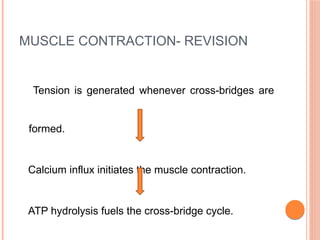
Tension is generated whenever cross-bridges are
formed.
Calcium influx initiates the muscle contraction.
ATP hydrolysis fuels the cross-bridge cycle.
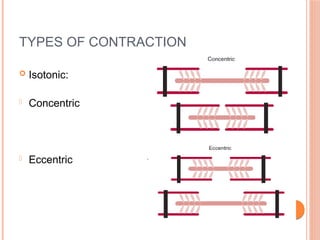
TYPES OF CONTRACTION
 Isotonic:
 Concentric
 Eccentric
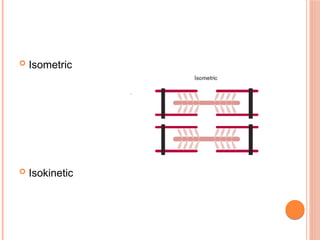
 Isometric
 Isokinetic
MUSCLE CONTRACTION FACTS (CROSS
BRIDGE CYCLE)
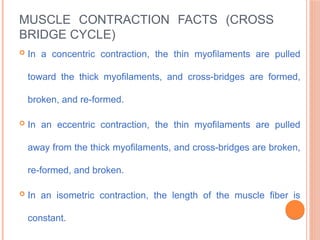
 In a concentric contraction, the thin myofilaments are pulled
toward the thick myofilaments, and cross-bridges are formed,
broken, and re-formed.
 In an eccentric contraction, the thin myofilaments are pulled
away from the thick myofilaments, and cross-bridges are broken,
re-formed, and broken.
 In an isometric contraction, the length of the muscle fiber is
constant.
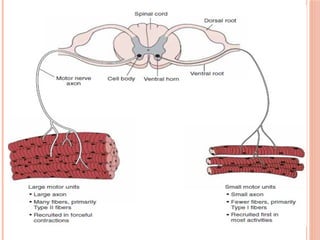
MOTOR UNIT
 The motor unit consists of the alpha motor neuron and
all of the muscle fibers it innervates.
 The stimulus that the muscle fiber receives initiating the
contractile process is transmitted through an alpha motor
neuron.
 The contraction of the entire muscle is the result of many
motor units firing asynchronously and repeatedly.
 The magnitude of the contraction of the entire muscle may be
altered by;
i. Changing the number of motor units that are activated.
ii. Frequency at which they are activated.
The number of motor units in a muscle, as well as the
structure of these units, varies from muscle to muscle.
 Size of motor unit: number of muscle fiber and size of
motor nerve axon.
 The motor units of the small muscles that control eye
motions may contain as few as six muscle fibers, whereas
the gastrocnemius muscles have motor units that contain
about 2000 muscle fibers.
 Greater the number of muscle fiber supplied by each
motor unit; lesser the number of motor unit that
particular muscle has and vice versa.
Muscle No. of motor units
per muscle
Each motor unnits
supplies -------Fibers
Platysma 1000 units 25 fibers
Gastrocnemius 600 units 2000 muscle fiber
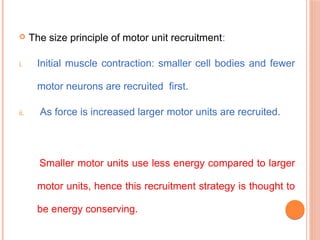
 The size principle of motor unit recruitment:
i. Initial muscle contraction: smaller cell bodies and fewer
motor neurons are recruited first.
ii. As force is increased larger motor units are recruited.
Smaller motor units use less energy compared to larger
motor units, hence this recruitment strategy is thought to
be energy conserving.
Recruitment strategy may be based on:
i. Energy conservation
ii. Previous experience
iii. The nature of the task (how rapidly the muscle must
respond or the anticipated magnitude of the required force)
iv. Type of muscle action (concentric, eccentric, isometric);
v. Mechanical advantage at a particular point in the range of
motion (ROM)
 What is Active Muscle Tension?
 Facts that affect Active tension of the muscle are:
i. Number of muscle fibers
ii. Diameter of the axon
iii. Number of motor units that are firing at one time
iv. Frequency of motor unit firing
v. Synchrony of motor units firing
 The sarcolemma of individual muscle fibers is
surrounded by connective tissue called the
endomysium
CONTENTS
 Definition of muscle
 Muscle structure
a. Fiber types
b. On the basis of: size, arrangement of fibers and
length.
 Parallel and Elastic Component of muscle
MUSCLE
 Definition of muscle:
 Muscle structure: Explanation of muscle belly, tendon,
sharpey’s fibers, bony attachment, aponeurosis.
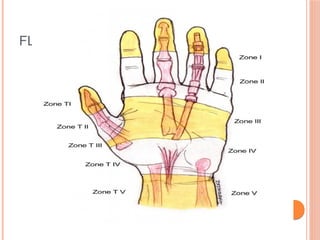
ZONE OF TENDONS
 Flexor tendon zone
 Extensor tendon zone
FLEXOR TENDON ZONES
ZONES OF FLEXOR TENDON
Zones Extent
I From tip of the fingers to the middle of
the middle phalanx
II From middle of middle phalanx to distal
palmar crease
III From distal palmar crease to the distal
edge of the flexor carpal ligament
IV Zone under the carpal ligament and
carpal tunnel
V From origin of the flexor tendons at their
respective muscle bellies to the proximal
edge of carpal tunnel
FIBER TYPES
Three primary muscle fiber types will be referred to as
 Type I (slow),
 Type IIA (intermediate),
 Type IIB (fast)
EXAMPLES OF FIBER TYPES PRESENT WITHIN
HUMAN BODY
Although the differences may be subtle, fiber type
changes with age so that there is a decrease in the
number and size of the type II fibers.
Muscle Fibers contained
Vatus lateralis, Rectus
femoris, deltoid,
Gastorcnemius
50%= type II
50%= type I
Hamstrings 50-55%=Type II
45-50%= type I
Soleus 80% type I
IN CADAVERIC STUDY;
FACTORS DETERMINING SHORTENING
AND LENGTHENING OF A MUSCLE??
1. Diameter of axon
2. Number of muscle fibers
3. Strength of Stimulus: {Number of sarcomeres recruited}
4. Length of muscle fibers
POSTURAL VS MOBILITY MUSCLE
Postural Mobility
For stability For Power and Mobility
Late fatigue Early fatigue
Contains most of type I fibers Type II (A or B) fibers
Eg: errector spinae, rectus
abdominis
Eg: hand muscles.
REMEMBER
 The relationship between the muscle fiber length and
the distance that it is able to move a bony lever is not
always a direct relationship. The arrangement of the
muscle fibers and the length of the moment arm (MA) of
the muscle affect the length-shortening relationship,
and, therefore, both fiber length and MA must be
considered
PCSA
 The PCSA is a measure of the cross-sectional area of the
muscle perpendicular to the orientation of the muscle
fibers.
 The amount of force that a muscle produces is directly
proportional to the number of sarcomeres aligned side by
side (or in parallel). Therefore, if there are a large number
of fibers packed into a muscle (as in a pennate muscle) or
if the fiber increases in size (addition of myofibrils), the
ability to produce force will be increased.
Quadriceps Hamstrings
Unipennate Unipennate
4 bellies 4 bellies
All are one joint muscles
except Rectus femoris
All are two joint muscles
Rectus femoris: crosses hip
and knee joints, rest all
only hip joint.
All 4 crosses both hip and
knee joints
Larger PCSA: greater force
production
Lengthier muscle fibers:
greater ROM
ON THE BASIS OF PENNATION
 Unipennate
 Bipennate
 Multipennate
ON THE BASIS OF ACTION
 Skeletal
 Cardiac
 Smooth
 The fasciculi may be parallel to the long axis of the
muscle (Fig. 3-8A), may spiral around the long axis
(see Fig. 3-8B), or may be at an angle to the long
axis (see Fig. 3-8C).
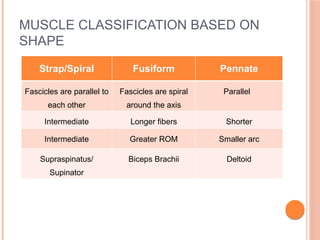
MUSCLE CLASSIFICATION BASED ON
SHAPE
Strap/Spiral Fusiform Pennate
Fascicles are parallel to
each other
Fascicles are spiral
around the axis
Parallel
Intermediate Longer fibers Shorter
Intermediate Greater ROM Smaller arc
Supraspinatus/
Supinator
Biceps Brachii Deltoid
Based on fascicle Arrangement
PENNATION: POINTS TO REMEMBER
 The obliquity of the muscle fibers in a pennate muscle
disrupts the direct relationship between the length of the
muscle fiber and the distance that the total muscle can
move a bony part. This decreases the amount of force
that is directed along the long axis of the muscle.
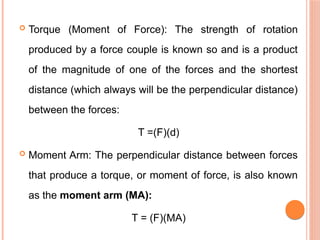
 Torque (Moment of Force): The strength of rotation
produced by a force couple is known so and is a product
of the magnitude of one of the forces and the shortest
distance (which always will be the perpendicular distance)
between the forces:
T =(F)(d)
 Moment Arm: The perpendicular distance between forces
that produce a torque, or moment of force, is also known
as the moment arm (MA):
T = (F)(MA)
APPLIED MYOLOGY
 DOMS
 Muscle tear
 Tendinitis
 Impingement
HOME WORK
 Positive work
 Negative work
 Factors responsible for muscle contraction.
 Isoinertial contraction
MUSCLE ACTION
 Normal muscle action
 Reverse muscle action
 Myotendinous junction possible sit of injury
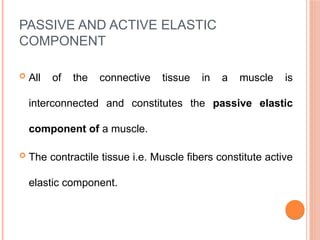
PASSIVE AND ACTIVE ELASTIC
COMPONENT
 All of the connective tissue in a muscle is
interconnected and constitutes the passive elastic
component of a muscle.
 The contractile tissue i.e. Muscle fibers constitute active
elastic component.
PARALLEL AND SERIES ELASTIC
COMPONENT
 The connective tissues that surround the muscle, plus
the sarcolemma, the elastic protein titin, and other
structures (i.e., nerves and blood vessels), form the
parallel elastic component of a muscle.
 When a muscle lengthens or shortens, these tissues
also lengthen or shorten, because they function in
parallel to the muscle contractile unit.
 The increased resistance of perimysium to elongation
may prevent overstretching of the muscle fiber bundles
and may contribute to the tension at the tendon.
 When sarcomeres shorten from their resting position, the
slack collagen fibers within the parallel elastic component
buckle (crimp) even further. Whatever tension might have
existed in the collagen at rest is diminished by the
shortening of the sarcomere.
 Because of the many parallel elastic components of a
muscle, the increase or decrease in passive tension can
substantially affect the total tension output of a muscle.
This relationship between length and tension is called as
length tension relationship.
 The tendon of the muscle is considered to function in
series with the contractile elements. This means that
the tendon will be under tension when the muscle actively
produces tension. When the contractile elements in a
muscle actively shorten, they exert a pull on the tendon.
The pull must be of sufficient magnitude to take up the
slack (compliance) in the tendon so that the muscle pull
can be transmitted through the tendon to the bony lever.
 The tendon is also under tension when a muscle is
controlling or braking the motion of the lever in an
eccentric contraction. A tendon is under reduced tension
only when a muscle is completely relaxed and in a
relatively shortened position.
PASSIVE TENSION ACTIVE TENSION
Developed in parallel elastic
component of muscle
Developed by contractile elements
of muscle
Created by lengthening of muscle
beyond the slack length
Initiated by cross bridge formation
The parallel elastic component
may add to the active tension
produced by the muscle when the
muscle is
lengthened, or it may become
slack and not contribute to the
total tension when the muscle is
shortened.
The amount of active tension that
a muscle can generate depends
on neural factors and mechanical
properties of the muscle fibers.
The neural factors that can
modulate the amount of
active tension include the
frequency, number, and size
of motor units that are firing.
NOTE
 The total tension that develops during an active
contraction of a muscle is a combination of the passive
(noncontractile) tension added to the active (contractile)
tension.
 The mechanical properties of muscle that determine the
active tension are the isometric length-tension
relationship and the force-velocity relationship.
HOME WORK: PG NO.: 129
 Summary of Intrinsic and Extrinsic Factors Involving
Active Muscle Tension
LENGTH TENSION RELATIONSHIP
 It is strictly, the direct relationship between isometric
tension development in a muscle fiber and the length of
the sarcomeres in a muscle fiber.
 There is an optimal sarcomere length at which a muscle
fiber is capable of developing maximal isometric tension.
At Optimal sarcomere length muscle fibers develops
maximum isometric tension.
 Muscle fibers develop maximal isometric tension at
optimal sarcomere length because the thick and thin
filaments are positioned so that the maximum number of
cross-bridges within the sarcomere can be formed. If the
muscle fiber is lengthened or shortened beyond optimal
length, the amount of active tension that the muscle fiber
is able to generate when stimulated decreases.
 When a muscle fiber is lengthened beyond optimal length,
there is less overlap between the thick and thin filaments
and consequently fewer possibilities for crossbridge
formation. However, the passive elastic tension in the
parallel component may be increased when the muscle is
elongated. This passive tension is added to the active
tension, resulting in the total tension.
 A similar loss of isometric tension or diminished capacity
for developing tension occurs when a muscle fiber is
shortened from its optimal sarcomere length. When the
sarcomere is at shorter lengths, the distance between the
Z disks decreases and there is interdigitation of the
filaments. The interdigitation of the thick and thin filaments
may interfere with the formation of cross-bridges from the
myosin molecules, thus decreasing the active force.
REMEMBER
 However, during dynamic contractions, the length-
tension relationship must be combined with the force-
velocity relationship to determine the effect that both
length and velocity have on the muscle tension.
 This means that: At different lengths of muscle, the
lengths of sarcomere may be different.
APPLICATION OF LENGTH TENSION RELATIONSHIP
 When the muscle is acting at a joint, the torque
produced is not only a function of the muscle force
(which depends on muscle length) but also a function of
the MA of the muscle. This means that at a certain joint
angle, the muscle length may be short (which suggests
that force will be low), but the MA may be relatively long,
thus maintaining a higher joint torque.
FORCE VELOCITY RELATIONSHIP
 The force-velocity relationship describes the relationship
between the velocity of the muscle contraction and the
force produced
 Another factor that affects the development of tension
within a muscle is the speed of shortening of the
myofilaments. The speed of shortening is the rate at
which the myofilaments are able to slide past one another
and form and re-form cross-bridges. Remember that the
speed of shortening is related to muscle fiber type as well
as muscle fiber length.
 Considering the velocity of muscle contraction is a
function of load being lifted,
 The maximum shortening speed occurs when there is no
resistance to the shortening.
 However, in this situation, no tension is developed in the
muscle because there is no resistance.
 Conversely, tension may be developed when the
resistance to movement of the bony lever prevents
visible shortening of the muscle, such as occurs in an
isometric contraction.
POINTS TO REMEMBER
 In a concentric muscle contraction, as the shortening
speed decreases, the tension in the muscle
increases.
 In an isometric contraction, the speed of shortening is
zero, and tension is greater than in a concentric
contraction.
 In an eccentric contraction, as the speed of
lengthening increases, the tension in the muscle
increases.
 Hence tension developed within the muscle is not
only dependent on the length of muscle, the number
of fibers recruited; but also on the speed of
contraction.
CLASSIFICATION OF MUSCLE
 Architectural: strap, fusiform, pennate.
 Functional: flexors, extensors, abductors,
adductors, internal rotators, external rotators.
 Based on action: prime movers (agonist),
antagonist, synergists,
HOME WORK
 Active insufficiency
 Passive insufficiency
FACTORS AFFECTING MUSCLE
FUNCTION
 Types of joints and location of muscle attachments
 Number of joints crossed by the muscle
 Passive insufficiency
 Sensory receptors
LOCATION OF MUSCLE ATTACHMENT
Depending on location the action occurs.:
 Flexors: anteriorly
 Extensors: posteriorly
 Abductors: laterally
 Adductors: medially
But not every time this holds true….
 Lower extremities
 Rotators
NUMBER OF JOINTS CROSSED BY
MUSCLES
 Two joint muscle: greater excursion of the
movement.
 One joint muscle: greater the force production at
that particular joint.
INSUFFICIENCY
 Active
 Passive
SENSORY RECEPTORS
 Two important sensory receptors, the Golgi tendon organ
and the muscle spindle.
 The Golgi tendon organs, which are located in the tendon
at the myotendinous junction, are sensitive to tension and
may be activated either by an active muscle contraction or
by an excessive passive stretch of the muscle.
 When the Golgi tendon organs are excited, they send a
message to the nervous system to inhibit the muscle in
whose tendon the receptor lies.
 The muscle spindles, which consist of 2 to 10
specialized muscle fibers (intrafusal fibers) enclosed
in a connective tissue sheath, are interspersed
throughout the muscle.
 These spindle fibers are sensitive to the length and the
velocity of lengthening of the muscle fibers (extrafusal
fibers). They send messages to the brain (cerebellum)
about the state of stretch of the muscle.
 When the muscle fiber shortens, the spindles stop
sending messages because they are no longer
stretched. When the signal decreases, the higher
centers send a message to the intrafusal muscle fibers in
the spindle to shorten so that they once again are able to
respond to the length change in the muscle.
 Both the Golgi tendon organs and the muscle
spindles provide constant feedback to the central
nervous system during movement so that appropriate
adjustments can be made and they help to protect the
injury by monitoring the changes within muscle during
action.
ISOINERTIAL
 Isoinertial exercise is defined as a type of exercise in
which muscles act against a constant load or resistance
and the measured torque is determined while the
constant load is accelerating or decelerating. This ROM
can change the direction but the force on extremity
remains same.
APPLIED MYOLOGY
 Aging: wasting
 Immobilization: shortened versus lengthened
 Injury: strain, grades of injury, atrophy, MTU
junction, DOMS
RESPONSE OF CONTRACTILE
STRUCTURES TO IMMOBILIZATION
Immobilization in shortened
position
Immobilization in
lengthened position
Sarcomere absorption causes
reduction in the length of the
muscle, its fibers and in the
number of sarcomeres.
The decrease in the overall
length of the muscle fibers and
their in-series sarcomeres,
contributes to muscle atrophy
and weakness.
Atrophies faster at a faster rate
than lengthened muscle.
Myofibrillogenesis
Permanent elastic form of
muscle.
Slower rate than Shortened
position
69
Thank You

Muscle action and_work

  • 1.
    MUSCLE ACTION ANDWORK RADHIKA CHINTAMANI ASST. PROFESSOR OMT
  • 2.
    CONTENTS  Muscle contraction:Isometric, Isokinetic, Isotonic  Facts of muscle contraction  Motor Unit  Recruitment strategy of motor unit
  • 3.
    MUSCLE CONTRACTION- REVISION Tensionis generated whenever cross-bridges are formed. Calcium influx initiates the muscle contraction. ATP hydrolysis fuels the cross-bridge cycle.
  • 4.
    TYPES OF CONTRACTION Isotonic:  Concentric  Eccentric
  • 5.
  • 6.
    MUSCLE CONTRACTION FACTS(CROSS BRIDGE CYCLE)  In a concentric contraction, the thin myofilaments are pulled toward the thick myofilaments, and cross-bridges are formed, broken, and re-formed.  In an eccentric contraction, the thin myofilaments are pulled away from the thick myofilaments, and cross-bridges are broken, re-formed, and broken.  In an isometric contraction, the length of the muscle fiber is constant.
  • 7.
    MOTOR UNIT  Themotor unit consists of the alpha motor neuron and all of the muscle fibers it innervates.  The stimulus that the muscle fiber receives initiating the contractile process is transmitted through an alpha motor neuron.  The contraction of the entire muscle is the result of many motor units firing asynchronously and repeatedly.
  • 9.
     The magnitudeof the contraction of the entire muscle may be altered by; i. Changing the number of motor units that are activated. ii. Frequency at which they are activated. The number of motor units in a muscle, as well as the structure of these units, varies from muscle to muscle.
  • 10.
     Size ofmotor unit: number of muscle fiber and size of motor nerve axon.  The motor units of the small muscles that control eye motions may contain as few as six muscle fibers, whereas the gastrocnemius muscles have motor units that contain about 2000 muscle fibers.
  • 11.
     Greater thenumber of muscle fiber supplied by each motor unit; lesser the number of motor unit that particular muscle has and vice versa. Muscle No. of motor units per muscle Each motor unnits supplies -------Fibers Platysma 1000 units 25 fibers Gastrocnemius 600 units 2000 muscle fiber
  • 12.
     The sizeprinciple of motor unit recruitment: i. Initial muscle contraction: smaller cell bodies and fewer motor neurons are recruited first. ii. As force is increased larger motor units are recruited. Smaller motor units use less energy compared to larger motor units, hence this recruitment strategy is thought to be energy conserving.
  • 13.
    Recruitment strategy maybe based on: i. Energy conservation ii. Previous experience iii. The nature of the task (how rapidly the muscle must respond or the anticipated magnitude of the required force) iv. Type of muscle action (concentric, eccentric, isometric); v. Mechanical advantage at a particular point in the range of motion (ROM)
  • 14.
     What isActive Muscle Tension?  Facts that affect Active tension of the muscle are: i. Number of muscle fibers ii. Diameter of the axon iii. Number of motor units that are firing at one time iv. Frequency of motor unit firing v. Synchrony of motor units firing
  • 15.
     The sarcolemmaof individual muscle fibers is surrounded by connective tissue called the endomysium
  • 16.
    CONTENTS  Definition ofmuscle  Muscle structure a. Fiber types b. On the basis of: size, arrangement of fibers and length.  Parallel and Elastic Component of muscle
  • 17.
    MUSCLE  Definition ofmuscle:  Muscle structure: Explanation of muscle belly, tendon, sharpey’s fibers, bony attachment, aponeurosis.
  • 18.
    ZONE OF TENDONS Flexor tendon zone  Extensor tendon zone
  • 19.
  • 20.
    ZONES OF FLEXORTENDON Zones Extent I From tip of the fingers to the middle of the middle phalanx II From middle of middle phalanx to distal palmar crease III From distal palmar crease to the distal edge of the flexor carpal ligament IV Zone under the carpal ligament and carpal tunnel V From origin of the flexor tendons at their respective muscle bellies to the proximal edge of carpal tunnel
  • 21.
    FIBER TYPES Three primarymuscle fiber types will be referred to as  Type I (slow),  Type IIA (intermediate),  Type IIB (fast)
  • 22.
    EXAMPLES OF FIBERTYPES PRESENT WITHIN HUMAN BODY Although the differences may be subtle, fiber type changes with age so that there is a decrease in the number and size of the type II fibers. Muscle Fibers contained Vatus lateralis, Rectus femoris, deltoid, Gastorcnemius 50%= type II 50%= type I Hamstrings 50-55%=Type II 45-50%= type I Soleus 80% type I IN CADAVERIC STUDY;
  • 24.
    FACTORS DETERMINING SHORTENING ANDLENGTHENING OF A MUSCLE?? 1. Diameter of axon 2. Number of muscle fibers 3. Strength of Stimulus: {Number of sarcomeres recruited} 4. Length of muscle fibers
  • 25.
    POSTURAL VS MOBILITYMUSCLE Postural Mobility For stability For Power and Mobility Late fatigue Early fatigue Contains most of type I fibers Type II (A or B) fibers Eg: errector spinae, rectus abdominis Eg: hand muscles.
  • 26.
    REMEMBER  The relationshipbetween the muscle fiber length and the distance that it is able to move a bony lever is not always a direct relationship. The arrangement of the muscle fibers and the length of the moment arm (MA) of the muscle affect the length-shortening relationship, and, therefore, both fiber length and MA must be considered
  • 27.
    PCSA  The PCSAis a measure of the cross-sectional area of the muscle perpendicular to the orientation of the muscle fibers.  The amount of force that a muscle produces is directly proportional to the number of sarcomeres aligned side by side (or in parallel). Therefore, if there are a large number of fibers packed into a muscle (as in a pennate muscle) or if the fiber increases in size (addition of myofibrils), the ability to produce force will be increased.
  • 28.
    Quadriceps Hamstrings Unipennate Unipennate 4bellies 4 bellies All are one joint muscles except Rectus femoris All are two joint muscles Rectus femoris: crosses hip and knee joints, rest all only hip joint. All 4 crosses both hip and knee joints Larger PCSA: greater force production Lengthier muscle fibers: greater ROM
  • 29.
    ON THE BASISOF PENNATION  Unipennate  Bipennate  Multipennate
  • 30.
    ON THE BASISOF ACTION  Skeletal  Cardiac  Smooth
  • 31.
     The fasciculimay be parallel to the long axis of the muscle (Fig. 3-8A), may spiral around the long axis (see Fig. 3-8B), or may be at an angle to the long axis (see Fig. 3-8C).
  • 32.
    MUSCLE CLASSIFICATION BASEDON SHAPE Strap/Spiral Fusiform Pennate Fascicles are parallel to each other Fascicles are spiral around the axis Parallel Intermediate Longer fibers Shorter Intermediate Greater ROM Smaller arc Supraspinatus/ Supinator Biceps Brachii Deltoid
  • 33.
    Based on fascicleArrangement
  • 34.
    PENNATION: POINTS TOREMEMBER  The obliquity of the muscle fibers in a pennate muscle disrupts the direct relationship between the length of the muscle fiber and the distance that the total muscle can move a bony part. This decreases the amount of force that is directed along the long axis of the muscle.
  • 35.
     Torque (Momentof Force): The strength of rotation produced by a force couple is known so and is a product of the magnitude of one of the forces and the shortest distance (which always will be the perpendicular distance) between the forces: T =(F)(d)  Moment Arm: The perpendicular distance between forces that produce a torque, or moment of force, is also known as the moment arm (MA): T = (F)(MA)
  • 36.
    APPLIED MYOLOGY  DOMS Muscle tear  Tendinitis  Impingement
  • 37.
    HOME WORK  Positivework  Negative work  Factors responsible for muscle contraction.  Isoinertial contraction
  • 39.
    MUSCLE ACTION  Normalmuscle action  Reverse muscle action  Myotendinous junction possible sit of injury
  • 40.
    PASSIVE AND ACTIVEELASTIC COMPONENT  All of the connective tissue in a muscle is interconnected and constitutes the passive elastic component of a muscle.  The contractile tissue i.e. Muscle fibers constitute active elastic component.
  • 41.
    PARALLEL AND SERIESELASTIC COMPONENT  The connective tissues that surround the muscle, plus the sarcolemma, the elastic protein titin, and other structures (i.e., nerves and blood vessels), form the parallel elastic component of a muscle.  When a muscle lengthens or shortens, these tissues also lengthen or shorten, because they function in parallel to the muscle contractile unit.
  • 42.
     The increasedresistance of perimysium to elongation may prevent overstretching of the muscle fiber bundles and may contribute to the tension at the tendon.  When sarcomeres shorten from their resting position, the slack collagen fibers within the parallel elastic component buckle (crimp) even further. Whatever tension might have existed in the collagen at rest is diminished by the shortening of the sarcomere.
  • 43.
     Because ofthe many parallel elastic components of a muscle, the increase or decrease in passive tension can substantially affect the total tension output of a muscle. This relationship between length and tension is called as length tension relationship.
  • 44.
     The tendonof the muscle is considered to function in series with the contractile elements. This means that the tendon will be under tension when the muscle actively produces tension. When the contractile elements in a muscle actively shorten, they exert a pull on the tendon. The pull must be of sufficient magnitude to take up the slack (compliance) in the tendon so that the muscle pull can be transmitted through the tendon to the bony lever.
  • 45.
     The tendonis also under tension when a muscle is controlling or braking the motion of the lever in an eccentric contraction. A tendon is under reduced tension only when a muscle is completely relaxed and in a relatively shortened position.
  • 46.
    PASSIVE TENSION ACTIVETENSION Developed in parallel elastic component of muscle Developed by contractile elements of muscle Created by lengthening of muscle beyond the slack length Initiated by cross bridge formation The parallel elastic component may add to the active tension produced by the muscle when the muscle is lengthened, or it may become slack and not contribute to the total tension when the muscle is shortened. The amount of active tension that a muscle can generate depends on neural factors and mechanical properties of the muscle fibers. The neural factors that can modulate the amount of active tension include the frequency, number, and size of motor units that are firing.
  • 47.
    NOTE  The totaltension that develops during an active contraction of a muscle is a combination of the passive (noncontractile) tension added to the active (contractile) tension.  The mechanical properties of muscle that determine the active tension are the isometric length-tension relationship and the force-velocity relationship.
  • 48.
    HOME WORK: PGNO.: 129  Summary of Intrinsic and Extrinsic Factors Involving Active Muscle Tension
  • 50.
    LENGTH TENSION RELATIONSHIP It is strictly, the direct relationship between isometric tension development in a muscle fiber and the length of the sarcomeres in a muscle fiber.  There is an optimal sarcomere length at which a muscle fiber is capable of developing maximal isometric tension. At Optimal sarcomere length muscle fibers develops maximum isometric tension.  Muscle fibers develop maximal isometric tension at optimal sarcomere length because the thick and thin filaments are positioned so that the maximum number of cross-bridges within the sarcomere can be formed. If the muscle fiber is lengthened or shortened beyond optimal length, the amount of active tension that the muscle fiber is able to generate when stimulated decreases.
  • 51.
     When amuscle fiber is lengthened beyond optimal length, there is less overlap between the thick and thin filaments and consequently fewer possibilities for crossbridge formation. However, the passive elastic tension in the parallel component may be increased when the muscle is elongated. This passive tension is added to the active tension, resulting in the total tension.  A similar loss of isometric tension or diminished capacity for developing tension occurs when a muscle fiber is shortened from its optimal sarcomere length. When the sarcomere is at shorter lengths, the distance between the Z disks decreases and there is interdigitation of the filaments. The interdigitation of the thick and thin filaments may interfere with the formation of cross-bridges from the myosin molecules, thus decreasing the active force.
  • 52.
    REMEMBER  However, duringdynamic contractions, the length- tension relationship must be combined with the force- velocity relationship to determine the effect that both length and velocity have on the muscle tension.  This means that: At different lengths of muscle, the lengths of sarcomere may be different.
  • 53.
    APPLICATION OF LENGTHTENSION RELATIONSHIP  When the muscle is acting at a joint, the torque produced is not only a function of the muscle force (which depends on muscle length) but also a function of the MA of the muscle. This means that at a certain joint angle, the muscle length may be short (which suggests that force will be low), but the MA may be relatively long, thus maintaining a higher joint torque.
  • 54.
    FORCE VELOCITY RELATIONSHIP The force-velocity relationship describes the relationship between the velocity of the muscle contraction and the force produced  Another factor that affects the development of tension within a muscle is the speed of shortening of the myofilaments. The speed of shortening is the rate at which the myofilaments are able to slide past one another and form and re-form cross-bridges. Remember that the speed of shortening is related to muscle fiber type as well as muscle fiber length.  Considering the velocity of muscle contraction is a function of load being lifted,
  • 55.
     The maximumshortening speed occurs when there is no resistance to the shortening.  However, in this situation, no tension is developed in the muscle because there is no resistance.  Conversely, tension may be developed when the resistance to movement of the bony lever prevents visible shortening of the muscle, such as occurs in an isometric contraction.
  • 56.
    POINTS TO REMEMBER In a concentric muscle contraction, as the shortening speed decreases, the tension in the muscle increases.  In an isometric contraction, the speed of shortening is zero, and tension is greater than in a concentric contraction.  In an eccentric contraction, as the speed of lengthening increases, the tension in the muscle increases.  Hence tension developed within the muscle is not only dependent on the length of muscle, the number of fibers recruited; but also on the speed of contraction.
  • 57.
    CLASSIFICATION OF MUSCLE Architectural: strap, fusiform, pennate.  Functional: flexors, extensors, abductors, adductors, internal rotators, external rotators.  Based on action: prime movers (agonist), antagonist, synergists,
  • 58.
    HOME WORK  Activeinsufficiency  Passive insufficiency
  • 60.
    FACTORS AFFECTING MUSCLE FUNCTION Types of joints and location of muscle attachments  Number of joints crossed by the muscle  Passive insufficiency  Sensory receptors
  • 61.
    LOCATION OF MUSCLEATTACHMENT Depending on location the action occurs.:  Flexors: anteriorly  Extensors: posteriorly  Abductors: laterally  Adductors: medially But not every time this holds true….  Lower extremities  Rotators
  • 62.
    NUMBER OF JOINTSCROSSED BY MUSCLES  Two joint muscle: greater excursion of the movement.  One joint muscle: greater the force production at that particular joint.
  • 63.
  • 64.
    SENSORY RECEPTORS  Twoimportant sensory receptors, the Golgi tendon organ and the muscle spindle.  The Golgi tendon organs, which are located in the tendon at the myotendinous junction, are sensitive to tension and may be activated either by an active muscle contraction or by an excessive passive stretch of the muscle.  When the Golgi tendon organs are excited, they send a message to the nervous system to inhibit the muscle in whose tendon the receptor lies.
  • 65.
     The musclespindles, which consist of 2 to 10 specialized muscle fibers (intrafusal fibers) enclosed in a connective tissue sheath, are interspersed throughout the muscle.  These spindle fibers are sensitive to the length and the velocity of lengthening of the muscle fibers (extrafusal fibers). They send messages to the brain (cerebellum) about the state of stretch of the muscle.  When the muscle fiber shortens, the spindles stop sending messages because they are no longer stretched. When the signal decreases, the higher centers send a message to the intrafusal muscle fibers in the spindle to shorten so that they once again are able to respond to the length change in the muscle.
  • 66.
     Both theGolgi tendon organs and the muscle spindles provide constant feedback to the central nervous system during movement so that appropriate adjustments can be made and they help to protect the injury by monitoring the changes within muscle during action.
  • 67.
    ISOINERTIAL  Isoinertial exerciseis defined as a type of exercise in which muscles act against a constant load or resistance and the measured torque is determined while the constant load is accelerating or decelerating. This ROM can change the direction but the force on extremity remains same.
  • 68.
    APPLIED MYOLOGY  Aging:wasting  Immobilization: shortened versus lengthened  Injury: strain, grades of injury, atrophy, MTU junction, DOMS
  • 69.
    RESPONSE OF CONTRACTILE STRUCTURESTO IMMOBILIZATION Immobilization in shortened position Immobilization in lengthened position Sarcomere absorption causes reduction in the length of the muscle, its fibers and in the number of sarcomeres. The decrease in the overall length of the muscle fibers and their in-series sarcomeres, contributes to muscle atrophy and weakness. Atrophies faster at a faster rate than lengthened muscle. Myofibrillogenesis Permanent elastic form of muscle. Slower rate than Shortened position 69
  • 70.