
Muscles
Dr. Abid Ullah (PT)
Lecturer PIHS
Islamabad
Email:
dr.abidullahpt@yahoo.com
Objectives
 At the end of this lecture, you must be able to know
about
 Muscular system & Musculoskeletal system
 Classification of Muscle
 Internal Structure of Skeletal Muscle
 Skeletal Muscle Action
Classification of Muscles
 Muscles are classified by three different methods, based on
different factors:
 Depending upon the presence or absence of striations
 Depending upon the control
 Depending upon the situation
 DEPENDING UPON STRIATIONS
 Striated muscle
 which has a large number of cross-striations (transverse lines).
 e.g. Skeletal muscle and cardiac muscle
 Non-striated muscle
 also called plain muscle or smooth muscle
 It is found in the wall of the visceral organs
Cont…
 DEPENDING UPON CONTROL
 Voluntary Muscle
 The muscle that is controlled by the will.
 Skeletal muscles are the voluntary muscles.
 These muscles are innervated by somatic nerves.
 Involuntary Muscle
 Muscle that cannot be controlled by the will is called
involuntary muscle.
 Cardiac muscle and smooth muscle are involuntary muscles.
 innervated by autonomic nerves.
Cont…
 DEPENDING UPON SITUATION
 Skeletal Muscle
 is situated in association with bones forming the skeletal system
 form 40% to 50% of body mass and are voluntary and striated
 supplied by somatic nerves
 Cardiac Muscle
 forms the musculature of the heart
 These muscles are striated and involuntary
 supplied by autonomic nerve fibers
 Smooth Muscle
 is situated in association with viscera. also called visceral muscle.
 different from skeletal and cardiac muscles because of the absence of
cross striations.
 supplied by autonomic nerve fibers.
 form the main contractile units of wall of the various visceral organs
Skeletal Muscle
 produce the movements of the skeleton
 has two or more attachments.
 The attachment that moves the least is referred to as
the origin, and the one that moves the most, the
insertion
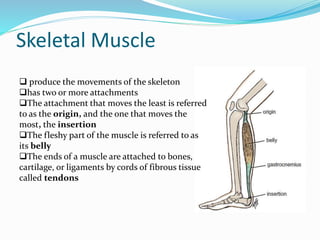
Skeletal Muscle
 produce the movements of the skeleton
has two or more attachments
The attachment that moves the least is referred
to as the origin, and the one that moves the
most, the insertion
The fleshy part of the muscle is referred to as
its belly
The ends of a muscle are attached to bones,
cartilage, or ligaments by cords of fibrous tissue
called tendons
Internal Structure of Skeletal Muscle
 The individual fibers of a muscle are arranged either parallel or oblique
 muscle shortens by one third to one half its resting length when it
contracts
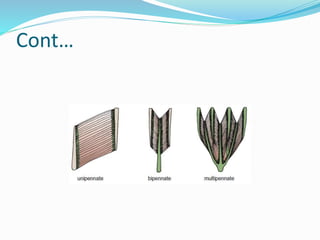
 Muscles whose fibers run obliquely to the line of pull are referred to as
pennate muscles
 A unipennate muscle is one in which the tendon lies along one side
of the muscle and the muscle fibers pass obliquely to it (e.g., extensor
digitorum longus)
 A bipennate muscle is one in which the tendon lies in the center of
the muscle and the muscle fibers pass to it from two sides (e.g., rectus
femoris).
 multipennate muscle may be arranged as a series of bipennate
muscles lying alongside one another (e.g., acromial fibers of the
deltoid) or may have the tendon lying within its center and the muscle
fibers passing to it from all sides, converging as they go (e.g., tibialis
anterior).
Cont…
Skeletal Muscle Action
 Prime mover: A muscle is a prime mover when it is
the chief muscle or member of a chief group of
muscles responsible for a particular movement.
 For example, the quadriceps femoris is a prime mover in
the movement of extending the knee joint
 Antagonist: Any muscle that opposes the action
of the prime mover is an antagonist.
 For example, the biceps femoris opposes the action of
the quadriceps femoris when the knee joint is extended
 Before a prime mover can contract, the antagonist
muscle must be equally relaxed
 Fixator: A fixator contracts isometrically to stabilize
the origin of the prime mover so that it can act
efficiently.
 For example, the muscles attaching the shoulder girdle
to the trunk contract as fixators to allow the deltoid to
act on the shoulder joint
Nerve Supply of Skeletal Muscle
 The nerve trunk to a muscle is a mixed nerve, about
60% is motor and 40% is sensory, and it also contains
some sympathetic autonomic fibers.
 The nerve enters the muscle at about the midpoint on
its deep surface
 The place of entrance is known as the motor point.
Assignment
 Write the Features of skeletal, cardiac and smooth muscle fibers
 Naming of Skeletal Muscles
Thank
You

Muscle anatomy

  • 1.
    Muscles Dr. Abid Ullah(PT) Lecturer PIHS Islamabad Email: dr.abidullahpt@yahoo.com
  • 2.
    Objectives  At theend of this lecture, you must be able to know about  Muscular system & Musculoskeletal system  Classification of Muscle  Internal Structure of Skeletal Muscle  Skeletal Muscle Action
  • 3.
    Classification of Muscles Muscles are classified by three different methods, based on different factors:  Depending upon the presence or absence of striations  Depending upon the control  Depending upon the situation  DEPENDING UPON STRIATIONS  Striated muscle  which has a large number of cross-striations (transverse lines).  e.g. Skeletal muscle and cardiac muscle  Non-striated muscle  also called plain muscle or smooth muscle  It is found in the wall of the visceral organs
  • 4.
    Cont…  DEPENDING UPONCONTROL  Voluntary Muscle  The muscle that is controlled by the will.  Skeletal muscles are the voluntary muscles.  These muscles are innervated by somatic nerves.  Involuntary Muscle  Muscle that cannot be controlled by the will is called involuntary muscle.  Cardiac muscle and smooth muscle are involuntary muscles.  innervated by autonomic nerves.
  • 5.
    Cont…  DEPENDING UPONSITUATION  Skeletal Muscle  is situated in association with bones forming the skeletal system  form 40% to 50% of body mass and are voluntary and striated  supplied by somatic nerves  Cardiac Muscle  forms the musculature of the heart  These muscles are striated and involuntary  supplied by autonomic nerve fibers  Smooth Muscle  is situated in association with viscera. also called visceral muscle.  different from skeletal and cardiac muscles because of the absence of cross striations.  supplied by autonomic nerve fibers.  form the main contractile units of wall of the various visceral organs
  • 6.
    Skeletal Muscle  producethe movements of the skeleton  has two or more attachments.  The attachment that moves the least is referred to as the origin, and the one that moves the most, the insertion
  • 7.
    Skeletal Muscle  producethe movements of the skeleton has two or more attachments The attachment that moves the least is referred to as the origin, and the one that moves the most, the insertion The fleshy part of the muscle is referred to as its belly The ends of a muscle are attached to bones, cartilage, or ligaments by cords of fibrous tissue called tendons
  • 8.
    Internal Structure ofSkeletal Muscle  The individual fibers of a muscle are arranged either parallel or oblique  muscle shortens by one third to one half its resting length when it contracts  Muscles whose fibers run obliquely to the line of pull are referred to as pennate muscles  A unipennate muscle is one in which the tendon lies along one side of the muscle and the muscle fibers pass obliquely to it (e.g., extensor digitorum longus)  A bipennate muscle is one in which the tendon lies in the center of the muscle and the muscle fibers pass to it from two sides (e.g., rectus femoris).  multipennate muscle may be arranged as a series of bipennate muscles lying alongside one another (e.g., acromial fibers of the deltoid) or may have the tendon lying within its center and the muscle fibers passing to it from all sides, converging as they go (e.g., tibialis anterior).
  • 9.
  • 10.
    Skeletal Muscle Action Prime mover: A muscle is a prime mover when it is the chief muscle or member of a chief group of muscles responsible for a particular movement.  For example, the quadriceps femoris is a prime mover in the movement of extending the knee joint  Antagonist: Any muscle that opposes the action of the prime mover is an antagonist.  For example, the biceps femoris opposes the action of the quadriceps femoris when the knee joint is extended  Before a prime mover can contract, the antagonist muscle must be equally relaxed
  • 11.
     Fixator: Afixator contracts isometrically to stabilize the origin of the prime mover so that it can act efficiently.  For example, the muscles attaching the shoulder girdle to the trunk contract as fixators to allow the deltoid to act on the shoulder joint
  • 12.
    Nerve Supply ofSkeletal Muscle  The nerve trunk to a muscle is a mixed nerve, about 60% is motor and 40% is sensory, and it also contains some sympathetic autonomic fibers.  The nerve enters the muscle at about the midpoint on its deep surface  The place of entrance is known as the motor point.
  • 13.
    Assignment  Write theFeatures of skeletal, cardiac and smooth muscle fibers  Naming of Skeletal Muscles
  • 14.