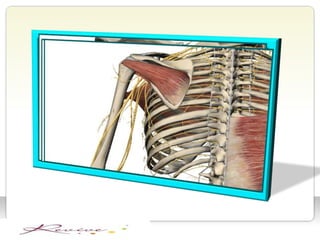
THE SHOULDER GIRDLE
Basic concepts about the Arthrokinematics of
shoulder girdle
 The shoulder girdle is the set
of bones which connects
the upper limb to
the axial skeleton on each side.
 Three synovial joints and a
functional articulations make
up the shoulder girdle
complex.
SHOULDER GIRDLE
SHOULDER GIRDLE
The shoulder girdle has only one
bony attachment to the axial
skeleton
 The clavicle articulates with the
sternum via the small
sternoclavicular joint.
 Stability is provided by an intricate
balance between the scapular and
glenohumeral muscles and the
structures of the joints in the
shoulder girdle.
Glenohumeral Joint
 “The shoulder is the most flexible joint in the body
making it the most susceptible to instability and injury.“
 Ball & socket joint with a lax joint capsule.
Glenohumeral Joint
It is supported by the tendons of the Rotator Cuff and
the Glenohumeral and Coraco-humeral & Transverse
Humeral ligaments.
Glenohumeral Joint
 The glenoid labrum (9mm thick), deepens the glenoid fossa for
greater congruity and serves as the attachment site for the capsule.
 Only a small portion of the head of humerus comes in contact with
the fossa, allowing for considerable humeral movement and
potential instability.
Joint surfaces
Capsulolabral complex
Ligaments
Rotator cuff
Scapular Stabilizer
Muscles
Mobility
Stability
Glenohumeral Joint
Normal range of motion of shoulder joint
Joint Arthrokinematics of the GH Joint
Pertaining to the movement of bone surfaces within a joint.
Joint Arthrokinematics of the GH Joint
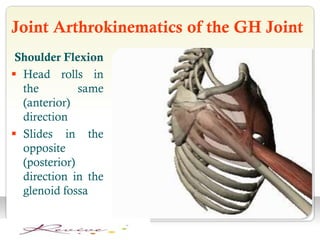
Shoulder Flexion
 Head rolls in
the same
(anterior)
direction
 Slides in the
opposite
(posterior)
direction in the
glenoid fossa
Joint Arthrokinematics of the GH Joint
 Head rolls in
the same
(posterior)
direction
 Slides in the
opposite
(anterior)
direction in the
glenoid fossa
Shoulder Extension
 Shoulder
abduction
oHead rolls in the
same (superior)
direction
oSlides in the
opposite (inferior)
direction in the
glenoid fossa
Joint Arthrokinematics of the GH Joint
 Head rolls in
the same
(inferior)
direction
 Slides in the
opposite
(superior)
direction in the
glenoid fossa
Shoulder adduction
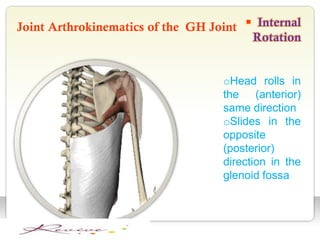
 Internal
Rotation
oHead rolls in
the (anterior)
same direction
oSlides in the
opposite
(posterior)
direction in the
glenoid fossa
Joint Arthrokinematics of the GH Joint
 Head rolls in
the (posterior)
same direction
 Slides in the
opposite
(anterior)
direction in the
glenoid fossa
External Rotation
Horizontal
abduction
Head rolls in the
same (posterior)
direction
Slides in the
opposite
(anterior)
direction in the
glenoid fossa
Joint Arthrokinematics of the GH Joint
Horizontal
Adduction
oHead rolls in
the (anterior)
same direction
oSlides in the
opposite
(posterior)
direction in the
glenoid fossa
Joint Arthrokinematics of the GH Joint
Acromioclavicular Joint
 The AC joint is a plane, triaxial joint
that may or may not have a disk. The
weak capsule is reinforced by the
superior and inferior AC ligaments.
 The convex bony partner is a facet on
the lateral end of the clavicle. The
concave bony partner is a facet on the
acromion of the scapula.
 The AC ligaments are supported by
the strong coracoclavicular ligament.
 No muscles directly cross this joint for
dynamic support.
Acromioclavicular Joint
Winging and tipping, seen with motion at the AC
joint concurrently with motions of the humerus
 Winging is a transverse plane motion where the
medial border lifts away from the rib cage; it
normally occurs with horizontal adduction of
the humerus.
 Forward tipping of the scapula occurs in
conjunction with internal rotation and
extension of the humerus when reaching the
hand behind the back.
Sternoclavicular Joint
 The sternoclavicular
(SC) joint is an
incongruent,
triaxial, saddle-
shaped joint with a
disk.
 The joint is
supported by the
anterior and
posterior SC
ligaments and the
interclavicular and
costoclavicular
ligaments
The motions of the clavicle occur as a result
of the scapular motions of elevation,
depression, protraction and retraction
Arthrokinematics
Arthrokinematics
Rotation of the clavicle occurs as an accessory motion when the
humerus is elevated above the horizontal position and the
scapula upwardly rotates
Normally there is considerable soft tissue flexibility,
allowing the scapula to slide along the thorax and
participate in all upper extremity motions.
Scapulothoracic Articulation

Motions of the Scapula
Protraction and retraction
Scapular Stability
 The weight of the arm creates a downward rotation, abduction, and forward
tipping moment on the scapula.
 The downward rotation is balanced by the dynamic support of the upper
trapezius and serratus anterior. The forward tipping and abduction is
balanced by the dynamic support of the rhomboids and middle trapezius.
Scapulohumeral Rhythm
The coracoacromial arch,
composed of the acromion and
coracoacromial ligament,
overlies the subacromial bursa &
supraspinatus tendon.
Faulty
o Muscle function
o Postural relationships
o joint mechanics
injury to the soft tissues or
structural anomalies
of the ACROMION lead to
impingement
Sub-acromial Space
Biglani et al, orthop trans, 1986
46
Shoulder girdle
Shoulder girdle

Shoulder girdle

  • 2.
  • 3.
    Basic concepts aboutthe Arthrokinematics of shoulder girdle
  • 4.
     The shouldergirdle is the set of bones which connects the upper limb to the axial skeleton on each side.  Three synovial joints and a functional articulations make up the shoulder girdle complex. SHOULDER GIRDLE
  • 5.
    SHOULDER GIRDLE The shouldergirdle has only one bony attachment to the axial skeleton  The clavicle articulates with the sternum via the small sternoclavicular joint.  Stability is provided by an intricate balance between the scapular and glenohumeral muscles and the structures of the joints in the shoulder girdle.
  • 11.
    Glenohumeral Joint  “Theshoulder is the most flexible joint in the body making it the most susceptible to instability and injury.“  Ball & socket joint with a lax joint capsule.
  • 12.
    Glenohumeral Joint It issupported by the tendons of the Rotator Cuff and the Glenohumeral and Coraco-humeral & Transverse Humeral ligaments.
  • 13.
    Glenohumeral Joint  Theglenoid labrum (9mm thick), deepens the glenoid fossa for greater congruity and serves as the attachment site for the capsule.  Only a small portion of the head of humerus comes in contact with the fossa, allowing for considerable humeral movement and potential instability.
  • 14.
    Joint surfaces Capsulolabral complex Ligaments Rotatorcuff Scapular Stabilizer Muscles Mobility Stability Glenohumeral Joint
  • 15.
    Normal range ofmotion of shoulder joint
  • 16.
    Joint Arthrokinematics ofthe GH Joint Pertaining to the movement of bone surfaces within a joint.
  • 17.
    Joint Arthrokinematics ofthe GH Joint Shoulder Flexion  Head rolls in the same (anterior) direction  Slides in the opposite (posterior) direction in the glenoid fossa
  • 18.
    Joint Arthrokinematics ofthe GH Joint  Head rolls in the same (posterior) direction  Slides in the opposite (anterior) direction in the glenoid fossa Shoulder Extension
  • 19.
     Shoulder abduction oHead rollsin the same (superior) direction oSlides in the opposite (inferior) direction in the glenoid fossa Joint Arthrokinematics of the GH Joint
  • 20.
    Joint Arthrokinematics ofthe GH Joint  Head rolls in the same (inferior) direction  Slides in the opposite (superior) direction in the glenoid fossa Shoulder adduction
  • 21.
     Internal Rotation oHead rollsin the (anterior) same direction oSlides in the opposite (posterior) direction in the glenoid fossa Joint Arthrokinematics of the GH Joint
  • 22.
    Joint Arthrokinematics ofthe GH Joint  Head rolls in the (posterior) same direction  Slides in the opposite (anterior) direction in the glenoid fossa External Rotation
  • 23.
    Horizontal abduction Head rolls inthe same (posterior) direction Slides in the opposite (anterior) direction in the glenoid fossa Joint Arthrokinematics of the GH Joint
  • 24.
    Horizontal Adduction oHead rolls in the(anterior) same direction oSlides in the opposite (posterior) direction in the glenoid fossa Joint Arthrokinematics of the GH Joint
  • 25.
    Acromioclavicular Joint  TheAC joint is a plane, triaxial joint that may or may not have a disk. The weak capsule is reinforced by the superior and inferior AC ligaments.  The convex bony partner is a facet on the lateral end of the clavicle. The concave bony partner is a facet on the acromion of the scapula.  The AC ligaments are supported by the strong coracoclavicular ligament.  No muscles directly cross this joint for dynamic support.
  • 26.
    Acromioclavicular Joint Winging andtipping, seen with motion at the AC joint concurrently with motions of the humerus  Winging is a transverse plane motion where the medial border lifts away from the rib cage; it normally occurs with horizontal adduction of the humerus.  Forward tipping of the scapula occurs in conjunction with internal rotation and extension of the humerus when reaching the hand behind the back.
  • 27.
    Sternoclavicular Joint  Thesternoclavicular (SC) joint is an incongruent, triaxial, saddle- shaped joint with a disk.  The joint is supported by the anterior and posterior SC ligaments and the interclavicular and costoclavicular ligaments
  • 28.
    The motions ofthe clavicle occur as a result of the scapular motions of elevation, depression, protraction and retraction Arthrokinematics
  • 29.
    Arthrokinematics Rotation of theclavicle occurs as an accessory motion when the humerus is elevated above the horizontal position and the scapula upwardly rotates
  • 30.
    Normally there isconsiderable soft tissue flexibility, allowing the scapula to slide along the thorax and participate in all upper extremity motions. Scapulothoracic Articulation
  • 31.
  • 32.
  • 33.
    Motions of theScapula Protraction and retraction
  • 34.
    Scapular Stability  Theweight of the arm creates a downward rotation, abduction, and forward tipping moment on the scapula.  The downward rotation is balanced by the dynamic support of the upper trapezius and serratus anterior. The forward tipping and abduction is balanced by the dynamic support of the rhomboids and middle trapezius.
  • 35.
  • 36.
  • 37.
  • 38.
  • 39.
    The coracoacromial arch, composedof the acromion and coracoacromial ligament, overlies the subacromial bursa & supraspinatus tendon. Faulty o Muscle function o Postural relationships o joint mechanics injury to the soft tissues or structural anomalies of the ACROMION lead to impingement Sub-acromial Space
  • 45.
    Biglani et al,orthop trans, 1986
  • 46.