 Hepatoblastoma only affects children of 3
years or younger.
 Hepatoblastoma is a tumor that originates in
the liver or gallbladder and has a potential to
spread to any other organs causing multiple
kinds of cancer.
 This disorder always starts out as a golf ball
sized tumor on the right lobe of the liver.
 At around 18 months is when it starts.
 100 cases reported of this disorder each year.
 Many genetic disorders can lead to having
Hepatoblastoma instead of the original
disorder.
 The main two genetic disorders that lead to
this disease Beckwith-Wiedemann syndrome
and familial adenomatous polyposis
 This can be passed to the child through
unknown recessive genes.
The most common
symptoms include:
A large abdominal mass, or
swollen abdomen
Weight loss
Decreased appetite
Abdominal pain.
Vomiting.
Jaundice – yellowing of eyes or
skin.
Fever
Itching Skin
Anemia – pale skin and lips from
decreased number of red blood
cells.
Back pain from compression of
the tumor.
This picture shows
how big the
abdomen can get.
The only “prevention”
is to see if you have
the recessive genes
either the disease
itself or the other
diseases that causes
it.
If you find out that
you have the mutated
genes then the best
thing to do is to not
have children.
Treatment depends on what
stage the tumor is at
Stage 1: Easily and completely
removed tumor.
Stage 2: Removed with a little
bit of the tumor left, which is
inactive because of a small
amount of chemotherapy.
Stage 3: Can’t be removed by
surgery alone, must have
chemotherapy to decrease the
size of the tumor, then the
tumor gets removed,
Stage 4: No treatment, 100%
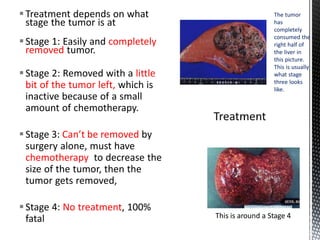
fatal This is around a Stage 4
The tumor
has
completely
consumed the
right half of
the liver in
this picture.
This is usually
what stage
three looks
like.

hepatoblastoma.ppt

  • 2.
     Hepatoblastoma onlyaffects children of 3 years or younger.  Hepatoblastoma is a tumor that originates in the liver or gallbladder and has a potential to spread to any other organs causing multiple kinds of cancer.  This disorder always starts out as a golf ball sized tumor on the right lobe of the liver.  At around 18 months is when it starts.  100 cases reported of this disorder each year.
  • 3.
     Many geneticdisorders can lead to having Hepatoblastoma instead of the original disorder.  The main two genetic disorders that lead to this disease Beckwith-Wiedemann syndrome and familial adenomatous polyposis  This can be passed to the child through unknown recessive genes.
  • 4.
    The most common symptomsinclude: A large abdominal mass, or swollen abdomen Weight loss Decreased appetite Abdominal pain. Vomiting. Jaundice – yellowing of eyes or skin. Fever Itching Skin Anemia – pale skin and lips from decreased number of red blood cells. Back pain from compression of the tumor. This picture shows how big the abdomen can get.
  • 5.
    The only “prevention” isto see if you have the recessive genes either the disease itself or the other diseases that causes it. If you find out that you have the mutated genes then the best thing to do is to not have children.
  • 6.
    Treatment depends onwhat stage the tumor is at Stage 1: Easily and completely removed tumor. Stage 2: Removed with a little bit of the tumor left, which is inactive because of a small amount of chemotherapy. Stage 3: Can’t be removed by surgery alone, must have chemotherapy to decrease the size of the tumor, then the tumor gets removed, Stage 4: No treatment, 100% fatal This is around a Stage 4 The tumor has completely consumed the right half of the liver in this picture. This is usually what stage three looks like.