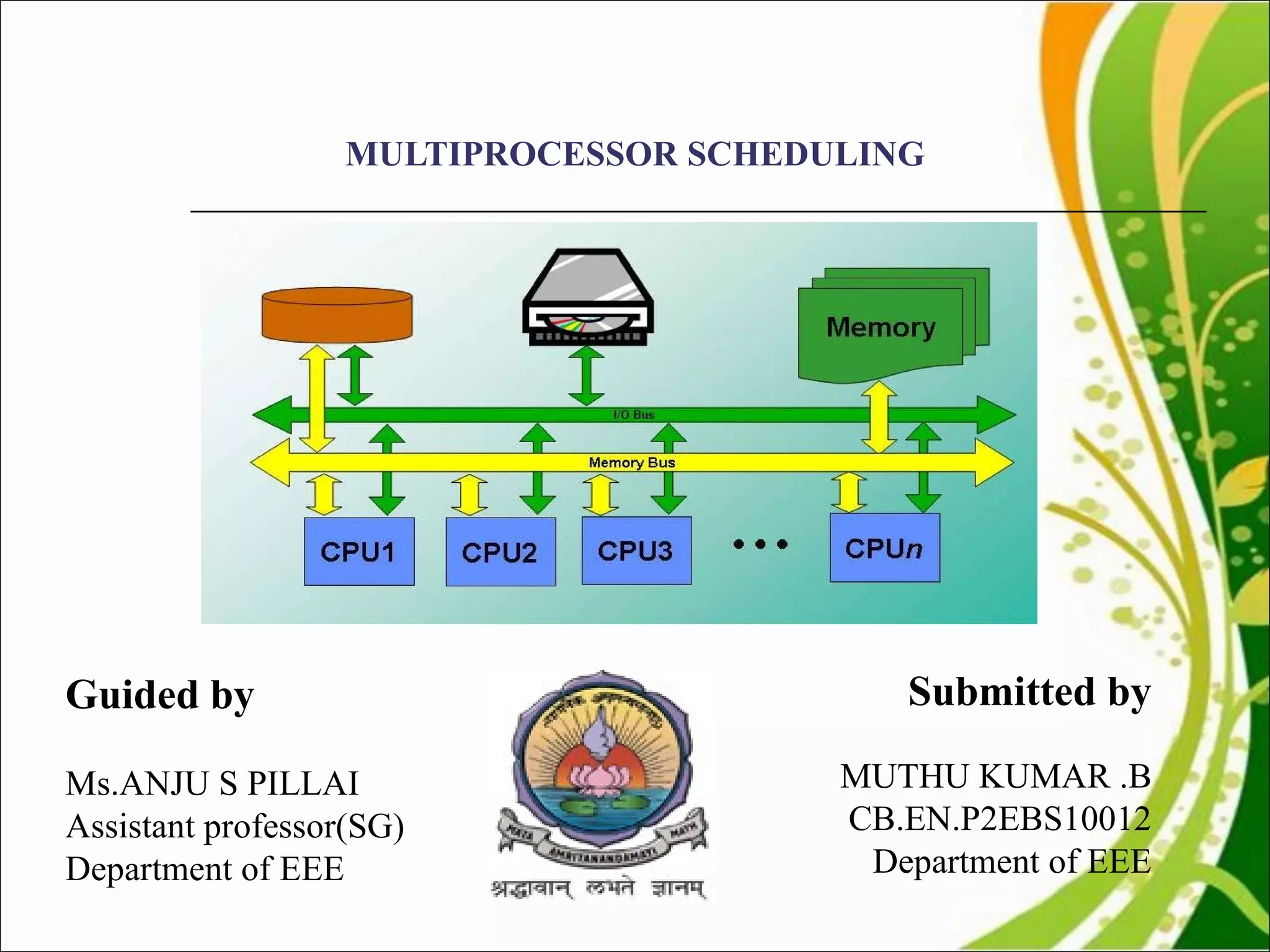
MULTIPROCESSOR SCHEDULING Guided by Ms.ANJU S PILLAI Assistant professor(SG) Department of EEE Submitted by MUTHU KUMAR .B CB.EN.P2EBS10012 Department of EEE
ABSTRACT Uniprocessor scheduling is widely used for its simplicity, reliability and ease for implementation. But it has got its limitations over less processor utilization factor. For a better processor utilization and performance multiprocessor scheduling is preferred.    One of the major challenges is to find an optimal task-processor assignment. The work aims at finding different task processor assignment policies and finding a better Processor Utilization and schedule the tasks dynamically using EDF algorithm.
METHODOLOGY The main objective of the project is to perform scheduling in a multiprocessor system.  Generation of a set of synthetic tasks.  Fix the number of processors needed for the system.  Static Priority assignment to all the tasks using RM policy.  Dynamic Priority assignment to all the tasks using EDF policy .  The next step is to perform task-processor assignment.  The final stage is the scheduling of all the tasks in the multiprocessor system.
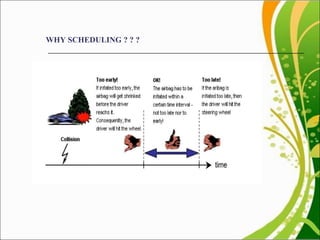
WHY SCHEDULING ? ? ?
APPLICATIONS OF REAL TIME SCHEDULING Patient monitoring Smart environments Mobile devices
MULTIPROCESSOR TASK ALLOCATION There are different strategies to allocate Tasks to multiprocessors. The allocation will decide which task to be assigned  to which processor in an optimal way.  1. Static allocation algorithms  Utilization balancing algorithm for EDF Next fit algorithm for RM Bin packing algorithm for EDF Disadvantages 1. Does not support in case if new tasks are added to the processors. 2. In case of processor failures it cannot switch tasks.
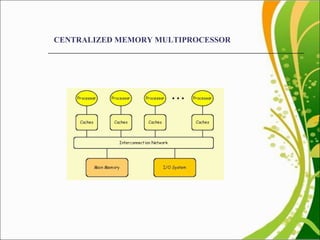
MULTIPROCESSOR TASK ALLOCATION 2. Dynamic allocation algorithms Focused addressing and bidding. Buddy algorithm.  Advantages 1. Supports new tasks added to the processors. 2. Accommodates in case of processor failure. NOTE : This algorithms are analyzed to give best results in centralized memory multiprocessors.
CENTRALIZED MEMORY MULTIPROCESSOR
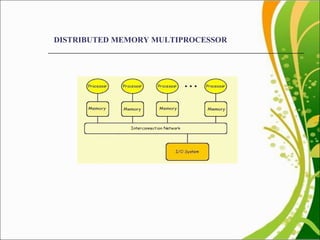
DISTRIBUTED MEMORY MULTIPROCESSOR
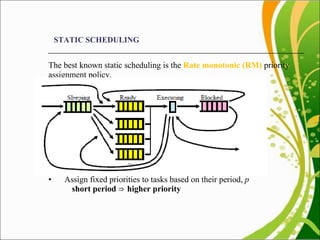
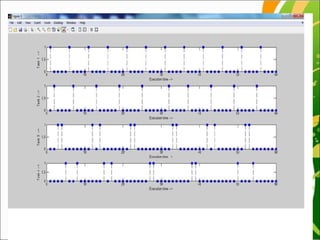
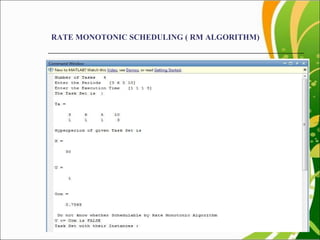
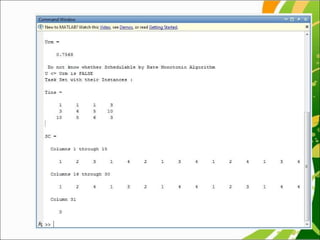
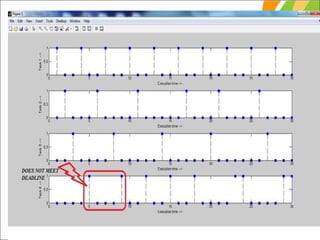
STATIC SCHEDULING The best known static scheduling is the  Rate monotonic (RM)  priority  assignment policy. Assign fixed priorities to tasks based on their period,  p short period ⇒ higher priority
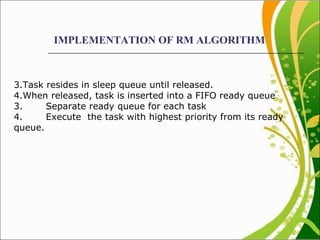
IMPLEMENTATION OF RM ALGORITHM Task resides in sleep queue until released. When released, task is inserted into a FIFO ready queue 3. Separate ready queue for each task 4. Execute  the task with highest priority from its ready queue.
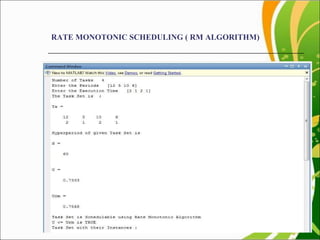
RATE MONOTONIC SCHEDULING ( RM ALGORITHM)
 
 
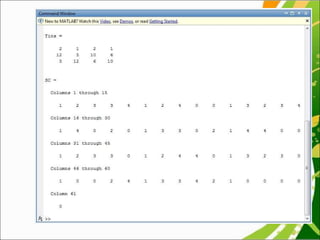
RATE MONOTONIC SCHEDULING ( RM ALGORITHM)
 
 
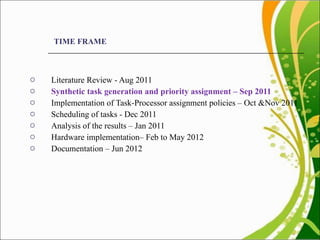
TIME FRAME Literature Review - Aug 2011  Synthetic task generation and priority assignment – Sep 2011 Implementation of Task-Processor assignment policies – Oct &Nov 2011 Scheduling of tasks - Dec 2011 Analysis of the results – Jan 2011 Hardware implementation– Feb to May 2012  Documentation – Jun 2012
REFERENCES P. Ancilotti, G. Buttazzo, M. D. Natale, and M. Spuri. “Design  and programming tools for time critical applications.” Real-Time Systems, 14:3, pp. 251–269, May 1998. R. Pellizzoni and G. Lipari  Feasibility “Analysis of Real-Time Periodic Tasks with Offsets “Real-Time Systems Journal, 2005. Eric W.Parsons and Kenneth C.Sevcik“Implementing multiprocessor algorithms”. Haobo Yu, Andreas Gerstlauer and Daniel Gajski “RTOS Scheduling in transaction level models”
THANK YOU !

Multiprocessor scheduling 2

  • 1.
    MULTIPROCESSOR SCHEDULING Guidedby Ms.ANJU S PILLAI Assistant professor(SG) Department of EEE Submitted by MUTHU KUMAR .B CB.EN.P2EBS10012 Department of EEE
  • 2.
    ABSTRACT Uniprocessor schedulingis widely used for its simplicity, reliability and ease for implementation. But it has got its limitations over less processor utilization factor. For a better processor utilization and performance multiprocessor scheduling is preferred.   One of the major challenges is to find an optimal task-processor assignment. The work aims at finding different task processor assignment policies and finding a better Processor Utilization and schedule the tasks dynamically using EDF algorithm.
  • 3.
    METHODOLOGY The mainobjective of the project is to perform scheduling in a multiprocessor system. Generation of a set of synthetic tasks. Fix the number of processors needed for the system. Static Priority assignment to all the tasks using RM policy. Dynamic Priority assignment to all the tasks using EDF policy . The next step is to perform task-processor assignment. The final stage is the scheduling of all the tasks in the multiprocessor system.
  • 4.
  • 5.
    APPLICATIONS OF REALTIME SCHEDULING Patient monitoring Smart environments Mobile devices
  • 6.
    MULTIPROCESSOR TASK ALLOCATIONThere are different strategies to allocate Tasks to multiprocessors. The allocation will decide which task to be assigned to which processor in an optimal way. 1. Static allocation algorithms Utilization balancing algorithm for EDF Next fit algorithm for RM Bin packing algorithm for EDF Disadvantages 1. Does not support in case if new tasks are added to the processors. 2. In case of processor failures it cannot switch tasks.
  • 7.
    MULTIPROCESSOR TASK ALLOCATION2. Dynamic allocation algorithms Focused addressing and bidding. Buddy algorithm. Advantages 1. Supports new tasks added to the processors. 2. Accommodates in case of processor failure. NOTE : This algorithms are analyzed to give best results in centralized memory multiprocessors.
  • 8.
  • 9.
  • 10.
    STATIC SCHEDULING Thebest known static scheduling is the Rate monotonic (RM) priority assignment policy. Assign fixed priorities to tasks based on their period, p short period ⇒ higher priority
  • 11.
    IMPLEMENTATION OF RMALGORITHM Task resides in sleep queue until released. When released, task is inserted into a FIFO ready queue 3. Separate ready queue for each task 4. Execute the task with highest priority from its ready queue.
  • 12.
  • 13.
  • 14.
  • 15.
  • 16.
  • 17.
  • 18.
    TIME FRAME LiteratureReview - Aug 2011 Synthetic task generation and priority assignment – Sep 2011 Implementation of Task-Processor assignment policies – Oct &Nov 2011 Scheduling of tasks - Dec 2011 Analysis of the results – Jan 2011 Hardware implementation– Feb to May 2012 Documentation – Jun 2012
  • 19.
    REFERENCES P. Ancilotti,G. Buttazzo, M. D. Natale, and M. Spuri. “Design and programming tools for time critical applications.” Real-Time Systems, 14:3, pp. 251–269, May 1998. R. Pellizzoni and G. Lipari Feasibility “Analysis of Real-Time Periodic Tasks with Offsets “Real-Time Systems Journal, 2005. Eric W.Parsons and Kenneth C.Sevcik“Implementing multiprocessor algorithms”. Haobo Yu, Andreas Gerstlauer and Daniel Gajski “RTOS Scheduling in transaction level models”
  • 20.