Operating System 31
Multiple-Processor Scheduling
Prof Neeraj Bhargava
Vaibhav Khanna
Department of Computer Science
School of Engineering and Systems Sciences
Maharshi Dayanand Saraswati University Ajmer
Multiple-Processor Scheduling
• CPU scheduling more complex when multiple CPUs are
available
• Homogeneous processors within a multiprocessor
• Asymmetric multiprocessing – only one processor
accesses the system data structures, alleviating the need
for data sharing
• Symmetric multiprocessing (SMP) – each processor is
self-scheduling, all processes in common ready queue, or
each has its own private queue of ready processes
– Currently, most common
• Processor affinity – process has affinity for processor on
which it is currently running
– soft affinity
– hard affinity
– Variations including processor sets
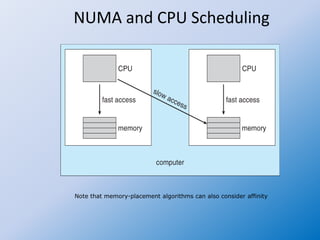
NUMA and CPU Scheduling
Note that memory-placement algorithms can also consider affinity
Multiple-Processor Scheduling – Load Balancing
• If SMP, need to keep all CPUs loaded
for efficiency
• Load balancing attempts to keep
workload evenly distributed
• Push migration – periodic task checks
load on each processor, and if found
pushes task from overloaded CPU to
other CPUs
• Pull migration – idle processors pulls
waiting task from busy processor
Multicore Processors
• Recent trend to place multiple
processor cores on same physical chip
• Faster and consumes less power
• Multiple threads per core also growing
– Takes advantage of memory stall to make
progress on another thread while
memory retrieve happens
Multithreaded Multicore System
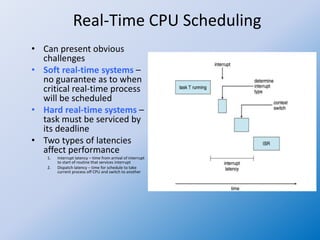
Real-Time CPU Scheduling
• Can present obvious
challenges
• Soft real-time systems –
no guarantee as to when
critical real-time process
will be scheduled
• Hard real-time systems –
task must be serviced by
its deadline
• Two types of latencies
affect performance
1. Interrupt latency – time from arrival of interrupt
to start of routine that services interrupt
2. Dispatch latency – time for schedule to take
current process off CPU and switch to another
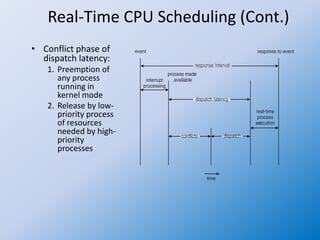
Real-Time CPU Scheduling (Cont.)
• Conflict phase of
dispatch latency:
1. Preemption of
any process
running in
kernel mode
2. Release by low-
priority process
of resources
needed by high-
priority
processes
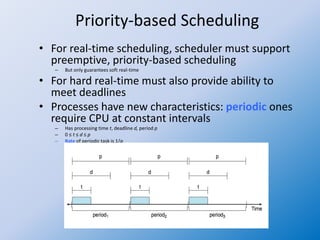
Priority-based Scheduling
• For real-time scheduling, scheduler must support
preemptive, priority-based scheduling
– But only guarantees soft real-time
• For hard real-time must also provide ability to
meet deadlines
• Processes have new characteristics: periodic ones
require CPU at constant intervals
– Has processing time t, deadline d, period p
– 0 ≤ t ≤ d ≤ p
– Rate of periodic task is 1/p
Virtualization and Scheduling
• Virtualization software schedules
multiple guests onto CPU(s)
• Each guest doing its own scheduling
– Not knowing it doesn’t own the CPUs
– Can result in poor response time
– Can effect time-of-day clocks in guests
• Can undo good scheduling algorithm
efforts of guests
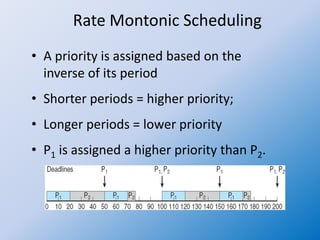
Rate Montonic Scheduling
• A priority is assigned based on the
inverse of its period
• Shorter periods = higher priority;
• Longer periods = lower priority
• P1 is assigned a higher priority than P2.
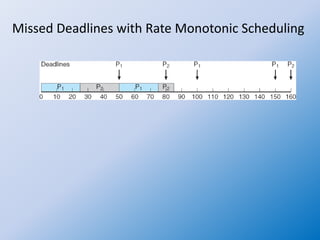
Missed Deadlines with Rate Monotonic Scheduling
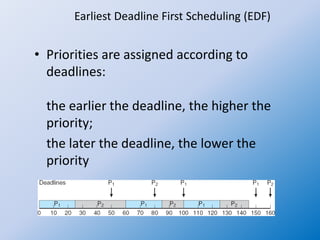
Earliest Deadline First Scheduling (EDF)
• Priorities are assigned according to
deadlines:
the earlier the deadline, the higher the
priority;
the later the deadline, the lower the
priority
Proportional Share Scheduling
• T shares are allocated among all
processes in the system
• An application receives N shares
where N < T
• This ensures each application will
receive N / T of the total processor
time
Assignment
• Explain Multiple-Processor Scheduling – Load
Balancing

Operating system 31 multiple processor scheduling

  • 1.
    Operating System 31 Multiple-ProcessorScheduling Prof Neeraj Bhargava Vaibhav Khanna Department of Computer Science School of Engineering and Systems Sciences Maharshi Dayanand Saraswati University Ajmer
  • 2.
    Multiple-Processor Scheduling • CPUscheduling more complex when multiple CPUs are available • Homogeneous processors within a multiprocessor • Asymmetric multiprocessing – only one processor accesses the system data structures, alleviating the need for data sharing • Symmetric multiprocessing (SMP) – each processor is self-scheduling, all processes in common ready queue, or each has its own private queue of ready processes – Currently, most common • Processor affinity – process has affinity for processor on which it is currently running – soft affinity – hard affinity – Variations including processor sets
  • 3.
    NUMA and CPUScheduling Note that memory-placement algorithms can also consider affinity
  • 4.
    Multiple-Processor Scheduling –Load Balancing • If SMP, need to keep all CPUs loaded for efficiency • Load balancing attempts to keep workload evenly distributed • Push migration – periodic task checks load on each processor, and if found pushes task from overloaded CPU to other CPUs • Pull migration – idle processors pulls waiting task from busy processor
  • 5.
    Multicore Processors • Recenttrend to place multiple processor cores on same physical chip • Faster and consumes less power • Multiple threads per core also growing – Takes advantage of memory stall to make progress on another thread while memory retrieve happens
  • 6.
  • 7.
    Real-Time CPU Scheduling •Can present obvious challenges • Soft real-time systems – no guarantee as to when critical real-time process will be scheduled • Hard real-time systems – task must be serviced by its deadline • Two types of latencies affect performance 1. Interrupt latency – time from arrival of interrupt to start of routine that services interrupt 2. Dispatch latency – time for schedule to take current process off CPU and switch to another
  • 8.
    Real-Time CPU Scheduling(Cont.) • Conflict phase of dispatch latency: 1. Preemption of any process running in kernel mode 2. Release by low- priority process of resources needed by high- priority processes
  • 9.
    Priority-based Scheduling • Forreal-time scheduling, scheduler must support preemptive, priority-based scheduling – But only guarantees soft real-time • For hard real-time must also provide ability to meet deadlines • Processes have new characteristics: periodic ones require CPU at constant intervals – Has processing time t, deadline d, period p – 0 ≤ t ≤ d ≤ p – Rate of periodic task is 1/p
  • 10.
    Virtualization and Scheduling •Virtualization software schedules multiple guests onto CPU(s) • Each guest doing its own scheduling – Not knowing it doesn’t own the CPUs – Can result in poor response time – Can effect time-of-day clocks in guests • Can undo good scheduling algorithm efforts of guests
  • 11.
    Rate Montonic Scheduling •A priority is assigned based on the inverse of its period • Shorter periods = higher priority; • Longer periods = lower priority • P1 is assigned a higher priority than P2.
  • 12.
    Missed Deadlines withRate Monotonic Scheduling
  • 13.
    Earliest Deadline FirstScheduling (EDF) • Priorities are assigned according to deadlines: the earlier the deadline, the higher the priority; the later the deadline, the lower the priority
  • 14.
    Proportional Share Scheduling •T shares are allocated among all processes in the system • An application receives N shares where N < T • This ensures each application will receive N / T of the total processor time
  • 15.
    Assignment • Explain Multiple-ProcessorScheduling – Load Balancing