MULTIPLEXING AND
AMPLITUDE MODULATION
MULTIPLEXING
Multiplexing is a technique in which several message
signals are combined into a composite signal for
transmission over a common channel.
Two type of multiplexing:
• TDM - used in digital transmission
• FDM - used in analogue transmission
TIME-DIVISION MULTIPLEXING
(TDM)
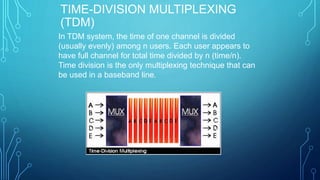
In TDM system, the time of one channel is divided
(usually evenly) among n users. Each user appears to
have full channel for total time divided by n (time/n).
Time division is the only multiplexing technique that can
be used in a baseband line.
FREQUENCY-DIVISION
MULTIPLEXING (FDM)
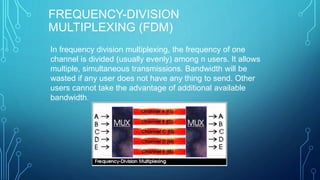
In frequency division multiplexing, the frequency of one
channel is divided (usually evenly) among n users. It allows
multiple, simultaneous transmissions. Bandwidth will be
wasted if any user does not have any thing to send. Other
users cannot take the advantage of additional available
bandwidth.
CSULB MAY 22, 2006 5
WHAT IS MODULATION
• Modulation
• In the modulation process, some characteristic of a high-
frequency carrier signal (bandpass), is changed according to
the instantaneous amplitude of the information (baseband)
signal.
• Why Modulation
• Suitable for signal transmission (distance…etc)
• Multiple signals transmitted on the same channel
• Capacitive or inductive devices require high frequency AC
input (carrier) to operate.
• Stability and noise rejection
CSULB MAY 22, 2006 6
ABOUT MODULATION
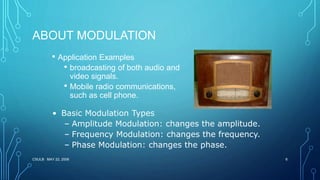
• Application Examples
• broadcasting of both audio and
video signals.
• Mobile radio communications,
such as cell phone.
• Basic Modulation Types
– Amplitude Modulation: changes the amplitude.
– Frequency Modulation: changes the frequency.
– Phase Modulation: changes the phase.
CSULB MAY 22, 2006 7
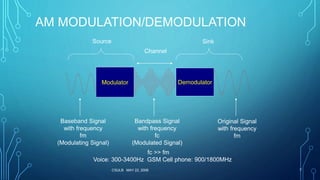
AM MODULATION/DEMODULATION
Modulator Demodulator
Baseband Signal
with frequency
fm
(Modulating Signal)
Bandpass Signal
with frequency
fc
(Modulated Signal)
Channel
Original Signal
with frequency
fm
Source Sink
fc >> fm
Voice: 300-3400Hz GSM Cell phone: 900/1800MHz
CSULB MAY 22, 2006 8
AMPLITUDE MODULATION
• The amplitude of high-carrier signal is varied
according to the instantaneous amplitude of the
modulating message signal m(t).
Carrier Signal: or
Modulating Message Signal: or
The AM Signal:
cos(2 ) cos( )
( ): cos(2 ) cos( )
( ) [ ( )]cos(2 )
c c
m m
AM c c
f t t
m t f t t
s t A m t f t
 
 
 
CSULB MAY 22, 2006 9
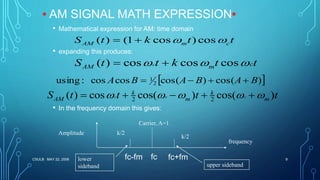
* AM SIGNAL MATH EXPRESSION*
• Mathematical expression for AM: time domain
• expanding this produces:
• In the frequency domain this gives:
( ) (1 cos ) cosAM m cS t k t t  
( ) cos cos cosc cAM mS t t k t t   
 )cos()cos(coscos:using 2
1 BABABA 
2 2( ) cos cos( ) cos( )c c c
k k
AM m mS t t t t        
frequency
k/2
k/2
Carrier, A=1.
upper sideband
lower
sideband
Amplitude
fcfc-fm fc+fm
CSULB MAY 22, 2006 10
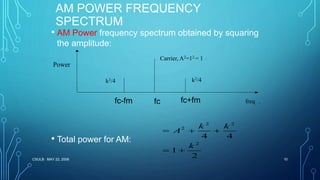
AM POWER FREQUENCY
SPECTRUM
• AM Power frequency spectrum obtained by squaring
the amplitude:
• Total power for AM:
.
2 2
2
2
4 4
1
2
k k
A
k
  
 
freq
k2/4k2/4
Carrier, A2=12 = 1
Power
fcfc-fm fc+fm
CSULB MAY 22, 2006 11
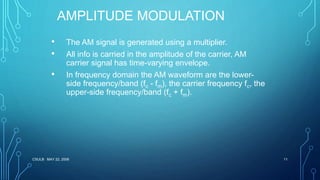
AMPLITUDE MODULATION
• The AM signal is generated using a multiplier.
• All info is carried in the amplitude of the carrier, AM
carrier signal has time-varying envelope.
• In frequency domain the AM waveform are the lower-
side frequency/band (fc - fm), the carrier frequency fc, the
upper-side frequency/band (fc + fm).
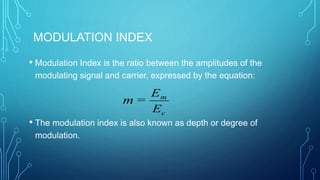
• Modulation Index is the ratio between the amplitudes of the
modulating signal and carrier, expressed by the equation:
• The modulation index is also known as depth or degree of
modulation.
MODULATION INDEX
c
m
E
E
m =
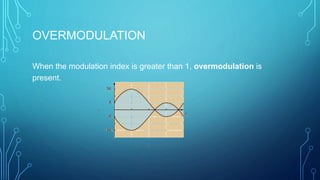
OVERMODULATION
When the modulation index is greater than 1, overmodulation is
present.

multiplexing and amplitude modulation

  • 1.
  • 2.
    MULTIPLEXING Multiplexing is atechnique in which several message signals are combined into a composite signal for transmission over a common channel. Two type of multiplexing: • TDM - used in digital transmission • FDM - used in analogue transmission
  • 3.
    TIME-DIVISION MULTIPLEXING (TDM) In TDMsystem, the time of one channel is divided (usually evenly) among n users. Each user appears to have full channel for total time divided by n (time/n). Time division is the only multiplexing technique that can be used in a baseband line.
  • 4.
    FREQUENCY-DIVISION MULTIPLEXING (FDM) In frequencydivision multiplexing, the frequency of one channel is divided (usually evenly) among n users. It allows multiple, simultaneous transmissions. Bandwidth will be wasted if any user does not have any thing to send. Other users cannot take the advantage of additional available bandwidth.
  • 5.
    CSULB MAY 22,2006 5 WHAT IS MODULATION • Modulation • In the modulation process, some characteristic of a high- frequency carrier signal (bandpass), is changed according to the instantaneous amplitude of the information (baseband) signal. • Why Modulation • Suitable for signal transmission (distance…etc) • Multiple signals transmitted on the same channel • Capacitive or inductive devices require high frequency AC input (carrier) to operate. • Stability and noise rejection
  • 6.
    CSULB MAY 22,2006 6 ABOUT MODULATION • Application Examples • broadcasting of both audio and video signals. • Mobile radio communications, such as cell phone. • Basic Modulation Types – Amplitude Modulation: changes the amplitude. – Frequency Modulation: changes the frequency. – Phase Modulation: changes the phase.
  • 7.
    CSULB MAY 22,2006 7 AM MODULATION/DEMODULATION Modulator Demodulator Baseband Signal with frequency fm (Modulating Signal) Bandpass Signal with frequency fc (Modulated Signal) Channel Original Signal with frequency fm Source Sink fc >> fm Voice: 300-3400Hz GSM Cell phone: 900/1800MHz
  • 8.
    CSULB MAY 22,2006 8 AMPLITUDE MODULATION • The amplitude of high-carrier signal is varied according to the instantaneous amplitude of the modulating message signal m(t). Carrier Signal: or Modulating Message Signal: or The AM Signal: cos(2 ) cos( ) ( ): cos(2 ) cos( ) ( ) [ ( )]cos(2 ) c c m m AM c c f t t m t f t t s t A m t f t      
  • 9.
    CSULB MAY 22,2006 9 * AM SIGNAL MATH EXPRESSION* • Mathematical expression for AM: time domain • expanding this produces: • In the frequency domain this gives: ( ) (1 cos ) cosAM m cS t k t t   ( ) cos cos cosc cAM mS t t k t t     )cos()cos(coscos:using 2 1 BABABA  2 2( ) cos cos( ) cos( )c c c k k AM m mS t t t t         frequency k/2 k/2 Carrier, A=1. upper sideband lower sideband Amplitude fcfc-fm fc+fm
  • 10.
    CSULB MAY 22,2006 10 AM POWER FREQUENCY SPECTRUM • AM Power frequency spectrum obtained by squaring the amplitude: • Total power for AM: . 2 2 2 2 4 4 1 2 k k A k      freq k2/4k2/4 Carrier, A2=12 = 1 Power fcfc-fm fc+fm
  • 11.
    CSULB MAY 22,2006 11 AMPLITUDE MODULATION • The AM signal is generated using a multiplier. • All info is carried in the amplitude of the carrier, AM carrier signal has time-varying envelope. • In frequency domain the AM waveform are the lower- side frequency/band (fc - fm), the carrier frequency fc, the upper-side frequency/band (fc + fm).
  • 12.
    • Modulation Indexis the ratio between the amplitudes of the modulating signal and carrier, expressed by the equation: • The modulation index is also known as depth or degree of modulation. MODULATION INDEX c m E E m =
  • 13.
    OVERMODULATION When the modulationindex is greater than 1, overmodulation is present.