VITAMIN A DR KAUSIK SUR D.C.H,DNB ASSISTANT PROFESSOR DEPARTMENT OF PEDIATRICS VIVEKANANDA INSTITUTE OF MEDICAL SCIENCES RAMAKRISHNA MISSION SEVA PRATISTHAN KOLKATA,INDIA
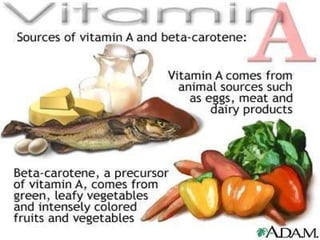
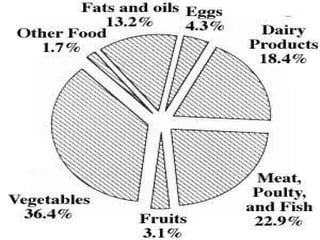
SOURCES ANIMAL FOODS Liver Egg Butter Cheese Whole milk Fish Meat PLANT FOODS Spinach Cabbage Lettuce Curry Reddish leaves Yellow pumpkin Mangos Papaya Tomatos


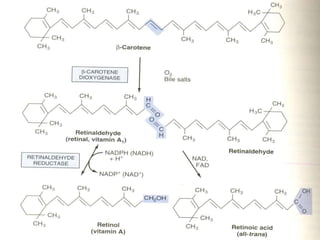
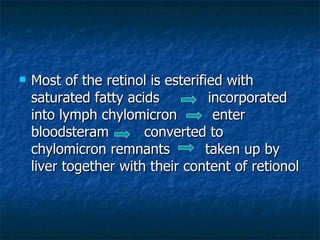
Most of the retinol is esterified with saturated fatty acids  incorporated into lymph chylomicron  enter bloodsteram  converted to chylomicron remnants  taken up by liver together with their content of retionol
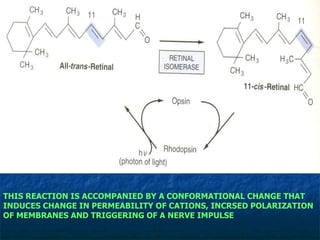
THIS REACTION IS ACCOMPANIED BY A CONFORMATIONAL CHANGE THAT INDUCES CHANGE IN PERMEABILITY OF CATIONS, INCRSED POLARIZATION OF MEMBRANES AND TRIGGERING OF A NERVE IMPULSE
RETINOIC ACID PARTICIPATES IN GLYCOPROTEIN SYNTHESIS Retinoic acid participates in promotion of growth and differentiation of tissues Retinoyl phosphate functions as a carrier of oligosaccharides across the lipid bilayer of cell
VITAMIN A IS ESSENTIAL FOR Normal maintenance and function of body tissues Vision Cellular integrity Immune competence Growth
BETA CAROTENE –  Antioxidant property Scavenger of free radicles Vitamin a and beta carotene may reduce the incidence of lung, breast, oral, esophageal, bladder cancer
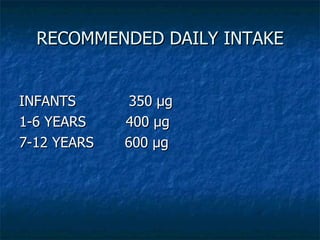
RECOMMENDED DAILY INTAKE INFANTS  350  µg 1-6 YEARS  400 µg 7-12 YEARS  600 µg
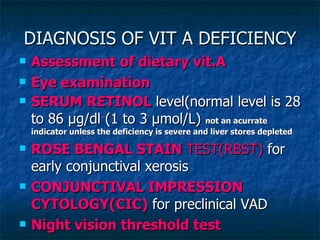
DIAGNOSIS OF VIT A DEFICIENCY Assessment of dietary vit.A Eye examination SERUM RETINOL  level(normal level is 28 to 86 μg/dl (1 to 3 µmol/L)  not an acurrate indicator unless the deficiency is severe and liver stores depleted ROSE BENGAL STAIN  TEST(RBST)  for early conjunctival xerosis CONJUNCTIVAL IMPRESSION CYTOLOGY(CIC)  for preclinical VAD Night vision threshold test
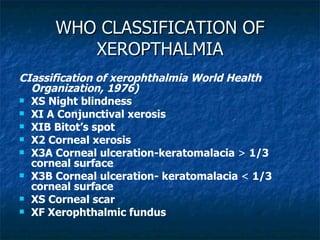
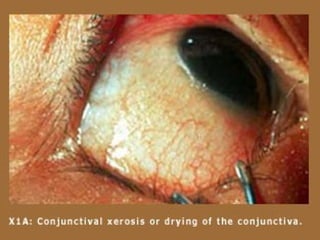
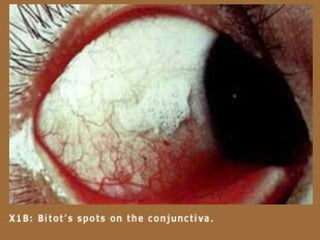
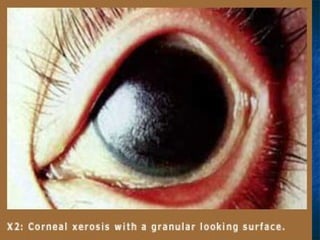
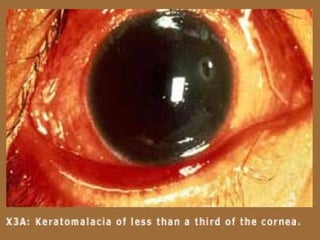
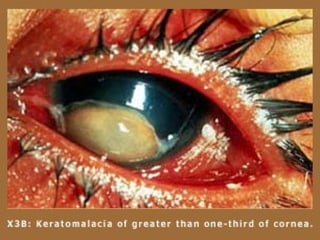
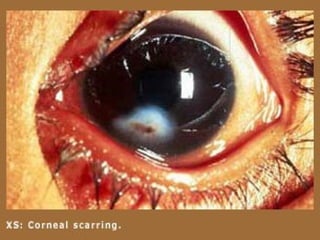
WHO CLASSIFICATION OF XEROPTHALMIA CIassification of xerophthalmia World Health Organization, 1976) XS Night blindness XI A Conjunctival xerosis XIB Bitot’s spot X2 Corneal xerosis X3A Corneal ulceration-keratomalacia  >  1/3 corneal surface X3B Corneal ulceration- keratomalacia  <  1/3   corneal surface XS Corneal scar XF Xerophthalmic fundus
 
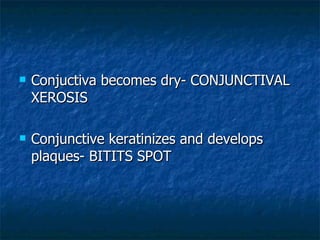
Conjuctiva becomes dry- CONJUNCTIVAL XEROSIS Conjunctive keratinizes and develops plaques- BITITS SPOT
 
 
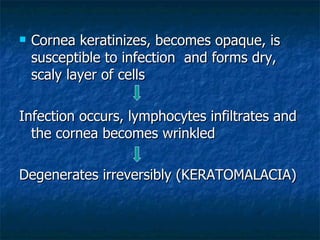
Cornea keratinizes, becomes opaque, is susceptible to infection  and forms dry, scaly layer of cells Infection occurs, lymphocytes infiltrates and the cornea becomes wrinkled Degenerates irreversibly (KERATOMALACIA)


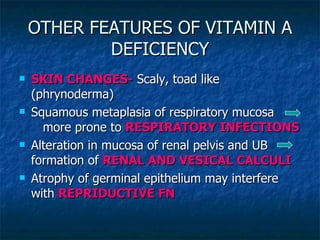
OTHER FEATURES OF VITAMIN A DEFICIENCY SKIN CHANGES-  Scaly, toad like (phrynoderma) Squamous metaplasia of respiratory mucosa  more prone to  RESPIRATORY INFECTIONS Alteration in mucosa of renal pelvis and UB  formation of  RENAL AND VESICAL CALCULI Atrophy of germinal epithelium may interfere with  REPRIDUCTIVE FN
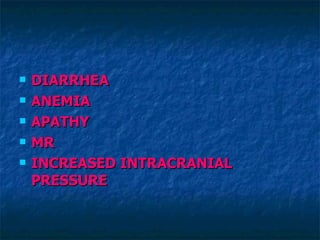
DIARRHEA ANEMIA APATHY MR INCREASED INTRACRANIAL PRESSURE
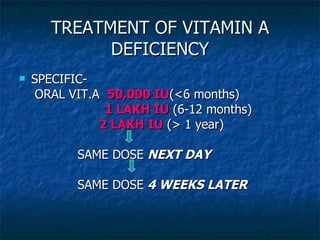
TREATMENT OF VITAMIN A DEFICIENCY SPECIFIC-  ORAL VIT.A  50,000 IU (<6 months) 1 LAKH IU  (6-12 months) 2 LAKH IU  (> 1 year) SAME DOSE  NEXT DAY SAME DOSE  4 WEEKS LATER
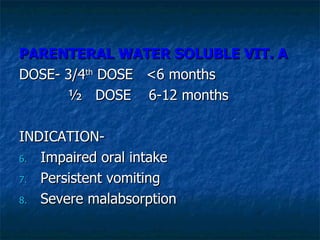
PARENTERAL WATER SOLUBLE VIT. A  DOSE- 3/4 th  DOSE  <6 months ½  DOSE  6-12 months INDICATION-  Impaired oral intake Persistent vomiting Severe malabsorption
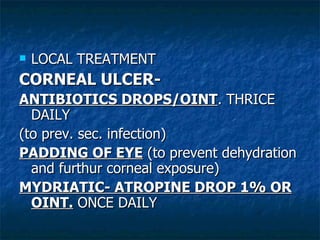
LOCAL TREATMENT CORNEAL ULCER- ANTIBIOTICS DROPS/OINT . THRICE DAILY (to prev. sec. infection) PADDING OF EYE  (to prevent dehydration and furthur corneal exposure) MYDRIATIC- ATROPINE DROP 1% OR   OINT.  ONCE DAILY
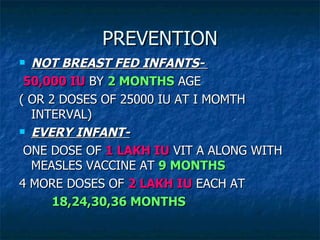
PREVENTION NOT BREAST FED INFANTS-  50,000 IU  BY  2 MONTHS  AGE ( OR 2 DOSES OF 25000 IU AT I MOMTH INTERVAL) EVERY INFANT-   ONE DOSE OF  1 LAKH IU  VIT A ALONG WITH MEASLES VACCINE AT  9 MONTHS 4 MORE DOSES OF  2 LAKH IU  EACH AT  18,24,30,36 MONTHS
IN VIT.A ENDEMIC AREAS CHILD SUFFERING FROM  MEASLEA SEVERE PEM 2 DOSES  OF ORAL VIT.A ON 2 CONSECUTIVE DAYS (1 LAKH FOR <1 YEAR AND 2 LAHS >1 YEAR)
PERSISTENT DIARRHEA, OTHER PROLONGED FRBRILE CONDITION One dose in each episode with  1 month interval
CONSUMPTION OF FOODS RICH IN VIT A  LONG TERM PREVENTION STRATEGIES Nutrition education and dietary diversification HORTICULTURAL INTERVENTION incl. Home gardening Nutritional supplementation Selective fortification for high risk and special groups
All Infants with birth weight of ≤1 kg should receive 5000IU of Vitamin A i.m 3 times a week for first 4 weeks- slightly reduce the incidence of chronic lung disease Manual of neonatal care – john p cloharty, 6 th  ed

Vitamin A

  • 1.
    VITAMIN A DRKAUSIK SUR D.C.H,DNB ASSISTANT PROFESSOR DEPARTMENT OF PEDIATRICS VIVEKANANDA INSTITUTE OF MEDICAL SCIENCES RAMAKRISHNA MISSION SEVA PRATISTHAN KOLKATA,INDIA
  • 2.
    SOURCES ANIMAL FOODSLiver Egg Butter Cheese Whole milk Fish Meat PLANT FOODS Spinach Cabbage Lettuce Curry Reddish leaves Yellow pumpkin Mangos Papaya Tomatos
  • 3.
  • 4.
  • 5.
  • 6.
    Most of theretinol is esterified with saturated fatty acids incorporated into lymph chylomicron enter bloodsteram converted to chylomicron remnants taken up by liver together with their content of retionol
  • 7.
    THIS REACTION ISACCOMPANIED BY A CONFORMATIONAL CHANGE THAT INDUCES CHANGE IN PERMEABILITY OF CATIONS, INCRSED POLARIZATION OF MEMBRANES AND TRIGGERING OF A NERVE IMPULSE
  • 8.
    RETINOIC ACID PARTICIPATESIN GLYCOPROTEIN SYNTHESIS Retinoic acid participates in promotion of growth and differentiation of tissues Retinoyl phosphate functions as a carrier of oligosaccharides across the lipid bilayer of cell
  • 9.
    VITAMIN A ISESSENTIAL FOR Normal maintenance and function of body tissues Vision Cellular integrity Immune competence Growth
  • 10.
    BETA CAROTENE – Antioxidant property Scavenger of free radicles Vitamin a and beta carotene may reduce the incidence of lung, breast, oral, esophageal, bladder cancer
  • 11.
    RECOMMENDED DAILY INTAKEINFANTS 350 µg 1-6 YEARS 400 µg 7-12 YEARS 600 µg
  • 12.
    DIAGNOSIS OF VITA DEFICIENCY Assessment of dietary vit.A Eye examination SERUM RETINOL level(normal level is 28 to 86 μg/dl (1 to 3 µmol/L) not an acurrate indicator unless the deficiency is severe and liver stores depleted ROSE BENGAL STAIN TEST(RBST) for early conjunctival xerosis CONJUNCTIVAL IMPRESSION CYTOLOGY(CIC) for preclinical VAD Night vision threshold test
  • 13.
    WHO CLASSIFICATION OFXEROPTHALMIA CIassification of xerophthalmia World Health Organization, 1976) XS Night blindness XI A Conjunctival xerosis XIB Bitot’s spot X2 Corneal xerosis X3A Corneal ulceration-keratomalacia > 1/3 corneal surface X3B Corneal ulceration- keratomalacia < 1/3 corneal surface XS Corneal scar XF Xerophthalmic fundus
  • 14.
  • 15.
    Conjuctiva becomes dry-CONJUNCTIVAL XEROSIS Conjunctive keratinizes and develops plaques- BITITS SPOT
  • 16.
  • 17.
  • 18.
    Cornea keratinizes, becomesopaque, is susceptible to infection and forms dry, scaly layer of cells Infection occurs, lymphocytes infiltrates and the cornea becomes wrinkled Degenerates irreversibly (KERATOMALACIA)
  • 19.
  • 20.
  • 21.
  • 22.
    OTHER FEATURES OFVITAMIN A DEFICIENCY SKIN CHANGES- Scaly, toad like (phrynoderma) Squamous metaplasia of respiratory mucosa more prone to RESPIRATORY INFECTIONS Alteration in mucosa of renal pelvis and UB formation of RENAL AND VESICAL CALCULI Atrophy of germinal epithelium may interfere with REPRIDUCTIVE FN
  • 23.
    DIARRHEA ANEMIA APATHYMR INCREASED INTRACRANIAL PRESSURE
  • 24.
    TREATMENT OF VITAMINA DEFICIENCY SPECIFIC- ORAL VIT.A 50,000 IU (<6 months) 1 LAKH IU (6-12 months) 2 LAKH IU (> 1 year) SAME DOSE NEXT DAY SAME DOSE 4 WEEKS LATER
  • 25.
    PARENTERAL WATER SOLUBLEVIT. A DOSE- 3/4 th DOSE <6 months ½ DOSE 6-12 months INDICATION- Impaired oral intake Persistent vomiting Severe malabsorption
  • 26.
    LOCAL TREATMENT CORNEALULCER- ANTIBIOTICS DROPS/OINT . THRICE DAILY (to prev. sec. infection) PADDING OF EYE (to prevent dehydration and furthur corneal exposure) MYDRIATIC- ATROPINE DROP 1% OR OINT. ONCE DAILY
  • 27.
    PREVENTION NOT BREASTFED INFANTS- 50,000 IU BY 2 MONTHS AGE ( OR 2 DOSES OF 25000 IU AT I MOMTH INTERVAL) EVERY INFANT- ONE DOSE OF 1 LAKH IU VIT A ALONG WITH MEASLES VACCINE AT 9 MONTHS 4 MORE DOSES OF 2 LAKH IU EACH AT 18,24,30,36 MONTHS
  • 28.
    IN VIT.A ENDEMICAREAS CHILD SUFFERING FROM MEASLEA SEVERE PEM 2 DOSES OF ORAL VIT.A ON 2 CONSECUTIVE DAYS (1 LAKH FOR <1 YEAR AND 2 LAHS >1 YEAR)
  • 29.
    PERSISTENT DIARRHEA, OTHERPROLONGED FRBRILE CONDITION One dose in each episode with 1 month interval
  • 30.
    CONSUMPTION OF FOODSRICH IN VIT A LONG TERM PREVENTION STRATEGIES Nutrition education and dietary diversification HORTICULTURAL INTERVENTION incl. Home gardening Nutritional supplementation Selective fortification for high risk and special groups
  • 31.
    All Infants withbirth weight of ≤1 kg should receive 5000IU of Vitamin A i.m 3 times a week for first 4 weeks- slightly reduce the incidence of chronic lung disease Manual of neonatal care – john p cloharty, 6 th ed