1
WHAT IS PLURILINGUALISM?
Plurilingualism: Is the knowledge of a number of
languages and the co-existence of them in a given
society.
Multilingualism: Is the diversity of languages in a
particular education system.
2
There are metacognitive skills which are common to all
languages.
These languages should be diversified.
Language learnign is a life long task.
3
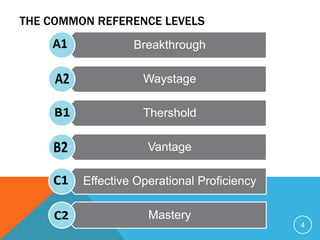
THE COMMON REFERENCE LEVELS
Breakthrough
Waystage
Thershold
Vantage
Effective Operational Proficiency
Mastery
4
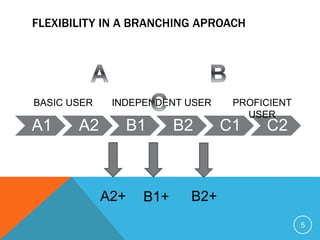
FLEXIBILITY IN A BRANCHING APROACH
A1 A2 B1 B2 C1 C2
5
A2+ B1+ B2+
BASIC USER INDEPENDENT USER PROFICIENT
USER
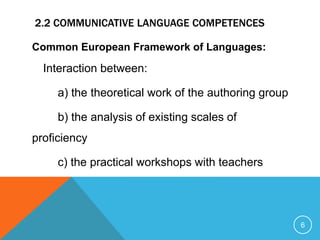
2.2 COMMUNICATIVE LANGUAGE COMPETENCES
Common European Framework of Languages:
Interaction between:
a) the theoretical work of the authoring group
b) the analysis of existing scales of
proficiency
c) the practical workshops with teachers
6
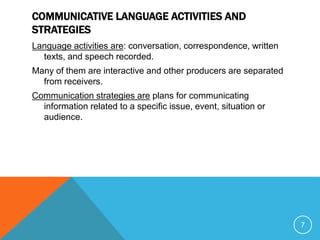
COMMUNICATIVE LANGUAGE ACTIVITIES AND
STRATEGIES
Language activities are: conversation, correspondence, written
texts, and speech recorded.
Many of them are interactive and other producers are separated
from receivers.
Communication strategies are plans for communicating
information related to a specific issue, event, situation or
audience.
7
PRODUCTIVE ACTIVITIES AND STRATEGIES
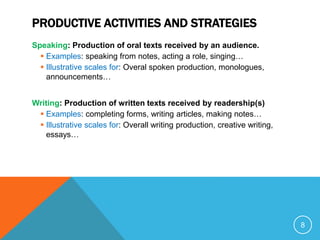
Speaking: Production of oral texts received by an audience.
 Examples: speaking from notes, acting a role, singing…
 Illustrative scales for: Overal spoken production, monologues,
announcements…
Writing: Production of written texts received by readership(s)
 Examples: completing forms, writing articles, making notes…
 Illustrative scales for: Overall writing production, creative writing,
essays…
8
PRODUCTIVE ACTIVITIES AND STRATEGIES
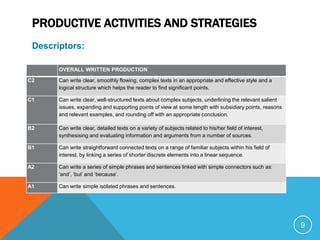
Descriptors:
9
OVERALL WRITTEN PRODUCTION
C2 Can write clear, smoothly flowing, complex texts in an appropriate and effective style and a
logical structure which helps the reader to find significant points.
C1 Can write clear, well-structured texts about complex subjects, underlining the relevant salient
issues, expanding and supporting points of view at some length with subsidiary points, reasons
and relevant examples, and rounding off with an appropriate conclusion.
B2 Can write clear, detailed texts on a variety of subjects related to his/her field of interest,
synthesising and evaluating information and arguments from a number of sources.
B1 Can write straightforward connected texts on a range of familiar subjects within his field of
interest, by linking a series of shorter discrete elements into a linear sequence.
A2 Can write a series of simple phrases and sentences linked with simple connectors such as:
‘and’, ‘but’ and ‘because’.
A1 Can write simple isolated phrases and sentences.
10
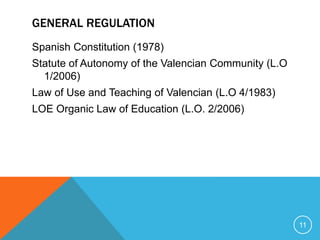
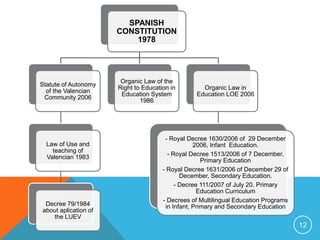
GENERAL REGULATION
Spanish Constitution (1978)
Statute of Autonomy of the Valencian Community (L.O
1/2006)
Law of Use and Teaching of Valencian (L.O 4/1983)
LOE Organic Law of Education (L.O. 2/2006)
11
SPANISH
CONSTITUTION
1978
Statute of Autonomy
of the Valencian
Community 2006
Law of Use and
teaching of
Valencian 1983
Decree 79/1984
about aplication of
the LUEV
Organic Law of the
Right to Education in
Education System
1986
Organic Law in
Education LOE 2006
- Royal Decree 1630/2006 of 29 December
2006, Infant Education.
- Royal Decree 1513/2006 of 7 December,
Primary Education
- Royal Decree 1631/2006 of December 29 of
December, Secondary Education.
- Decree 111/2007 of July 20. Primary
Education Curriculum
- Decrees of Multilingual Education Programs
in Infant, Primary and Secondary Education
12
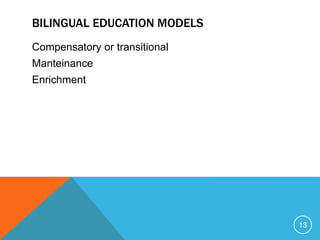
BILINGUAL EDUCATION MODELS
Compensatory or transitional
Manteinance
Enrichment
13
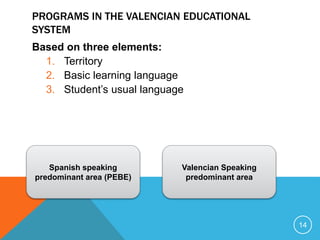
PROGRAMS IN THE VALENCIAN EDUCATIONAL
SYSTEM
Based on three elements:
1. Territory
2. Basic learning language
3. Student’s usual language
14
Spanish speaking
predominant area (PEBE)
Valencian Speaking
predominant area
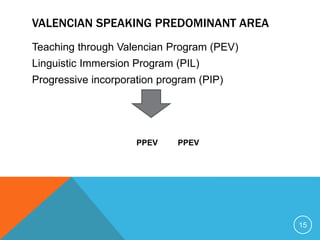
VALENCIAN SPEAKING PREDOMINANT AREA
Teaching through Valencian Program (PEV)
Linguistic Immersion Program (PIL)
Progressive incorporation program (PIP)
PPEV PPEV
15
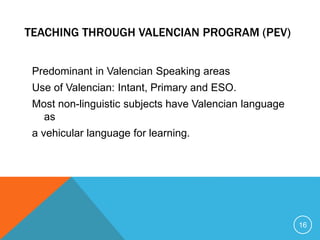
TEACHING THROUGH VALENCIAN PROGRAM (PEV)
Predominant in Valencian Speaking areas
Use of Valencian: Intant, Primary and ESO.
Most non-linguistic subjects have Valencian language
as
a vehicular language for learning.
16
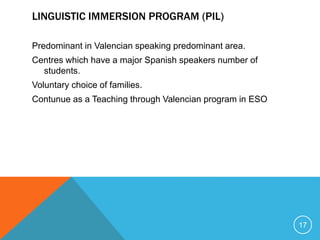
LINGUISTIC IMMERSION PROGRAM (PIL)
Predominant in Valencian speaking predominant area.
Centres which have a major Spanish speakers number of
students.
Voluntary choice of families.
Contunue as a Teaching through Valencian program in ESO
17
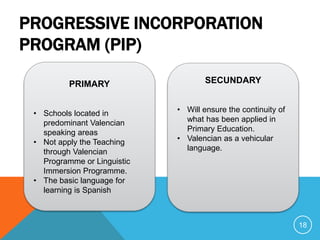
PROGRESSIVE INCORPORATION
PROGRAM (PIP)
18
PRIMARY
• Schools located in
predominant Valencian
speaking areas
• Not apply the Teaching
through Valencian
Programme or Linguistic
Immersion Programme.
• The basic language for
learning is Spanish
SECUNDARY
• Will ensure the continuity of
what has been applied in
Primary Education.
• Valencian as a vehicular
language.
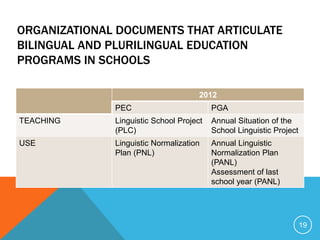
ORGANIZATIONAL DOCUMENTS THAT ARTICULATE
BILINGUAL AND PLURILINGUAL EDUCATION
PROGRAMS IN SCHOOLS
2012
PEC PGA
TEACHING Linguistic School Project
(PLC)
Annual Situation of the
School Linguistic Project
USE Linguistic Normalization
Plan (PNL)
Annual Linguistic
Normalization Plan
(PANL)
Assessment of last
school year (PANL)
19
20
21
22
23

Plurilingualism

  • 1.
  • 2.
    WHAT IS PLURILINGUALISM? Plurilingualism:Is the knowledge of a number of languages and the co-existence of them in a given society. Multilingualism: Is the diversity of languages in a particular education system. 2
  • 3.
    There are metacognitiveskills which are common to all languages. These languages should be diversified. Language learnign is a life long task. 3
  • 4.
    THE COMMON REFERENCELEVELS Breakthrough Waystage Thershold Vantage Effective Operational Proficiency Mastery 4
  • 5.
    FLEXIBILITY IN ABRANCHING APROACH A1 A2 B1 B2 C1 C2 5 A2+ B1+ B2+ BASIC USER INDEPENDENT USER PROFICIENT USER
  • 6.
    2.2 COMMUNICATIVE LANGUAGECOMPETENCES Common European Framework of Languages: Interaction between: a) the theoretical work of the authoring group b) the analysis of existing scales of proficiency c) the practical workshops with teachers 6
  • 7.
    COMMUNICATIVE LANGUAGE ACTIVITIESAND STRATEGIES Language activities are: conversation, correspondence, written texts, and speech recorded. Many of them are interactive and other producers are separated from receivers. Communication strategies are plans for communicating information related to a specific issue, event, situation or audience. 7
  • 8.
    PRODUCTIVE ACTIVITIES ANDSTRATEGIES Speaking: Production of oral texts received by an audience.  Examples: speaking from notes, acting a role, singing…  Illustrative scales for: Overal spoken production, monologues, announcements… Writing: Production of written texts received by readership(s)  Examples: completing forms, writing articles, making notes…  Illustrative scales for: Overall writing production, creative writing, essays… 8
  • 9.
    PRODUCTIVE ACTIVITIES ANDSTRATEGIES Descriptors: 9 OVERALL WRITTEN PRODUCTION C2 Can write clear, smoothly flowing, complex texts in an appropriate and effective style and a logical structure which helps the reader to find significant points. C1 Can write clear, well-structured texts about complex subjects, underlining the relevant salient issues, expanding and supporting points of view at some length with subsidiary points, reasons and relevant examples, and rounding off with an appropriate conclusion. B2 Can write clear, detailed texts on a variety of subjects related to his/her field of interest, synthesising and evaluating information and arguments from a number of sources. B1 Can write straightforward connected texts on a range of familiar subjects within his field of interest, by linking a series of shorter discrete elements into a linear sequence. A2 Can write a series of simple phrases and sentences linked with simple connectors such as: ‘and’, ‘but’ and ‘because’. A1 Can write simple isolated phrases and sentences.
  • 10.
  • 11.
    GENERAL REGULATION Spanish Constitution(1978) Statute of Autonomy of the Valencian Community (L.O 1/2006) Law of Use and Teaching of Valencian (L.O 4/1983) LOE Organic Law of Education (L.O. 2/2006) 11
  • 12.
    SPANISH CONSTITUTION 1978 Statute of Autonomy ofthe Valencian Community 2006 Law of Use and teaching of Valencian 1983 Decree 79/1984 about aplication of the LUEV Organic Law of the Right to Education in Education System 1986 Organic Law in Education LOE 2006 - Royal Decree 1630/2006 of 29 December 2006, Infant Education. - Royal Decree 1513/2006 of 7 December, Primary Education - Royal Decree 1631/2006 of December 29 of December, Secondary Education. - Decree 111/2007 of July 20. Primary Education Curriculum - Decrees of Multilingual Education Programs in Infant, Primary and Secondary Education 12
  • 13.
    BILINGUAL EDUCATION MODELS Compensatoryor transitional Manteinance Enrichment 13
  • 14.
    PROGRAMS IN THEVALENCIAN EDUCATIONAL SYSTEM Based on three elements: 1. Territory 2. Basic learning language 3. Student’s usual language 14 Spanish speaking predominant area (PEBE) Valencian Speaking predominant area
  • 15.
    VALENCIAN SPEAKING PREDOMINANTAREA Teaching through Valencian Program (PEV) Linguistic Immersion Program (PIL) Progressive incorporation program (PIP) PPEV PPEV 15
  • 16.
    TEACHING THROUGH VALENCIANPROGRAM (PEV) Predominant in Valencian Speaking areas Use of Valencian: Intant, Primary and ESO. Most non-linguistic subjects have Valencian language as a vehicular language for learning. 16
  • 17.
    LINGUISTIC IMMERSION PROGRAM(PIL) Predominant in Valencian speaking predominant area. Centres which have a major Spanish speakers number of students. Voluntary choice of families. Contunue as a Teaching through Valencian program in ESO 17
  • 18.
    PROGRESSIVE INCORPORATION PROGRAM (PIP) 18 PRIMARY •Schools located in predominant Valencian speaking areas • Not apply the Teaching through Valencian Programme or Linguistic Immersion Programme. • The basic language for learning is Spanish SECUNDARY • Will ensure the continuity of what has been applied in Primary Education. • Valencian as a vehicular language.
  • 19.
    ORGANIZATIONAL DOCUMENTS THATARTICULATE BILINGUAL AND PLURILINGUAL EDUCATION PROGRAMS IN SCHOOLS 2012 PEC PGA TEACHING Linguistic School Project (PLC) Annual Situation of the School Linguistic Project USE Linguistic Normalization Plan (PNL) Annual Linguistic Normalization Plan (PANL) Assessment of last school year (PANL) 19
  • 20.
  • 21.
  • 22.
  • 23.