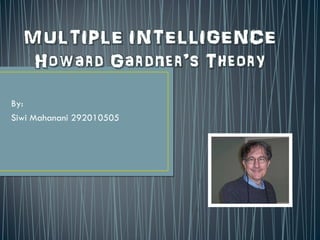
By: Siwi Mahanani 292010505
The multiple intelligence concepts is simple and accessible methods to understand and explain people’s preferred ways to learn and develop. Howard Gardner’s Multiple Intelligence Theory was first published in Howard Gardner’s book, Frames of Mind (1983) and quickly became established as a classical model by which to understand and teach many aspects of human intelligence, learning style, personality and behavior in education and industry.
Gardner said that multiple intelligence were not limited into those seven types, but other additional intelligences are rather more complex to be defined. Those type are relatively cut and dried, measurable, we know what they are, what they mean and we can evidence or illustrate them. INTELLIGENCE TYPE CAPABILITY and PERCEPTION Linguistic Words and language Logical – Mathematical Logic and numbers Musical Music, sound, rhythm Bodily – Kinesthetic Body movement control Spatial – Visual Images and space Interpersonal Other people’s feelings intrapersonal Self-awareness
Those potential additional human capabilities, perceptions and attunements are highly subjective and complex and contain many overlapping aspects. INTELLIGENCE TYPE CAPABILITY and PERCEPTION Naturalist Natural Environment Spiritual/ Existential Religion and ultimate issue Moral  ethics, humanity, value of life
Intelligence Type Description  Typical Roles Related tasks, activities or test Preferred learning style clues 1 Linguistic  Words and language, written and spoken, retention, interpretation &  explanation of ideas and information via language, understand relationship between communication and meaning Writers, lawyers, journalists, speakers, trainers, copy-writers, English teachers, poets, editors, PR consultants, media consultant, presenters, voice-over artistes  Write a set of instructions, speak on a subject, edit a written piece or work, write a speech, commentate on an event, apply positive/ negative spin to a story Word and language
Intelligence Type Description  Typical Roles Related tasks, activities or test Preferred learning style clues 2 Logical - Mathematical logical thinking, detecting patterns, scientific reasoning and deduction; analyze problems, perform mathematical calculations, understands relationship between cause and effect towards a tangible outcome or result scientists, engineers, computer experts, accountants, statisticians, researchers, analysts, traders, bankers bookmakers, insurance brokers, negotiators, deal-makers, trouble-shooters, directors perform a mental arithmetic calculation; create a process to measure something difficult; analyze how a machine works; create a process; devise a strategy to achieve an aim; assess the value of a business or a proposition numbers and logic
Intelligence Type Description  Typical Roles Related tasks, activities or test Preferred learning style clues 3 Musical musical ability, awareness, appreciation and use of sound; recognition of tonal and rhythmic patterns, understands relationship between sound and feeling musicians, singers, composers, DJ's, music producers, piano tuners, acoustic engineers, entertainers, party-planners, environment and noise advisors, voice coaches perform a musical piece; sing a song; review a musical work; coach someone to play a musical instrument; specify mood music for telephone systems and receptions music, sounds, rhythm
Intelligence Type Description  Typical Roles Related tasks, activities or test Preferred learning style clues 4 Bodily-Kinesthetic  body movement control, manual dexterity, physical agility and balance; eye and body coordination dancers, demonstrators, actors, athletes, divers, sports-people, soldiers, fire-fighters, PTI's, performance artistes; ergonomists, osteopaths, fishermen, drivers, crafts-people; gardeners, chefs, acupuncturists, healers, adventurers juggle; demonstrate a sports technique; flip a beer-mat; create a mime to explain something; toss a pancake; fly a kite; coach workplace posture, assess work-station ergonomics physical experience and movement, touch and feel
Intelligence Type Description  Typical Roles Related tasks, activities or test Preferred learning style clues 5 Spatial-Visual visual and spatial perception; interpretation and creation of visual images; pictorial imagination and expression; understands relationship between images and meanings, and between space and effect artists, designers, cartoonists, story-boarders, architects, photographers, sculptors, town-planners, visionaries, inventors, engineers, cosmetics and beauty consultants design a costume; interpret a painting; create a room layout; create a corporate logo; design a building; pack a suitcase or the boot of a car pictures, shapes, images, 3D space
Intelligence Type Description  Typical Roles Related tasks, activities or test Preferred learning style clues 6 Interpersonal perception of other people's feelings; ability to relate to others; interpretation of behaviour and communications; understands the relationships between people and their situations, including other people therapists, HR professionals, mediators, leaders, counselors, politicians, educators, sales-people, clergy, psychologists, teachers, doctors, healers, organizers, careers, advertising professionals, coaches and mentors; (there is clear association between this type of intelligence and what is now termed EQ interpret moods from facial expressions; demonstrate feelings though body language affect the feelings of others in a planned way; coach or counsel another person human contact, communications, cooperation, teamwork
Intelligence Type Description  Typical Roles Related tasks, activities or test Preferred learning style clues 7 Intrapersonal self-awareness, personal cognizance, personal objectivity, the capability to understand oneself, one's relationship to others and the world, and one's own need for, and reaction to change arguably anyone (see note below) who is self-aware and involved in the process of changing personal thoughts, beliefs and behavior in relation to their situation, other people, their purpose and aims - in this respect there is a similarity to  Maslow’s self- actualization level, and again there is clear association between this type of intelligence and what is now termed emotional intelligence / EQ consider and decide one's own aims and personal changes required to achieve them (not necessarily reveal this to others); consider one's own ‘ ’Johani Window’ and decide options for development; consider and decide one's own position in relation to the emotional intelligence model self-reflection, self-discovery
 

Multiple intelligence pp

  • 1.
  • 2.
    The multiple intelligenceconcepts is simple and accessible methods to understand and explain people’s preferred ways to learn and develop. Howard Gardner’s Multiple Intelligence Theory was first published in Howard Gardner’s book, Frames of Mind (1983) and quickly became established as a classical model by which to understand and teach many aspects of human intelligence, learning style, personality and behavior in education and industry.
  • 3.
    Gardner said thatmultiple intelligence were not limited into those seven types, but other additional intelligences are rather more complex to be defined. Those type are relatively cut and dried, measurable, we know what they are, what they mean and we can evidence or illustrate them. INTELLIGENCE TYPE CAPABILITY and PERCEPTION Linguistic Words and language Logical – Mathematical Logic and numbers Musical Music, sound, rhythm Bodily – Kinesthetic Body movement control Spatial – Visual Images and space Interpersonal Other people’s feelings intrapersonal Self-awareness
  • 4.
    Those potential additionalhuman capabilities, perceptions and attunements are highly subjective and complex and contain many overlapping aspects. INTELLIGENCE TYPE CAPABILITY and PERCEPTION Naturalist Natural Environment Spiritual/ Existential Religion and ultimate issue Moral ethics, humanity, value of life
  • 5.
    Intelligence Type Description Typical Roles Related tasks, activities or test Preferred learning style clues 1 Linguistic Words and language, written and spoken, retention, interpretation & explanation of ideas and information via language, understand relationship between communication and meaning Writers, lawyers, journalists, speakers, trainers, copy-writers, English teachers, poets, editors, PR consultants, media consultant, presenters, voice-over artistes Write a set of instructions, speak on a subject, edit a written piece or work, write a speech, commentate on an event, apply positive/ negative spin to a story Word and language
  • 6.
    Intelligence Type Description Typical Roles Related tasks, activities or test Preferred learning style clues 2 Logical - Mathematical logical thinking, detecting patterns, scientific reasoning and deduction; analyze problems, perform mathematical calculations, understands relationship between cause and effect towards a tangible outcome or result scientists, engineers, computer experts, accountants, statisticians, researchers, analysts, traders, bankers bookmakers, insurance brokers, negotiators, deal-makers, trouble-shooters, directors perform a mental arithmetic calculation; create a process to measure something difficult; analyze how a machine works; create a process; devise a strategy to achieve an aim; assess the value of a business or a proposition numbers and logic
  • 7.
    Intelligence Type Description Typical Roles Related tasks, activities or test Preferred learning style clues 3 Musical musical ability, awareness, appreciation and use of sound; recognition of tonal and rhythmic patterns, understands relationship between sound and feeling musicians, singers, composers, DJ's, music producers, piano tuners, acoustic engineers, entertainers, party-planners, environment and noise advisors, voice coaches perform a musical piece; sing a song; review a musical work; coach someone to play a musical instrument; specify mood music for telephone systems and receptions music, sounds, rhythm
  • 8.
    Intelligence Type Description Typical Roles Related tasks, activities or test Preferred learning style clues 4 Bodily-Kinesthetic  body movement control, manual dexterity, physical agility and balance; eye and body coordination dancers, demonstrators, actors, athletes, divers, sports-people, soldiers, fire-fighters, PTI's, performance artistes; ergonomists, osteopaths, fishermen, drivers, crafts-people; gardeners, chefs, acupuncturists, healers, adventurers juggle; demonstrate a sports technique; flip a beer-mat; create a mime to explain something; toss a pancake; fly a kite; coach workplace posture, assess work-station ergonomics physical experience and movement, touch and feel
  • 9.
    Intelligence Type Description Typical Roles Related tasks, activities or test Preferred learning style clues 5 Spatial-Visual visual and spatial perception; interpretation and creation of visual images; pictorial imagination and expression; understands relationship between images and meanings, and between space and effect artists, designers, cartoonists, story-boarders, architects, photographers, sculptors, town-planners, visionaries, inventors, engineers, cosmetics and beauty consultants design a costume; interpret a painting; create a room layout; create a corporate logo; design a building; pack a suitcase or the boot of a car pictures, shapes, images, 3D space
  • 10.
    Intelligence Type Description Typical Roles Related tasks, activities or test Preferred learning style clues 6 Interpersonal perception of other people's feelings; ability to relate to others; interpretation of behaviour and communications; understands the relationships between people and their situations, including other people therapists, HR professionals, mediators, leaders, counselors, politicians, educators, sales-people, clergy, psychologists, teachers, doctors, healers, organizers, careers, advertising professionals, coaches and mentors; (there is clear association between this type of intelligence and what is now termed EQ interpret moods from facial expressions; demonstrate feelings though body language affect the feelings of others in a planned way; coach or counsel another person human contact, communications, cooperation, teamwork
  • 11.
    Intelligence Type Description Typical Roles Related tasks, activities or test Preferred learning style clues 7 Intrapersonal self-awareness, personal cognizance, personal objectivity, the capability to understand oneself, one's relationship to others and the world, and one's own need for, and reaction to change arguably anyone (see note below) who is self-aware and involved in the process of changing personal thoughts, beliefs and behavior in relation to their situation, other people, their purpose and aims - in this respect there is a similarity to  Maslow’s self- actualization level, and again there is clear association between this type of intelligence and what is now termed emotional intelligence / EQ consider and decide one's own aims and personal changes required to achieve them (not necessarily reveal this to others); consider one's own ‘ ’Johani Window’ and decide options for development; consider and decide one's own position in relation to the emotional intelligence model self-reflection, self-discovery
  • 12.