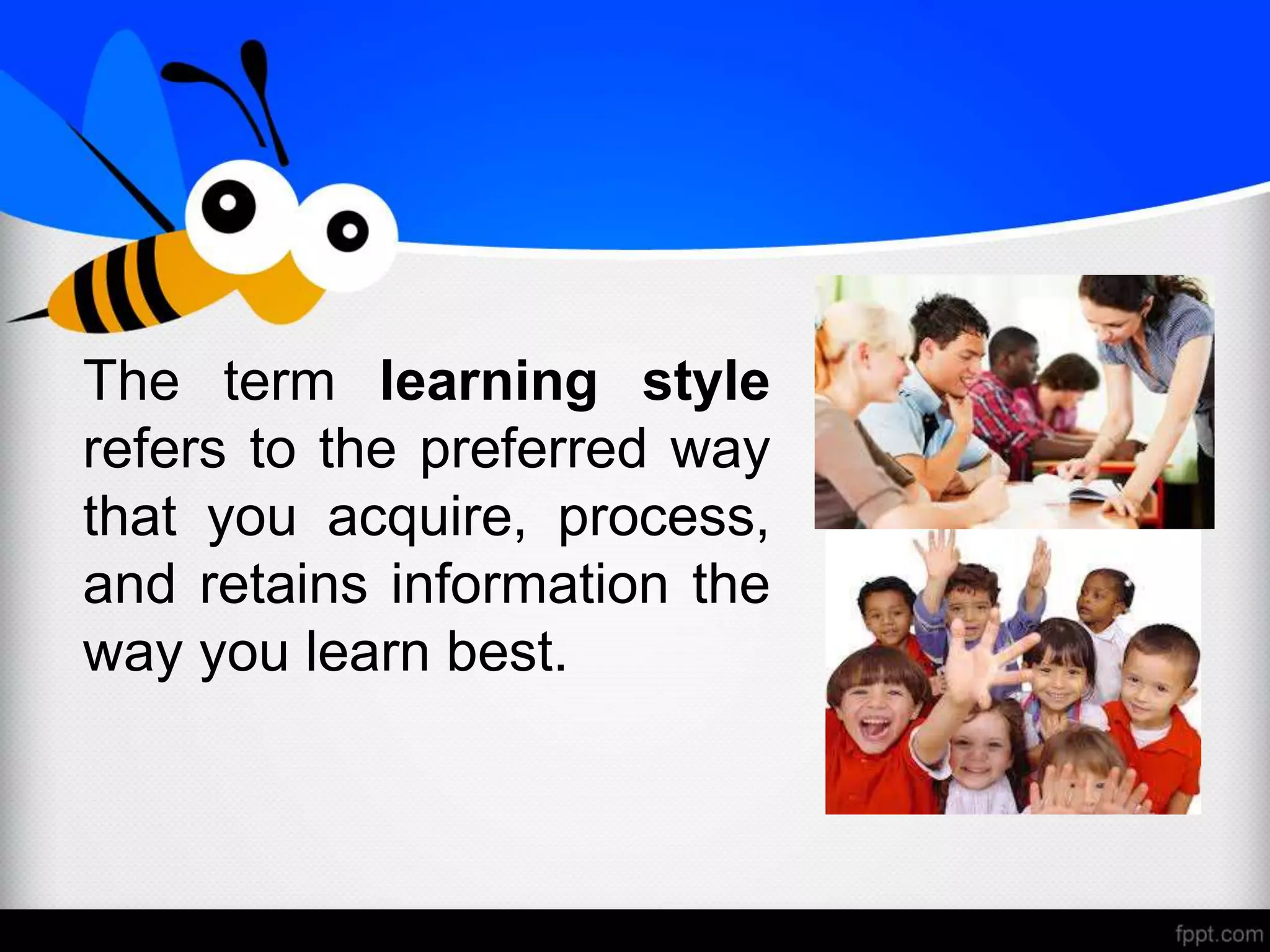
The term learning style
refers to the preferred way
that you acquire, process,
and retains information the
way you learn best.
Learning Style is..
1. A person’s unique way of learning.
2. A result of an individual’s perception and
process experience.
 It is an essential element of effective
learning thus it develops an awareness of
your own preferred learning style.
Types of Learning Styles
Visual Learner-
he/she learns best by
seeing things (i.e.,
pictures, diagrams and
charts)
Types of Learning Styles
Kinesthetic- he/she learns
best by doing things; learns
well from doing
experiments or replanting
the talks he/she will later
have perform in the testing
situation.
Types of Learning Styles
Auditory- he/she learns
best by hearing
information prefers to
listen to lectures before
reading out loud the text
passages is preferred.
Multiple Intelligences
Verbal-linguistic
intelligence (well-
developed verbal skills
and sensitivity to the
sounds, meanings and
rhythms of words)
Multiple Intelligences
Logical-mathematical
intelligence (ability to
think conceptually and
abstractly, and capacity to
discern logical and
numerical patterns)
Multiple Intelligences
Spatial-visual intelligence
(capacity to think in images
and pictures, to visualize
accurately and abstractly)
Multiple Intelligences
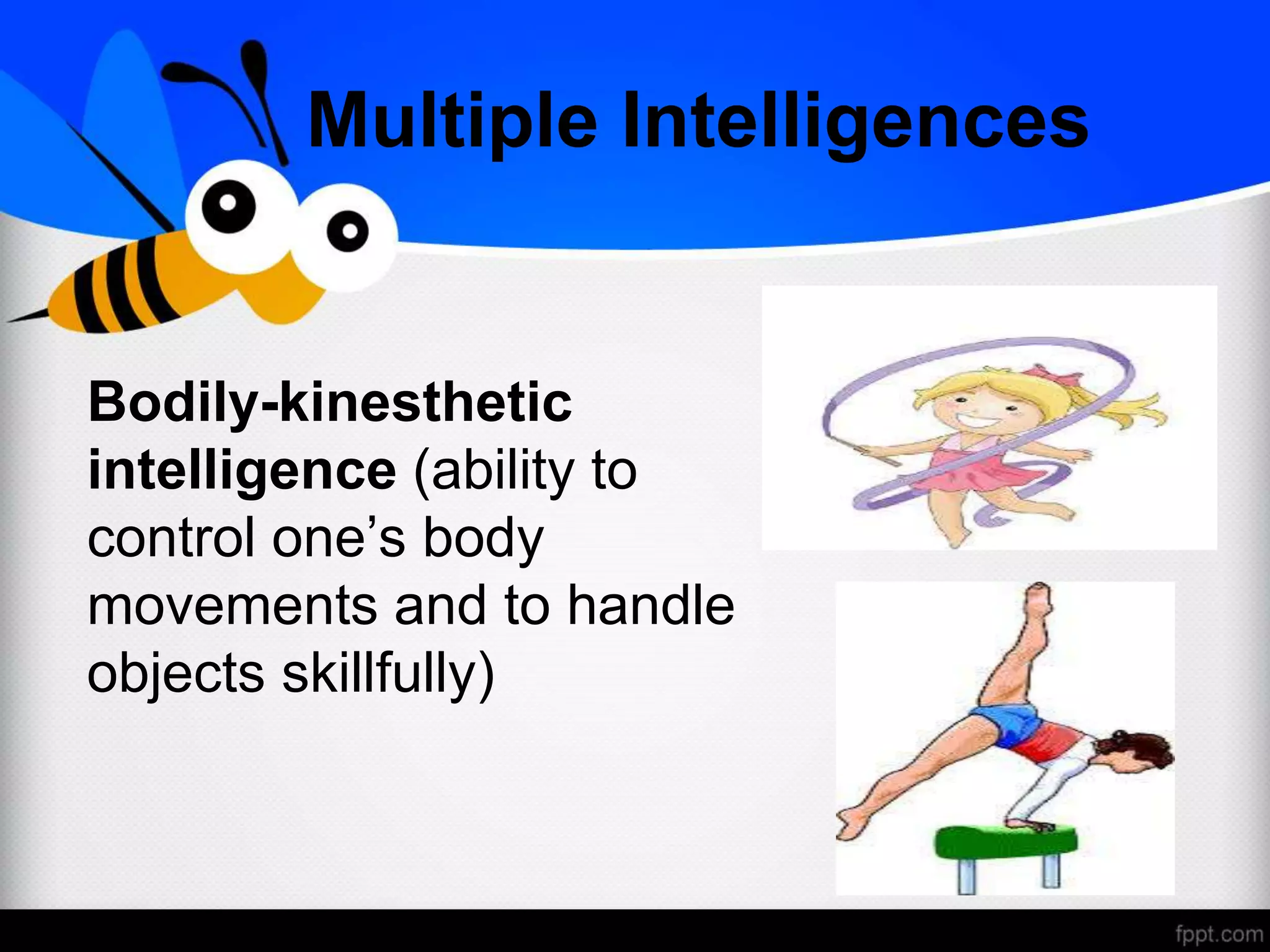
Bodily-kinesthetic
intelligence (ability to
control one’s body
movements and to handle
objects skillfully)
Multiple Intelligences
Musical intelligences
(ability to produce and
appreciate rhythm, pitch
and timber)
Multiple Intelligences
Interpersonal
intelligence (capacity to
detect and respond
appropriately to the
moods, motivations and
desires of others)
Multiple Intelligences
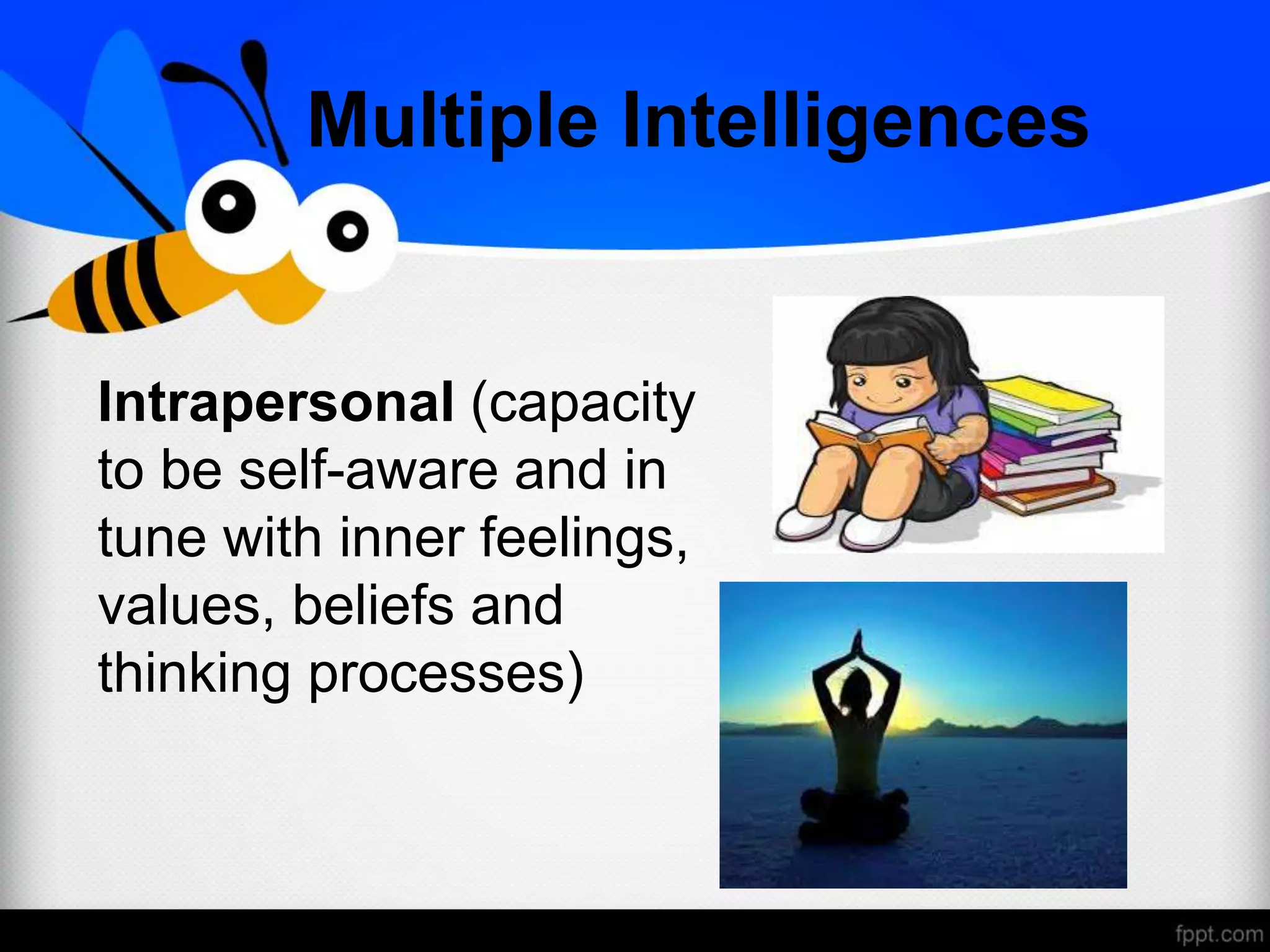
Intrapersonal (capacity
to be self-aware and in
tune with inner feelings,
values, beliefs and
thinking processes)
Multiple Intelligences
Naturalist intelligence
(ability to recognize and
categorize plants, animals
and other objects in
nature)
Multiple Intelligences
Existential intelligence
(sensitivity and capacity to
tackle deep questions about
human existence such as,
What is the meaning of life?
Why do we die? How did we
get here?
Creating an
Experience
Reflecting/
Analyzing
Experience
Integrating
Reflective
Analysis &
Concepts
Developing
concepts
Practicing
defined
givens
Practicing
and adding
something
to oneself
Analyzing
Experience
for
relevance
(usefulness)
Doing &
Adding to
new more
complex
experince
Concrete
Experience
Active
Experimentation
Reflective
Observation
Abstract
Conceptualization
14
3 2

Learning styles and Multiple Intelligence