Chapter 5
Data Compression
-PRATIK MAN SINGH PRADHAN (WWW.PMSPRATIK.COM.NP)-
MMS2401 – MULTIMEDIA SYSTEMS & COMMUNICATIONS (3 CREDITS)
Compression
 File compression is the practice of packaging a file
or files to use less disk space.
 The File Compression category includes software
programs that will archive your files and extract
archived files such as ZIP and RAR files.
 Many products in this category let you manage files
and protect them with encryption.
Data Compression
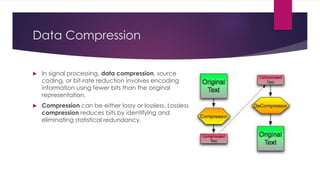
 In signal processing, data compression, source
coding, or bit-rate reduction involves encoding
information using fewer bits than the original
representation.
 Compression can be either lossy or lossless. Lossless
compression reduces bits by identifying and
eliminating statistical redundancy.
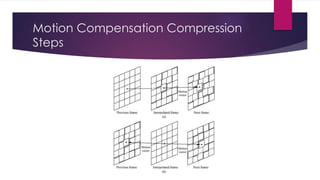
Need for Data Compression
 Bit rates required for uncompressed PAL Video
 720X576 = 414720 Pixels in each frame
 Frame Rate = 60 (for regular displays)
 Bit Rate = More than 160 Mbps
 Bit rates required for uncompressed High Definition Video
 1920 X 1080 = 2073600 Pixels in each frame
 Frame Rate = 60 (for regular displays)
 Bit Rate = More than 2 Gbps
 Bit rates required for uncompressed audio data stream
 Telephone Quality = 60 Kbps
 CD Quality = 1.4 Mbps
Fundamentals of Multimedia Data
Compression Coding Technique
 Audio, image and video require vast amounts of data
 320x240x8bits grayscale image: 77Kb
 1100x900x24bits color image: 3MB
 640x480x24x30frames/sec: 27.6 MB/sec
 Low network’s bandwidth doesn't allow for real time video transmission
 Slow storage devices don't allow for fast playing back ‰Compression
reduces storage requirements
Modes of Compression
 Lossless Compression
 Only redundancies or repetition are removed
 Data is not altered or lost in the process
 E.g. Computer file compression
 Lossy Compression
 Redundancies as well as some unessential information in the data are removed
 E.g. Image and video compression
Lossy DCT-Based Compression
 A discrete cosine transform (DCT) expresses a finite sequence of data
points in terms of a sum of cosine functions oscillating at different
frequencies.
 DCTs are important to numerous applications in science and engineering,
from lossy compression of audio (e.g. MP3) and images (e.g. JPEG) (where
small high-frequency components can be discarded), to spectral methods
for the numerical solution of partial differential equations.
 The use of cosine rather than sine functions is critical for compression, since
it turns out (as described below) that fewer cosine functions are needed to
approximate a typical signal, whereas for differential equations the cosines
express a particular choice of boundary conditions.
Two Types of Compression
 Entropy Encoding
 Does not take into account the nature of information to be compressed
 Treats all data as sequence of data
 Is lossless
 Source Encoding
 Makes use of transformations dependent on the type of original data E.g.
Suppression of silence for audio, and exploring motion redundancies for video.
 Is either lossy or lossless
Compression Efficiency
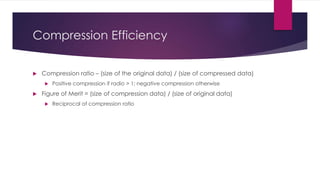
 Compression ratio – (size of the original data) / (size of compressed data)
 Positive compression if radio > 1; negative compression otherwise
 Figure of Merit = (size of compression data) / (size of original data)
 Reciprocal of compression ratio
Compression
Coding
Standards
 JPEG
 ITU-T
 H.261
 H.264
 MPEG
 Motion Compensation
 Huffman Code
 Hybrid Encoding
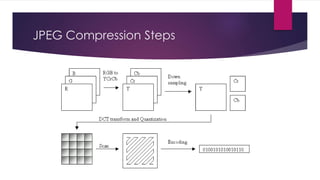
JPEG
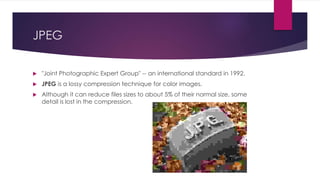
 "Joint Photographic Expert Group" -- an international standard in 1992.
 JPEG is a lossy compression technique for color images.
 Although it can reduce files sizes to about 5% of their normal size, some
detail is lost in the compression.
JPEG Compression Steps
ITU-T
 The ITU Telecommunication Standardization Sector (ITU-T) is one of the
three sectors (divisions or units) of the International Telecommunication
Union (ITU); it coordinates standards for telecommunications.
 The Video Coding Experts Group or Visual Coding Experts Group (VCEG) is
the informal name of Question 6 (Visual coding) of Working Party 3 (Media
coding) of Study Group 16 (Multimedia coding, systems and applications)
of the ITU-T. Its abbreviated title is ITU-T Q.6/SG 16. It is responsible for
standardization of the "H.26x" line of video coding standards, the "T.8xx" line
of image coding standards, and related technologies.
H.261 (px64)
 The basic approach to H.261 Compression is
summarized as follows:
 H.261 Compression has been specifically
designed for video telecommunication
applications:
 Developed by CCITT in 1988-1990
 Meant for videoconferencing, videotelephone
applications over ISDN telephone lines.
 Baseline ISDN is 64 kbits/sec, and integral
multiples (px64)
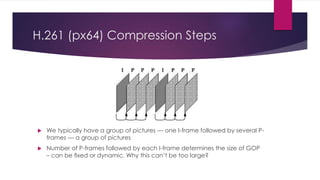
H.261 (px64) Compression Steps
 We typically have a group of pictures — one I-frame followed by several P-
frames — a group of pictures
 Number of P-frames followed by each I-frame determines the size of GOP
– can be fixed or dynamic. Why this can’t be too large?
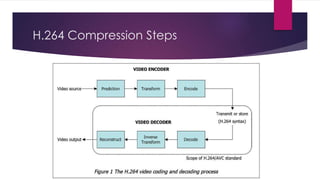
H.264
 H.264 or MPEG-4 Part 10, Advanced Video Coding (MPEG-4 AVC) is a
video coding format that is currently one of the most commonly used
formats for the recording, compression, and distribution of video content.
H.264 Compression Steps
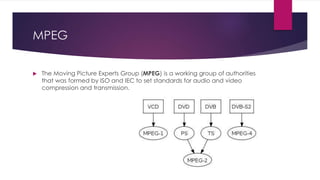
MPEG
 The Moving Picture Experts Group (MPEG) is a working group of authorities
that was formed by ISO and IEC to set standards for audio and video
compression and transmission.
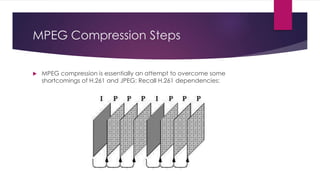
MPEG Compression Steps
 MPEG compression is essentially an attempt to overcome some
shortcomings of H.261 and JPEG: Recall H.261 dependencies:
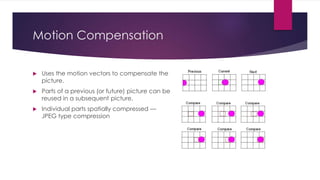
Motion Compensation
 Uses the motion vectors to compensate the
picture.
 Parts of a previous (or future) picture can be
reused in a subsequent picture.
 Individual parts spatially compressed —
JPEG type compression
Motion Compensation Compression
Steps
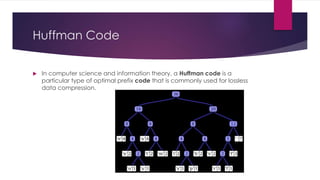
Huffman Code
 In computer science and information theory, a Huffman code is a
particular type of optimal prefix code that is commonly used for lossless
data compression.
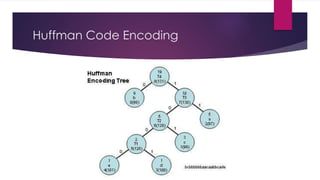
Huffman Code Encoding
Huffman Code Decoding
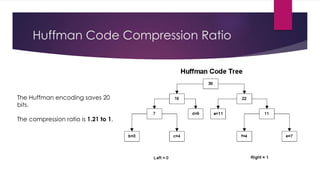
Huffman Code Compression Ratio
The Huffman encoding saves 20
bits.
The compression ratio is 1.21 to 1.
Huffman Code Relative Redundancy
Hybrid Encoding
 A hybrid encoding method is used to assemble the double-random phase-encoding technique
and the binary encoding method.
 Because the double-random phase-encoding technique is robust for noises and the binary
encoding method is free of using external keys, the proposed hybrid encoding method has their
advantages.
 The hybrid encoding method first encodes a covert image to form a complex-number matrix by
using the double-random phase-encoding technique, where two random real-number matrices
are used to increase the security of the encoding work.
 Then the elements of the two random real-number matrices and the elements of the complex-
number matrix are encoded to form a binary-bit string by using the binary encoding method.
 Finally, the binary data in the binary-bit string are encoded into a host image to form an overt
image with hidden information by using a gray-value modulation method. The decoding work is
easy for authorized people, but it is very difficult for unauthorized people. Therefore, the
proposed hybrid encoding method is a very useful encoding method.

Chapter 5 - Data Compression

  • 1.
    Chapter 5 Data Compression -PRATIKMAN SINGH PRADHAN (WWW.PMSPRATIK.COM.NP)- MMS2401 – MULTIMEDIA SYSTEMS & COMMUNICATIONS (3 CREDITS)
  • 2.
    Compression  File compressionis the practice of packaging a file or files to use less disk space.  The File Compression category includes software programs that will archive your files and extract archived files such as ZIP and RAR files.  Many products in this category let you manage files and protect them with encryption.
  • 3.
    Data Compression  Insignal processing, data compression, source coding, or bit-rate reduction involves encoding information using fewer bits than the original representation.  Compression can be either lossy or lossless. Lossless compression reduces bits by identifying and eliminating statistical redundancy.
  • 4.
    Need for DataCompression  Bit rates required for uncompressed PAL Video  720X576 = 414720 Pixels in each frame  Frame Rate = 60 (for regular displays)  Bit Rate = More than 160 Mbps  Bit rates required for uncompressed High Definition Video  1920 X 1080 = 2073600 Pixels in each frame  Frame Rate = 60 (for regular displays)  Bit Rate = More than 2 Gbps  Bit rates required for uncompressed audio data stream  Telephone Quality = 60 Kbps  CD Quality = 1.4 Mbps
  • 5.
    Fundamentals of MultimediaData Compression Coding Technique  Audio, image and video require vast amounts of data  320x240x8bits grayscale image: 77Kb  1100x900x24bits color image: 3MB  640x480x24x30frames/sec: 27.6 MB/sec  Low network’s bandwidth doesn't allow for real time video transmission  Slow storage devices don't allow for fast playing back ‰Compression reduces storage requirements
  • 6.
    Modes of Compression Lossless Compression  Only redundancies or repetition are removed  Data is not altered or lost in the process  E.g. Computer file compression  Lossy Compression  Redundancies as well as some unessential information in the data are removed  E.g. Image and video compression
  • 7.
    Lossy DCT-Based Compression A discrete cosine transform (DCT) expresses a finite sequence of data points in terms of a sum of cosine functions oscillating at different frequencies.  DCTs are important to numerous applications in science and engineering, from lossy compression of audio (e.g. MP3) and images (e.g. JPEG) (where small high-frequency components can be discarded), to spectral methods for the numerical solution of partial differential equations.  The use of cosine rather than sine functions is critical for compression, since it turns out (as described below) that fewer cosine functions are needed to approximate a typical signal, whereas for differential equations the cosines express a particular choice of boundary conditions.
  • 8.
    Two Types ofCompression  Entropy Encoding  Does not take into account the nature of information to be compressed  Treats all data as sequence of data  Is lossless  Source Encoding  Makes use of transformations dependent on the type of original data E.g. Suppression of silence for audio, and exploring motion redundancies for video.  Is either lossy or lossless
  • 9.
    Compression Efficiency  Compressionratio – (size of the original data) / (size of compressed data)  Positive compression if radio > 1; negative compression otherwise  Figure of Merit = (size of compression data) / (size of original data)  Reciprocal of compression ratio
  • 10.
    Compression Coding Standards  JPEG  ITU-T H.261  H.264  MPEG  Motion Compensation  Huffman Code  Hybrid Encoding
  • 11.
    JPEG  "Joint PhotographicExpert Group" -- an international standard in 1992.  JPEG is a lossy compression technique for color images.  Although it can reduce files sizes to about 5% of their normal size, some detail is lost in the compression.
  • 12.
  • 13.
    ITU-T  The ITUTelecommunication Standardization Sector (ITU-T) is one of the three sectors (divisions or units) of the International Telecommunication Union (ITU); it coordinates standards for telecommunications.  The Video Coding Experts Group or Visual Coding Experts Group (VCEG) is the informal name of Question 6 (Visual coding) of Working Party 3 (Media coding) of Study Group 16 (Multimedia coding, systems and applications) of the ITU-T. Its abbreviated title is ITU-T Q.6/SG 16. It is responsible for standardization of the "H.26x" line of video coding standards, the "T.8xx" line of image coding standards, and related technologies.
  • 14.
    H.261 (px64)  Thebasic approach to H.261 Compression is summarized as follows:  H.261 Compression has been specifically designed for video telecommunication applications:  Developed by CCITT in 1988-1990  Meant for videoconferencing, videotelephone applications over ISDN telephone lines.  Baseline ISDN is 64 kbits/sec, and integral multiples (px64)
  • 15.
    H.261 (px64) CompressionSteps  We typically have a group of pictures — one I-frame followed by several P- frames — a group of pictures  Number of P-frames followed by each I-frame determines the size of GOP – can be fixed or dynamic. Why this can’t be too large?
  • 16.
    H.264  H.264 orMPEG-4 Part 10, Advanced Video Coding (MPEG-4 AVC) is a video coding format that is currently one of the most commonly used formats for the recording, compression, and distribution of video content.
  • 17.
  • 18.
    MPEG  The MovingPicture Experts Group (MPEG) is a working group of authorities that was formed by ISO and IEC to set standards for audio and video compression and transmission.
  • 19.
    MPEG Compression Steps MPEG compression is essentially an attempt to overcome some shortcomings of H.261 and JPEG: Recall H.261 dependencies:
  • 20.
    Motion Compensation  Usesthe motion vectors to compensate the picture.  Parts of a previous (or future) picture can be reused in a subsequent picture.  Individual parts spatially compressed — JPEG type compression
  • 21.
  • 22.
    Huffman Code  Incomputer science and information theory, a Huffman code is a particular type of optimal prefix code that is commonly used for lossless data compression.
  • 23.
  • 24.
  • 25.
    Huffman Code CompressionRatio The Huffman encoding saves 20 bits. The compression ratio is 1.21 to 1.
  • 26.
  • 27.
    Hybrid Encoding  Ahybrid encoding method is used to assemble the double-random phase-encoding technique and the binary encoding method.  Because the double-random phase-encoding technique is robust for noises and the binary encoding method is free of using external keys, the proposed hybrid encoding method has their advantages.  The hybrid encoding method first encodes a covert image to form a complex-number matrix by using the double-random phase-encoding technique, where two random real-number matrices are used to increase the security of the encoding work.  Then the elements of the two random real-number matrices and the elements of the complex- number matrix are encoded to form a binary-bit string by using the binary encoding method.  Finally, the binary data in the binary-bit string are encoded into a host image to form an overt image with hidden information by using a gray-value modulation method. The decoding work is easy for authorized people, but it is very difficult for unauthorized people. Therefore, the proposed hybrid encoding method is a very useful encoding method.