RTL Verification and FPGA Implementation of 4x4
Vedic Multiplier
Mohd Esa , Konasagar Achyut and Chandrajeet Singh
Abstract. The objective of this paper is to study 4x4 Vedic multiplier.
Multiplication is an important fundamental function in arithmetic operations.
Vedic multiplier using Urdhva-Tiryagbyam sutra is predominant in
performance evaluation of parameters such as power, area & delay. This paper
presents design, verification and FPGA implementation of Vedic multiplier.
Verification is carried out in Questa Sim 10.4e using System Verilog HVL and
design is carried out in Xilinx ISE Design Suite 14.7 using Verilog HDL
environment.
Keywords: Vedic Multiplier, HVL, HDL, RTL, FPGA.
1 Introduction
inary number system uses only zero‟s and one‟s. Just like decimal system,
binary possesses every arithmetic operation. A binary multiplier is any such
electronic circuit used in digital electronics to multiply two binary numbers
[1]. Unlike the decimal base ten, binary multiplication is done in binary base two. The
concept of Vedic multiplier has been acquired from the Vedic mathematics in which
there are several methods to operate with the number systems.Urdhva-Triyagbhyam
sutra is one among those Vedic methods which helps to follow general formula
applicable to all cases in multiplication. The meaning of Urdhva-Triyagbhyam is
vertically and crosswise.
This paper presents the design and verification of 4x4 bit Vedic multiplier
using HDL and HVL respectively, which helps us to justify that design is working
without any bugs or errors. This paper also presents implementation of Vedic
multiplier in Field Programming Gate Array.FPGAs are semiconductor devices that
are based around a matrix of configurable logic blocks connected via programmable
interconnects. FPGAs can be reprogrammed to desired application or functionality
requirements after manufacturing.
2 Ripple Carry Adder
As the name of the circuit itself represents that the carry is rippled to a
succeeding part. The combination of full adders whose carry output is propagated as a
B
Parishodh Journal
Volume IX , Issue III , March/2020
ISSN NO:2347-6648
Page No:772
carry input to the succeeding full adder is called as a Ripple Carry Adder. The
addition of two binary numbers in parallel implies that all the bits of addend and
augend are available for computation at the same time [2].
Fig.1. Ripple Carry Adder logic circuit
Table 1.Ripple Carry Adder truth table
In this work, three ripple carry adders are used in which the first bits from addend and
augend binary numbers are computed by half adders and rest with full adders to form
a complete ripple addition. The truth table for various possible combinations of ripple
carry adder is shown table 1.
3 Urdhva Triyagbhyam Sutra
Mathematics is mother of all sciences, it is full of mysteries and magic.
Ancient Indians were able to understand these mysteries and developed simple keys
to solve them. The ancient system of Vedic maths was introduced by Swami Bharati
Krishna Tirthaji. His work includes various methods of calculations and this in turn
Indians named it as Vedic mathematics [3].
This paper presents multiplication operation done over two 4-bit binary
numbers through the Urdhva-Triyagbhyam technique. As usual the multiplication has
a multiplier and a multiplicand, but the method of multiplication is done by
multiplying first two bits of multiplicand and multiplier followed by cross
multiplication of side numbers of multiplicand with numbers in multiplier, finally the
last digits are multiplied parallelly to complete the multiplication process. This
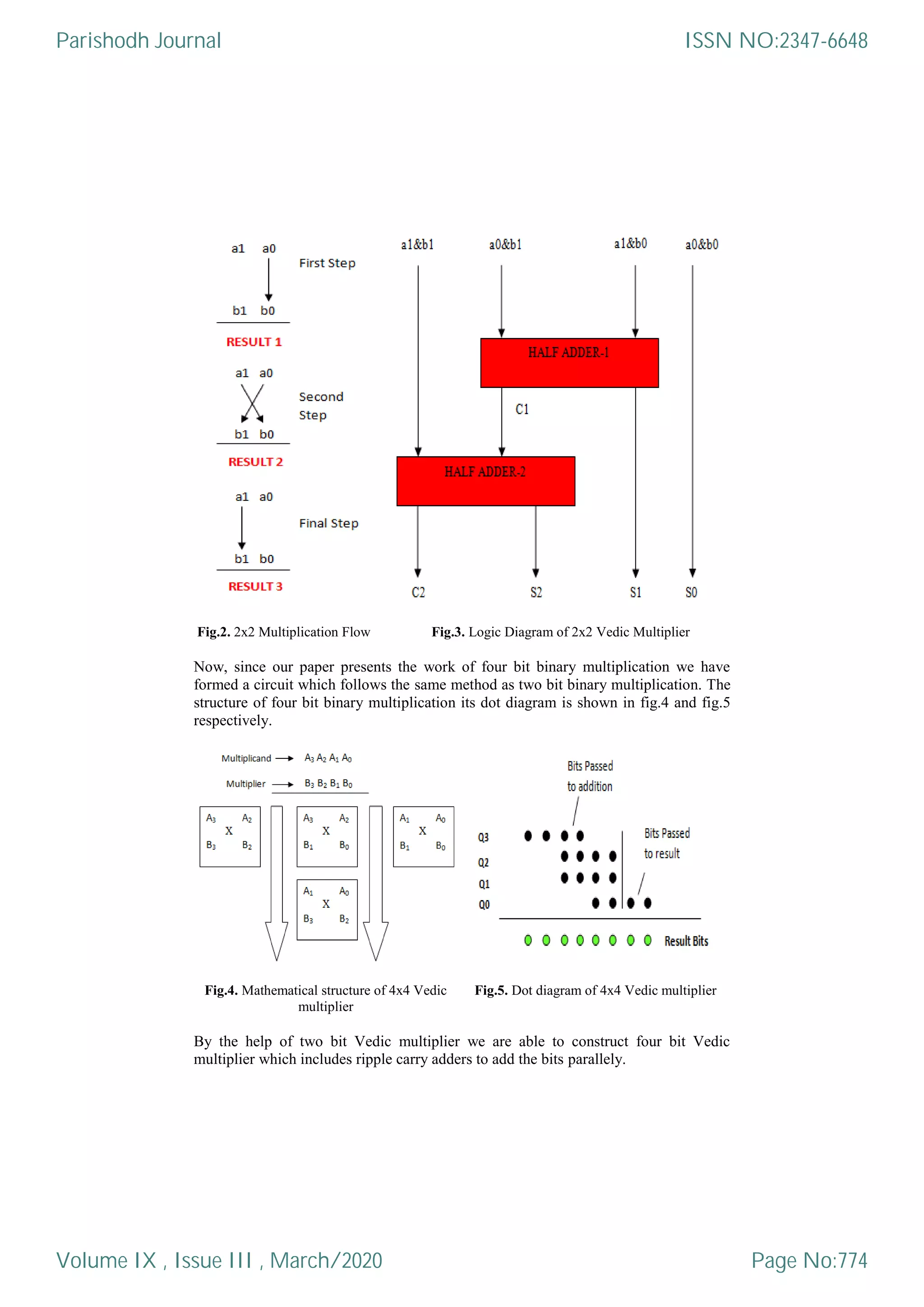
method can be observed as shown in the fig.2 for two bit binary numbers. To perform
this in digital logic the block diagram of two bit Vedic multiplier is shown in fig.3.
Parishodh Journal
Volume IX , Issue III , March/2020
ISSN NO:2347-6648
Page No:773
Fig.2. 2x2 Multiplication Flow Fig.3. Logic Diagram of 2x2 Vedic Multiplier
Now, since our paper presents the work of four bit binary multiplication we have
formed a circuit which follows the same method as two bit binary multiplication. The
structure of four bit binary multiplication its dot diagram is shown in fig.4 and fig.5
respectively.
Fig.4. Mathematical structure of 4x4 Vedic
multiplier
Fig.5. Dot diagram of 4x4 Vedic multiplier
By the help of two bit Vedic multiplier we are able to construct four bit Vedic
multiplier which includes ripple carry adders to add the bits parallely.
Parishodh Journal
Volume IX , Issue III , March/2020
ISSN NO:2347-6648
Page No:774
Fig.6. Architecture of 4x4 Vedic Multiplier
4 Simulation results
Simulation provides an effective way to investigate the design which can be
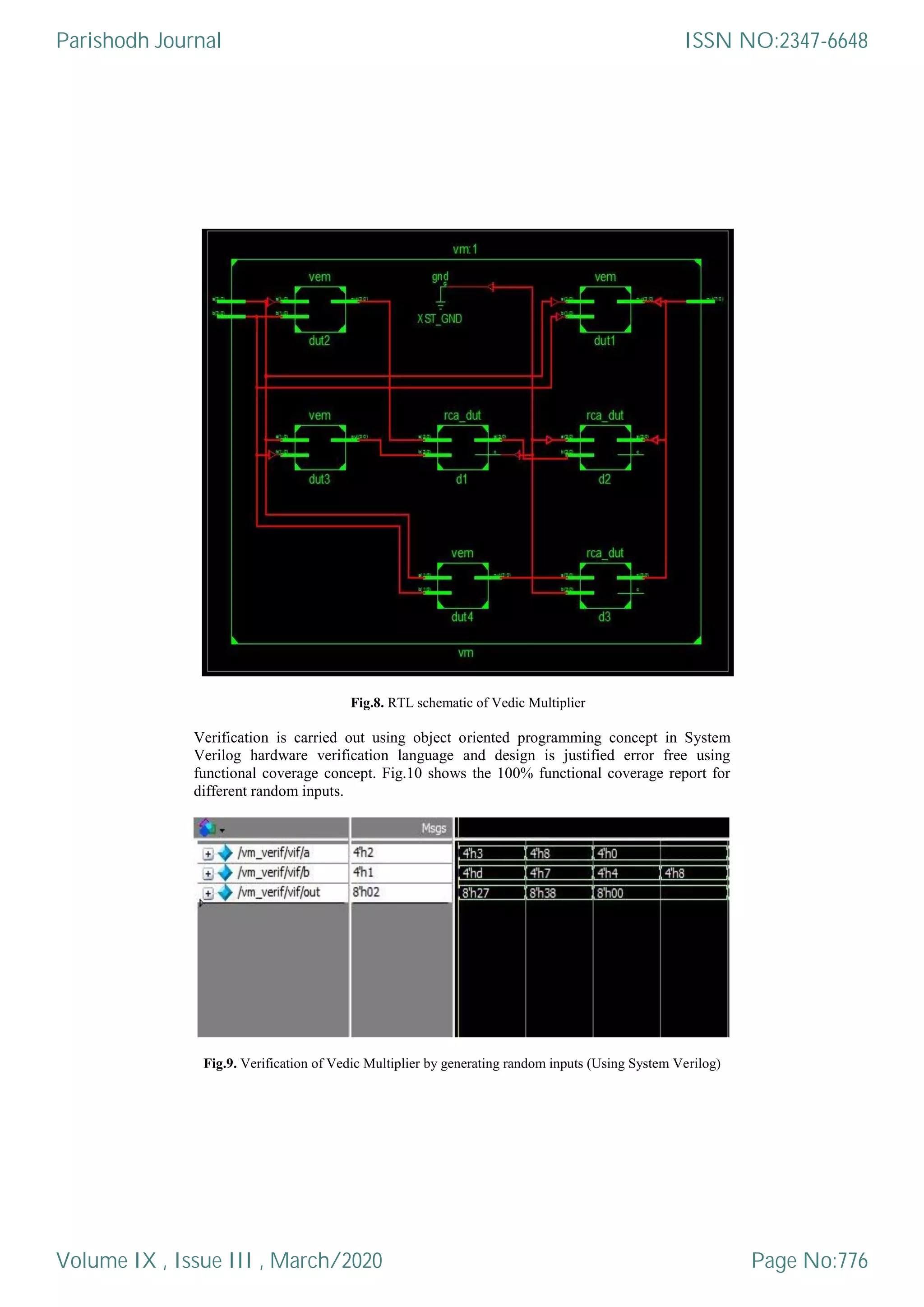
easily rectified by means of EDA tools. Fig.7 shows simulation waveforms of inputs
as well as output using Verilog HDL & fig.8 shows RTL schematic of Vedic
Multiplier.
Fig. 7. Simulation output of 4x4 Vedic Multiplier (Using Verilog)
Parishodh Journal
Volume IX , Issue III , March/2020
ISSN NO:2347-6648
Page No:775
Fig.8. RTL schematic of Vedic Multiplier
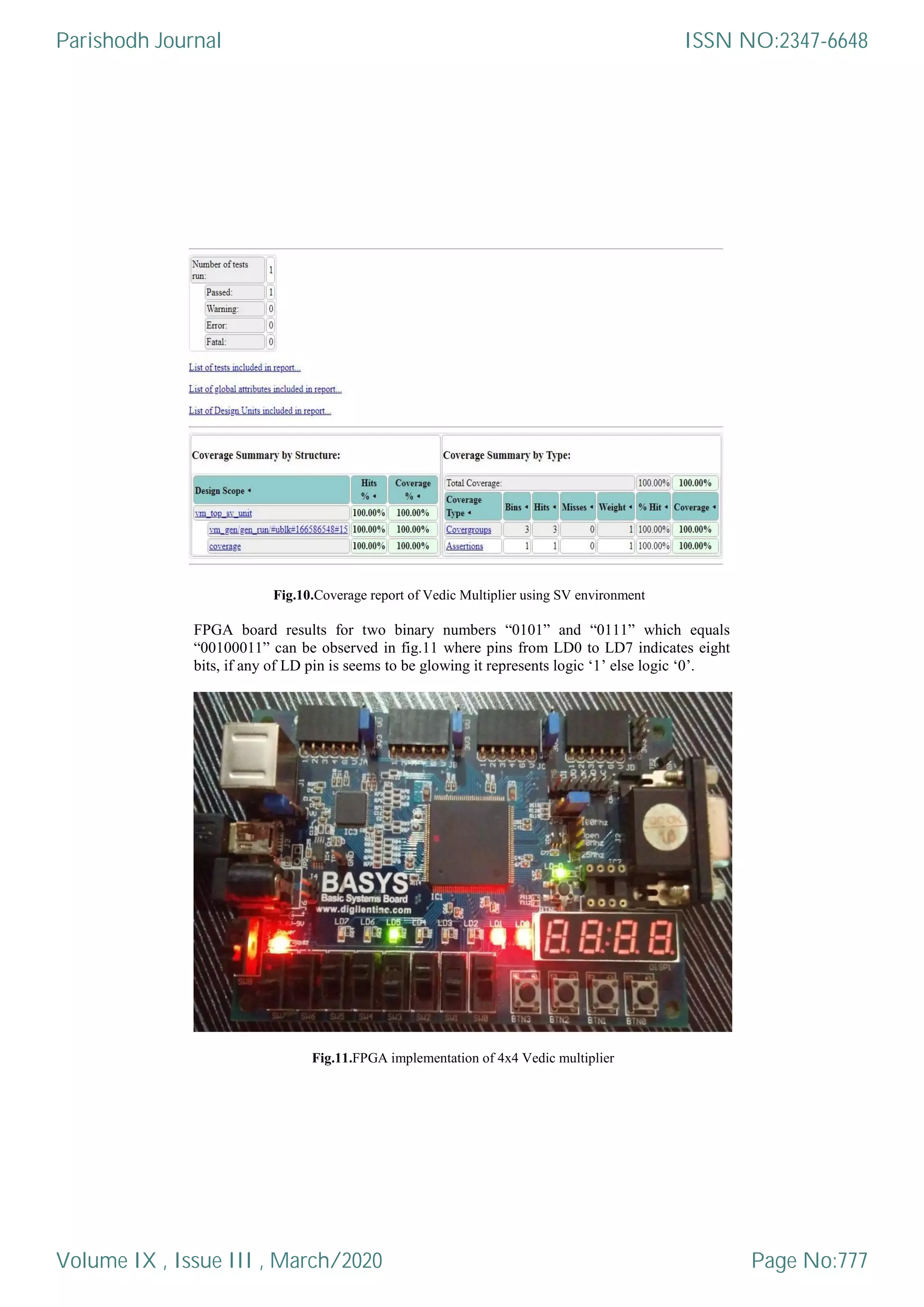
Verification is carried out using object oriented programming concept in System
Verilog hardware verification language and design is justified error free using
functional coverage concept. Fig.10 shows the 100% functional coverage report for
different random inputs.
Fig.9. Verification of Vedic Multiplier by generating random inputs (Using System Verilog)
Parishodh Journal
Volume IX , Issue III , March/2020
ISSN NO:2347-6648
Page No:776
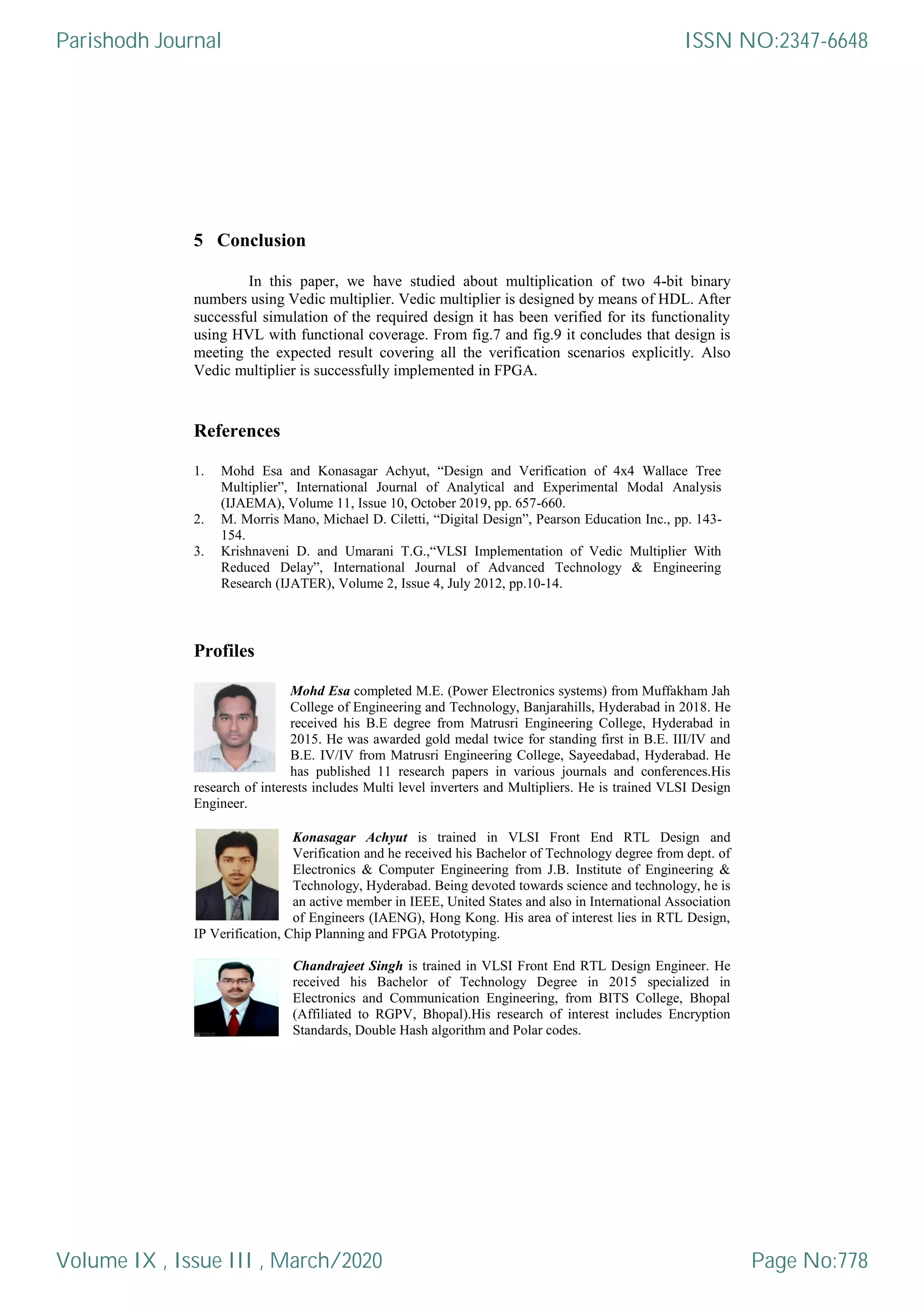
Fig.10.Coverage report of Vedic Multiplier using SV environment
FPGA board results for two binary numbers “0101” and “0111” which equals
“00100011” can be observed in fig.11 where pins from LD0 to LD7 indicates eight
bits, if any of LD pin is seems to be glowing it represents logic „1‟ else logic „0‟.
Fig.11.FPGA implementation of 4x4 Vedic multiplier
Parishodh Journal
Volume IX , Issue III , March/2020
ISSN NO:2347-6648
Page No:777
5 Conclusion
In this paper, we have studied about multiplication of two 4-bit binary
numbers using Vedic multiplier. Vedic multiplier is designed by means of HDL. After
successful simulation of the required design it has been verified for its functionality
using HVL with functional coverage. From fig.7 and fig.9 it concludes that design is
meeting the expected result covering all the verification scenarios explicitly. Also
Vedic multiplier is successfully implemented in FPGA.
References
1. Mohd Esa and Konasagar Achyut, “Design and Verification of 4x4 Wallace Tree
Multiplier”, International Journal of Analytical and Experimental Modal Analysis
(IJAEMA), Volume 11, Issue 10, October 2019, pp. 657-660.
2. M. Morris Mano, Michael D. Ciletti, “Digital Design”, Pearson Education Inc., pp. 143-
154.
3. Krishnaveni D. and Umarani T.G.,“VLSI Implementation of Vedic Multiplier With
Reduced Delay”, International Journal of Advanced Technology & Engineering
Research (IJATER), Volume 2, Issue 4, July 2012, pp.10-14.
Profiles
Mohd Esa completed M.E. (Power Electronics systems) from Muffakham Jah
College of Engineering and Technology, Banjarahills, Hyderabad in 2018. He
received his B.E degree from Matrusri Engineering College, Hyderabad in
2015. He was awarded gold medal twice for standing first in B.E. III/IV and
B.E. IV/IV from Matrusri Engineering College, Sayeedabad, Hyderabad. He
has published 11 research papers in various journals and conferences.His
research of interests includes Multi level inverters and Multipliers. He is trained VLSI Design
Engineer.
Konasagar Achyut is trained in VLSI Front End RTL Design and
Verification and he received his Bachelor of Technology degree from dept. of
Electronics & Computer Engineering from J.B. Institute of Engineering &
Technology, Hyderabad. Being devoted towards science and technology, he is
an active member in IEEE, United States and also in International Association
of Engineers (IAENG), Hong Kong. His area of interest lies in RTL Design,
IP Verification, Chip Planning and FPGA Prototyping.
Chandrajeet Singh is trained in VLSI Front End RTL Design Engineer. He
received his Bachelor of Technology Degree in 2015 specialized in
Electronics and Communication Engineering, from BITS College, Bhopal
(Affiliated to RGPV, Bhopal).His research of interest includes Encryption
Standards, Double Hash algorithm and Polar codes.
Parishodh Journal
Volume IX , Issue III , March/2020
ISSN NO:2347-6648
Page No:778

RTL Verification and FPGA Implementation of 4x4 Vedic Multiplier

  • 1.
    RTL Verification andFPGA Implementation of 4x4 Vedic Multiplier Mohd Esa , Konasagar Achyut and Chandrajeet Singh Abstract. The objective of this paper is to study 4x4 Vedic multiplier. Multiplication is an important fundamental function in arithmetic operations. Vedic multiplier using Urdhva-Tiryagbyam sutra is predominant in performance evaluation of parameters such as power, area & delay. This paper presents design, verification and FPGA implementation of Vedic multiplier. Verification is carried out in Questa Sim 10.4e using System Verilog HVL and design is carried out in Xilinx ISE Design Suite 14.7 using Verilog HDL environment. Keywords: Vedic Multiplier, HVL, HDL, RTL, FPGA. 1 Introduction inary number system uses only zero‟s and one‟s. Just like decimal system, binary possesses every arithmetic operation. A binary multiplier is any such electronic circuit used in digital electronics to multiply two binary numbers [1]. Unlike the decimal base ten, binary multiplication is done in binary base two. The concept of Vedic multiplier has been acquired from the Vedic mathematics in which there are several methods to operate with the number systems.Urdhva-Triyagbhyam sutra is one among those Vedic methods which helps to follow general formula applicable to all cases in multiplication. The meaning of Urdhva-Triyagbhyam is vertically and crosswise. This paper presents the design and verification of 4x4 bit Vedic multiplier using HDL and HVL respectively, which helps us to justify that design is working without any bugs or errors. This paper also presents implementation of Vedic multiplier in Field Programming Gate Array.FPGAs are semiconductor devices that are based around a matrix of configurable logic blocks connected via programmable interconnects. FPGAs can be reprogrammed to desired application or functionality requirements after manufacturing. 2 Ripple Carry Adder As the name of the circuit itself represents that the carry is rippled to a succeeding part. The combination of full adders whose carry output is propagated as a B Parishodh Journal Volume IX , Issue III , March/2020 ISSN NO:2347-6648 Page No:772
  • 2.
    carry input tothe succeeding full adder is called as a Ripple Carry Adder. The addition of two binary numbers in parallel implies that all the bits of addend and augend are available for computation at the same time [2]. Fig.1. Ripple Carry Adder logic circuit Table 1.Ripple Carry Adder truth table In this work, three ripple carry adders are used in which the first bits from addend and augend binary numbers are computed by half adders and rest with full adders to form a complete ripple addition. The truth table for various possible combinations of ripple carry adder is shown table 1. 3 Urdhva Triyagbhyam Sutra Mathematics is mother of all sciences, it is full of mysteries and magic. Ancient Indians were able to understand these mysteries and developed simple keys to solve them. The ancient system of Vedic maths was introduced by Swami Bharati Krishna Tirthaji. His work includes various methods of calculations and this in turn Indians named it as Vedic mathematics [3]. This paper presents multiplication operation done over two 4-bit binary numbers through the Urdhva-Triyagbhyam technique. As usual the multiplication has a multiplier and a multiplicand, but the method of multiplication is done by multiplying first two bits of multiplicand and multiplier followed by cross multiplication of side numbers of multiplicand with numbers in multiplier, finally the last digits are multiplied parallelly to complete the multiplication process. This method can be observed as shown in the fig.2 for two bit binary numbers. To perform this in digital logic the block diagram of two bit Vedic multiplier is shown in fig.3. Parishodh Journal Volume IX , Issue III , March/2020 ISSN NO:2347-6648 Page No:773
  • 3.
    Fig.2. 2x2 MultiplicationFlow Fig.3. Logic Diagram of 2x2 Vedic Multiplier Now, since our paper presents the work of four bit binary multiplication we have formed a circuit which follows the same method as two bit binary multiplication. The structure of four bit binary multiplication its dot diagram is shown in fig.4 and fig.5 respectively. Fig.4. Mathematical structure of 4x4 Vedic multiplier Fig.5. Dot diagram of 4x4 Vedic multiplier By the help of two bit Vedic multiplier we are able to construct four bit Vedic multiplier which includes ripple carry adders to add the bits parallely. Parishodh Journal Volume IX , Issue III , March/2020 ISSN NO:2347-6648 Page No:774
  • 4.
    Fig.6. Architecture of4x4 Vedic Multiplier 4 Simulation results Simulation provides an effective way to investigate the design which can be easily rectified by means of EDA tools. Fig.7 shows simulation waveforms of inputs as well as output using Verilog HDL & fig.8 shows RTL schematic of Vedic Multiplier. Fig. 7. Simulation output of 4x4 Vedic Multiplier (Using Verilog) Parishodh Journal Volume IX , Issue III , March/2020 ISSN NO:2347-6648 Page No:775
  • 5.
    Fig.8. RTL schematicof Vedic Multiplier Verification is carried out using object oriented programming concept in System Verilog hardware verification language and design is justified error free using functional coverage concept. Fig.10 shows the 100% functional coverage report for different random inputs. Fig.9. Verification of Vedic Multiplier by generating random inputs (Using System Verilog) Parishodh Journal Volume IX , Issue III , March/2020 ISSN NO:2347-6648 Page No:776
  • 6.
    Fig.10.Coverage report ofVedic Multiplier using SV environment FPGA board results for two binary numbers “0101” and “0111” which equals “00100011” can be observed in fig.11 where pins from LD0 to LD7 indicates eight bits, if any of LD pin is seems to be glowing it represents logic „1‟ else logic „0‟. Fig.11.FPGA implementation of 4x4 Vedic multiplier Parishodh Journal Volume IX , Issue III , March/2020 ISSN NO:2347-6648 Page No:777
  • 7.
    5 Conclusion In thispaper, we have studied about multiplication of two 4-bit binary numbers using Vedic multiplier. Vedic multiplier is designed by means of HDL. After successful simulation of the required design it has been verified for its functionality using HVL with functional coverage. From fig.7 and fig.9 it concludes that design is meeting the expected result covering all the verification scenarios explicitly. Also Vedic multiplier is successfully implemented in FPGA. References 1. Mohd Esa and Konasagar Achyut, “Design and Verification of 4x4 Wallace Tree Multiplier”, International Journal of Analytical and Experimental Modal Analysis (IJAEMA), Volume 11, Issue 10, October 2019, pp. 657-660. 2. M. Morris Mano, Michael D. Ciletti, “Digital Design”, Pearson Education Inc., pp. 143- 154. 3. Krishnaveni D. and Umarani T.G.,“VLSI Implementation of Vedic Multiplier With Reduced Delay”, International Journal of Advanced Technology & Engineering Research (IJATER), Volume 2, Issue 4, July 2012, pp.10-14. Profiles Mohd Esa completed M.E. (Power Electronics systems) from Muffakham Jah College of Engineering and Technology, Banjarahills, Hyderabad in 2018. He received his B.E degree from Matrusri Engineering College, Hyderabad in 2015. He was awarded gold medal twice for standing first in B.E. III/IV and B.E. IV/IV from Matrusri Engineering College, Sayeedabad, Hyderabad. He has published 11 research papers in various journals and conferences.His research of interests includes Multi level inverters and Multipliers. He is trained VLSI Design Engineer. Konasagar Achyut is trained in VLSI Front End RTL Design and Verification and he received his Bachelor of Technology degree from dept. of Electronics & Computer Engineering from J.B. Institute of Engineering & Technology, Hyderabad. Being devoted towards science and technology, he is an active member in IEEE, United States and also in International Association of Engineers (IAENG), Hong Kong. His area of interest lies in RTL Design, IP Verification, Chip Planning and FPGA Prototyping. Chandrajeet Singh is trained in VLSI Front End RTL Design Engineer. He received his Bachelor of Technology Degree in 2015 specialized in Electronics and Communication Engineering, from BITS College, Bhopal (Affiliated to RGPV, Bhopal).His research of interest includes Encryption Standards, Double Hash algorithm and Polar codes. Parishodh Journal Volume IX , Issue III , March/2020 ISSN NO:2347-6648 Page No:778