Learning Multifractal Structure in Large Networks 
Austin Benson, Carlos Riquelme, Sven Schmit 
Stanford University 
f arbenson, rikel, schmit g @ stanford.edu 
Knowledge Discovery and Data Mining (KDD) 
August 26, 2014
Setting 
We want a simple, scalable method to model networks and generate 
random (undirected) graphs 
I Looking for graph generators that can mimic real world graph 
structure 
{ Power law degree distribution, 
{ High clustering coecient, etc. 
I Many models have been proposed, starting with Erdos-Renyi graphs 
I Relatively recent models: SKG [Leskovec et al. 2010], BTER 
[Seshadhri et al. 2012], TCL [Pfeier et al. 2012] 
I In 2011 Palla et al. introduce multifractal network generators, 
`generalizing' SKG 
2
Our contributions 
We propose methods to make MFNG a feasible framework to model large 
networks 
3
Our contributions 
We propose methods to make MFNG a feasible framework to model large 
networks 
I First, we give an intuitive theoretical result that opens the door to 
scalable estimation 
I We show how we can
t MFNG to graphs using mehod of moments 
estimation, with runtime independent of the size of the graph 
I We develop a fast heuristic for sampling MFNG 
I We demonstrate the ectiveness of our approach in synthetic and 
real world settings. 
3
An introduction to Multifractal Network Generators 
(MFNG) 
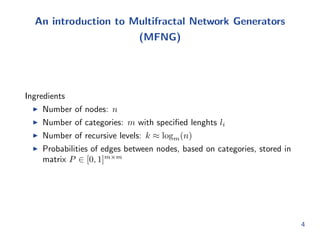
Ingredients 
I Number of nodes: n 
I Number of categories: m with speci
ed lenghts li 
I Number of recursive levels: k  logm(n) 
I Probabilities of edges between nodes, based on categories, stored in 
matrix P 2 [0; 1]mm 
4
Generating a graph with no recursion 
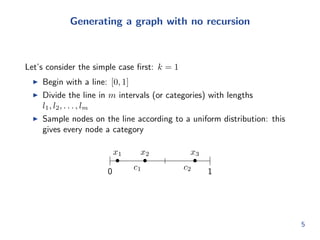
Let's consider the simple case
rst: k = 1 
I Begin with a line: [0; 1] 
I Divide the line in m intervals (or categories) with lengths 
l1; l2; : : : ; lm 
I Sample nodes on the line according to a uniform distribution: this 
gives every node a category 
x2 
 
x3 
c1 c2 
x1 
 
 
0 1 
5
From line to square 
c1 c2 
x3  
c2 
x2  
c1 
 
x1 
 
x2 
 
x3 
x1  
pc1;c1 
pc2;c2 
pc1;c2 
pc1;c2 
I For any two nodes u 2 ci; v 2 cj , add an edge with probability 
according to pci;cj 
6
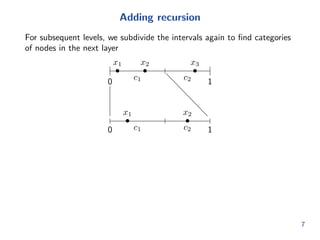
Adding recursion 
For subsequent levels, we subdivide the intervals again to
nd categories 
of nodes in the next layer 
x2 
 
x3 
c1 c2 
x1 
 
 
0 1 
x1 
 
x2 
 
0 c1 c2 1 
7
Adding recursion 
For subsequent levels, we subdivide the intervals again to
nd categories 
of nodes in the next layer 
x2 
 
x3 
c1 c2 
x1 
 
 
0 1 
x1 
 
x2 
 
0 c1 c2 1 
Now add an edge between nodes by multiplying probabilities 
corresponding to categories in each layer. 
In the above two layer example 
I node x1 has categories (c1; c1), 
I node x2 has categories (c1; c2), and 
I node x3 has categories (c2; c2) 
And hence, we add edge (x1; x2) with probability pc1;c1pc1;c2 . 
7
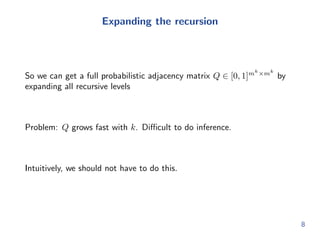
Expanding the recursion 
So we can get a full probabilistic adjacency matrix Q 2 [0; 1]mkmk 
by 
expanding all recursive levels 
Problem: Q grows fast with k. Dicult to do inference. 
Intuitively, we should not have to do this. 
8
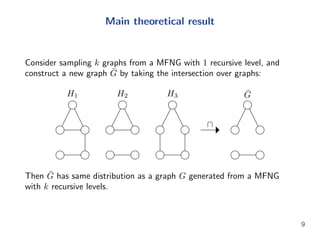
Main theoretical result 
Consider sampling k graphs from a MFNG with 1 recursive level, and 
construct a new graph G 
by taking the intersection over graphs: 
H1 H2 H3 G 
 
Then G 
has same distribution as a graph G generated from a MFNG 
with k recursive levels. 
9
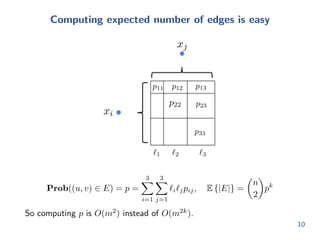
Computing expected number of edges is easy 
p11 p12 
p22 
xi 
xj 
p13 
p23 
p33 
`1 `2 `3 
Prob((u; v) 2 E) = p = 
X3 
i=1 
X3 
j=1 
`i`jpij ; E fjEjg = 
 
n 
2 
 
pk 
So computing p is O(m2) instead of O(m2k). 
10
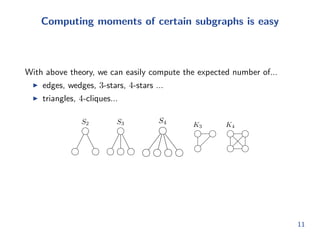
Computing moments of certain subgraphs is easy 
With above theory, we can easily compute the expected number of... 
I edges, wedges, 3-stars, 4-stars ... 
I triangles, 4-cliques... 
S2 S3 S4 K3 K4 
11
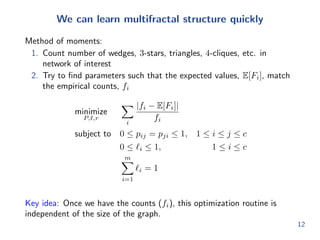
We can learn multifractal structure quickly 
Method of moments: 
1. Count number of wedges, 3-stars, triangles, 4-cliques, etc. in 
network of interest 
2. Try to
nd parameters such that the expected values, E[Fi], match 
the empirical counts, fi 
minimize 
P;`;r 
X 
i 
jfi  E[Fi]j 
fi 
subject to 0  pij = pji  1; 1  i  j  c 
0  `i  1; 1  i  c 
Xm 
i=1 
`i = 1 
Key idea: Once we have the counts (fi), this optimization routine is 
independent of the size of the graph. 
12

Learning multifractal structure in large networks (KDD 2014)

  • 1.
    Learning Multifractal Structurein Large Networks Austin Benson, Carlos Riquelme, Sven Schmit Stanford University f arbenson, rikel, schmit g @ stanford.edu Knowledge Discovery and Data Mining (KDD) August 26, 2014
  • 2.
    Setting We wanta simple, scalable method to model networks and generate random (undirected) graphs I Looking for graph generators that can mimic real world graph structure { Power law degree distribution, { High clustering coecient, etc. I Many models have been proposed, starting with Erdos-Renyi graphs I Relatively recent models: SKG [Leskovec et al. 2010], BTER [Seshadhri et al. 2012], TCL [Pfeier et al. 2012] I In 2011 Palla et al. introduce multifractal network generators, `generalizing' SKG 2
  • 3.
    Our contributions Wepropose methods to make MFNG a feasible framework to model large networks 3
  • 4.
    Our contributions Wepropose methods to make MFNG a feasible framework to model large networks I First, we give an intuitive theoretical result that opens the door to scalable estimation I We show how we can
  • 5.
    t MFNG tographs using mehod of moments estimation, with runtime independent of the size of the graph I We develop a fast heuristic for sampling MFNG I We demonstrate the ectiveness of our approach in synthetic and real world settings. 3
  • 6.
    An introduction toMultifractal Network Generators (MFNG) Ingredients I Number of nodes: n I Number of categories: m with speci
  • 7.
    ed lenghts li I Number of recursive levels: k logm(n) I Probabilities of edges between nodes, based on categories, stored in matrix P 2 [0; 1]mm 4
  • 8.
    Generating a graphwith no recursion Let's consider the simple case
  • 9.
    rst: k =1 I Begin with a line: [0; 1] I Divide the line in m intervals (or categories) with lengths l1; l2; : : : ; lm I Sample nodes on the line according to a uniform distribution: this gives every node a category x2 x3 c1 c2 x1 0 1 5
  • 10.
    From line tosquare c1 c2 x3 c2 x2 c1 x1 x2 x3 x1 pc1;c1 pc2;c2 pc1;c2 pc1;c2 I For any two nodes u 2 ci; v 2 cj , add an edge with probability according to pci;cj 6
  • 11.
    Adding recursion Forsubsequent levels, we subdivide the intervals again to
  • 12.
    nd categories ofnodes in the next layer x2 x3 c1 c2 x1 0 1 x1 x2 0 c1 c2 1 7
  • 13.
    Adding recursion Forsubsequent levels, we subdivide the intervals again to
  • 14.
    nd categories ofnodes in the next layer x2 x3 c1 c2 x1 0 1 x1 x2 0 c1 c2 1 Now add an edge between nodes by multiplying probabilities corresponding to categories in each layer. In the above two layer example I node x1 has categories (c1; c1), I node x2 has categories (c1; c2), and I node x3 has categories (c2; c2) And hence, we add edge (x1; x2) with probability pc1;c1pc1;c2 . 7
  • 15.
    Expanding the recursion So we can get a full probabilistic adjacency matrix Q 2 [0; 1]mkmk by expanding all recursive levels Problem: Q grows fast with k. Dicult to do inference. Intuitively, we should not have to do this. 8
  • 16.
    Main theoretical result Consider sampling k graphs from a MFNG with 1 recursive level, and construct a new graph G by taking the intersection over graphs: H1 H2 H3 G Then G has same distribution as a graph G generated from a MFNG with k recursive levels. 9
  • 17.
    Computing expected numberof edges is easy p11 p12 p22 xi xj p13 p23 p33 `1 `2 `3 Prob((u; v) 2 E) = p = X3 i=1 X3 j=1 `i`jpij ; E fjEjg = n 2 pk So computing p is O(m2) instead of O(m2k). 10
  • 18.
    Computing moments ofcertain subgraphs is easy With above theory, we can easily compute the expected number of... I edges, wedges, 3-stars, 4-stars ... I triangles, 4-cliques... S2 S3 S4 K3 K4 11
  • 19.
    We can learnmultifractal structure quickly Method of moments: 1. Count number of wedges, 3-stars, triangles, 4-cliques, etc. in network of interest 2. Try to
  • 20.
    nd parameters suchthat the expected values, E[Fi], match the empirical counts, fi minimize P;`;r X i jfi E[Fi]j fi subject to 0 pij = pji 1; 1 i j c 0 `i 1; 1 i c Xm i=1 `i = 1 Key idea: Once we have the counts (fi), this optimization routine is independent of the size of the graph. 12