HILL CIPHER
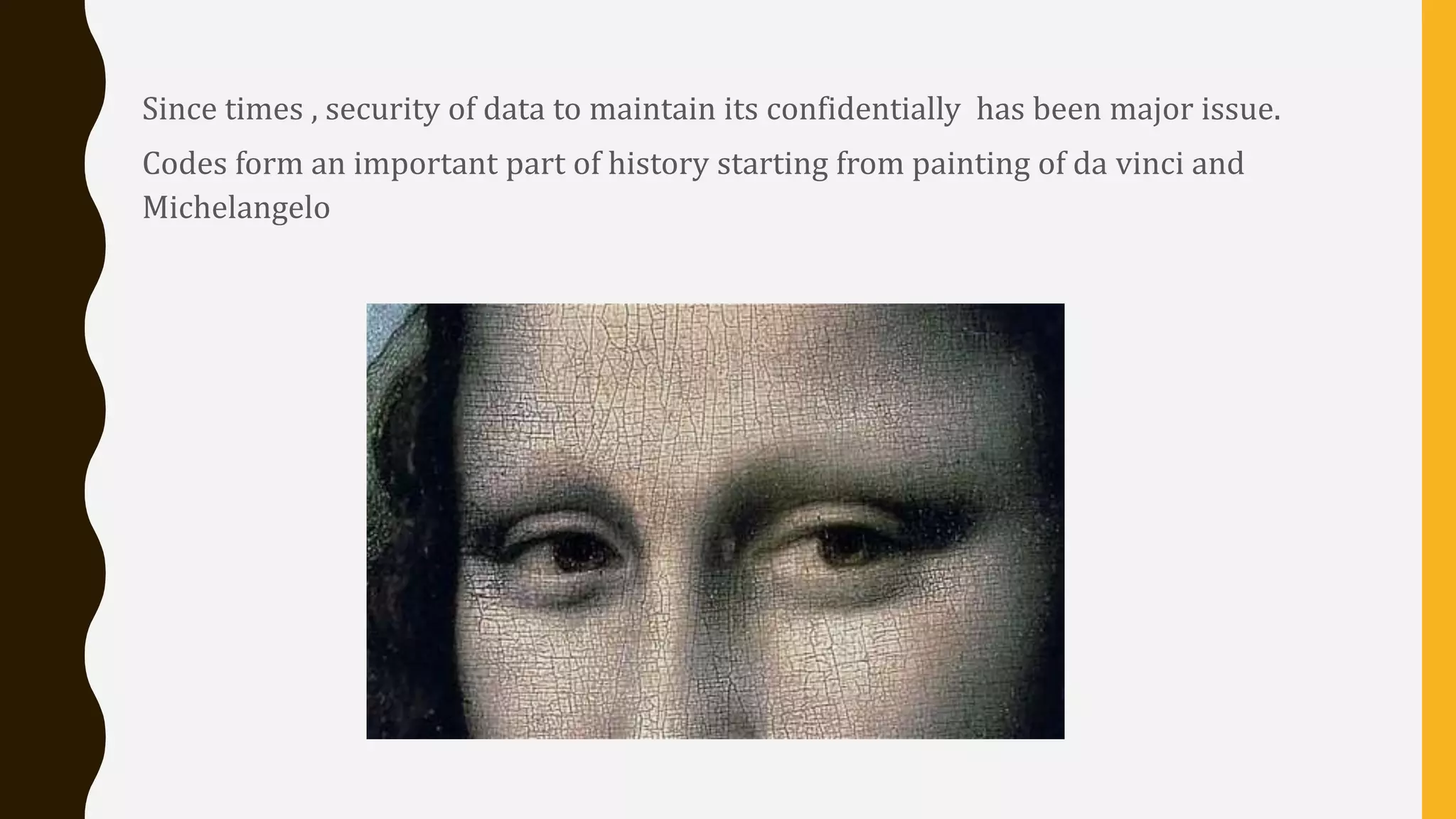
Since times , security of data to maintain its confidentially has been major issue.
Codes form an important part of history starting from painting of da vinci and
Michelangelo
TERMINOLOGY
• Encipher/ encode/ encrypt : A set of steps that converts information into a secret text
(not for all).
• Plaintext : Original information
• Ciphertext : Encrypted form of plaintext. It contains all the information of the plaintext
message, but is not in a format readable by a human or computer without the proper
mechanism to decrypt it.
CRYTOGRAPHY
• a cipher (or cypher) is an algorithm for performing encryption or decryption
• Cryptography is the study of Secret (crypto-)-Writing (-graphy).It is the science or art
of
encompassing the principles and methods of transforming an intelligible message into
one that is intelligible and then transforming the message back to its original for
ENCRYPTION TECHNIQUE
• There are basically two types of encryption techniques
• Substitution :In this technique letters of plaintext are replaced by or by numbers and
symbols.
• Transposition: Transposition (or permutation) does not alter any of the bits in the
plaintext, but instant moves the position around within it.
CAESAR CIPHER
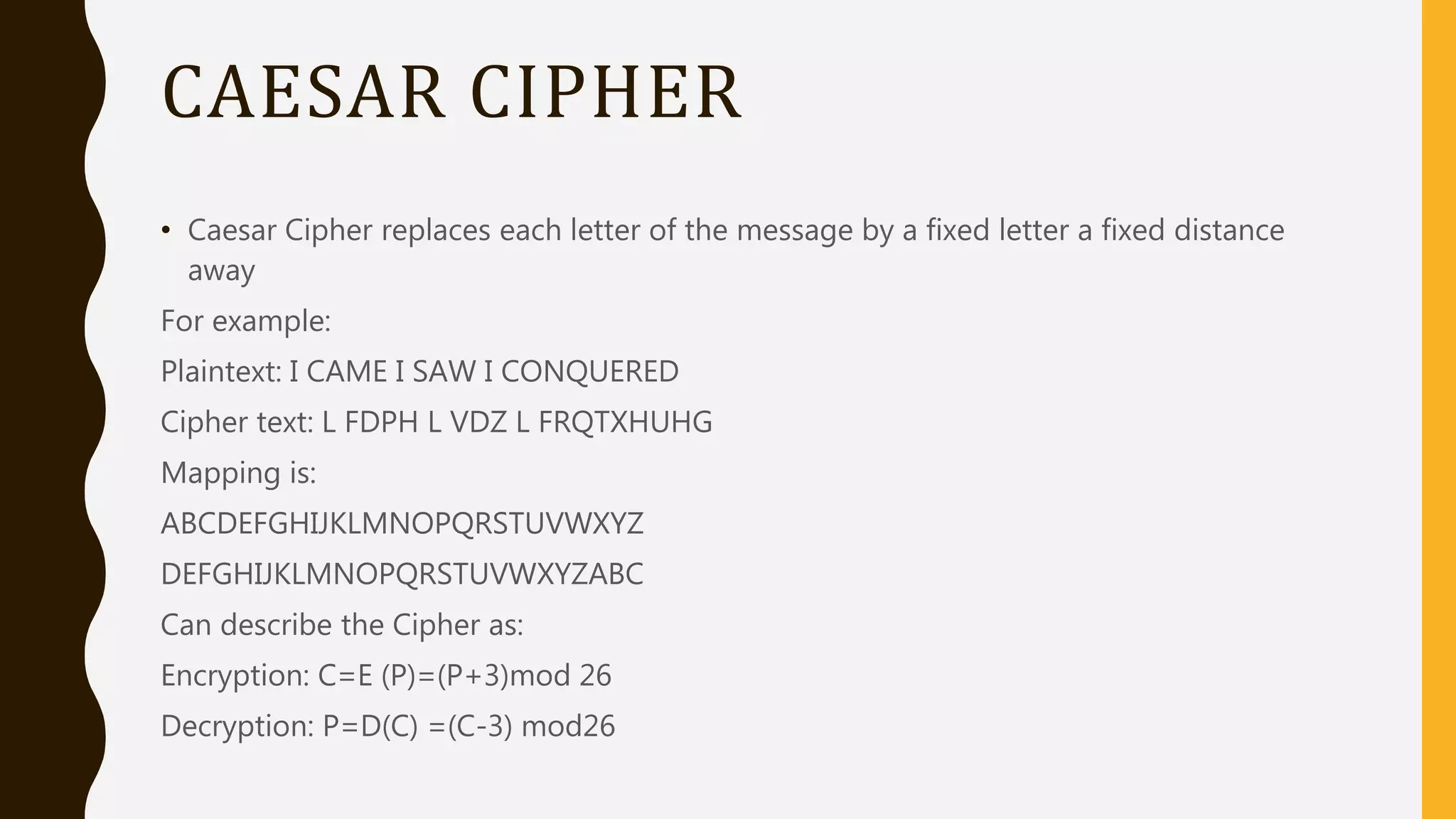
• Caesar Cipher replaces each letter of the message by a fixed letter a fixed distance
away
For example:
Plaintext: I CAME I SAW I CONQUERED
Cipher text: L FDPH L VDZ L FRQTXHUHG
Mapping is:
ABCDEFGHIJKLMNOPQRSTUVWXYZ
DEFGHIJKLMNOPQRSTUVWXYZABC
Can describe the Cipher as:
Encryption: C=E (P)=(P+3)mod 26
Decryption: P=D(C) =(C-3) mod26
PLAY FAIR CIPHER
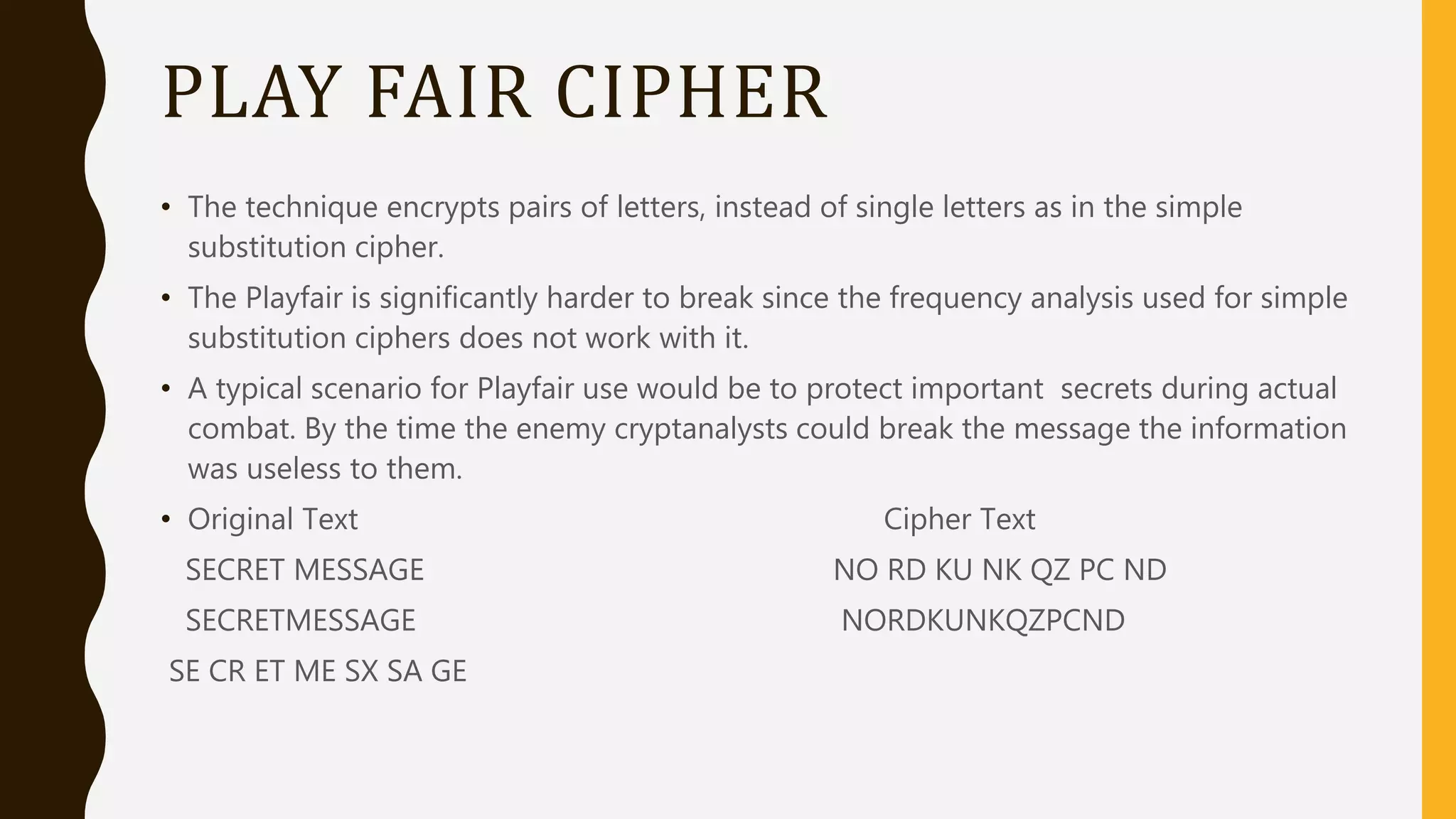
• The technique encrypts pairs of letters, instead of single letters as in the simple
substitution cipher.
• The Playfair is significantly harder to break since the frequency analysis used for simple
substitution ciphers does not work with it.
• A typical scenario for Playfair use would be to protect important secrets during actual
combat. By the time the enemy cryptanalysts could break the message the information
was useless to them.
• Original Text Cipher Text
SECRET MESSAGE NO RD KU NK QZ PC ND
SECRETMESSAGE NORDKUNKQZPCND
SE CR ET ME SX SA GE
MONO-ALPHABETIC-CIPHER
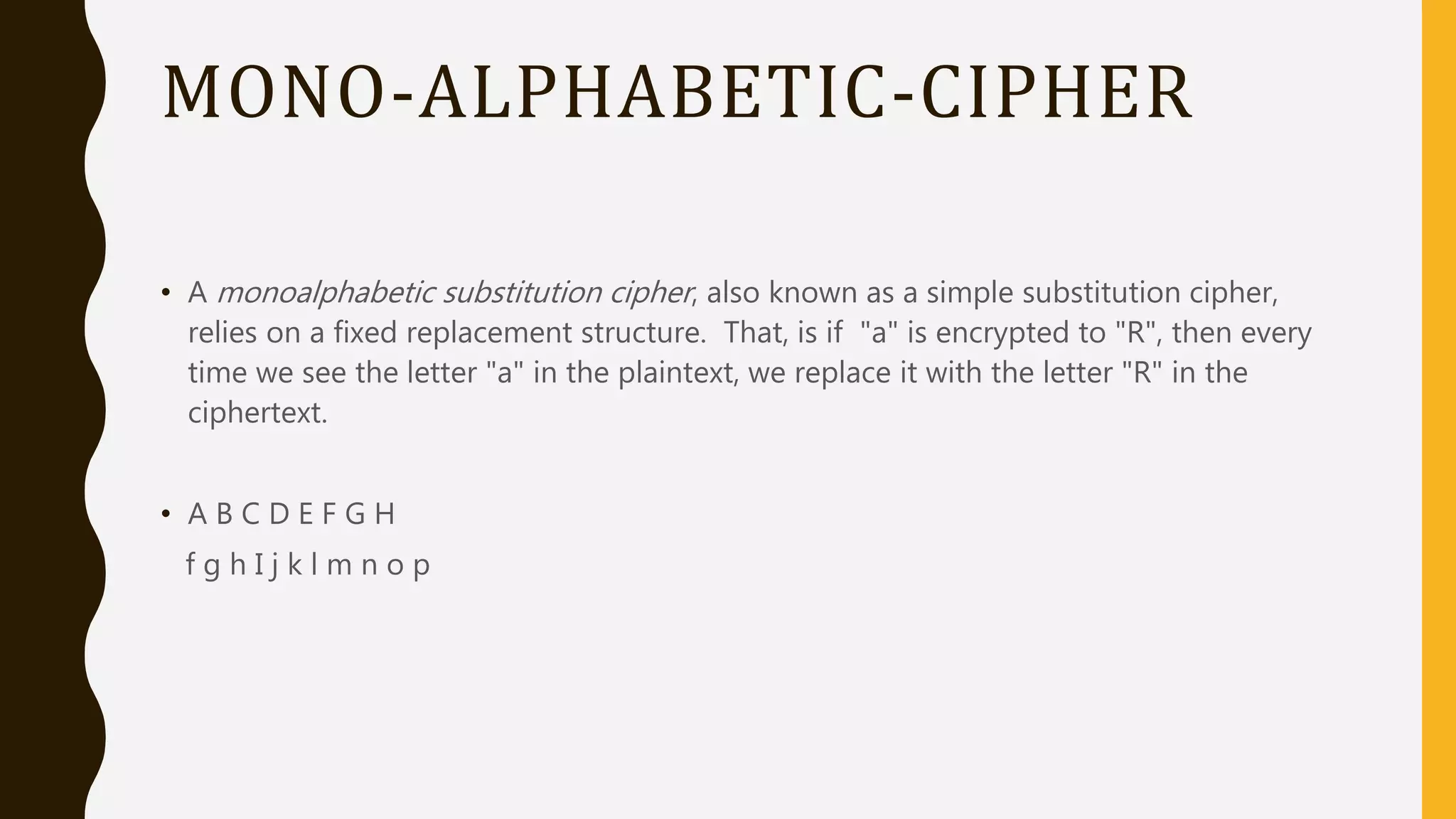
• A monoalphabetic substitution cipher, also known as a simple substitution cipher,
relies on a fixed replacement structure. That, is if "a" is encrypted to "R", then every
time we see the letter "a" in the plaintext, we replace it with the letter "R" in the
ciphertext.
• A B C D E F G H
f g h I j k l m n o p
HILL CIPHERS
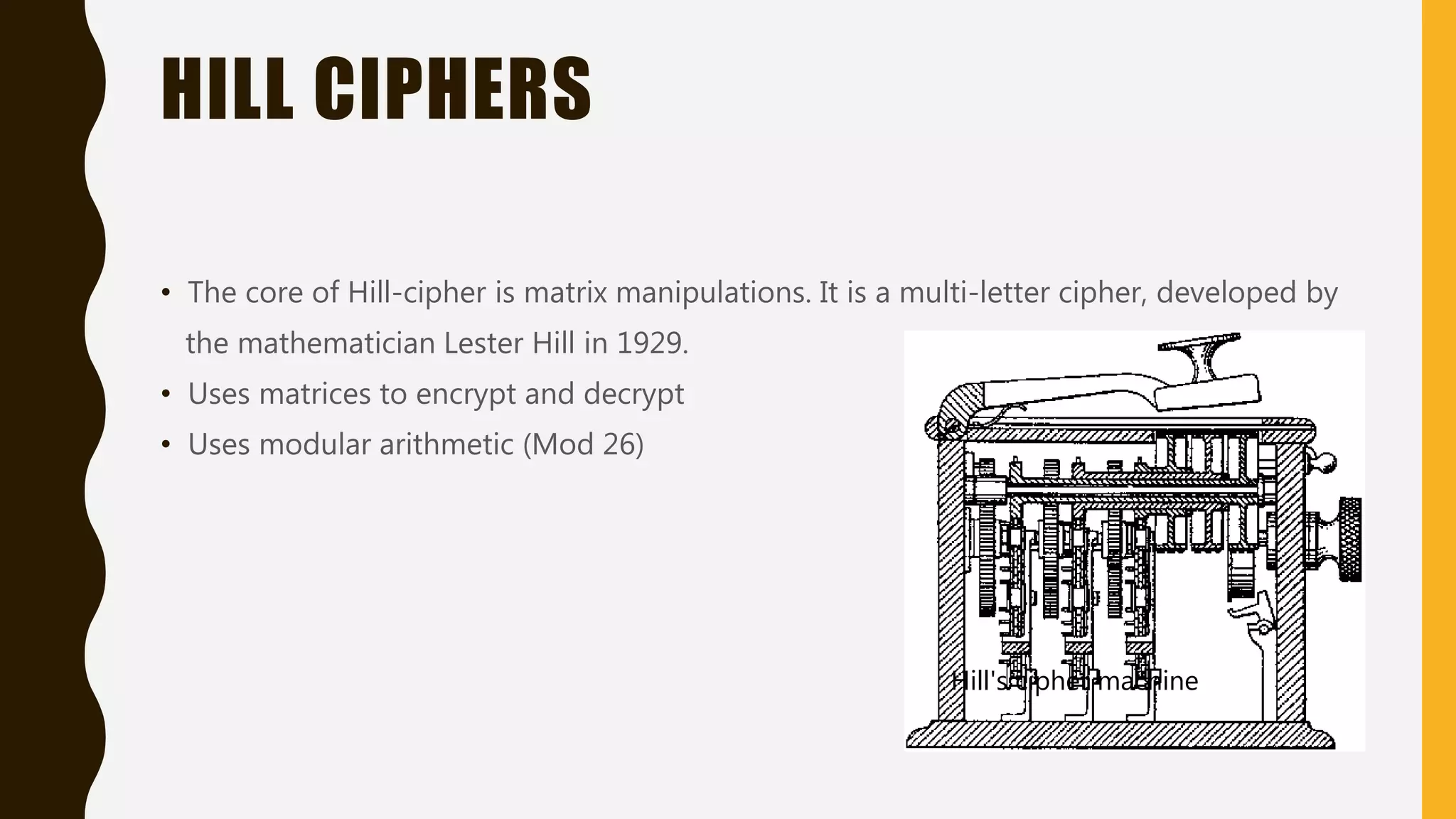
• The core of Hill-cipher is matrix manipulations. It is a multi-letter cipher, developed by
the mathematician Lester Hill in 1929.
• Uses matrices to encrypt and decrypt
• Uses modular arithmetic (Mod 26)
Hill's cipher machine
HISTORY
• Invented by Lester S. Hill in 1929.
• The Hill cipher is a polygraphic substitution cipher based on linear algebra, as it can
work on digraphs, trigraphs (3 letter blocks) or theoretically any sized blocks.
• To counter charges that his system was too complicated for day to day use, Hill
constructed a cipher machine for his system using a series of geared wheels and
chains. However, the machine never really sold.
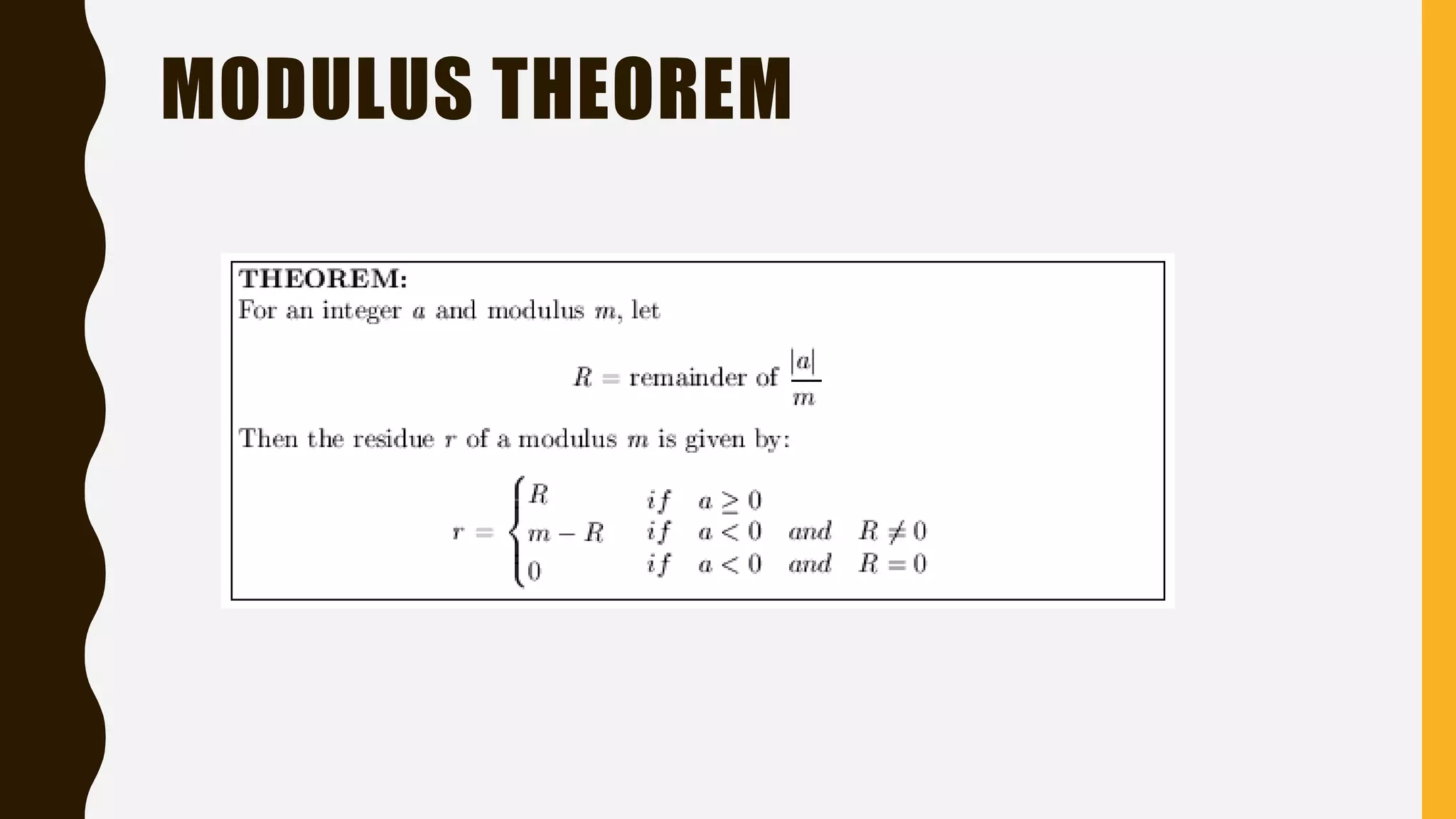
MODULUS THEOREM
MODULAR INVERSES
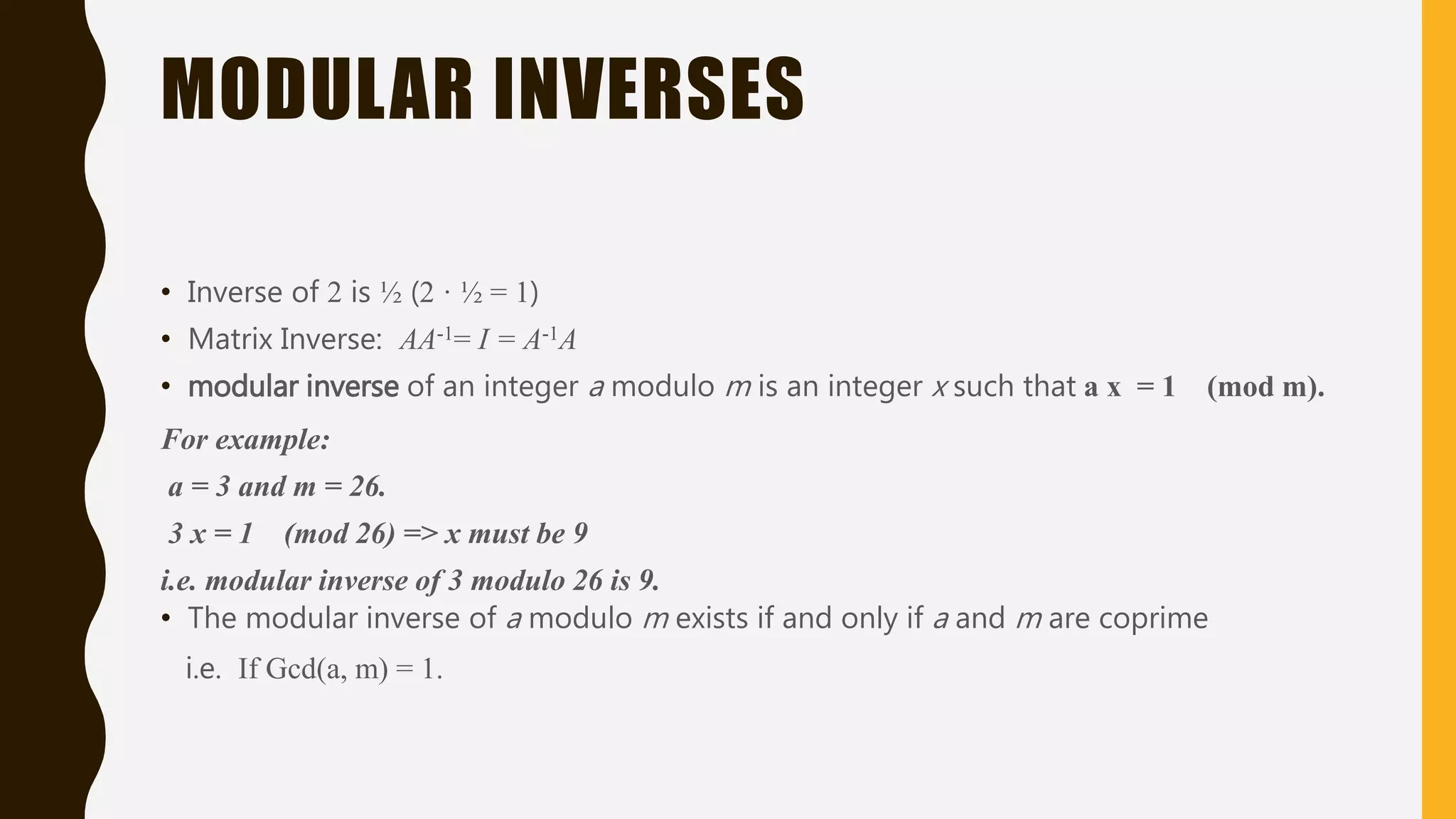
• Inverse of 2 is ½ (2 · ½ = 1)
• Matrix Inverse: AA-1= I = A-1A
• modular inverse of an integer a modulo m is an integer x such that a x = 1 (mod m).
For example:
a = 3 and m = 26.
3 x = 1 (mod 26) => x must be 9
i.e. modular inverse of 3 modulo 26 is 9.
• The modular inverse of a modulo m exists if and only if a and m are coprime
i.e. If Gcd(a, m) = 1.
HILL CIPHER MATRICES
• One matrix to encrypt, one to decrypt
• Must be n x n, invertible matrices
• Decryption matrix must be modular inverse of encryption matrix in Mod 26
• the determinant of encryption matrix must be nonzero, and must not be divisible by 2
or 13
• If the determinant of encryption matrix is 0, or divisible by 2 or 13 then it has
common factors with 26 so modular inverse doesn’t exist and the matrix cannot be
used in the Hill cipher.
ENCRYPTION
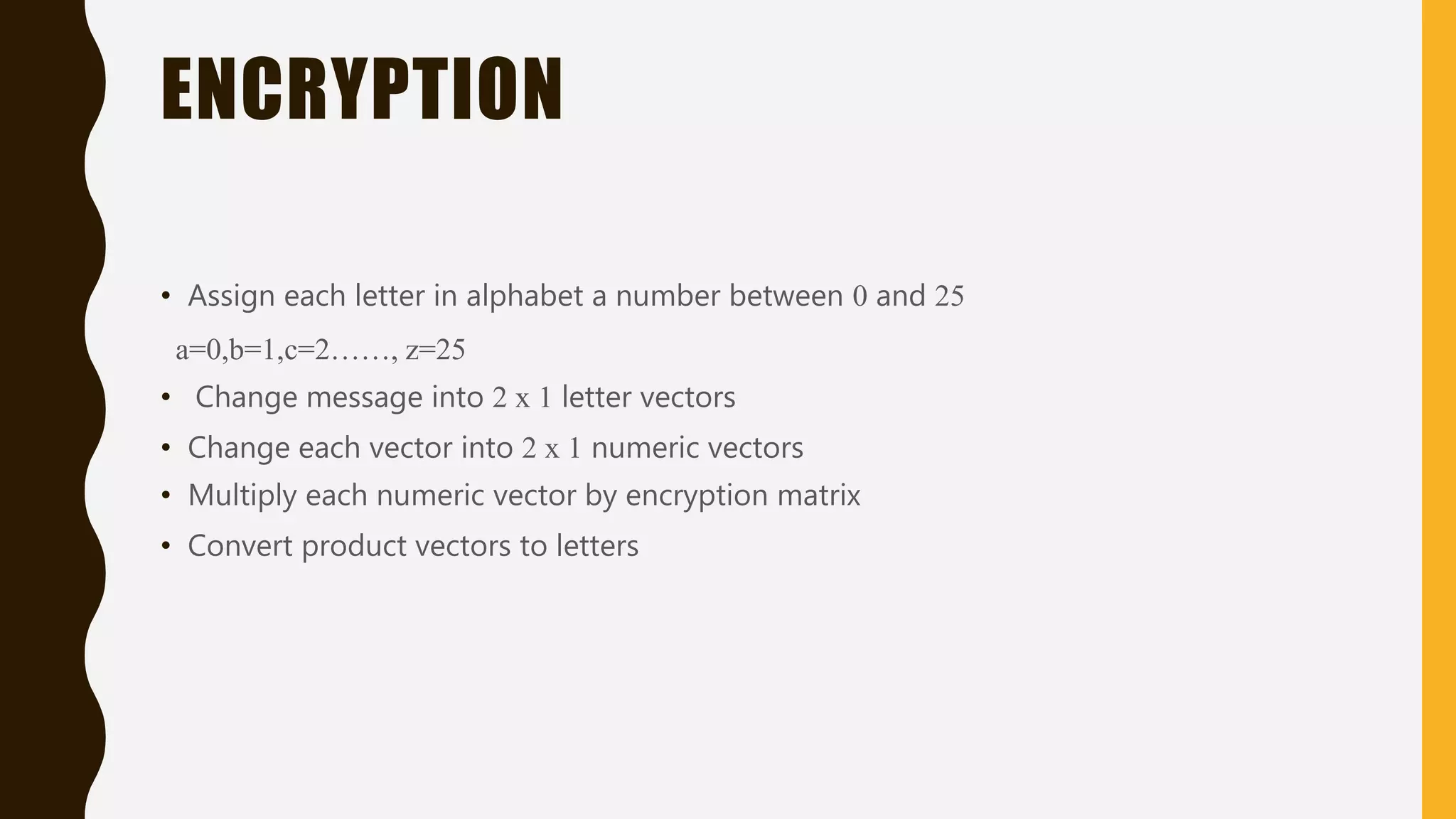
• Assign each letter in alphabet a number between 0 and 25
a=0,b=1,c=2……, z=25
• Change message into 2 x 1 letter vectors
• Change each vector into 2 x 1 numeric vectors
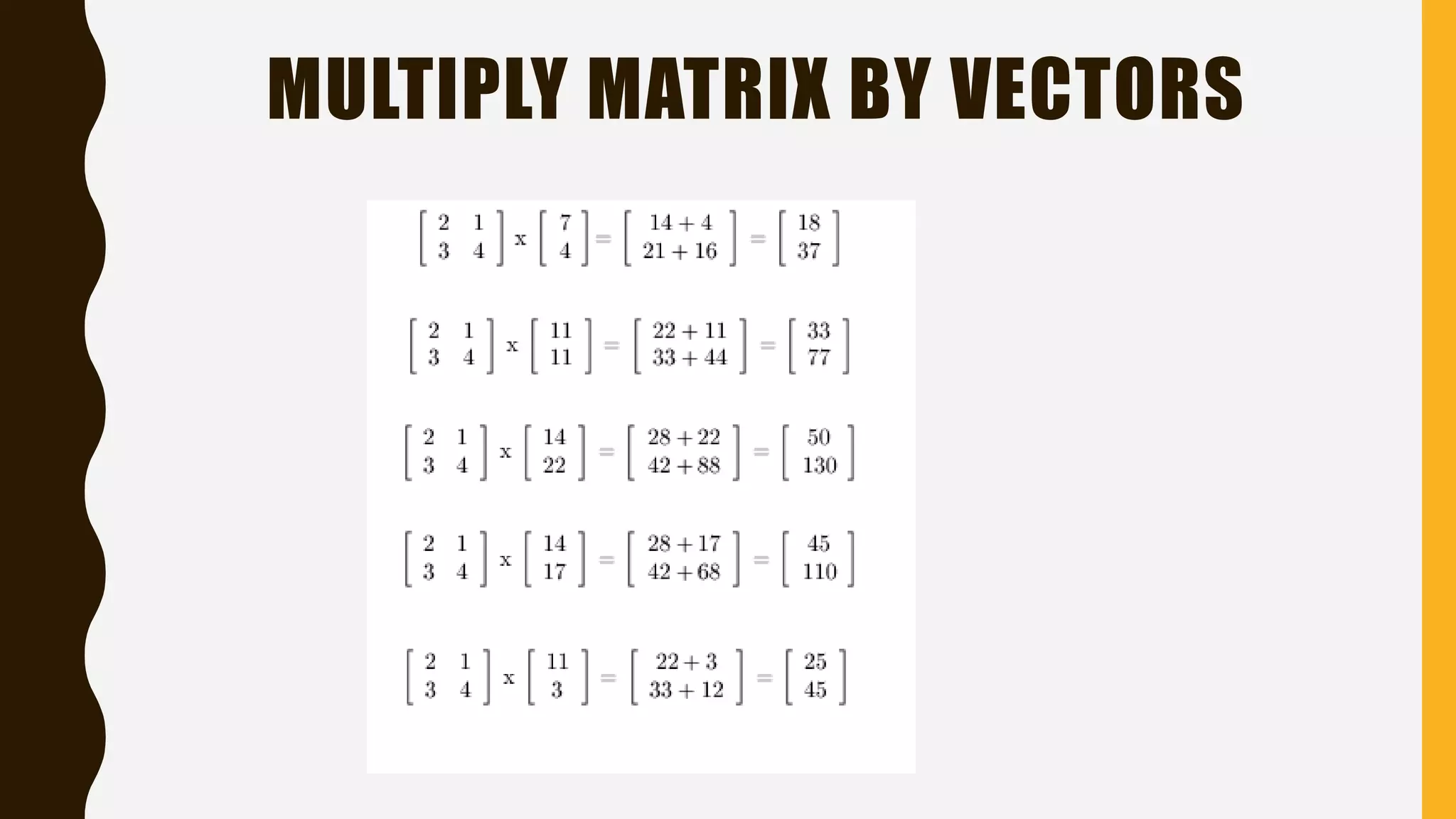
• Multiply each numeric vector by encryption matrix
• Convert product vectors to letters
EXAMPLE
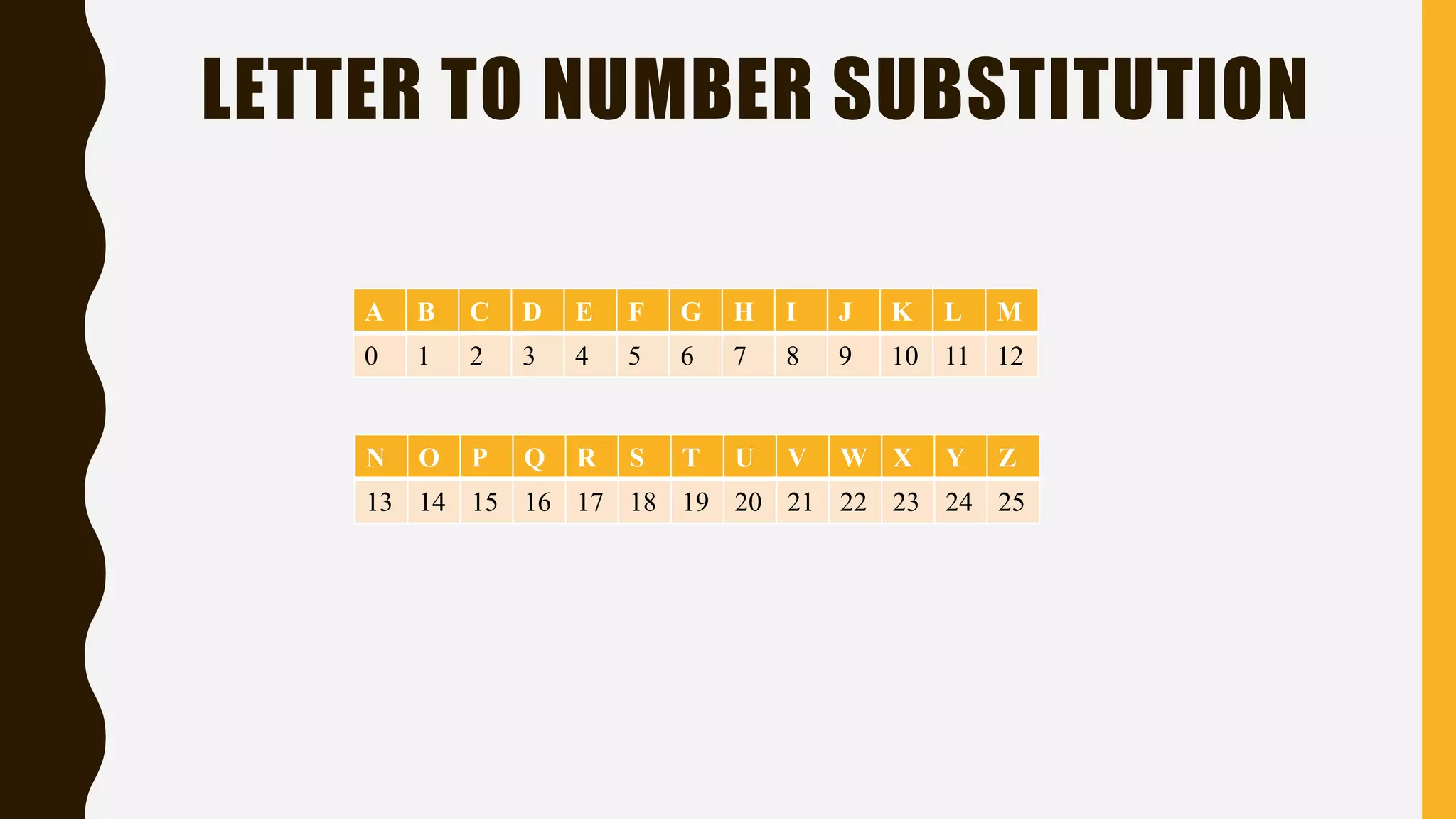
LETTER TO NUMBER SUBSTITUTION
A B C D E F G H I J K L M
0 1 2 3 4 5 6 7 8 9 10 11 12
N O P Q R S T U V W X Y Z
13 14 15 16 17 18 19 20 21 22 23 24 25
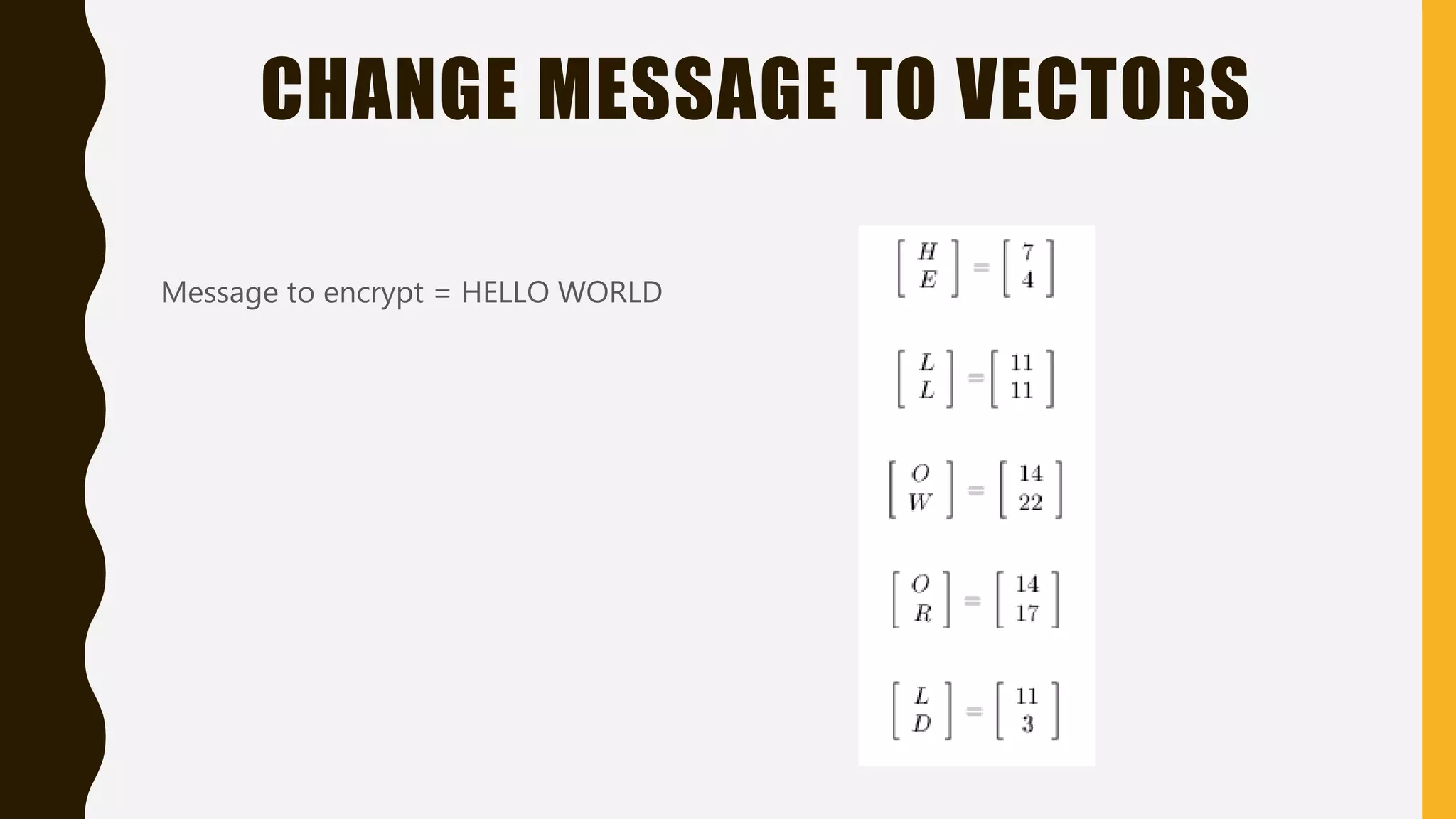
CHANGE MESSAGE TO VECTORS
Message to encrypt = HELLO WORLD
MULTIPLY MATRIX BY VECTORS
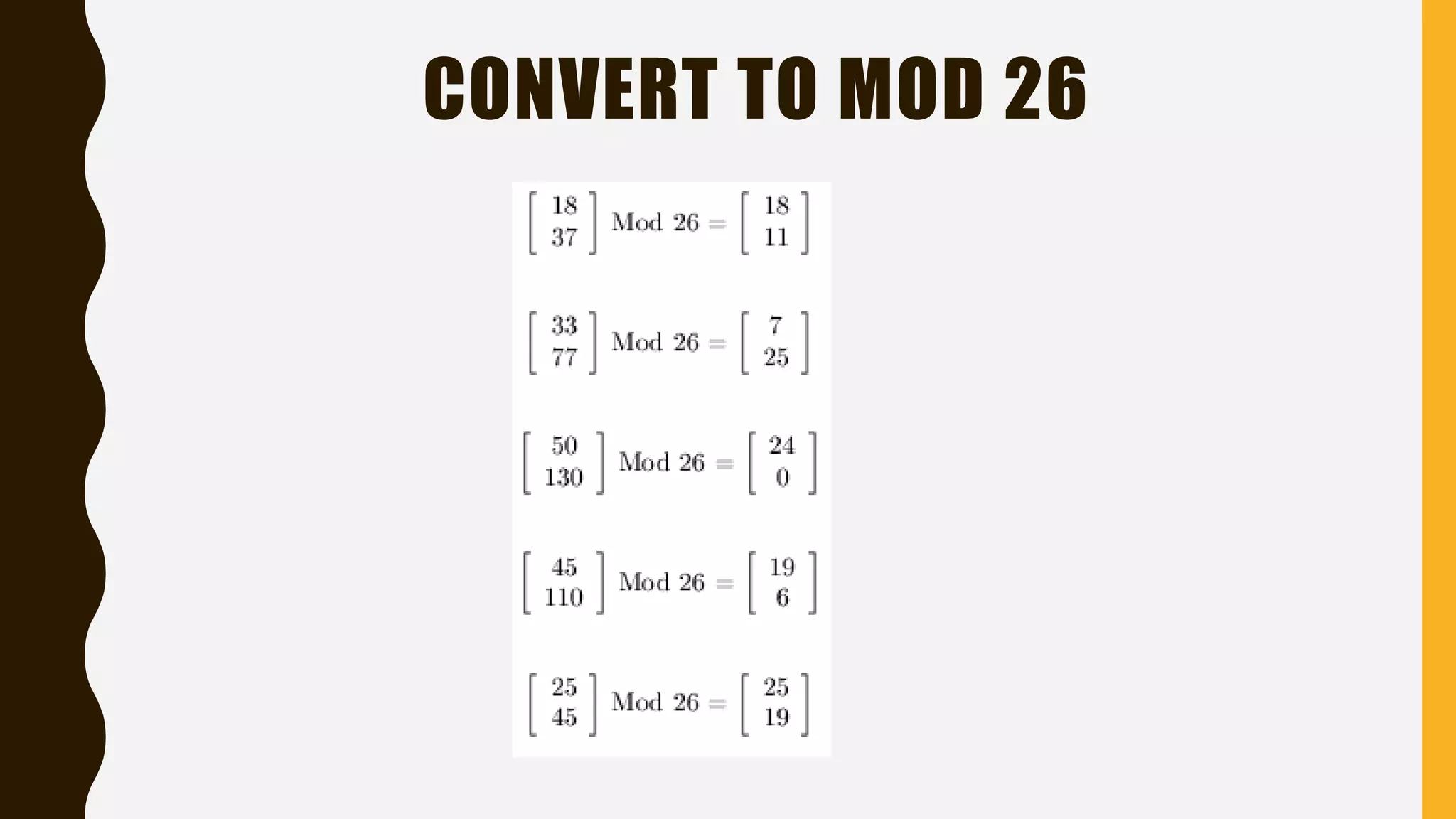
CONVERT TO MOD 26
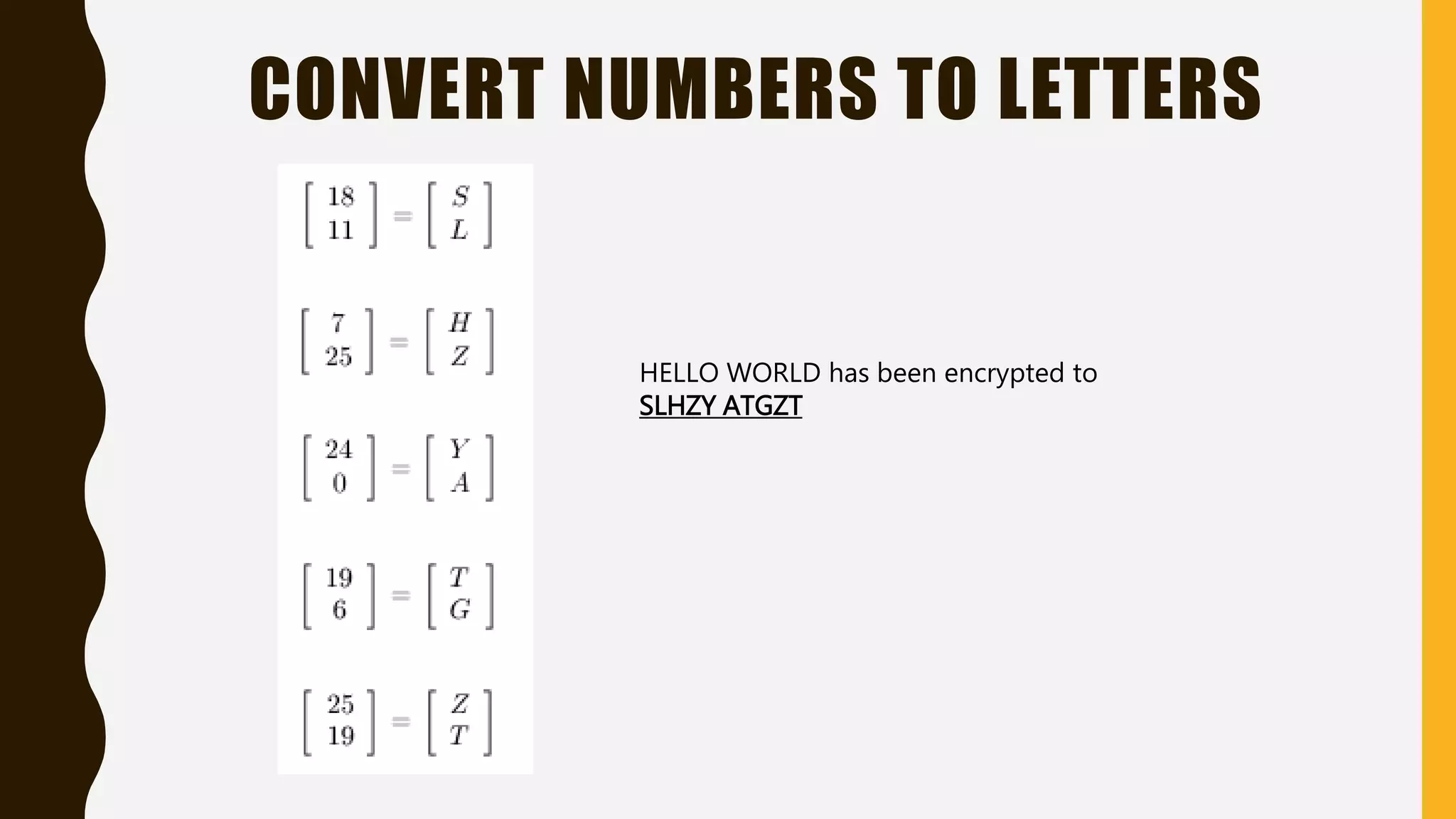
CONVERT NUMBERS TO LETTERS
HELLO WORLD has been encrypted to
SLHZY ATGZT
DECRYPTION MATRIX
• Calculate determinant of given encryption matrix A, det A
• Make sure that det A has a modular inverse for Mod 26
• Calculate the adjoint of A, adj A
• Multiply adj A by modular inverse of det A
• Calculate Mod 26 of the result to get B
• Use A to encrypt, B to decrypt
DECRYPTION
• Change message into 2 x 1 letter vectors
• Change each vector into 2 x 1 numeric vectors
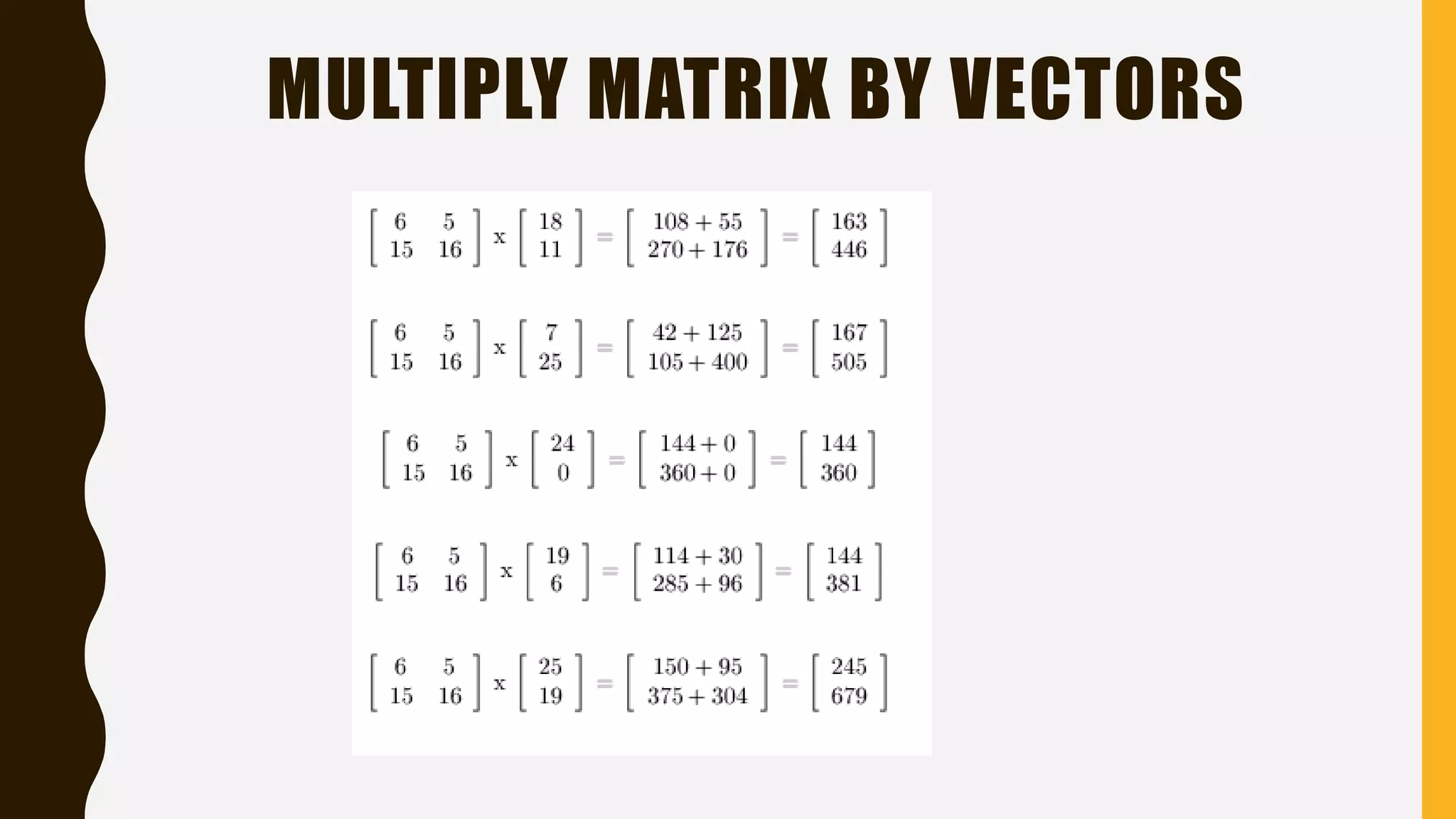
• Multiply each numeric vector by decryption matrix
• Convert new vectors to letters
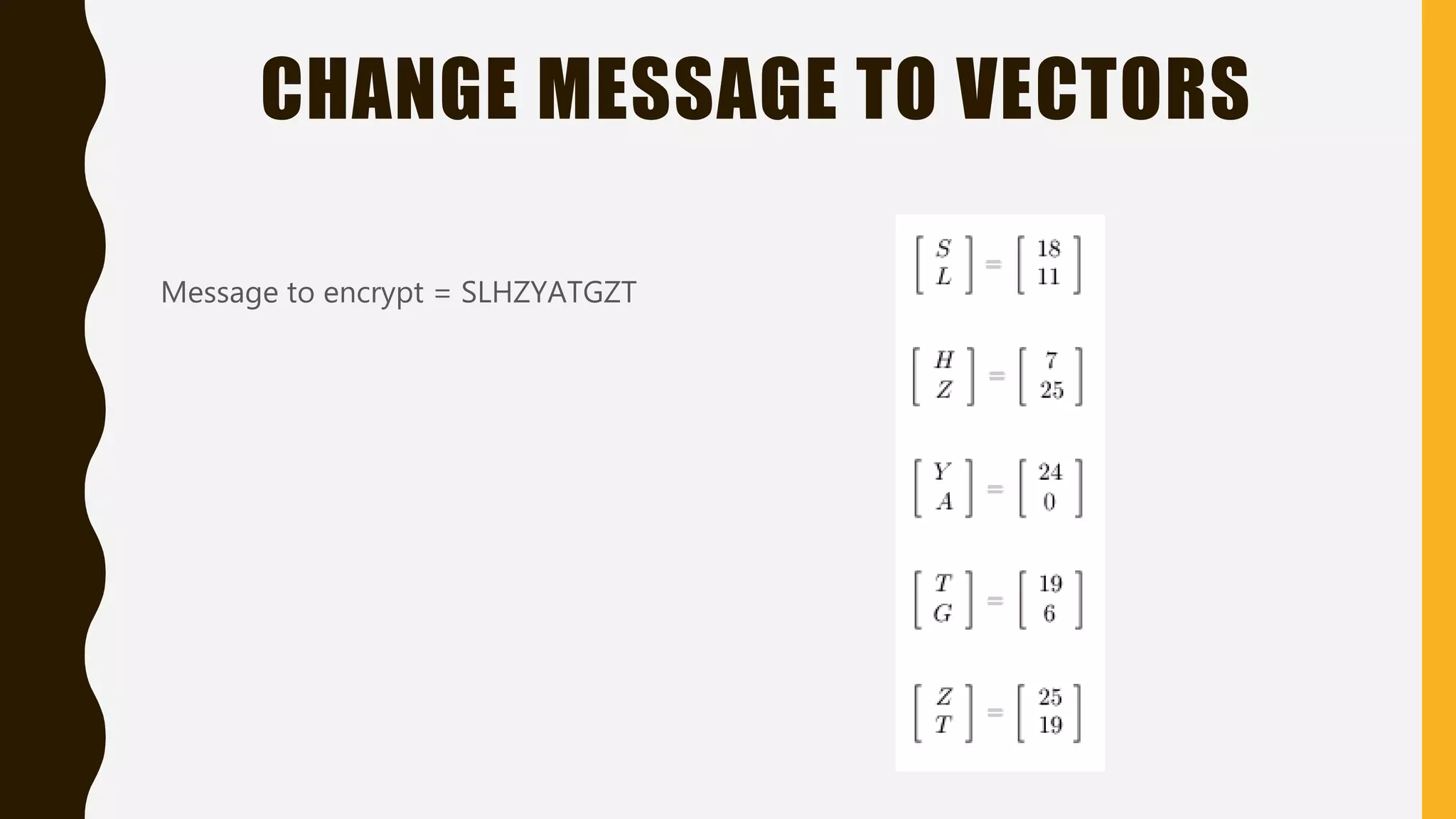
CHANGE MESSAGE TO VECTORS
Message to encrypt = SLHZYATGZT
MULTIPLY MATRIX BY VECTORS
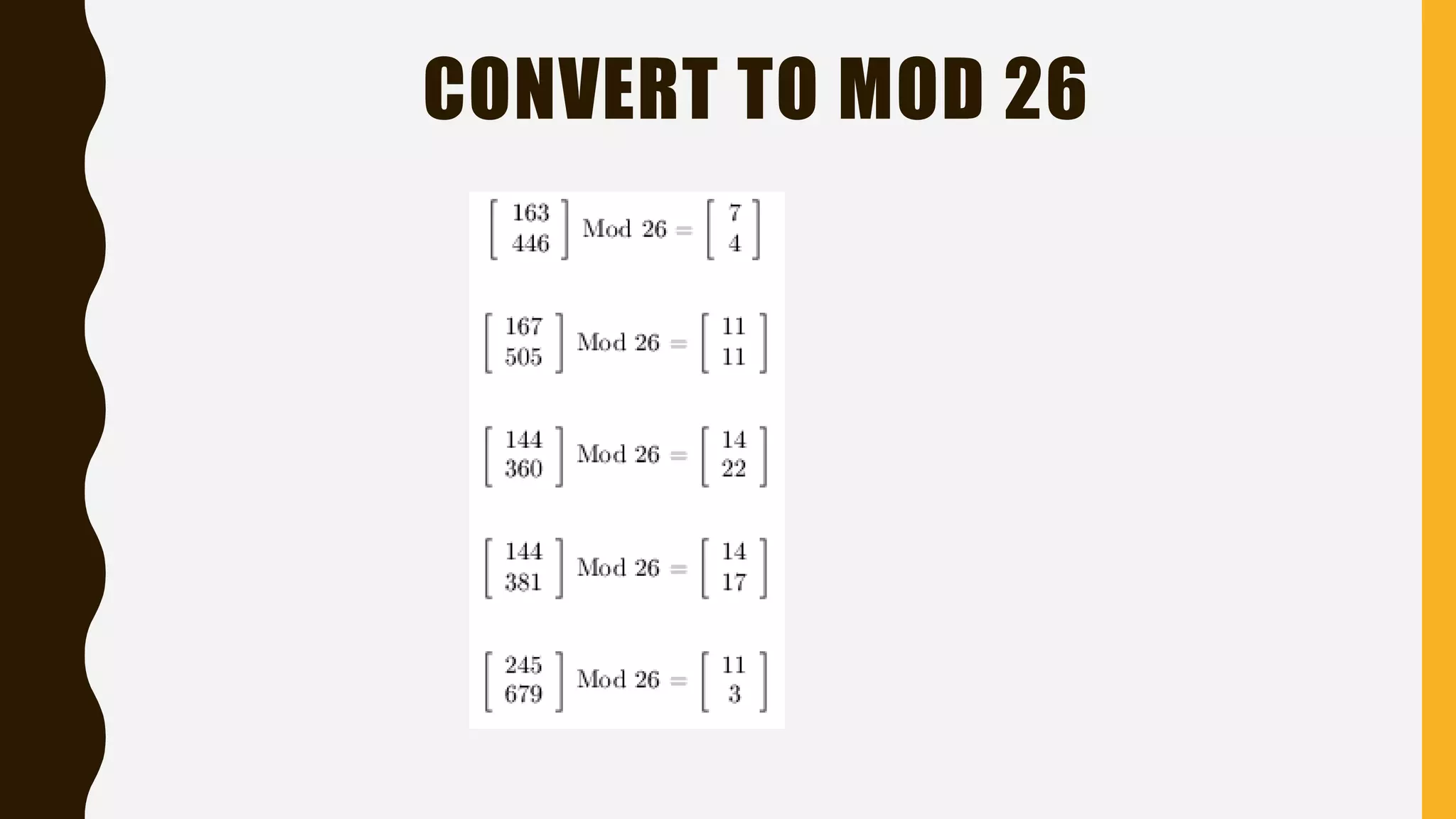
CONVERT TO MOD 26
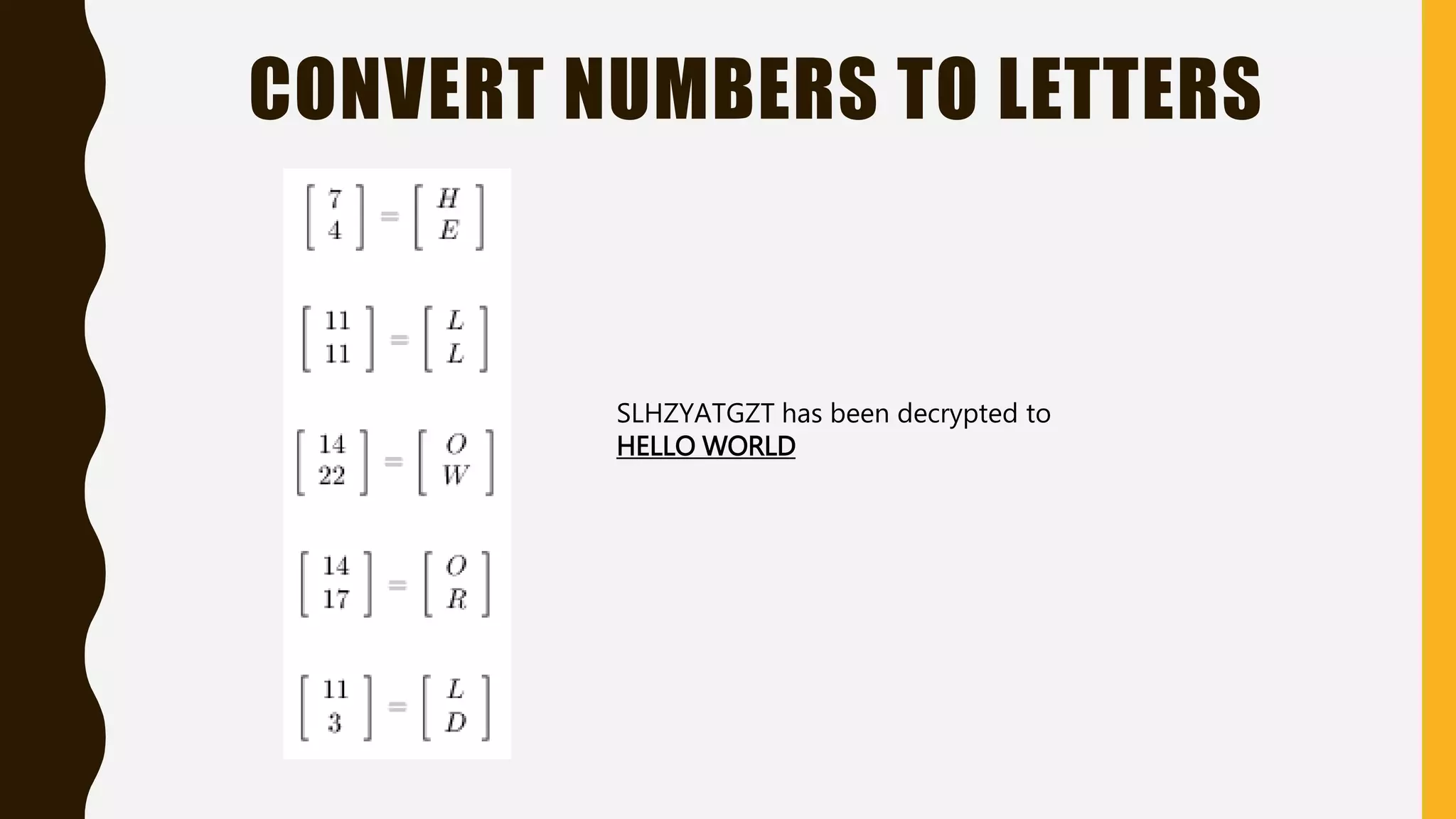
CONVERT NUMBERS TO LETTERS
SLHZYATGZT has been decrypted to
HELLO WORLD
OBJECTIVES
• In the next presentation, we will see how to break through the hill cypher,
requirements for breaking it and we will one or two examples using that.
THANK YOU
REFERENCES
• Wikipedia
– https://en.wikipedia.org/wiki/Hill_cipher

Applications of-linear-algebra-hill-cipher

  • 1.
  • 2.
    Since times ,security of data to maintain its confidentially has been major issue. Codes form an important part of history starting from painting of da vinci and Michelangelo
  • 3.
    TERMINOLOGY • Encipher/ encode/encrypt : A set of steps that converts information into a secret text (not for all). • Plaintext : Original information • Ciphertext : Encrypted form of plaintext. It contains all the information of the plaintext message, but is not in a format readable by a human or computer without the proper mechanism to decrypt it.
  • 4.
    CRYTOGRAPHY • a cipher(or cypher) is an algorithm for performing encryption or decryption • Cryptography is the study of Secret (crypto-)-Writing (-graphy).It is the science or art of encompassing the principles and methods of transforming an intelligible message into one that is intelligible and then transforming the message back to its original for
  • 5.
    ENCRYPTION TECHNIQUE • Thereare basically two types of encryption techniques • Substitution :In this technique letters of plaintext are replaced by or by numbers and symbols. • Transposition: Transposition (or permutation) does not alter any of the bits in the plaintext, but instant moves the position around within it.
  • 6.
    CAESAR CIPHER • CaesarCipher replaces each letter of the message by a fixed letter a fixed distance away For example: Plaintext: I CAME I SAW I CONQUERED Cipher text: L FDPH L VDZ L FRQTXHUHG Mapping is: ABCDEFGHIJKLMNOPQRSTUVWXYZ DEFGHIJKLMNOPQRSTUVWXYZABC Can describe the Cipher as: Encryption: C=E (P)=(P+3)mod 26 Decryption: P=D(C) =(C-3) mod26
  • 7.
    PLAY FAIR CIPHER •The technique encrypts pairs of letters, instead of single letters as in the simple substitution cipher. • The Playfair is significantly harder to break since the frequency analysis used for simple substitution ciphers does not work with it. • A typical scenario for Playfair use would be to protect important secrets during actual combat. By the time the enemy cryptanalysts could break the message the information was useless to them. • Original Text Cipher Text SECRET MESSAGE NO RD KU NK QZ PC ND SECRETMESSAGE NORDKUNKQZPCND SE CR ET ME SX SA GE
  • 8.
    MONO-ALPHABETIC-CIPHER • A monoalphabeticsubstitution cipher, also known as a simple substitution cipher, relies on a fixed replacement structure. That, is if "a" is encrypted to "R", then every time we see the letter "a" in the plaintext, we replace it with the letter "R" in the ciphertext. • A B C D E F G H f g h I j k l m n o p
  • 9.
    HILL CIPHERS • Thecore of Hill-cipher is matrix manipulations. It is a multi-letter cipher, developed by the mathematician Lester Hill in 1929. • Uses matrices to encrypt and decrypt • Uses modular arithmetic (Mod 26) Hill's cipher machine
  • 10.
    HISTORY • Invented byLester S. Hill in 1929. • The Hill cipher is a polygraphic substitution cipher based on linear algebra, as it can work on digraphs, trigraphs (3 letter blocks) or theoretically any sized blocks. • To counter charges that his system was too complicated for day to day use, Hill constructed a cipher machine for his system using a series of geared wheels and chains. However, the machine never really sold.
  • 11.
  • 12.
    MODULAR INVERSES • Inverseof 2 is ½ (2 · ½ = 1) • Matrix Inverse: AA-1= I = A-1A • modular inverse of an integer a modulo m is an integer x such that a x = 1 (mod m). For example: a = 3 and m = 26. 3 x = 1 (mod 26) => x must be 9 i.e. modular inverse of 3 modulo 26 is 9. • The modular inverse of a modulo m exists if and only if a and m are coprime i.e. If Gcd(a, m) = 1.
  • 13.
    HILL CIPHER MATRICES •One matrix to encrypt, one to decrypt • Must be n x n, invertible matrices • Decryption matrix must be modular inverse of encryption matrix in Mod 26 • the determinant of encryption matrix must be nonzero, and must not be divisible by 2 or 13 • If the determinant of encryption matrix is 0, or divisible by 2 or 13 then it has common factors with 26 so modular inverse doesn’t exist and the matrix cannot be used in the Hill cipher.
  • 14.
    ENCRYPTION • Assign eachletter in alphabet a number between 0 and 25 a=0,b=1,c=2……, z=25 • Change message into 2 x 1 letter vectors • Change each vector into 2 x 1 numeric vectors • Multiply each numeric vector by encryption matrix • Convert product vectors to letters
  • 15.
  • 16.
    LETTER TO NUMBERSUBSTITUTION A B C D E F G H I J K L M 0 1 2 3 4 5 6 7 8 9 10 11 12 N O P Q R S T U V W X Y Z 13 14 15 16 17 18 19 20 21 22 23 24 25
  • 17.
    CHANGE MESSAGE TOVECTORS Message to encrypt = HELLO WORLD
  • 18.
  • 19.
  • 20.
    CONVERT NUMBERS TOLETTERS HELLO WORLD has been encrypted to SLHZY ATGZT
  • 21.
    DECRYPTION MATRIX • Calculatedeterminant of given encryption matrix A, det A • Make sure that det A has a modular inverse for Mod 26 • Calculate the adjoint of A, adj A • Multiply adj A by modular inverse of det A • Calculate Mod 26 of the result to get B • Use A to encrypt, B to decrypt
  • 22.
    DECRYPTION • Change messageinto 2 x 1 letter vectors • Change each vector into 2 x 1 numeric vectors • Multiply each numeric vector by decryption matrix • Convert new vectors to letters
  • 23.
    CHANGE MESSAGE TOVECTORS Message to encrypt = SLHZYATGZT
  • 24.
  • 25.
  • 26.
    CONVERT NUMBERS TOLETTERS SLHZYATGZT has been decrypted to HELLO WORLD
  • 27.
    OBJECTIVES • In thenext presentation, we will see how to break through the hill cypher, requirements for breaking it and we will one or two examples using that.
  • 28.
  • 29.