Image encryption using elliptical curve cryptosytem with hill cipher
This document discusses an image encryption technique that combines the elliptic curve cryptosystem with the hill cipher, addressing the need for secure communication of images over the internet. It details the limitations of existing encryption methods and promotes the efficiency and security improvements offered by the proposed elliptic curve with hill cipher algorithm. The document also outlines key generation, encryption, and decryption processes involved in this new technique, along with an implementation timeline.
Introduction to image encryption, importance due to internet communication, process of encryption/decryption, and cryptography's role in securing images.
Overview of various encryption techniques like Hash Function, Chaotic Logistic Maps, and Affine Transform. Mention the speed issues in current techniques.
Details on Hill Cipher's symmetric technique, its structure, speed, and weaknesses such as the need for key-sharing.
Introduction to ECC as an asymmetric cryptographic technique, its advantages like small key size and security enhancement of Hill Cipher.
Detailed ECC algorithm, fixing parameters, key generation processes for users, and steps for image encryption and decryption.
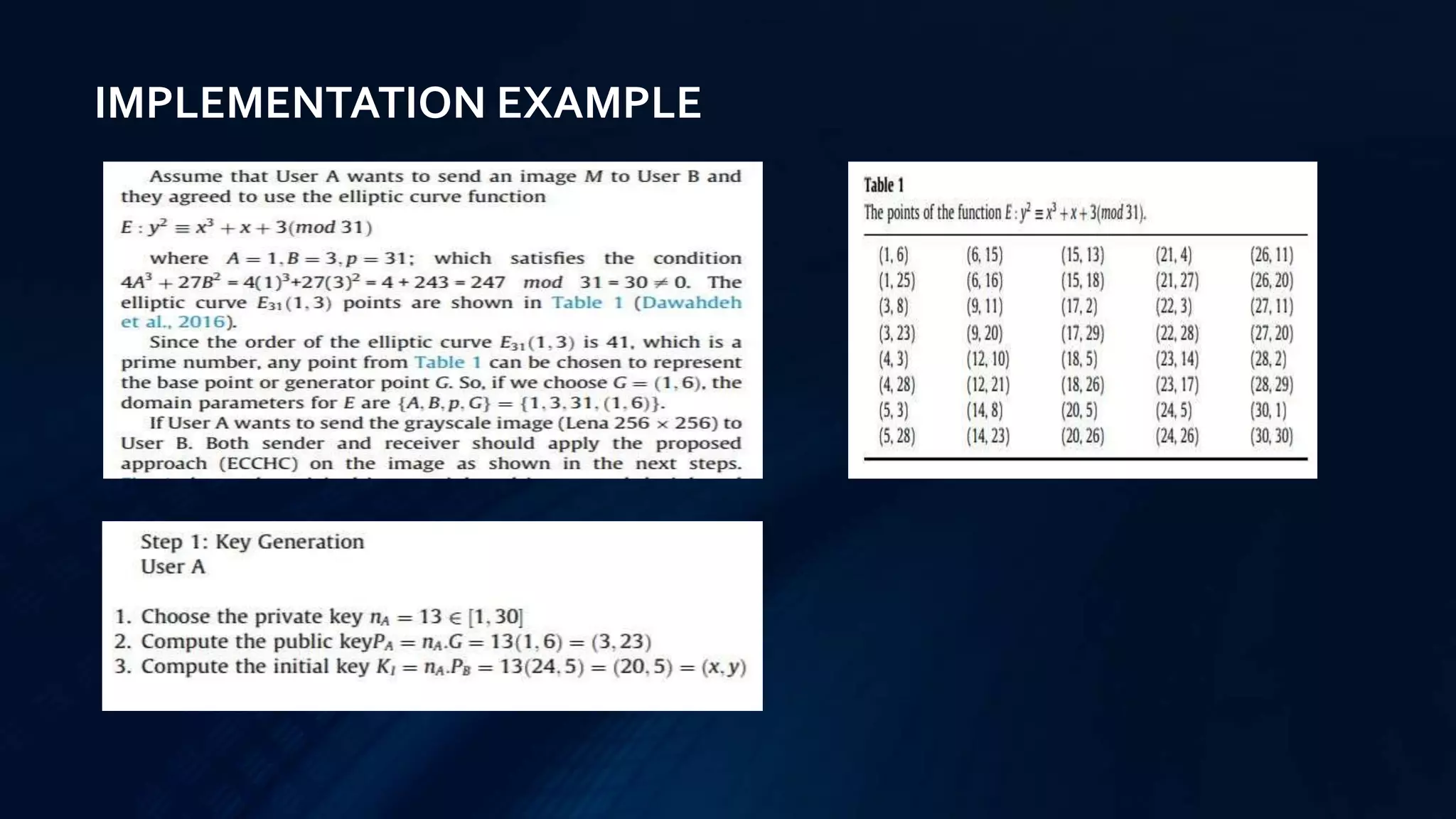
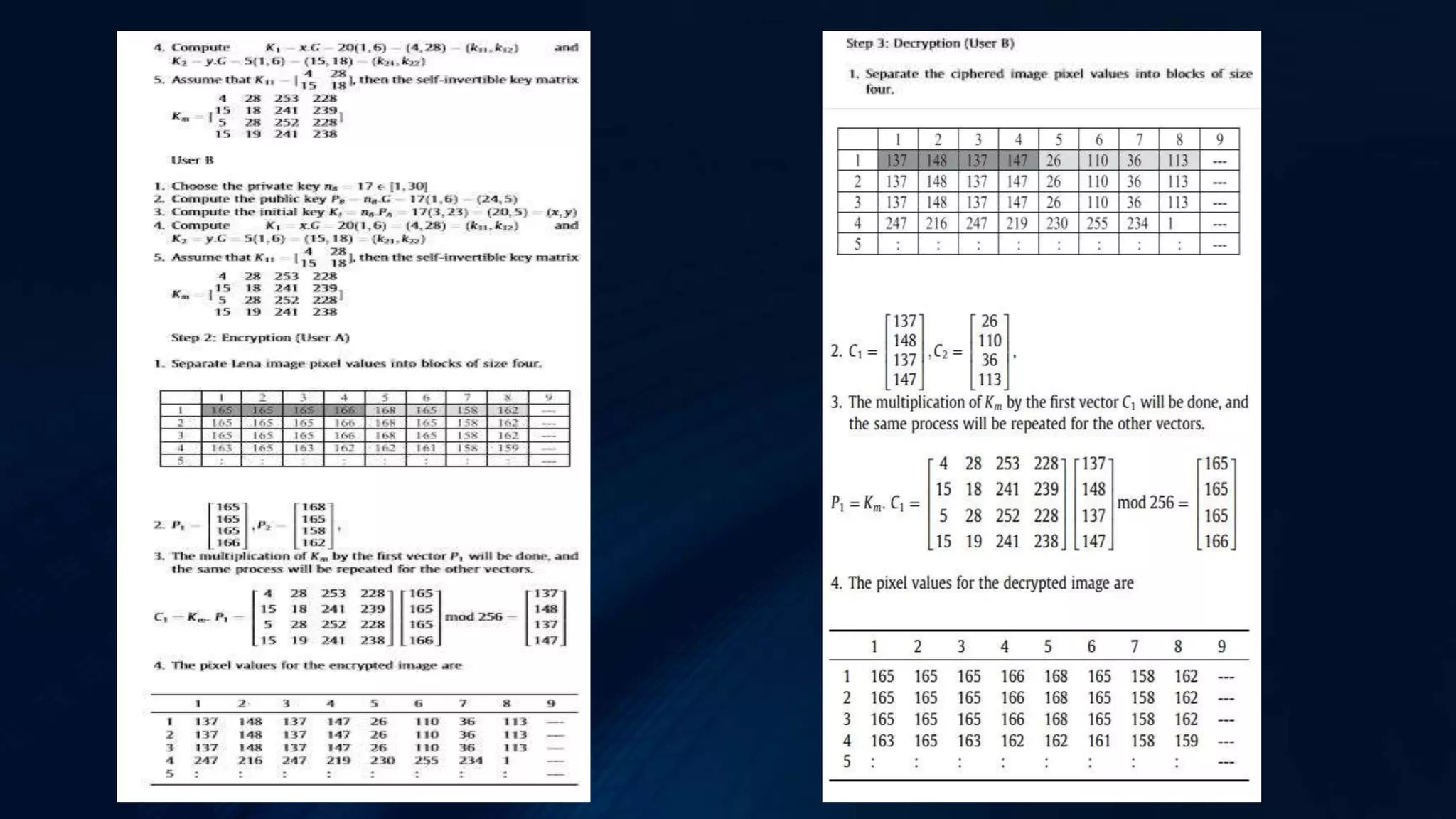
Examples of how the proposed encryption techniques can be implemented.
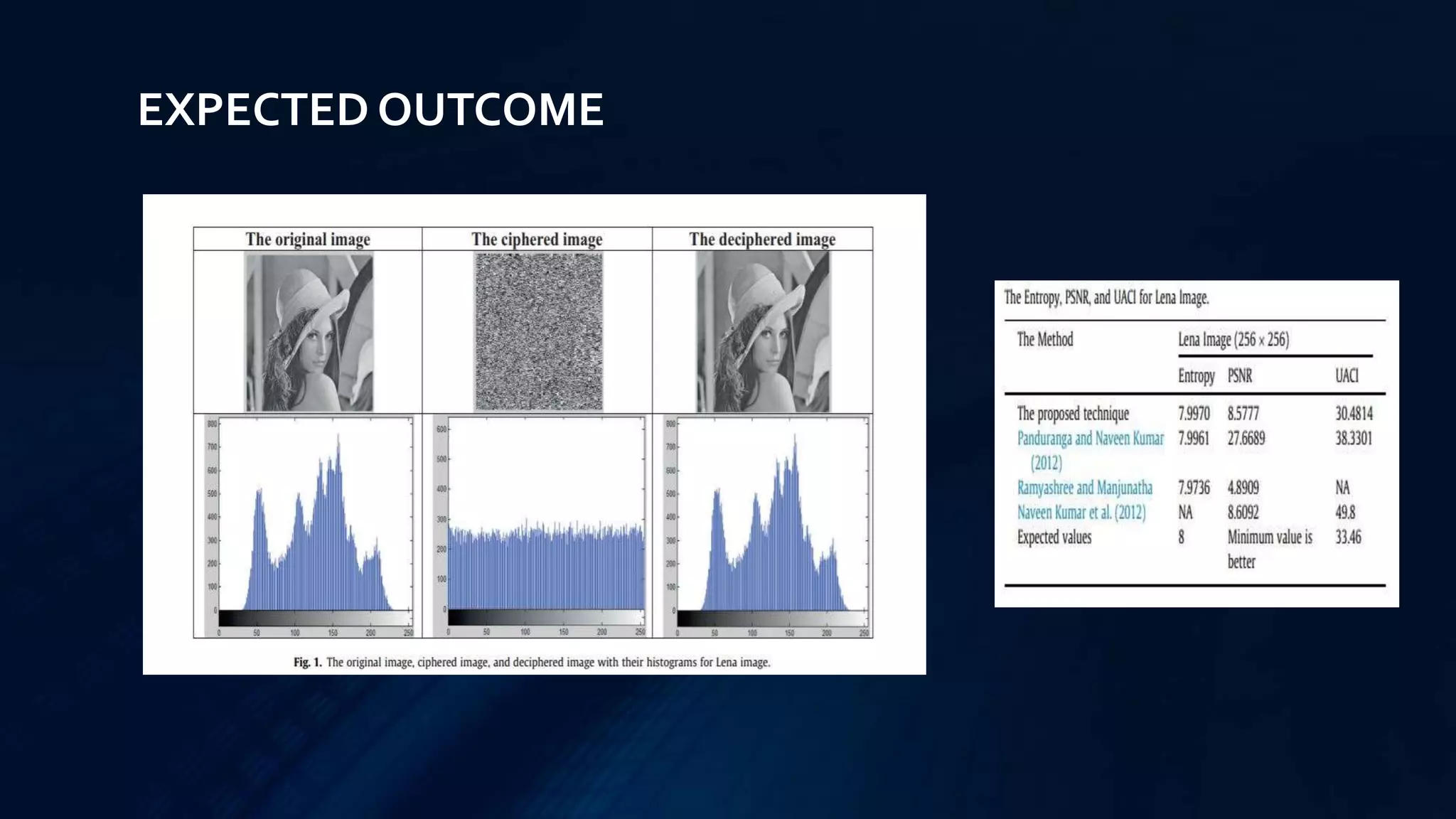
The expected results and improvements from using the combined Elliptic Curve and Hill Cipher techniques.
Reference to the original research work relevant to the encryption technique discussed.
Timeline for project tasks from December to April, including theory study, design, and writing.
INTRODUCTION
• Image encryptionis rapidly increased recently by the increasing use of the
internet and communication media
• Sharing important images over unsecured channels is liable for attacking
and stealing.Encryption techniques are the suitable methods to protect
images from attacks.
• Encryption is done by the sender to convert the original grayscale image to
encrypted image before sending it via the internet to the other user
(recipient). Decryption is done by the receiver to return the ciphered image
back to the original image.
• Cryptography is one of the mathematical techniques that are used to
protect images from adversaries and increase the security of
communications.
3.
A FEW EXISTINGIMAGE ENCRYPTION
TECHNIQUES . .
• Image Encryption Algorithm Based on Hash Function:
Firstly does pre-processing operation to shuffle one half of image then hash function to
generate a random number mask.The mask is then XORed with the other part of the image
which is going to be encrypted.
• Algorithm Based Composition ofTwo Chaotic Logistic Maps:
It composes two chaotic logistic maps and external secret key for encryption of image. In this
an external secret key of 104 bit and two chaotic logistic maps are used to differentiate
between the encrypted image and the plain image.
• Algorithm Using AffineTransform and XOR Operation:
Uses AffineTransform and was based on shuffling the image pixels. It was two phase
encryption decryption algorithm. Firstly using XOR operation they encrypted the resulting
image and then using the affine transformation, the pixel values were redistributed to different
locations with 4 bit keys.
NOTE:All the existing encryption techniques, lack the speed in Encrypting & Decrypting the image but
HILL CIPHERTECHNIQUE with convenient modifications increases the security and reduces the
vulnerability.
4.
HILL CIPHER TECHNIQUE
•Hill cipher algorithm is one of the symmetric techniques, it has a
simple structure and fast computations.
• In symmetric encryption, the same key (private key) is used for both
encryption and decryption processes.
• Hill cipher algorithm has high throughput, high speed, and simple
structure, but weak security because both sender and receiver should
use and share the same key (private key) via unsecured channels.
• Hill cipher employs polygraphic substitution cipher based on linear
algebra. It uses matrices and matrix multiplication to mix up the
plaintext.
5.
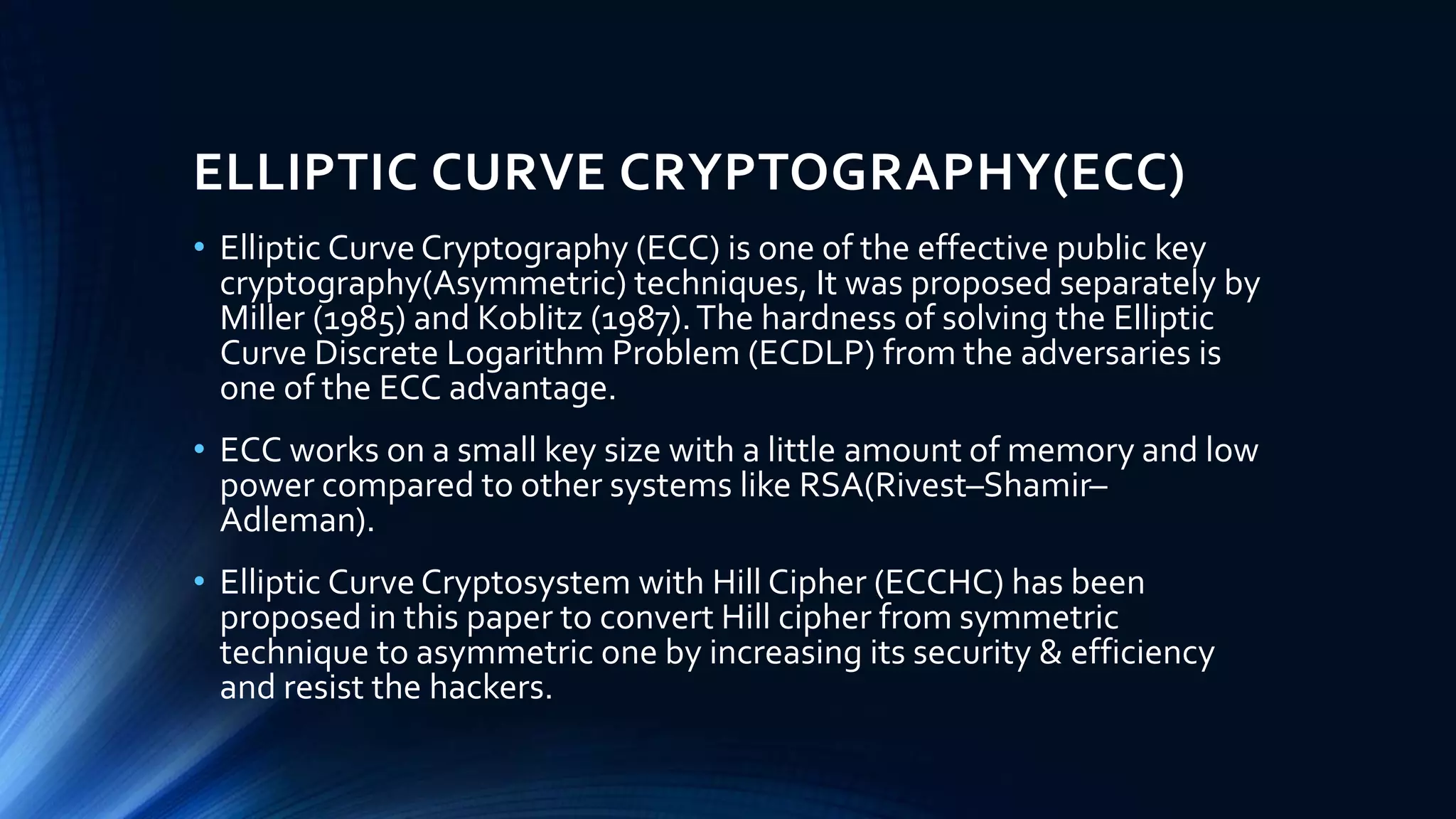
ELLIPTIC CURVE CRYPTOGRAPHY(ECC)
•Elliptic Curve Cryptography (ECC) is one of the effective public key
cryptography(Asymmetric) techniques, It was proposed separately by
Miller (1985) and Koblitz (1987).The hardness of solving the Elliptic
Curve Discrete Logarithm Problem (ECDLP) from the adversaries is
one of the ECC advantage.
• ECC works on a small key size with a little amount of memory and low
power compared to other systems like RSA(Rivest–Shamir–
Adleman).
• Elliptic Curve Cryptosystem with Hill Cipher (ECCHC) has been
proposed in this paper to convert Hill cipher from symmetric
technique to asymmetric one by increasing its security & efficiency
and resist the hackers.
6.
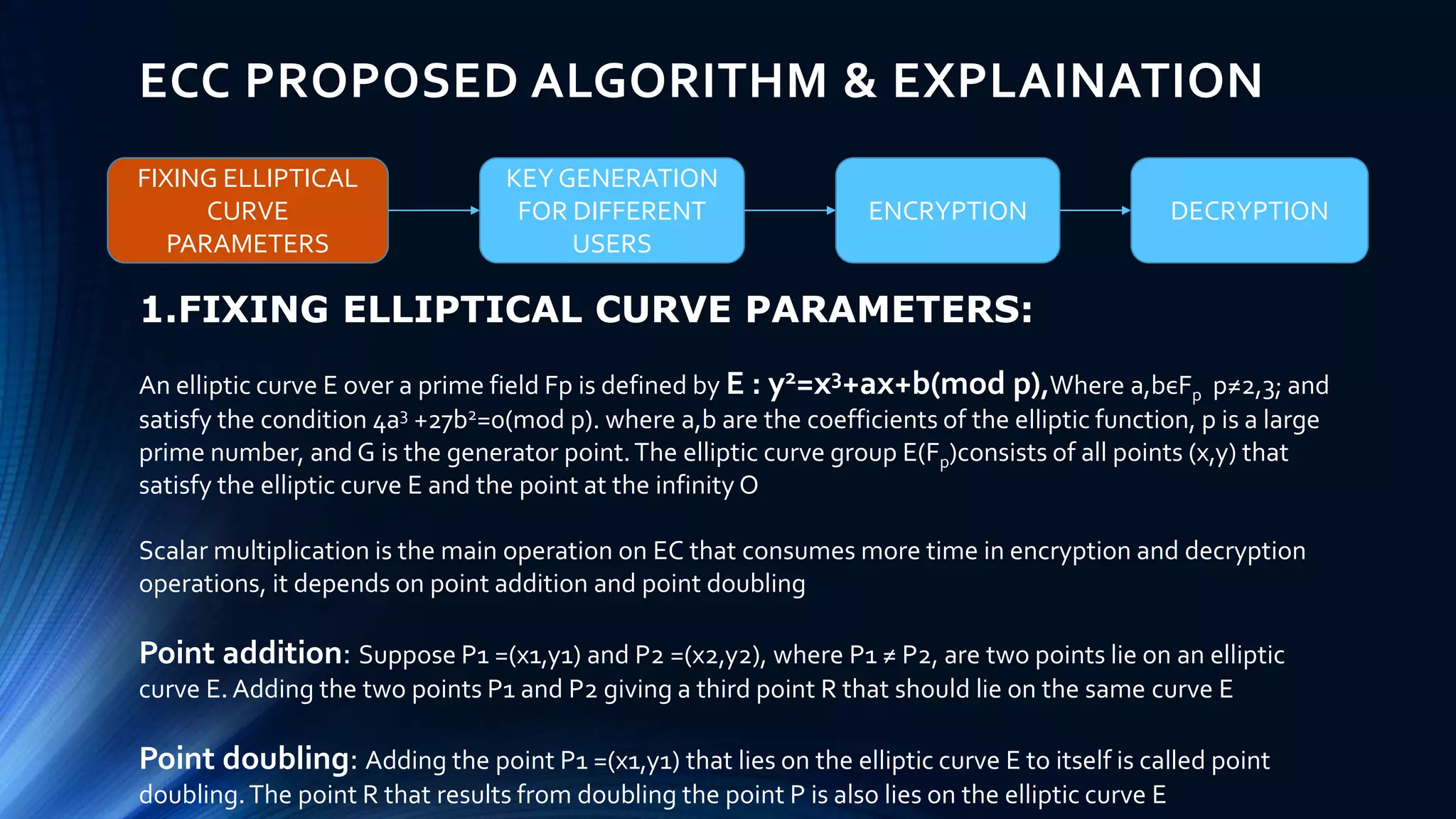
ECC PROPOSED ALGORITHM& EXPLAINATION
FIXING ELLIPTICAL
CURVE
PARAMETERS
KEY GENERATION
FOR DIFFERENT
USERS
ENCRYPTION DECRYPTION
1.FIXING ELLIPTICAL CURVE PARAMETERS:
An elliptic curve E over a prime field Fp is defined by E : y2=x3+ax+b(mod p),Where a,bєFp p≠2,3; and
satisfy the condition 4a3 +27b2=0(mod p). where a,b are the coefficients of the elliptic function, p is a large
prime number, and G is the generator point.The elliptic curve group E(Fp)consists of all points (x,y) that
satisfy the elliptic curve E and the point at the infinity O
Scalar multiplication is the main operation on EC that consumes more time in encryption and decryption
operations, it depends on point addition and point doubling
Point addition: Suppose P1 =(x1,y1) and P2 =(x2,y2), where P1 ≠ P2, are two points lie on an elliptic
curve E. Adding the two points P1 and P2 giving a third point R that should lie on the same curve E
Point doubling: Adding the point P1 =(x1,y1) that lies on the elliptic curve E to itself is called point
doubling.The point R that results from doubling the point P is also lies on the elliptic curve E
7.
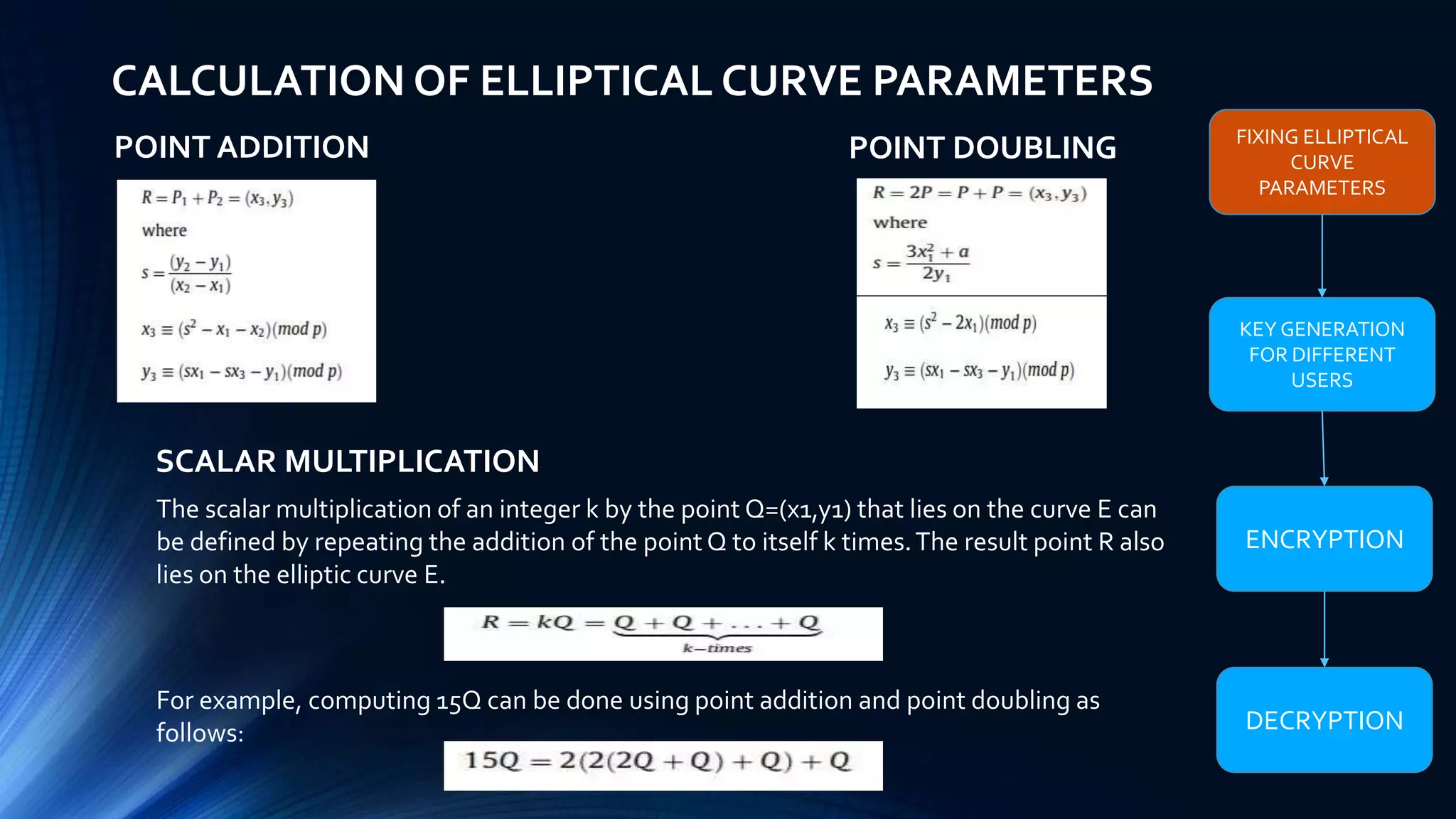
CALCULATION OF ELLIPTICALCURVE PARAMETERS
POINT ADDITION POINT DOUBLING
SCALAR MULTIPLICATION
The scalar multiplication of an integer k by the point Q=(x1,y1) that lies on the curve E can
be defined by repeating the addition of the point Q to itself k times.The result point R also
lies on the elliptic curve E.
For example, computing 15Q can be done using point addition and point doubling as
follows:
FIXING ELLIPTICAL
CURVE
PARAMETERS
KEY GENERATION
FOR DIFFERENT
USERS
ENCRYPTION
DECRYPTION
8.
2.KEY GENERATION
Key Generation:User A (The Sender)
Choose the private key :nA є [ 1,p-1]
Compute the public key PA =nA.G
Compute the initial key KI= nA.PB =(x,y)
Compute K1 = x.G = (k11,k12) and K2 =y.G =(k21, k22)
Generate the self-invertible key matrix Km
Key Generation :User B (The Receiver)
Choose the private key :nB є [ 1,p-1]
Compute the public key PB=nB.G
Compute the initial key KI= nB.PA =(x,y)
Compute K1 = x.G = (k11,k12) and K2 =y.G =(k21, k22)
Generate the self-invertible key matrix Km
FIXING ELLIPTICAL
CURVE
PARAMETERS
KEY GENERATION
FOR DIFFERENT
USERS
ENCRYPTION
DECRYPTION
9.
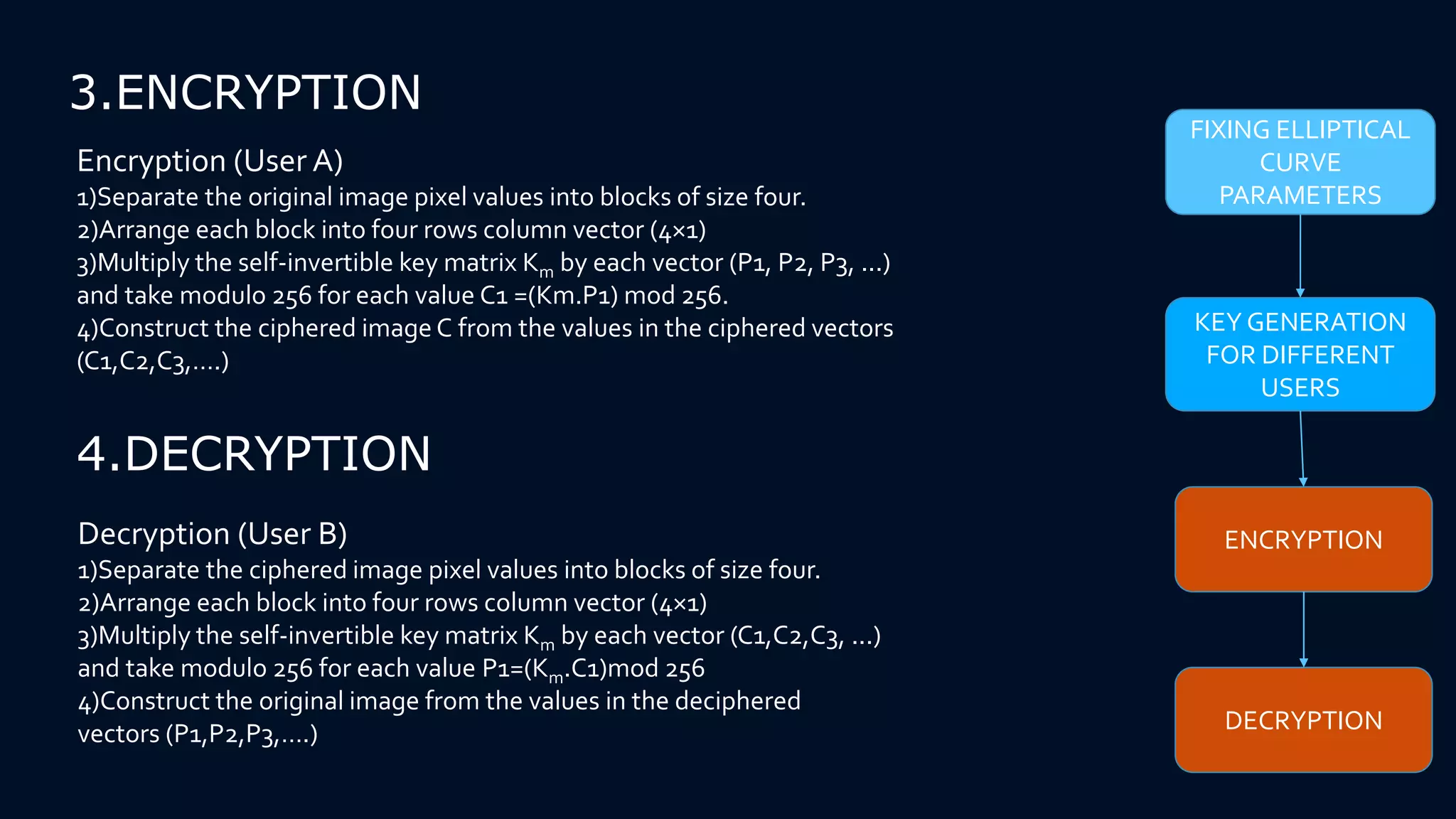
Encryption (User A)
1)Separatethe original image pixel values into blocks of size four.
2)Arrange each block into four rows column vector (4×1)
3)Multiply the self-invertible key matrix Km by each vector (P1, P2, P3, ...)
and take modulo 256 for each value C1 =(Km.P1) mod 256.
4)Construct the ciphered image C from the values in the ciphered vectors
(C1,C2,C3,….)
3.ENCRYPTION
4.DECRYPTION
Decryption (User B)
1)Separate the ciphered image pixel values into blocks of size four.
2)Arrange each block into four rows column vector (4×1)
3)Multiply the self-invertible key matrix Km by each vector (C1,C2,C3, ...)
and take modulo 256 for each value P1=(Km.C1)mod 256
4)Construct the original image from the values in the deciphered
vectors (P1,P2,P3,….)
FIXING ELLIPTICAL
CURVE
PARAMETERS
KEY GENERATION
FOR DIFFERENT
USERS
ENCRYPTION
DECRYPTION
REFERENCE
A new ImageEncryptionTechnique combining Elliptic Curve Cryptosystem
with Hill Cipher
By Ziad E.Dawahdeh Shahrul N.Yaakob RozmieRazif bin Othman
https://www.sciencedirect.com/science/article/pii/S1319157817301039
DOI:https://doi.org/10.1016/j.jksuci.2017.06.004
14.
TIME LINE (DECto APR 2018)
Sl NO: MONTH TASKTO BE COMPLETED
1. DECEMBER Learning theory and coding for existing paper
2. JANUARY Design and Experimentation
3. FEBRUARY Modification of the results obtained
4. MARCH Tuning results and writing the paper
5. APRIL Final review