Multicystic Dysplastic Kidney Ayman Abou Mehrem, MD, CABP Neonatology Fellow September 28, 2010
Objectives Case presentation of a patient with ? Syndromic multicystic dysplastic kidney Review of MCDK etiology, presentation, and management.
Case presentation Maternal history: 23 year old, Caucasian,  G 3 P 0 TA 1 SA 1 Blood group A+ HBV, HIV, VDRL negative Chlamydia, gonorrhea negative Rubella, and varicella immune GBS (?) unknown No DM, no HTN Smoking about 8 cig/day No alcohol, no street drugs
Case presentation Maternal history: ….cont’d Initially, the pregnancy was unremarkable US @ 11 wks    normal Routine US @ 21 wks: Oligohydramnios Small amount of ascites Prominent soft tissue edema (cranial, neck, abdomenal wall) No pericardial or pleural effusions Two kidneys noted, tiny amount of fluid in the bladder EGA= 20 wks ± 10 days
Case presentation Maternal history: ….cont’d Amniocentesis: QF-PCR: 46, XY AF-AFP: 22.1 mg/L = 4.48 MoM (N < 2.00 MoM) Risk of spina bifida 1:5 CMV, Toxo PCR: negative
Case presentation Maternal history: ….cont’d Multiple visits to FAU US @ 29 wks: Cystic enlargement of the Lt kidney Ascites and pleural effusion resolved Borderline oligohydramnios Betamethasone given Seen by Neonatology team @ 30 wks
Case presentation Maternal history: ….cont’d US @ 36 wks: BPP 4/8  Decreased end-diastolic flow Frank breech Non reassuring CTG
Case presentation Delivery Room management: Emergency LSCS Absent respiration, bradycardia PPV < 1 min    free flow O 2 Respiratory distress    nCPAP AS 2 1 , 6 5 , 8 10 Cord ABG: pH 7.0, PCO 2  103, HCO 3  14, BE -12
Case presentation Clinical Examination: Growth parameters: Wt: 3250g HC: 34.5 cm Length: 46 cm General: Moderate generalized edema Pinkish on O 2 Petechiae allover the body
Case presentation Clinical Examination: Dysmorphic features: Box shaped head Up slanting palpebral fissures Small nose Micrognathia Short neck Bilateral palmar transverse crease
Case presentation Clinical Examination: CNS: wide soft AF, no abnormalities CVS: normal pulses, BP. No murmur. Respiratory: mild RD, bilaterally ↓ air entry GI: engorged abd wall veins, liver 2 cm ↓RCM GU: grossly edematous, coronal hypospadias, testes in the scrotum. MSK: hip dislocation
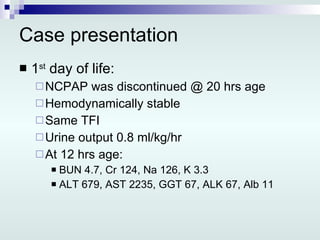
Case presentation Impression: Non immune hydrops fetalis Rule out: Cardiac causes Genetic and metabolic causes Congenital renal anomaly
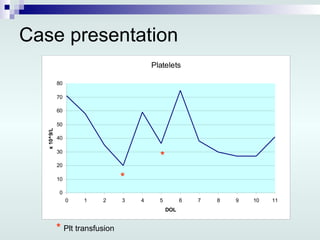
Case presentation NICU course: on admission: TFI 65 ml/kg/day, D10W, NPO Blood culture, Ampicillin + Cefotaxime NCPAP +8 CXR Trial to insert urinary catheter failed. CBC: low platelets (71)
Case presentation
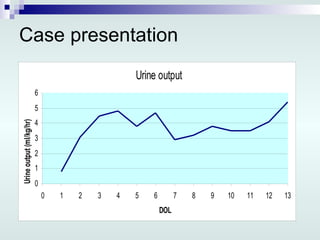
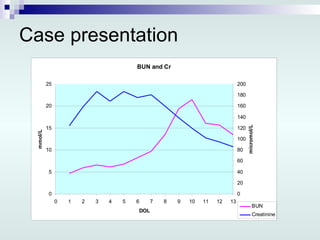
Case presentation 1 st  day of life: NCPAP was discontinued @ 20 hrs age Hemodynamically stable Same TFI Urine output 0.8 ml/kg/hr At 12 hrs age: BUN 4.7, Cr 124, Na 126, K 3.3 ALT 679, AST 2235, GGT 67, ALK 67, Alb 11
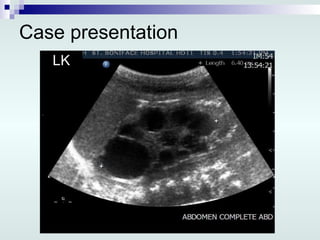
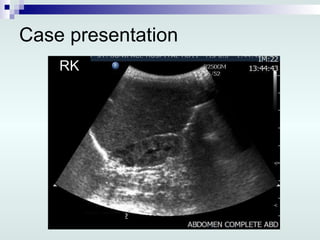
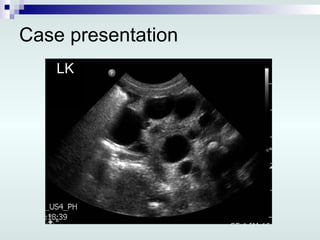
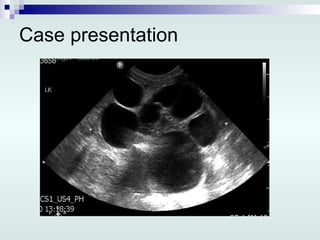
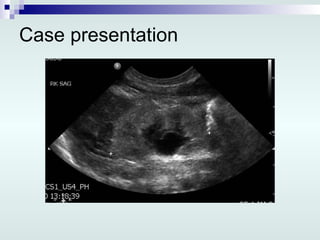
Case presentation 1 st  day of life: Abdominal and renal US: Lt multicystic dysplastic kidney, 7.3 x 4.1 x 4.8 cm Rt kidney smallish, 3.2 x 2.1 x 1.8 cm Urinary bladder is minimally distended No ascites Nephrology consultation: Renal failure Foley’s catheter VCUG
Case presentation LK
Case presentation RK
Case presentation 1 st  day of life: Cranial US: Some slight asymmetric fullness in the left caudothalamic groove with tiny bit of cystic change that may represent a small amount of subepindymal bleeding Otherwise normal
Case presentation 2 nd  day of life: Urine output 3.1 ml/kg/hr BUN 6, Cr 159, Na 129, K 2.9, Ca 1.54 Plt 35 Antibiotics discontinued Transfer to HSC for further management
Case presentation In HSC, 3 rd  day of life: BUN 6.6, Cr 187, Plt 20 Nephrology: No need for Foley’s Furosemide 1 mg/kg/dose bid Meeting with the family: expected mortality 50% in the 1 st  year, need for peritoneal dialysis
Case presentation In HSC, 3 rd  day of life: Repeated US: Lt multicystic dysplastic kidney, 6.4 cm Rt kidney smallish, 3.5 cm,  ↑ echogenicity, poor corticomedullary differentiation, mild pelvic dilatation Urinary bladder is minimally distended Minimal intraperitoneal fluid
Case presentation LK
Case presentation
Case presentation
Case presentation In HSC, other consultations: Echocardiography: Small PDA, L  R shunt, PFO Normal LV function TR, with gradient 40 mmHg MPA pressure estimated to be moderately increased    mild PPHN
Case presentation In HSC, other consultations: Genetics: Non immune hydrops fetalis, most probably secondary to the renal disease Rule out metabolic diseases Lactate, ammonia, metabolic screen, ferritin, transferrin isoelectric focusing, ATP assay, palmitate oxidation, VLCFA, total and free carnitine, DNA banking
Case presentation In HSC, other consultations: Infectious diseases: Non immune hydrops fetalis, most probably secondary to the renal disease Rule out infectious causes Parvovirus B19: tested by PCR and IgM TORCH, adenovirus, HSV Syphilis, non treponemal tests Ophthalmology: normal
Case presentation 5 th  day of life: Urine output 3.8 ml/kg/day BP is normal BUN 6.8, Cr 187, Plt 36  PD catheter was inserted.
Case presentation 10 th  day of life: Urine output 3.5 ml/kg/day BP is normal BUN 21.5, Cr 120, Plt 27  Transferred to CK-5.
Multicustic Dysplastic Kidney History: The terms  multicystic  and  polycystic  were used interchangeably in discussing the kidney In 1955,  Spence  stressed that these terms designated completely different entities. Wein: Campbell-Walsh Urology, 9 th  ed., 2007 Saunders, Chapter 114 – Renal Dysgenesis and Cystic Disease of the Kidney
Multicustic Dysplastic Kidney Cystic Renal Dysplasia: By microscopic features, is an anomaly of differentiation of the fetal kidney, that contains primitive ducts and nonrenal tissues such as cartilage, fat, hematopoietic tissue, and often cysts. MCDK is the most severe form. Patrick Niaudet, Renal cystic diseases in children, UpToDate 2010
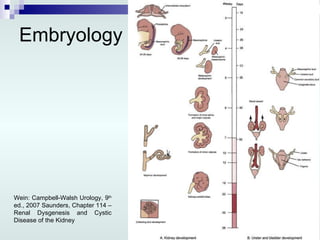
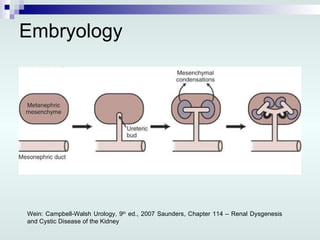
Embryology Wein: Campbell-Walsh Urology, 9 th  ed., 2007 Saunders, Chapter 114 – Renal Dysgenesis and Cystic Disease of the Kidney
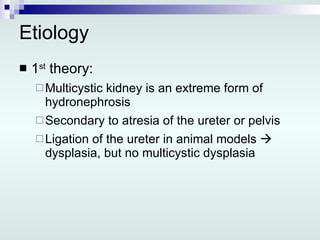
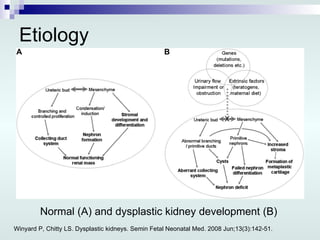
Etiology 1 st  theory: Multicystic kidney is an extreme form of hydronephrosis Secondary to atresia of the ureter or pelvis Ligation of the ureter in animal models    dysplasia, but no multicystic dysplasia
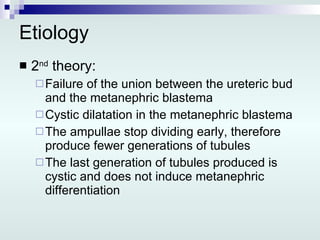
Etiology 2 nd  theory: Failure of the union between the ureteric bud and the metanephric blastema Cystic dilatation in the metanephric blastema The ampullae stop dividing early, therefore produce fewer generations of tubules  The last generation of tubules produced is cystic and does not induce metanephric differentiation
Etiology Normal (A) and dysplastic kidney development (B) Winyard P, Chitty LS. Dysplastic kidneys. Semin Fetal Neonatal Med. 2008 Jun;13(3):142-51.
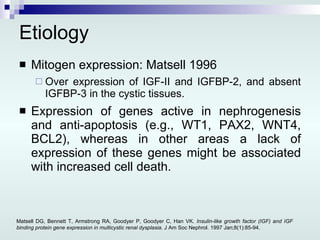
Etiology Mitogen expression: Matsell 1996 Over expression of IGF-II and IGFBP-2, and absent IGFBP-3 in the cystic tissues. Expression of genes active in nephrogenesis and anti-apoptosis (e.g., WT1, PAX2, WNT4, BCL2), whereas in other areas a lack of expression of these genes might be associated with increased cell death. Matsell DG, Bennett T, Armstrong RA, Goodyer P, Goodyer C, Han VK.  Insulin-like growth factor (IGF) and IGF binding protein gene expression in multicystic renal dysplasia.  J Am Soc Nephrol. 1997 Jan;8(1):85-94.
Genetics Mostly sporadic Case reports about familial type AD inheritance Watanabe et al described a case diagnosed of MCDK in a mother and her fetus diagnosed by fetal MRI.  Watanabe T, Yamazaki A, Kurabayashi T, Hanaoka J. Familial multicystic dysplastic kidney. Pediatr Nephrol. 2005 Aug;20(8):1200. Epub 2005 May 24.
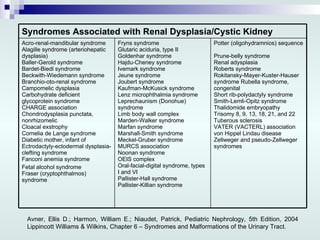
Genetics Associated with many malformations and syndromes Bilateral MCDK is associated more with non-renal and chromosomal anomalies
Avner, Ellis D.; Harmon, William E.; Niaudet, Patrick, Pediatric Nephrology, 5th Edition, 2004 Lippincott Williams & Wilkins, Chapter 6 – Syndromes and Malformations of the Urinary Tract. Potter (oligohydramnios) sequence  Prune-belly syndrome  Renal adysplasia  Roberts syndrome  Rokitansky-Mayer-Kuster-Hauser syndrome Rubella syndrome, congenital  Short rib-polydactyly syndrome  Smith-Lemli-Opitz syndrome  Thalidomide embryopathy  Trisomy 8, 9, 13, 18, 21, and 22  Tuberous sclerosis  VATER (VACTERL) association  von Hippel Lindau disease  Zellweger and pseudo-Zellweger syndromes Fryns syndrome  Glutaric aciduria, type II  Goldenhar syndrome  Hajdu-Cheney syndrome  Ivemark syndrome  Jeune syndrome  Joubert syndrome  Kaufman-McKusick syndrome  Lenz microphthalmia syndrome  Leprechaunism (Donohue) syndrome  Limb body wall complex  Marden-Walker syndrome  Marfan syndrome  Marshall-Smith syndrome  Meckel-Gruber syndrome  MURCS association  Noonan syndrome  OEIS complex  Oral-facial-digital syndrome, types I and VI  Pallister-Hall syndrome  Pallister-Killian syndrome  Acro-renal-mandibular syndrome  Alagille syndrome (arteriohepatic dysplasia)  Baller-Gerold syndrome  Bardet-Biedl syndrome  Beckwith-Wiedemann syndrome  Branchio-oto-renal syndrome  Campomelic dysplasia  Carbohydrate deficient glycoprotein syndrome  CHARGE association  Chondrodysplasia punctata, nonrhizomelic  Cloacal exstrophy  Cornelia de Lange syndrome  Diabetic mother, infant of  Ectrodactyly-ectodermal dysplasia-clefting syndrome  Fanconi anemia syndrome Fetal alcohol syndrome  Fraser (cryptophthalmos) syndrome  Syndromes Associated with Renal Dysplasia/Cystic Kidney
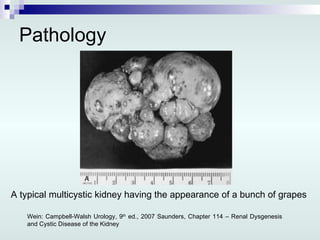
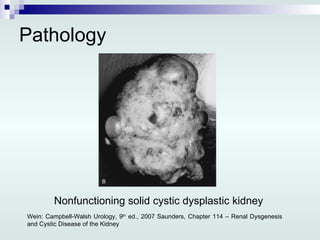
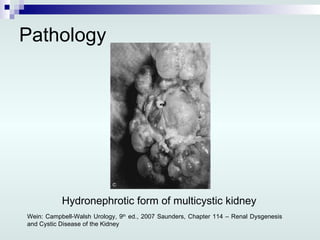
Pathology No reniform configuration, and no calyceal drainage system is present Appearance of “a bunch of grapes” Little stroma between the cysts Renal size is highly variable, from slightly less than normal to enormous Three types: Typical MCDK Solid cystic dysplasia Hydronephrotic form
Pathology A typical multicystic kidney having the appearance of a bunch of grapes Wein: Campbell-Walsh Urology, 9 th  ed., 2007 Saunders, Chapter 114 – Renal Dysgenesis and Cystic Disease of the Kidney
Pathology Nonfunctioning solid cystic dysplastic kidney  Wein: Campbell-Walsh Urology, 9 th  ed., 2007 Saunders, Chapter 114 – Renal Dysgenesis and Cystic Disease of the Kidney
Pathology Wein: Campbell-Walsh Urology, 9 th  ed., 2007 Saunders, Chapter 114 – Renal Dysgenesis and Cystic Disease of the Kidney Hydronephrotic form of multicystic kidney
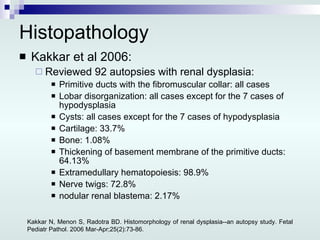
Histopathology Kakkar et al 2006: Reviewed 92 autopsies with renal dysplasia: Primitive ducts with the fibromuscular collar: all cases Lobar disorganization: all cases except for the 7 cases of hypodysplasia Cysts: all cases except for the 7 cases of hypodysplasia Cartilage: 33.7% Bone: 1.08% Thickening of basement membrane of the primitive ducts: 64.13% Extramedullary hematopoiesis: 98.9% Nerve twigs: 72.8% nodular renal blastema: 2.17% Kakkar N, Menon S, Radotra BD.  Histomorphology of renal dysplasia--an autopsy study.  Fetal Pediatr Pathol. 2006 Mar-Apr;25(2):73-86.
Histopathology 20 – 30% of cases exhibits some form of limited dysplasia in the other kidney Avner, Ellis D.; Harmon, William E.; Niaudet, Patrick, Pediatric Nephrology, 5th Edition, 2004 Lippincott Williams & Wilkins, Chapter 5 – Renal Dysplasia/Hypoplasia.
Epidemiology Incidence 1 in 3600 live births Male : Female 1.5 – 2.4:1 for unilateral 1:2 for bilateral Left > Right
Clinical manifestation Asymptomatic Abdominal mass: considered the most common cause of an abdominal mass in the newborn Renal failure in the newborn period Potter’s sequence 19 – 34%    bilateral  3 – 12%    contralateral UPJ obstruction 18 – 43%    contralateral VUR Wein: Campbell-Walsh Urology, 9 th  ed., 2007 Saunders, Chapter 114 – Renal Dysgenesis and Cystic Disease of the Kidney
Clinical manifestation As neonatologists, we may see one more presentation! Antenatally diagnosed MCKD
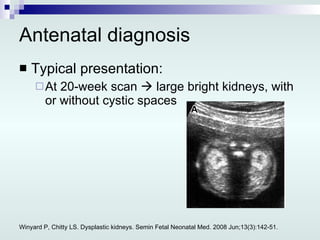
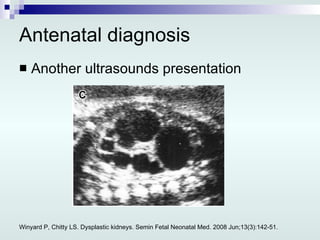
Antenatal diagnosis Typical presentation: At 20-week scan    large bright kidneys, with or without cystic spaces Winyard P, Chitty LS. Dysplastic kidneys. Semin Fetal Neonatal Med. 2008 Jun;13(3):142-51.
Antenatal diagnosis Another ultrasounds presentation Winyard P, Chitty LS. Dysplastic kidneys. Semin Fetal Neonatal Med. 2008 Jun;13(3):142-51.
Antenatal diagnosis The degree of abnormality is a key indicator, which can be addressed via the following questions: How abnormal is the size? How bright is the kidney?  Are cysts visible? Are cysts multiple? (if  ‘yes’  @ 20 weeks, then it is more likely to be MCDK) What is the liquor volume? Are there other abnormalities on a detailed anomaly scan, suggesting a multi-organ syndrome? Winyard P, Chitty LS. Dysplastic kidneys. Semin Fetal Neonatal Med. 2008 Jun;13(3):142-51.
Antenatal diagnosis Other important aspects: Family history of renal or other diseases (particularly diabetes, as outlined with TCF2/HNF1ß mutations below) An ultrasound scan of the parents’ kidneys Referral to genetics Other investigations, such as karyotype or specific testing, as indicated Winyard P, Chitty LS. Dysplastic kidneys. Semin Fetal Neonatal Med. 2008 Jun;13(3):142-51.
Antenatal management Confirm the diagnosis as early as possible Choice of termination of the pregnancy Uncertainty! Reversion to normal Progression Involution Prognosis depends on the other kidney Winyard P, Chitty LS. Dysplastic kidneys. Semin Fetal Neonatal Med. 2008 Jun;13(3):142-51.
Postnatal diagnosis Initial diagnosis: US VCUG: Ismaili et al 2005 To assess if 2 successive US examinations could rule out the presence of clinically significant contralateral anomalies in neonates with MCDK Followed 76 newborn infants with antenatally discovered MCDK US within the first week and @ around 1 mo VCUG and isotopic studies were performed in all infants Ismaili K, Avni FE, Alexander M, Schulman C, Collier F, Hall M. Routine voiding cystourethrography is of no value in neonates with unilateral multicystic dysplastic kidney.  J Pediatr. 2005 Jun;146(6):759-63.
Postnatal diagnosis VCUG: Ismaili et al 2005 61 (80% of total) had normal contralateral urinary tract on the 2 successive neonatal renal US scans 4 of 61 (7%) with low-grade VUR on VCUG    resolved spontaneously before 2 years of age Two successive normal neonatal renal ultrasound scans will rule out clinically significant contralateral anomalies Routine VCUG is unnecessary
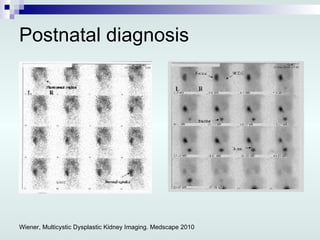
Postnatal diagnosis Nuclear scans Dynamic study: 99m Tc-DTPA is purely glomerular agent    GFR 99m Tc-MAG is partly secreted by renal tubules Static study: 99m Tc-DMSA for renal scaring In MCDK:  Dynamic study is used to detect any residual function.
Postnatal diagnosis Wiener, Multicystic Dysplastic Kidney Imaging. Medscape 2010
Medical conditions perceived to be associated with MCDK Psooy 2007: systematic review  Wilms’ tumour Hypertension Vesicoureteral reflux and urinary tract infection Chronic renal insufficiency/end-stage renal disease Psooy K. Multicystic dysplastic kidney in the neonate: the role of the urologist. Can Urol Assoc J. 2010 Apr;4(2):95-7.
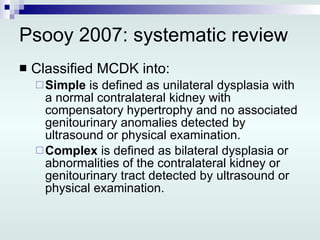
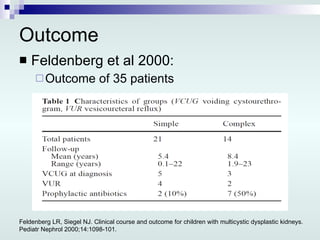
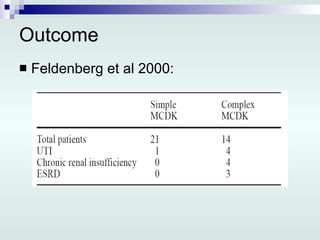
Psooy 2007: systematic review  Classified MCDK into: Simple  is defined as unilateral dysplasia with a normal contralateral kidney with compensatory hypertrophy and no associated genitourinary anomalies detected by ultrasound or physical examination. Complex  is defined as bilateral dysplasia or abnormalities of the contralateral kidney or genitourinary tract detected by ultrasound or physical examination.
Wilms’ tumour The increased risk of developing Wilms’ tumour appears negligible, if not nonexistent, and does not warrant surveillance  (Level 3 evidence) .
Hypertension Review of published cohort studies of MCDK suggested the risk developing hypertension was no higher than that of the general pediatric population
VUR and UTI The overall incidence of contralateral VUR is higher in those with MCDK than the general population The likeliness of having MCDK associated VUR is significantly higher in those whose ultrasound shows contralateral renal abnormalities, in comparison to those who do not  (Level 3 evidence) .  On a continuum, those with “simple” MCDK have the lowest risk of UTI (7%).; those with “complex” MCDK are at the highest risk of UTI (29%) (Level 3 evidence) .
Chronic renal insufficiency/ESRD The contralateral kidney in those with “simple” MCDK does not warrant urological follow-up. The contralateral kidney in those with “complex” MCDK warrants urological and/or nephrological follow-up depending on the associated abnormalities identified  (Level 3 evidence) . Children with a normal solitary functioning kidney have a small risk of future renal insufficiency  (Level 3 evidence) .
Outcome Feldenberg et al 2000: Outcome of 35 patients Feldenberg LR, Siegel NJ. Clinical course and outcome for children with multicystic dysplastic kidneys. Pediatr Nephrol 2000;14:1098-101.
Outcome Feldenberg et al 2000:
Involution Most MCDKs become smaller and involute during a period of follow-up Siqueira Rabelo 2006: Clear tendency of MCDK (91% of cases) to decrease in size, with the rate of the involution greater during the first 30 months than the rate in older children Siqueira Rabelo EA, Oliveira EA, Silva JM, Oliveira DS, Colosimo EA. Ultrasound progression of prenatally detected multicystic dysplastic kidney. Urology. 2006 Nov;68(5):1098-102. Epub 2006 Nov 7.
Involution Al-Ghwery 2005: Follow-up US examinations showed partial involution in 17 (48.6%), complete involution in 13 (37.1%), and 5 (14.3%) showed an unchanged size without any pathological manifestations. No child developed complications such as hypertension or tumors, and all maintained normal growth and development. Al-Ghwery S, Al-Asmari A. Multicystic dysplastic kidney: conservative management and follow-up. Ren Fail. 2005;27(2):189-92.
Nephrectomy Is not indicated routinely Indications: Pain/discomfort Increasing abdominal distension Poor feeding Hypertension
Back to the case presentation Day of life 13 : Urine output 5.4 ml/kg/day BUN 13.5, Cr 86, Plt not done  Hematology consultation: Rule out: NAIT   mom +dad blood for type. Marrow hypoxia Congenital thrombocytopeniawith malformations
Case presentation
Case presentation
Case presentation
Case presentation * * *  Plt transfusion
Case presentation
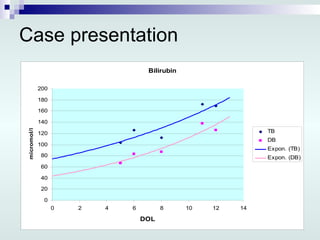
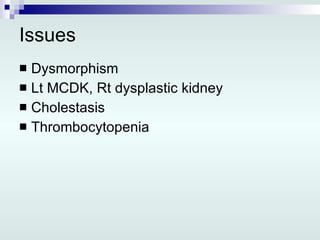
Issues Dysmorphism Lt MCDK, Rt dysplastic kidney Cholestasis Thrombocytopenia
Diagnosis ? Syndrome ?
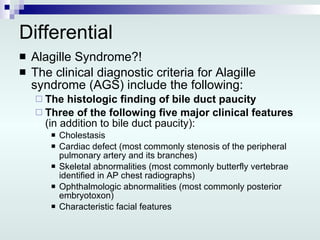
Differential Alagille Syndrome?! The clinical diagnostic criteria for Alagille syndrome (AGS) include the following: The histologic finding of bile duct paucity Three of the following five major clinical features  (in addition to bile duct paucity):  Cholestasis  Cardiac defect (most commonly stenosis of the peripheral pulmonary artery and its branches)  Skeletal abnormalities (most commonly butterfly vertebrae identified in AP chest radiographs)  Ophthalmologic abnormalities (most commonly posterior embryotoxon)  Characteristic facial features
THANK YOU

Multicystic Dysplastic Kidney

  • 1.
    Multicystic Dysplastic KidneyAyman Abou Mehrem, MD, CABP Neonatology Fellow September 28, 2010
  • 2.
    Objectives Case presentationof a patient with ? Syndromic multicystic dysplastic kidney Review of MCDK etiology, presentation, and management.
  • 3.
    Case presentation Maternalhistory: 23 year old, Caucasian, G 3 P 0 TA 1 SA 1 Blood group A+ HBV, HIV, VDRL negative Chlamydia, gonorrhea negative Rubella, and varicella immune GBS (?) unknown No DM, no HTN Smoking about 8 cig/day No alcohol, no street drugs
  • 4.
    Case presentation Maternalhistory: ….cont’d Initially, the pregnancy was unremarkable US @ 11 wks  normal Routine US @ 21 wks: Oligohydramnios Small amount of ascites Prominent soft tissue edema (cranial, neck, abdomenal wall) No pericardial or pleural effusions Two kidneys noted, tiny amount of fluid in the bladder EGA= 20 wks ± 10 days
  • 5.
    Case presentation Maternalhistory: ….cont’d Amniocentesis: QF-PCR: 46, XY AF-AFP: 22.1 mg/L = 4.48 MoM (N < 2.00 MoM) Risk of spina bifida 1:5 CMV, Toxo PCR: negative
  • 6.
    Case presentation Maternalhistory: ….cont’d Multiple visits to FAU US @ 29 wks: Cystic enlargement of the Lt kidney Ascites and pleural effusion resolved Borderline oligohydramnios Betamethasone given Seen by Neonatology team @ 30 wks
  • 7.
    Case presentation Maternalhistory: ….cont’d US @ 36 wks: BPP 4/8 Decreased end-diastolic flow Frank breech Non reassuring CTG
  • 8.
    Case presentation DeliveryRoom management: Emergency LSCS Absent respiration, bradycardia PPV < 1 min  free flow O 2 Respiratory distress  nCPAP AS 2 1 , 6 5 , 8 10 Cord ABG: pH 7.0, PCO 2 103, HCO 3 14, BE -12
  • 9.
    Case presentation ClinicalExamination: Growth parameters: Wt: 3250g HC: 34.5 cm Length: 46 cm General: Moderate generalized edema Pinkish on O 2 Petechiae allover the body
  • 10.
    Case presentation ClinicalExamination: Dysmorphic features: Box shaped head Up slanting palpebral fissures Small nose Micrognathia Short neck Bilateral palmar transverse crease
  • 11.
    Case presentation ClinicalExamination: CNS: wide soft AF, no abnormalities CVS: normal pulses, BP. No murmur. Respiratory: mild RD, bilaterally ↓ air entry GI: engorged abd wall veins, liver 2 cm ↓RCM GU: grossly edematous, coronal hypospadias, testes in the scrotum. MSK: hip dislocation
  • 12.
    Case presentation Impression:Non immune hydrops fetalis Rule out: Cardiac causes Genetic and metabolic causes Congenital renal anomaly
  • 13.
    Case presentation NICUcourse: on admission: TFI 65 ml/kg/day, D10W, NPO Blood culture, Ampicillin + Cefotaxime NCPAP +8 CXR Trial to insert urinary catheter failed. CBC: low platelets (71)
  • 14.
  • 15.
    Case presentation 1st day of life: NCPAP was discontinued @ 20 hrs age Hemodynamically stable Same TFI Urine output 0.8 ml/kg/hr At 12 hrs age: BUN 4.7, Cr 124, Na 126, K 3.3 ALT 679, AST 2235, GGT 67, ALK 67, Alb 11
  • 16.
    Case presentation 1st day of life: Abdominal and renal US: Lt multicystic dysplastic kidney, 7.3 x 4.1 x 4.8 cm Rt kidney smallish, 3.2 x 2.1 x 1.8 cm Urinary bladder is minimally distended No ascites Nephrology consultation: Renal failure Foley’s catheter VCUG
  • 17.
  • 18.
  • 19.
    Case presentation 1st day of life: Cranial US: Some slight asymmetric fullness in the left caudothalamic groove with tiny bit of cystic change that may represent a small amount of subepindymal bleeding Otherwise normal
  • 20.
    Case presentation 2nd day of life: Urine output 3.1 ml/kg/hr BUN 6, Cr 159, Na 129, K 2.9, Ca 1.54 Plt 35 Antibiotics discontinued Transfer to HSC for further management
  • 21.
    Case presentation InHSC, 3 rd day of life: BUN 6.6, Cr 187, Plt 20 Nephrology: No need for Foley’s Furosemide 1 mg/kg/dose bid Meeting with the family: expected mortality 50% in the 1 st year, need for peritoneal dialysis
  • 22.
    Case presentation InHSC, 3 rd day of life: Repeated US: Lt multicystic dysplastic kidney, 6.4 cm Rt kidney smallish, 3.5 cm, ↑ echogenicity, poor corticomedullary differentiation, mild pelvic dilatation Urinary bladder is minimally distended Minimal intraperitoneal fluid
  • 23.
  • 24.
  • 25.
  • 26.
    Case presentation InHSC, other consultations: Echocardiography: Small PDA, L  R shunt, PFO Normal LV function TR, with gradient 40 mmHg MPA pressure estimated to be moderately increased  mild PPHN
  • 27.
    Case presentation InHSC, other consultations: Genetics: Non immune hydrops fetalis, most probably secondary to the renal disease Rule out metabolic diseases Lactate, ammonia, metabolic screen, ferritin, transferrin isoelectric focusing, ATP assay, palmitate oxidation, VLCFA, total and free carnitine, DNA banking
  • 28.
    Case presentation InHSC, other consultations: Infectious diseases: Non immune hydrops fetalis, most probably secondary to the renal disease Rule out infectious causes Parvovirus B19: tested by PCR and IgM TORCH, adenovirus, HSV Syphilis, non treponemal tests Ophthalmology: normal
  • 29.
    Case presentation 5th day of life: Urine output 3.8 ml/kg/day BP is normal BUN 6.8, Cr 187, Plt 36 PD catheter was inserted.
  • 30.
    Case presentation 10th day of life: Urine output 3.5 ml/kg/day BP is normal BUN 21.5, Cr 120, Plt 27 Transferred to CK-5.
  • 31.
    Multicustic Dysplastic KidneyHistory: The terms multicystic and polycystic were used interchangeably in discussing the kidney In 1955, Spence stressed that these terms designated completely different entities. Wein: Campbell-Walsh Urology, 9 th ed., 2007 Saunders, Chapter 114 – Renal Dysgenesis and Cystic Disease of the Kidney
  • 32.
    Multicustic Dysplastic KidneyCystic Renal Dysplasia: By microscopic features, is an anomaly of differentiation of the fetal kidney, that contains primitive ducts and nonrenal tissues such as cartilage, fat, hematopoietic tissue, and often cysts. MCDK is the most severe form. Patrick Niaudet, Renal cystic diseases in children, UpToDate 2010
  • 33.
    Embryology Wein: Campbell-WalshUrology, 9 th ed., 2007 Saunders, Chapter 114 – Renal Dysgenesis and Cystic Disease of the Kidney
  • 34.
    Embryology Wein: Campbell-WalshUrology, 9 th ed., 2007 Saunders, Chapter 114 – Renal Dysgenesis and Cystic Disease of the Kidney
  • 35.
    Etiology 1 st theory: Multicystic kidney is an extreme form of hydronephrosis Secondary to atresia of the ureter or pelvis Ligation of the ureter in animal models  dysplasia, but no multicystic dysplasia
  • 36.
    Etiology 2 nd theory: Failure of the union between the ureteric bud and the metanephric blastema Cystic dilatation in the metanephric blastema The ampullae stop dividing early, therefore produce fewer generations of tubules The last generation of tubules produced is cystic and does not induce metanephric differentiation
  • 37.
    Etiology Normal (A)and dysplastic kidney development (B) Winyard P, Chitty LS. Dysplastic kidneys. Semin Fetal Neonatal Med. 2008 Jun;13(3):142-51.
  • 38.
    Etiology Mitogen expression:Matsell 1996 Over expression of IGF-II and IGFBP-2, and absent IGFBP-3 in the cystic tissues. Expression of genes active in nephrogenesis and anti-apoptosis (e.g., WT1, PAX2, WNT4, BCL2), whereas in other areas a lack of expression of these genes might be associated with increased cell death. Matsell DG, Bennett T, Armstrong RA, Goodyer P, Goodyer C, Han VK. Insulin-like growth factor (IGF) and IGF binding protein gene expression in multicystic renal dysplasia. J Am Soc Nephrol. 1997 Jan;8(1):85-94.
  • 39.
    Genetics Mostly sporadicCase reports about familial type AD inheritance Watanabe et al described a case diagnosed of MCDK in a mother and her fetus diagnosed by fetal MRI. Watanabe T, Yamazaki A, Kurabayashi T, Hanaoka J. Familial multicystic dysplastic kidney. Pediatr Nephrol. 2005 Aug;20(8):1200. Epub 2005 May 24.
  • 40.
    Genetics Associated withmany malformations and syndromes Bilateral MCDK is associated more with non-renal and chromosomal anomalies
  • 41.
    Avner, Ellis D.;Harmon, William E.; Niaudet, Patrick, Pediatric Nephrology, 5th Edition, 2004 Lippincott Williams & Wilkins, Chapter 6 – Syndromes and Malformations of the Urinary Tract. Potter (oligohydramnios) sequence Prune-belly syndrome Renal adysplasia Roberts syndrome Rokitansky-Mayer-Kuster-Hauser syndrome Rubella syndrome, congenital Short rib-polydactyly syndrome Smith-Lemli-Opitz syndrome Thalidomide embryopathy Trisomy 8, 9, 13, 18, 21, and 22 Tuberous sclerosis VATER (VACTERL) association von Hippel Lindau disease Zellweger and pseudo-Zellweger syndromes Fryns syndrome Glutaric aciduria, type II Goldenhar syndrome Hajdu-Cheney syndrome Ivemark syndrome Jeune syndrome Joubert syndrome Kaufman-McKusick syndrome Lenz microphthalmia syndrome Leprechaunism (Donohue) syndrome Limb body wall complex Marden-Walker syndrome Marfan syndrome Marshall-Smith syndrome Meckel-Gruber syndrome MURCS association Noonan syndrome OEIS complex Oral-facial-digital syndrome, types I and VI Pallister-Hall syndrome Pallister-Killian syndrome Acro-renal-mandibular syndrome Alagille syndrome (arteriohepatic dysplasia) Baller-Gerold syndrome Bardet-Biedl syndrome Beckwith-Wiedemann syndrome Branchio-oto-renal syndrome Campomelic dysplasia Carbohydrate deficient glycoprotein syndrome CHARGE association Chondrodysplasia punctata, nonrhizomelic Cloacal exstrophy Cornelia de Lange syndrome Diabetic mother, infant of Ectrodactyly-ectodermal dysplasia-clefting syndrome Fanconi anemia syndrome Fetal alcohol syndrome Fraser (cryptophthalmos) syndrome Syndromes Associated with Renal Dysplasia/Cystic Kidney
  • 42.
    Pathology No reniformconfiguration, and no calyceal drainage system is present Appearance of “a bunch of grapes” Little stroma between the cysts Renal size is highly variable, from slightly less than normal to enormous Three types: Typical MCDK Solid cystic dysplasia Hydronephrotic form
  • 43.
    Pathology A typicalmulticystic kidney having the appearance of a bunch of grapes Wein: Campbell-Walsh Urology, 9 th ed., 2007 Saunders, Chapter 114 – Renal Dysgenesis and Cystic Disease of the Kidney
  • 44.
    Pathology Nonfunctioning solidcystic dysplastic kidney Wein: Campbell-Walsh Urology, 9 th ed., 2007 Saunders, Chapter 114 – Renal Dysgenesis and Cystic Disease of the Kidney
  • 45.
    Pathology Wein: Campbell-WalshUrology, 9 th ed., 2007 Saunders, Chapter 114 – Renal Dysgenesis and Cystic Disease of the Kidney Hydronephrotic form of multicystic kidney
  • 46.
    Histopathology Kakkar etal 2006: Reviewed 92 autopsies with renal dysplasia: Primitive ducts with the fibromuscular collar: all cases Lobar disorganization: all cases except for the 7 cases of hypodysplasia Cysts: all cases except for the 7 cases of hypodysplasia Cartilage: 33.7% Bone: 1.08% Thickening of basement membrane of the primitive ducts: 64.13% Extramedullary hematopoiesis: 98.9% Nerve twigs: 72.8% nodular renal blastema: 2.17% Kakkar N, Menon S, Radotra BD. Histomorphology of renal dysplasia--an autopsy study. Fetal Pediatr Pathol. 2006 Mar-Apr;25(2):73-86.
  • 47.
    Histopathology 20 –30% of cases exhibits some form of limited dysplasia in the other kidney Avner, Ellis D.; Harmon, William E.; Niaudet, Patrick, Pediatric Nephrology, 5th Edition, 2004 Lippincott Williams & Wilkins, Chapter 5 – Renal Dysplasia/Hypoplasia.
  • 48.
    Epidemiology Incidence 1in 3600 live births Male : Female 1.5 – 2.4:1 for unilateral 1:2 for bilateral Left > Right
  • 49.
    Clinical manifestation AsymptomaticAbdominal mass: considered the most common cause of an abdominal mass in the newborn Renal failure in the newborn period Potter’s sequence 19 – 34%  bilateral 3 – 12%  contralateral UPJ obstruction 18 – 43%  contralateral VUR Wein: Campbell-Walsh Urology, 9 th ed., 2007 Saunders, Chapter 114 – Renal Dysgenesis and Cystic Disease of the Kidney
  • 50.
    Clinical manifestation Asneonatologists, we may see one more presentation! Antenatally diagnosed MCKD
  • 51.
    Antenatal diagnosis Typicalpresentation: At 20-week scan  large bright kidneys, with or without cystic spaces Winyard P, Chitty LS. Dysplastic kidneys. Semin Fetal Neonatal Med. 2008 Jun;13(3):142-51.
  • 52.
    Antenatal diagnosis Anotherultrasounds presentation Winyard P, Chitty LS. Dysplastic kidneys. Semin Fetal Neonatal Med. 2008 Jun;13(3):142-51.
  • 53.
    Antenatal diagnosis Thedegree of abnormality is a key indicator, which can be addressed via the following questions: How abnormal is the size? How bright is the kidney? Are cysts visible? Are cysts multiple? (if ‘yes’ @ 20 weeks, then it is more likely to be MCDK) What is the liquor volume? Are there other abnormalities on a detailed anomaly scan, suggesting a multi-organ syndrome? Winyard P, Chitty LS. Dysplastic kidneys. Semin Fetal Neonatal Med. 2008 Jun;13(3):142-51.
  • 54.
    Antenatal diagnosis Otherimportant aspects: Family history of renal or other diseases (particularly diabetes, as outlined with TCF2/HNF1ß mutations below) An ultrasound scan of the parents’ kidneys Referral to genetics Other investigations, such as karyotype or specific testing, as indicated Winyard P, Chitty LS. Dysplastic kidneys. Semin Fetal Neonatal Med. 2008 Jun;13(3):142-51.
  • 55.
    Antenatal management Confirmthe diagnosis as early as possible Choice of termination of the pregnancy Uncertainty! Reversion to normal Progression Involution Prognosis depends on the other kidney Winyard P, Chitty LS. Dysplastic kidneys. Semin Fetal Neonatal Med. 2008 Jun;13(3):142-51.
  • 56.
    Postnatal diagnosis Initialdiagnosis: US VCUG: Ismaili et al 2005 To assess if 2 successive US examinations could rule out the presence of clinically significant contralateral anomalies in neonates with MCDK Followed 76 newborn infants with antenatally discovered MCDK US within the first week and @ around 1 mo VCUG and isotopic studies were performed in all infants Ismaili K, Avni FE, Alexander M, Schulman C, Collier F, Hall M. Routine voiding cystourethrography is of no value in neonates with unilateral multicystic dysplastic kidney. J Pediatr. 2005 Jun;146(6):759-63.
  • 57.
    Postnatal diagnosis VCUG:Ismaili et al 2005 61 (80% of total) had normal contralateral urinary tract on the 2 successive neonatal renal US scans 4 of 61 (7%) with low-grade VUR on VCUG  resolved spontaneously before 2 years of age Two successive normal neonatal renal ultrasound scans will rule out clinically significant contralateral anomalies Routine VCUG is unnecessary
  • 58.
    Postnatal diagnosis Nuclearscans Dynamic study: 99m Tc-DTPA is purely glomerular agent  GFR 99m Tc-MAG is partly secreted by renal tubules Static study: 99m Tc-DMSA for renal scaring In MCDK: Dynamic study is used to detect any residual function.
  • 59.
    Postnatal diagnosis Wiener,Multicystic Dysplastic Kidney Imaging. Medscape 2010
  • 60.
    Medical conditions perceivedto be associated with MCDK Psooy 2007: systematic review Wilms’ tumour Hypertension Vesicoureteral reflux and urinary tract infection Chronic renal insufficiency/end-stage renal disease Psooy K. Multicystic dysplastic kidney in the neonate: the role of the urologist. Can Urol Assoc J. 2010 Apr;4(2):95-7.
  • 61.
    Psooy 2007: systematicreview Classified MCDK into: Simple is defined as unilateral dysplasia with a normal contralateral kidney with compensatory hypertrophy and no associated genitourinary anomalies detected by ultrasound or physical examination. Complex is defined as bilateral dysplasia or abnormalities of the contralateral kidney or genitourinary tract detected by ultrasound or physical examination.
  • 62.
    Wilms’ tumour Theincreased risk of developing Wilms’ tumour appears negligible, if not nonexistent, and does not warrant surveillance (Level 3 evidence) .
  • 63.
    Hypertension Review ofpublished cohort studies of MCDK suggested the risk developing hypertension was no higher than that of the general pediatric population
  • 64.
    VUR and UTIThe overall incidence of contralateral VUR is higher in those with MCDK than the general population The likeliness of having MCDK associated VUR is significantly higher in those whose ultrasound shows contralateral renal abnormalities, in comparison to those who do not (Level 3 evidence) . On a continuum, those with “simple” MCDK have the lowest risk of UTI (7%).; those with “complex” MCDK are at the highest risk of UTI (29%) (Level 3 evidence) .
  • 65.
    Chronic renal insufficiency/ESRDThe contralateral kidney in those with “simple” MCDK does not warrant urological follow-up. The contralateral kidney in those with “complex” MCDK warrants urological and/or nephrological follow-up depending on the associated abnormalities identified (Level 3 evidence) . Children with a normal solitary functioning kidney have a small risk of future renal insufficiency (Level 3 evidence) .
  • 66.
    Outcome Feldenberg etal 2000: Outcome of 35 patients Feldenberg LR, Siegel NJ. Clinical course and outcome for children with multicystic dysplastic kidneys. Pediatr Nephrol 2000;14:1098-101.
  • 67.
  • 68.
    Involution Most MCDKsbecome smaller and involute during a period of follow-up Siqueira Rabelo 2006: Clear tendency of MCDK (91% of cases) to decrease in size, with the rate of the involution greater during the first 30 months than the rate in older children Siqueira Rabelo EA, Oliveira EA, Silva JM, Oliveira DS, Colosimo EA. Ultrasound progression of prenatally detected multicystic dysplastic kidney. Urology. 2006 Nov;68(5):1098-102. Epub 2006 Nov 7.
  • 69.
    Involution Al-Ghwery 2005:Follow-up US examinations showed partial involution in 17 (48.6%), complete involution in 13 (37.1%), and 5 (14.3%) showed an unchanged size without any pathological manifestations. No child developed complications such as hypertension or tumors, and all maintained normal growth and development. Al-Ghwery S, Al-Asmari A. Multicystic dysplastic kidney: conservative management and follow-up. Ren Fail. 2005;27(2):189-92.
  • 70.
    Nephrectomy Is notindicated routinely Indications: Pain/discomfort Increasing abdominal distension Poor feeding Hypertension
  • 71.
    Back to thecase presentation Day of life 13 : Urine output 5.4 ml/kg/day BUN 13.5, Cr 86, Plt not done Hematology consultation: Rule out: NAIT  mom +dad blood for type. Marrow hypoxia Congenital thrombocytopeniawith malformations
  • 72.
  • 73.
  • 74.
  • 75.
    Case presentation ** * Plt transfusion
  • 76.
  • 77.
    Issues Dysmorphism LtMCDK, Rt dysplastic kidney Cholestasis Thrombocytopenia
  • 78.
  • 79.
    Differential Alagille Syndrome?!The clinical diagnostic criteria for Alagille syndrome (AGS) include the following: The histologic finding of bile duct paucity Three of the following five major clinical features (in addition to bile duct paucity): Cholestasis Cardiac defect (most commonly stenosis of the peripheral pulmonary artery and its branches) Skeletal abnormalities (most commonly butterfly vertebrae identified in AP chest radiographs) Ophthalmologic abnormalities (most commonly posterior embryotoxon) Characteristic facial features
  • 80.