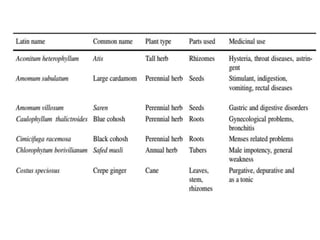
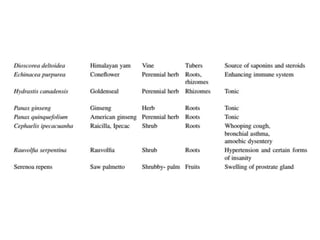
Integration of Medicinal and Aromatic
Plants in different Cropping Systems
Sukriti DuttA
Research Scholar
Csir-neist, jorhat, assam
Introduction
MAPs are not only as a source of affordable health care
products - also as a source of income
Systematic collection and conservation of MAPs is lacking in
India
90% collection of medicinal plants is from wild sources and
10% of MAPs are distributed among other landscape
elements like open grasslands, agricultural pastures,
wasteland and fresh water bodies etc.
Dwindling supplies from natural resources and increasing
global demand - expanding the cultivation of MAPs - an
important strategy
No scope for horizontal expansion of cultivated area
Integrate MAPs in different cropping systems with the
predominant crops of the region
Different ways of growing crops to give maximum benefit
Two types of cropping patterns:
• Mixed cropping: Growing two or more crops
simultaneously on the same piece of land
• Inter cropping: Practice of growing two or more crops
with a definite row pattern in proximity
Intercropping
Objectives
• Insurance against total crop failure under aberrant
weather conditions or pest epidemics.
• Increase in total productivity per unit land area
• Judicious utilization of resources such as land
labour and inputs
Intercropping in Medicinal Aromatic Plants (MAPs)
• Major constraint in cultivation of MAPs - availability of
cultivable land
• In order to derive maximum benefit of soil moisture,
nutrients and other inputs, MAPs can be grown as inter-
crops
• The most common goal of Intercropping is to produce a
greater yield on a given piece of land by making use of
resources that would otherwise not be utilized by a single
crop
• Examples of Intercropping strategies are planting a
deep-rooted crop with shallow-rooted crop, or
planting a tall crop with shorter crop which
requires partial shade.
• Senna (Cassia angustifolia) can be effectively
intercropped with chick pea than Sunflower,
Linseed, Mustard, Wheat to obtain better Senna
herb yield along with maximum net return.
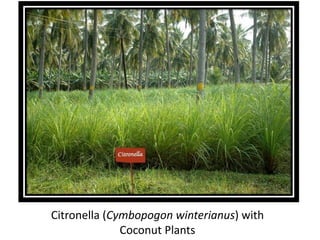
Citronella (Cymbopogon winterianus) with
Coconut Plants
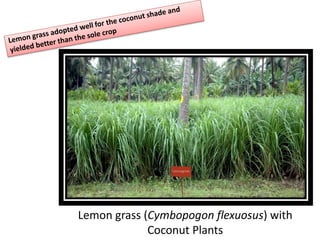
Lemon grass (Cymbopogon flexuosus) with
Coconut Plants
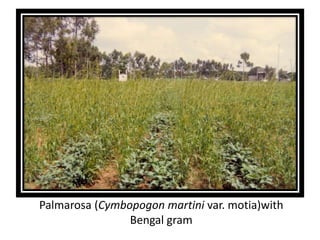
Palmarosa (Cymbopogon martini var. motia)with
Bengal gram
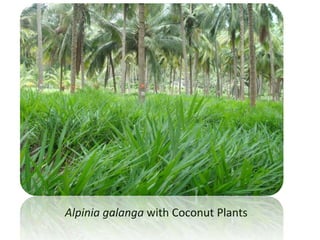
Alpinia galanga with Coconut Plants
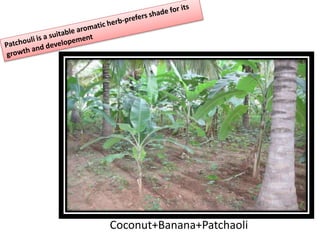
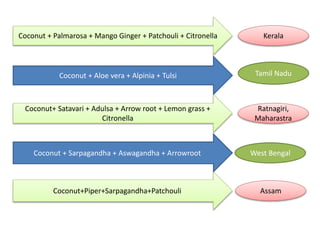
Coconut+Banana+Patchaoli
Coconut + Palmarosa + Mango Ginger + Patchouli + Citronella
Tamil NaduCoconut + Aloe vera + Alpinia + Tulsi
Coconut+ Satavari + Adulsa + Arrow root + Lemon grass +
Citronella
Coconut + Sarpagandha + Aswagandha + Arrowroot
Coconut+Piper+Sarpagandha+Patchouli
Kerala
Ratnagiri,
Maharastra
West Bengal
Assam
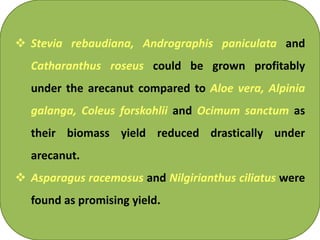
 Stevia rebaudiana, Andrographis paniculata and
Catharanthus roseus could be grown profitably
under the arecanut compared to Aloe vera, Alpinia
galanga, Coleus forskohlii and Ocimum sanctum as
their biomass yield reduced drastically under
arecanut.
 Asparagus racemosus and Nilgirianthus ciliatus were
found as promising yield.
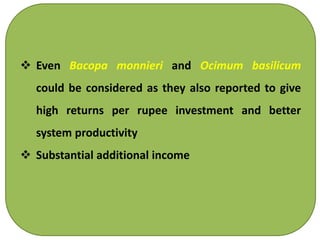
 Even Bacopa monnieri and Ocimum basilicum
could be considered as they also reported to give
high returns per rupee investment and better
system productivity
 Substantial additional income
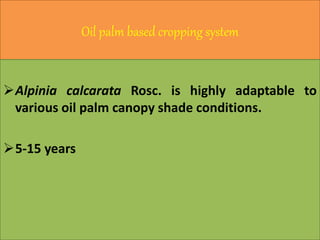
Oil palm based cropping system
Alpinia calcarata Rosc. is highly adaptable to
various oil palm canopy shade conditions.
5-15 years
Intercropping of medicinal plants in
black pepper
• Inter-spaces remain unutilized during early years
of planting
• Adhatoda beddomei ,
• Desmodium gangeticum,
• Pseudarthria viscida,
• Plumbago zeylinicum,
• Niligirianthus ciliatus,
• Alpinia calcarata,
• Crysopogon zizanioides,
• Asparagus racemosus.
Intercropping of medicinal plants in
black pepper
• Asparagus gave maximum yield (1998 kg/ha)
followed by Alpinia (1,700 kg/ha).
• Highest income (B:C ratio = 2.3:1) was obtained
with Crysopogon intercropping
MAPS in multistorey cropping system
• It is a system of growing crops together of different
heights at the same time on the same piece of land
and thus using land, water, and space most
efficiently and economically
• New plantations of coffee, tea & cocoa offer scope
for cultivation of forest medicinal trees that are
under demand
Medicinal trees
• Prunus africana (Red stinkwood),
• Eucalyptus globules (for oil),
• Santalum album (Sandalwood),
• Saraca ashoka (Ashok),
• Aegle marmelos (Bael),
• Anona squamosa (Custard apple),
• Emblica officinalis (Amla),
• Moringa oleifera (Drumstick) and
• Sapindus mukorossi (Soap nut tree)
Medicinal trees
• Medicinal trees may allow intercropping for many
years or on a permanent basis depending on the
spacing and nature of the trees.
• The intercrops give some income to farmers during
the period when the main trees have not started
production.
• Eucalyptus citriodora can be effectively grown along
with Coffee, Lemongrass and Palmarosa.
Types of Intercropping
• Mixed Intercropping: The component crops are
mixed in the available space.
• Row Cropping: Component crops are arranged
alternate rows.
• Alley Cropping: An agroforestry practice where
agricultural or horticultural crops are grown in the
alleyways between widely spaced rows of woody
plants.
 Strip Cropping: Growing soil conserving crops in
alternate strips running perpendicular to the slope
of the land or to the direction of prevailing winds
for the purpose of reducing erosion.
 Vetiver (Vetiveria zizanioides),
 Lemongrass (Cymbopogon flexuosus) and
 Citronella (Cymbopogon winterianus)
•Relay Cropping: The second crop is sown during the
growth, often near the onset of reproductive
development or fruiting, of the first crop, so that the
first crop is harvested to make room prepare for the
full development of the second crop.
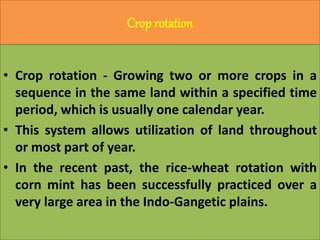
Crop rotation
• Crop rotation - Growing two or more crops in a
sequence in the same land within a specified time
period, which is usually one calendar year.
• This system allows utilization of land throughout
or most part of year.
• In the recent past, the rice-wheat rotation with
corn mint has been successfully practiced over a
very large area in the Indo-Gangetic plains.
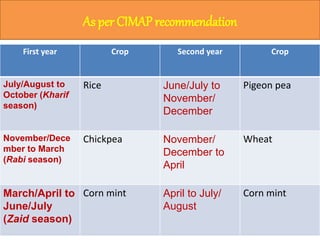
As per CIMAP recommendation
First year Crop Second year Crop
July/August to
October (Kharif
season)
Rice June/July to
November/
December
Pigeon pea
November/Dece
mber to March
(Rabi season)
Chickpea November/
December to
April
Wheat
March/April to
June/July
(Zaid season)
Corn mint April to July/
August
Corn mint
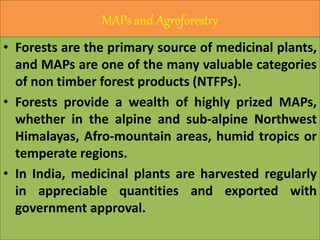
MAPs and Agroforestry
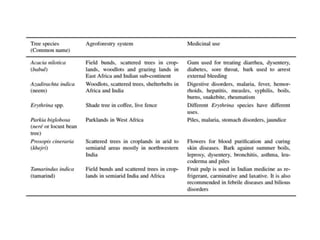
• Forests are the primary source of medicinal plants,
and MAPs are one of the many valuable categories
of non timber forest products (NTFPs).
• Forests provide a wealth of highly prized MAPs,
whether in the alpine and sub-alpine Northwest
Himalayas, Afro-mountain areas, humid tropics or
temperate regions.

• In India, medicinal plants are harvested regularly
in appreciable quantities and exported with
government approval.
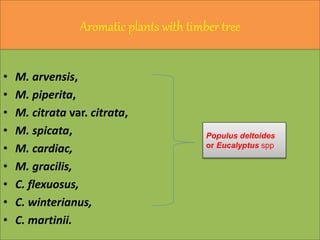
Aromatic plants with timber tree
• M. arvensis,
• M. piperita,
• M. citrata var. citrata,
• M. spicata,
• M. cardiac,
• M. gracilis,
• C. flexuosus,
• C. winterianus,
• C. martinii.
Populus deltoides
or Eucalyptus spp
Aromatic plants with timber tree
• Pelargonium graveolens
• M. arvensis,
• M. piperita,
• M. citrata var. citrata,
• M. spicata,
• M. cardiac and M. gracilis
• C. flexuosus,
• C. winterianus,
• C. martinii.
• 2-4 times greater economic returns than sole cropping
Initial 3-5 years
Eucalyptus citriodora
Aromatic plants profitably grown in association with
fuel and timber trees such as Leucana leucocephala,
Casuarina spp. and Grevillea robusta.
Aromatic grasses such as vetiver (Vetiveria
zizanioides), lemongrass (Cymbopogon flexuosus) and
citronella (Cymbopogon winterianus ) can be grown on
field bunds and soil conservation bunds.
In West Bengal, Costus speciosus, a diosgenin
producing plant, is recommended as major storey crop
in social forestry programs.
9
Acacia auriculiformis,
Albizia lebbeck,
Eucalyptus tereticornis,
Gmelina arborea &
Leucaeana leucocephala
Most of the temperate medicinal plants are highly suitable for
agroforestry system
Safed musli (C. borivilianum),
Rauvolfia (Rauvolfia
serpentina)
Turmeric (Curcuma longa),
Wild turmeric (C. aromatica),
Ginger (Zingiber officinale)
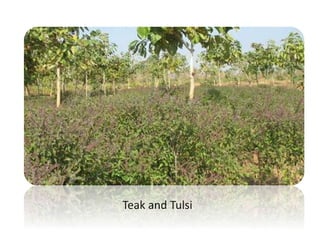
Teak and Tulsi
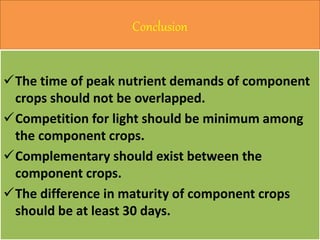
Conclusion
The time of peak nutrient demands of component
crops should not be overlapped.
Competition for light should be minimum among
the component crops.
Complementary should exist between the
component crops.
The difference in maturity of component crops
should be at least 30 days.
References
• Nath, J.C., Deka, K.K.,Saud, B.K. and Mahaswarappa, H.P.(2015).
“Intercropping of medicinal and aromatic crops in adult Coconut
garden under Brahmaputra valley region of Assam.” Journalm of
Plantation Crops. 43(1): 17-22.
• Oum, G. and Jeruto, P. (2010). “Sustainable horticultural crop
production through intercropping: The case of fruit and vegetable
crops: A review.” Agriculture and Biology Journal of North America.
1(5): 1098-1105.
• Singh, D.C., Sharma, A. and Vashit K.(2015). “Intercropping of
Medicinal Plants.” International Journal of Applied Ayurved
Research. 1(9):48-54.
• http://www.agriinfo.in/?page=topic&superid=1&topicid=661.
intercropping ppt

intercropping ppt

  • 1.
    Integration of Medicinaland Aromatic Plants in different Cropping Systems Sukriti DuttA Research Scholar Csir-neist, jorhat, assam
  • 2.
    Introduction MAPs are notonly as a source of affordable health care products - also as a source of income Systematic collection and conservation of MAPs is lacking in India 90% collection of medicinal plants is from wild sources and 10% of MAPs are distributed among other landscape elements like open grasslands, agricultural pastures, wasteland and fresh water bodies etc.
  • 3.
    Dwindling supplies fromnatural resources and increasing global demand - expanding the cultivation of MAPs - an important strategy No scope for horizontal expansion of cultivated area Integrate MAPs in different cropping systems with the predominant crops of the region
  • 4.
    Different ways ofgrowing crops to give maximum benefit Two types of cropping patterns: • Mixed cropping: Growing two or more crops simultaneously on the same piece of land • Inter cropping: Practice of growing two or more crops with a definite row pattern in proximity
  • 5.
  • 6.
    Objectives • Insurance againsttotal crop failure under aberrant weather conditions or pest epidemics. • Increase in total productivity per unit land area • Judicious utilization of resources such as land labour and inputs
  • 7.
    Intercropping in MedicinalAromatic Plants (MAPs) • Major constraint in cultivation of MAPs - availability of cultivable land • In order to derive maximum benefit of soil moisture, nutrients and other inputs, MAPs can be grown as inter- crops • The most common goal of Intercropping is to produce a greater yield on a given piece of land by making use of resources that would otherwise not be utilized by a single crop
  • 8.
    • Examples ofIntercropping strategies are planting a deep-rooted crop with shallow-rooted crop, or planting a tall crop with shorter crop which requires partial shade. • Senna (Cassia angustifolia) can be effectively intercropped with chick pea than Sunflower, Linseed, Mustard, Wheat to obtain better Senna herb yield along with maximum net return.
  • 9.
  • 10.
    Lemon grass (Cymbopogonflexuosus) with Coconut Plants
  • 11.
    Palmarosa (Cymbopogon martinivar. motia)with Bengal gram
  • 12.
    Alpinia galanga withCoconut Plants
  • 13.
  • 14.
    Coconut + Palmarosa+ Mango Ginger + Patchouli + Citronella Tamil NaduCoconut + Aloe vera + Alpinia + Tulsi Coconut+ Satavari + Adulsa + Arrow root + Lemon grass + Citronella Coconut + Sarpagandha + Aswagandha + Arrowroot Coconut+Piper+Sarpagandha+Patchouli Kerala Ratnagiri, Maharastra West Bengal Assam
  • 15.
     Stevia rebaudiana,Andrographis paniculata and Catharanthus roseus could be grown profitably under the arecanut compared to Aloe vera, Alpinia galanga, Coleus forskohlii and Ocimum sanctum as their biomass yield reduced drastically under arecanut.  Asparagus racemosus and Nilgirianthus ciliatus were found as promising yield.
  • 16.
     Even Bacopamonnieri and Ocimum basilicum could be considered as they also reported to give high returns per rupee investment and better system productivity  Substantial additional income
  • 17.
    Oil palm basedcropping system Alpinia calcarata Rosc. is highly adaptable to various oil palm canopy shade conditions. 5-15 years
  • 18.
    Intercropping of medicinalplants in black pepper • Inter-spaces remain unutilized during early years of planting • Adhatoda beddomei , • Desmodium gangeticum, • Pseudarthria viscida, • Plumbago zeylinicum, • Niligirianthus ciliatus, • Alpinia calcarata, • Crysopogon zizanioides, • Asparagus racemosus.
  • 19.
    Intercropping of medicinalplants in black pepper • Asparagus gave maximum yield (1998 kg/ha) followed by Alpinia (1,700 kg/ha). • Highest income (B:C ratio = 2.3:1) was obtained with Crysopogon intercropping
  • 20.
    MAPS in multistoreycropping system • It is a system of growing crops together of different heights at the same time on the same piece of land and thus using land, water, and space most efficiently and economically • New plantations of coffee, tea & cocoa offer scope for cultivation of forest medicinal trees that are under demand
  • 21.
    Medicinal trees • Prunusafricana (Red stinkwood), • Eucalyptus globules (for oil), • Santalum album (Sandalwood), • Saraca ashoka (Ashok), • Aegle marmelos (Bael), • Anona squamosa (Custard apple), • Emblica officinalis (Amla), • Moringa oleifera (Drumstick) and • Sapindus mukorossi (Soap nut tree)
  • 22.
    Medicinal trees • Medicinaltrees may allow intercropping for many years or on a permanent basis depending on the spacing and nature of the trees. • The intercrops give some income to farmers during the period when the main trees have not started production. • Eucalyptus citriodora can be effectively grown along with Coffee, Lemongrass and Palmarosa.
  • 23.
    Types of Intercropping •Mixed Intercropping: The component crops are mixed in the available space. • Row Cropping: Component crops are arranged alternate rows. • Alley Cropping: An agroforestry practice where agricultural or horticultural crops are grown in the alleyways between widely spaced rows of woody plants.
  • 24.
     Strip Cropping:Growing soil conserving crops in alternate strips running perpendicular to the slope of the land or to the direction of prevailing winds for the purpose of reducing erosion.  Vetiver (Vetiveria zizanioides),  Lemongrass (Cymbopogon flexuosus) and  Citronella (Cymbopogon winterianus)
  • 25.
    •Relay Cropping: Thesecond crop is sown during the growth, often near the onset of reproductive development or fruiting, of the first crop, so that the first crop is harvested to make room prepare for the full development of the second crop.
  • 26.
    Crop rotation • Croprotation - Growing two or more crops in a sequence in the same land within a specified time period, which is usually one calendar year. • This system allows utilization of land throughout or most part of year. • In the recent past, the rice-wheat rotation with corn mint has been successfully practiced over a very large area in the Indo-Gangetic plains.
  • 27.
    As per CIMAPrecommendation First year Crop Second year Crop July/August to October (Kharif season) Rice June/July to November/ December Pigeon pea November/Dece mber to March (Rabi season) Chickpea November/ December to April Wheat March/April to June/July (Zaid season) Corn mint April to July/ August Corn mint
  • 28.
    MAPs and Agroforestry •Forests are the primary source of medicinal plants, and MAPs are one of the many valuable categories of non timber forest products (NTFPs). • Forests provide a wealth of highly prized MAPs, whether in the alpine and sub-alpine Northwest Himalayas, Afro-mountain areas, humid tropics or temperate regions. • In India, medicinal plants are harvested regularly in appreciable quantities and exported with government approval.
  • 29.
    Aromatic plants withtimber tree • M. arvensis, • M. piperita, • M. citrata var. citrata, • M. spicata, • M. cardiac, • M. gracilis, • C. flexuosus, • C. winterianus, • C. martinii. Populus deltoides or Eucalyptus spp
  • 30.
    Aromatic plants withtimber tree • Pelargonium graveolens • M. arvensis, • M. piperita, • M. citrata var. citrata, • M. spicata, • M. cardiac and M. gracilis • C. flexuosus, • C. winterianus, • C. martinii. • 2-4 times greater economic returns than sole cropping Initial 3-5 years Eucalyptus citriodora
  • 31.
    Aromatic plants profitablygrown in association with fuel and timber trees such as Leucana leucocephala, Casuarina spp. and Grevillea robusta. Aromatic grasses such as vetiver (Vetiveria zizanioides), lemongrass (Cymbopogon flexuosus) and citronella (Cymbopogon winterianus ) can be grown on field bunds and soil conservation bunds. In West Bengal, Costus speciosus, a diosgenin producing plant, is recommended as major storey crop in social forestry programs.
  • 32.
    9 Acacia auriculiformis, Albizia lebbeck, Eucalyptustereticornis, Gmelina arborea & Leucaeana leucocephala Most of the temperate medicinal plants are highly suitable for agroforestry system Safed musli (C. borivilianum), Rauvolfia (Rauvolfia serpentina) Turmeric (Curcuma longa), Wild turmeric (C. aromatica), Ginger (Zingiber officinale)
  • 33.
  • 37.
    Conclusion The time ofpeak nutrient demands of component crops should not be overlapped. Competition for light should be minimum among the component crops. Complementary should exist between the component crops. The difference in maturity of component crops should be at least 30 days.
  • 38.
    References • Nath, J.C.,Deka, K.K.,Saud, B.K. and Mahaswarappa, H.P.(2015). “Intercropping of medicinal and aromatic crops in adult Coconut garden under Brahmaputra valley region of Assam.” Journalm of Plantation Crops. 43(1): 17-22. • Oum, G. and Jeruto, P. (2010). “Sustainable horticultural crop production through intercropping: The case of fruit and vegetable crops: A review.” Agriculture and Biology Journal of North America. 1(5): 1098-1105. • Singh, D.C., Sharma, A. and Vashit K.(2015). “Intercropping of Medicinal Plants.” International Journal of Applied Ayurved Research. 1(9):48-54. • http://www.agriinfo.in/?page=topic&superid=1&topicid=661.