Master’s Seminar
ON
INTER-CROPPING SYSTEM IN Bt COTTON
(Gossypium hirsutum)
Submitted to-
Dr. Vikram Singh
Associate Professor
Department of Agronomy
Allahabad School of Agriculture
SHIATS
Submitted by
Vikram Pal
M.Sc. (Ag) Agronomy
I.D. No – 16MSAGRO010
Department of Agronomy
SHIATS
FLOW OF PRESENTATION
 INTRODUCTION
 WHY INTERCROP ?
 OBJECTIVES OF INTERCROPPING SYSTEMS
 TYPES OF INTER-CROPPING
 ADVANTAGES
 PRINCIPLES OF INTERCROPPING
 RESEARCH FINDINGS REGARDING OBJECTIVES
 CONCLUSION
 REFERENCES
INTRODUCTION
Intercropping
- Intercropping is the cultivation of two or
more crops at the same time on the same
field. The most common goal
of intercropping is to produce a greater yield
on a given piece of land by making use of
resources that would otherwise not be
utilized by a single crop.
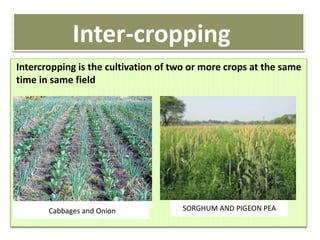
Inter-cropping
Intercropping is the cultivation of two or more crops at the same
time in same field
Cabbages and Onion SORGHUM AND PIGEON PEA
Why intercrop ?
 1. Stability: Intercropping adds diversity to the cropping
system and diversity tends to lead to stability.
 2. Reduced chemical use. Intercropping may allow for lower
input levels in a cropping system by reducing fertilizer and
pesticide requirements.
 3.Extra yield. Over yielding occurs when the yield produced by
an intercrop is larger than the yield produced by the
component crops grown in monoculture on the same total
land area.
Objectives of intercropping systems
 Intercropping was originally practiced as an insurance against crop failure under
rainfall condition.
 At present the main objective of intercropping is higher productivity per unit area
in addition to stability in production.
 Intercropping system utilizes resources sufficiently and their productivity is
increased.
 Insurance against total crop failure under aberrant weather conditions or pest
epidemics.
 Increase in total productivity per unit land area.
 Judicious utilization of resources such as land labour and inputs.
Types of Inter-Cropping
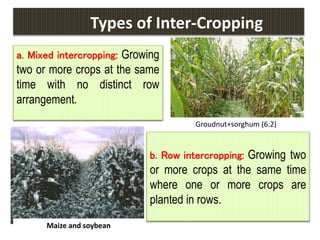
a. Mixed intercropping: Growing
two or more crops at the same
time with no distinct row
arrangement.
b. Row intercropping: Growing two
or more crops at the same time
where one or more crops are
planted in rows.
Groudnut+sorghum (6:2)
Maize and soybean
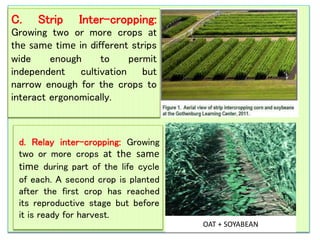
C. Strip Inter-cropping:
Growing two or more crops at
the same time in different strips
wide enough to permit
independent cultivation but
narrow enough for the crops to
interact ergonomically.
d. Relay inter-cropping: Growing
two or more crops at the same
time during part of the life cycle
of each. A second crop is planted
after the first crop has reached
its reproductive stage but before
it is ready for harvest.
OAT + SOYABEAN
Inter-cropping may be divided into the following
four groups (Singh 1990)
 i) Parallel Cropping: Under this cropping two crops are selected
which have different growth habits and have a zero competition
between each other .
E.g. 1) Green gram or black gram with maize. 2) Green gram or
soybean with cotton.
 ii) Companion Cropping: In companion cropping the yield of one
crop is not affected by other.
E.g.1) Mustard, wheat, potato, etc. with sugarcane 2) Wheat,
radish, cabbage, sugar beat etc., with potato.
Cont.….
iii) Multistoried Cropping: or Multi-tire cropping:
Growing plants of different height in the same field at
the same time is termed as multistoried cropping.
e.g. 1) Eucalyptus +Papaya + Berseem )
Multi-tire Cropping: Inter-cropping is mostly prevalent
in plantation crops like coconut and areca nut. The
practice different crops of varying heights, rooting
pattern and duration are called multi-tire cropping.
e .g. Coconut + black pepper + cocoa + pineapple.
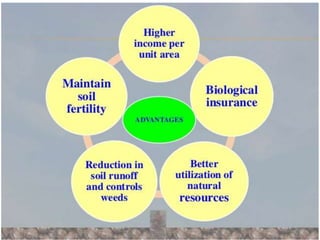
Advantages
Intercropping gives higher income per unit area than
sole cropping.
Intercrops maintain soil fertility as the nutrient uptake is
made from both layers.
 Reduce soil runoff.
intercropping economizes water use. E.g. Pearl millet +
red grams.
Source :My Agriculture Information Bank
Principles of intercropping
Intercrops should occupy a secondary place in the orchard,
primary consideration being given to the perennial fruit trees.
At least 120 cm. radius must be left from the base of the
growing fruit trees for taking intercrops.
Such intercrops should be selected that do not exhaust
the nutrient and moisture from the soil, so essential for
the growth of fruit trees.
Cont.….
Perennial or exhaustive crops should be
discouraged as an intercrop in the orchard.
This may have devitalizing effect on the growing
trees. For example, sugarcane, pigeon pea,
maize, jowar should invariably be excluded from
an intercropping programme in the orchard.
RESEARCH FINDINGS
REGARDING OBJECTIVES
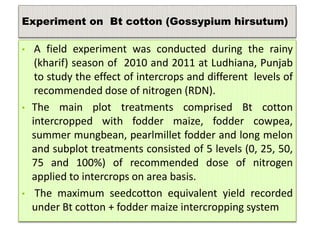
• A field experiment was conducted during the rainy
(kharif) season of 2010 and 2011 at Ludhiana, Punjab
to study the effect of intercrops and different levels of
recommended dose of nitrogen (RDN).
• The main plot treatments comprised Bt cotton
intercropped with fodder maize, fodder cowpea,
summer mungbean, pearlmillet fodder and long melon
and subplot treatments consisted of 5 levels (0, 25, 50,
75 and 100%) of recommended dose of nitrogen
applied to intercrops on area basis.
• The maximum seedcotton equivalent yield recorded
under Bt cotton + fodder maize intercropping system
Experiment on Bt cotton (Gossypium hirsutum)
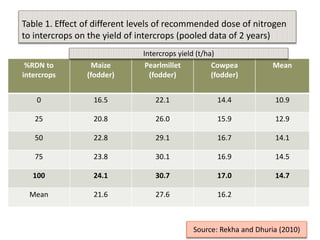
Table 1. Effect of different levels of recommended dose of nitrogen
to intercrops on the yield of intercrops (pooled data of 2 years)
%RDN to
intercrops
Maize
(fodder)
Pearlmillet
(fodder)
Cowpea
(fodder)
Mean
0 16.5 22.1 14.4 10.9
25 20.8 26.0 15.9 12.9
50 22.8 29.1 16.7 14.1
75 23.8 30.1 16.9 14.5
100 24.1 30.7 17.0 14.7
Mean 21.6 27.6 16.2
Intercrops yield (t/ha)
Source: Rekha and Dhuria (2010)
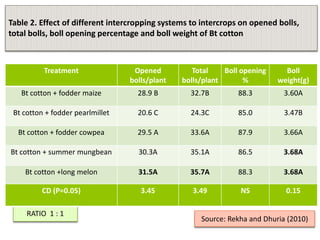
Table 2. Effect of different intercropping systems to intercrops on opened bolls,
total bolls, boll opening percentage and boll weight of Bt cotton
Treatment Opened
bolls/plant
Total
bolls/plant
Boll opening
%
Boll
weight(g)
Bt cotton + fodder maize 28.9 B 32.7B 88.3 3.60A
Bt cotton + fodder pearlmillet 20.6 C 24.3C 85.0 3.47B
Bt cotton + fodder cowpea 29.5 A 33.6A 87.9 3.66A
Bt cotton + summer mungbean 30.3A 35.1A 86.5 3.68A
Bt cotton +long melon 31.5A 35.7A 88.3 3.68A
RATIO 1 : 1
CD (P=0.05) 3.45 3.49 NS 0.15
Source: Rekha and Dhuria (2010)
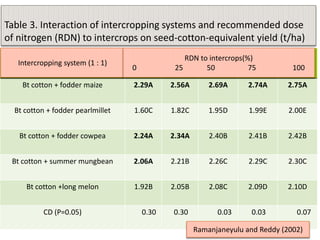
Table 3. Interaction of intercropping systems and recommended dose
of nitrogen (RDN) to intercrops on seed-cotton-equivalent yield (t/ha)
Bt cotton + fodder maize 2.29A 2.56A 2.69A 2.74A 2.75A
Bt cotton + fodder pearlmillet 1.60C 1.82C 1.95D 1.99E 2.00E
Bt cotton + fodder cowpea 2.24A 2.34A 2.40B 2.41B 2.42B
Bt cotton + summer mungbean 2.06A 2.21B 2.26C 2.29C 2.30C
Bt cotton +long melon 1.92B 2.05B 2.08C 2.09D 2.10D
CD (P=0.05) 0.30 0.30 0.03 0.03 0.07
RDN to intercrops(%)
0 25 50 75 100
Intercropping system (1 : 1)
Ramanjaneyulu and Reddy (2002)
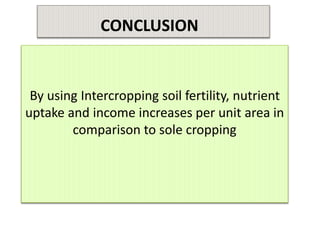
CONCLUSION
By using Intercropping soil fertility, nutrient
uptake and income increases per unit area in
comparison to sole cropping
References
Cotton Association of India (2008) Cotton statistics and news (Issue No. 42).
Mumbai, Maharashtra, India
Palchamy A, Purushothaman S, Rajgopal A (1991) Water use of crops grown
in pure and intercropping stands. Indian J Agron 36:300–302
Singh A., Singh T. (2015). Growth, yield and quality of Bt cotton (Gossypium
hirsutum) as influenced by different intercropping systems and nitrogen
levels. Indian Journal of Agronomy, 60 (2): 236-244
Singh R.V., Sharma A.K. and Tomar, (2003) . Weed-control in chickpea (Cicer
arietinum) under late sown condition. Indian Journal of Agronomy 48(2):
114–16.
Intercropping system in BT cotton

Intercropping system in BT cotton

  • 2.
    Master’s Seminar ON INTER-CROPPING SYSTEMIN Bt COTTON (Gossypium hirsutum) Submitted to- Dr. Vikram Singh Associate Professor Department of Agronomy Allahabad School of Agriculture SHIATS Submitted by Vikram Pal M.Sc. (Ag) Agronomy I.D. No – 16MSAGRO010 Department of Agronomy SHIATS
  • 3.
    FLOW OF PRESENTATION INTRODUCTION  WHY INTERCROP ?  OBJECTIVES OF INTERCROPPING SYSTEMS  TYPES OF INTER-CROPPING  ADVANTAGES  PRINCIPLES OF INTERCROPPING  RESEARCH FINDINGS REGARDING OBJECTIVES  CONCLUSION  REFERENCES
  • 4.
    INTRODUCTION Intercropping - Intercropping isthe cultivation of two or more crops at the same time on the same field. The most common goal of intercropping is to produce a greater yield on a given piece of land by making use of resources that would otherwise not be utilized by a single crop.
  • 5.
    Inter-cropping Intercropping is thecultivation of two or more crops at the same time in same field Cabbages and Onion SORGHUM AND PIGEON PEA
  • 6.
    Why intercrop ? 1. Stability: Intercropping adds diversity to the cropping system and diversity tends to lead to stability.  2. Reduced chemical use. Intercropping may allow for lower input levels in a cropping system by reducing fertilizer and pesticide requirements.  3.Extra yield. Over yielding occurs when the yield produced by an intercrop is larger than the yield produced by the component crops grown in monoculture on the same total land area.
  • 7.
    Objectives of intercroppingsystems  Intercropping was originally practiced as an insurance against crop failure under rainfall condition.  At present the main objective of intercropping is higher productivity per unit area in addition to stability in production.  Intercropping system utilizes resources sufficiently and their productivity is increased.  Insurance against total crop failure under aberrant weather conditions or pest epidemics.  Increase in total productivity per unit land area.  Judicious utilization of resources such as land labour and inputs.
  • 8.
    Types of Inter-Cropping a.Mixed intercropping: Growing two or more crops at the same time with no distinct row arrangement. b. Row intercropping: Growing two or more crops at the same time where one or more crops are planted in rows. Groudnut+sorghum (6:2) Maize and soybean
  • 9.
    C. Strip Inter-cropping: Growingtwo or more crops at the same time in different strips wide enough to permit independent cultivation but narrow enough for the crops to interact ergonomically. d. Relay inter-cropping: Growing two or more crops at the same time during part of the life cycle of each. A second crop is planted after the first crop has reached its reproductive stage but before it is ready for harvest. OAT + SOYABEAN
  • 10.
    Inter-cropping may bedivided into the following four groups (Singh 1990)  i) Parallel Cropping: Under this cropping two crops are selected which have different growth habits and have a zero competition between each other . E.g. 1) Green gram or black gram with maize. 2) Green gram or soybean with cotton.  ii) Companion Cropping: In companion cropping the yield of one crop is not affected by other. E.g.1) Mustard, wheat, potato, etc. with sugarcane 2) Wheat, radish, cabbage, sugar beat etc., with potato. Cont.….
  • 11.
    iii) Multistoried Cropping:or Multi-tire cropping: Growing plants of different height in the same field at the same time is termed as multistoried cropping. e.g. 1) Eucalyptus +Papaya + Berseem ) Multi-tire Cropping: Inter-cropping is mostly prevalent in plantation crops like coconut and areca nut. The practice different crops of varying heights, rooting pattern and duration are called multi-tire cropping. e .g. Coconut + black pepper + cocoa + pineapple.
  • 12.
    Advantages Intercropping gives higherincome per unit area than sole cropping. Intercrops maintain soil fertility as the nutrient uptake is made from both layers.  Reduce soil runoff. intercropping economizes water use. E.g. Pearl millet + red grams. Source :My Agriculture Information Bank
  • 14.
    Principles of intercropping Intercropsshould occupy a secondary place in the orchard, primary consideration being given to the perennial fruit trees. At least 120 cm. radius must be left from the base of the growing fruit trees for taking intercrops. Such intercrops should be selected that do not exhaust the nutrient and moisture from the soil, so essential for the growth of fruit trees. Cont.….
  • 15.
    Perennial or exhaustivecrops should be discouraged as an intercrop in the orchard. This may have devitalizing effect on the growing trees. For example, sugarcane, pigeon pea, maize, jowar should invariably be excluded from an intercropping programme in the orchard.
  • 16.
  • 17.
    • A fieldexperiment was conducted during the rainy (kharif) season of 2010 and 2011 at Ludhiana, Punjab to study the effect of intercrops and different levels of recommended dose of nitrogen (RDN). • The main plot treatments comprised Bt cotton intercropped with fodder maize, fodder cowpea, summer mungbean, pearlmillet fodder and long melon and subplot treatments consisted of 5 levels (0, 25, 50, 75 and 100%) of recommended dose of nitrogen applied to intercrops on area basis. • The maximum seedcotton equivalent yield recorded under Bt cotton + fodder maize intercropping system Experiment on Bt cotton (Gossypium hirsutum)
  • 18.
    Table 1. Effectof different levels of recommended dose of nitrogen to intercrops on the yield of intercrops (pooled data of 2 years) %RDN to intercrops Maize (fodder) Pearlmillet (fodder) Cowpea (fodder) Mean 0 16.5 22.1 14.4 10.9 25 20.8 26.0 15.9 12.9 50 22.8 29.1 16.7 14.1 75 23.8 30.1 16.9 14.5 100 24.1 30.7 17.0 14.7 Mean 21.6 27.6 16.2 Intercrops yield (t/ha) Source: Rekha and Dhuria (2010)
  • 19.
    Table 2. Effectof different intercropping systems to intercrops on opened bolls, total bolls, boll opening percentage and boll weight of Bt cotton Treatment Opened bolls/plant Total bolls/plant Boll opening % Boll weight(g) Bt cotton + fodder maize 28.9 B 32.7B 88.3 3.60A Bt cotton + fodder pearlmillet 20.6 C 24.3C 85.0 3.47B Bt cotton + fodder cowpea 29.5 A 33.6A 87.9 3.66A Bt cotton + summer mungbean 30.3A 35.1A 86.5 3.68A Bt cotton +long melon 31.5A 35.7A 88.3 3.68A RATIO 1 : 1 CD (P=0.05) 3.45 3.49 NS 0.15 Source: Rekha and Dhuria (2010)
  • 20.
    Table 3. Interactionof intercropping systems and recommended dose of nitrogen (RDN) to intercrops on seed-cotton-equivalent yield (t/ha) Bt cotton + fodder maize 2.29A 2.56A 2.69A 2.74A 2.75A Bt cotton + fodder pearlmillet 1.60C 1.82C 1.95D 1.99E 2.00E Bt cotton + fodder cowpea 2.24A 2.34A 2.40B 2.41B 2.42B Bt cotton + summer mungbean 2.06A 2.21B 2.26C 2.29C 2.30C Bt cotton +long melon 1.92B 2.05B 2.08C 2.09D 2.10D CD (P=0.05) 0.30 0.30 0.03 0.03 0.07 RDN to intercrops(%) 0 25 50 75 100 Intercropping system (1 : 1) Ramanjaneyulu and Reddy (2002)
  • 21.
    CONCLUSION By using Intercroppingsoil fertility, nutrient uptake and income increases per unit area in comparison to sole cropping
  • 22.
    References Cotton Association ofIndia (2008) Cotton statistics and news (Issue No. 42). Mumbai, Maharashtra, India Palchamy A, Purushothaman S, Rajgopal A (1991) Water use of crops grown in pure and intercropping stands. Indian J Agron 36:300–302 Singh A., Singh T. (2015). Growth, yield and quality of Bt cotton (Gossypium hirsutum) as influenced by different intercropping systems and nitrogen levels. Indian Journal of Agronomy, 60 (2): 236-244 Singh R.V., Sharma A.K. and Tomar, (2003) . Weed-control in chickpea (Cicer arietinum) under late sown condition. Indian Journal of Agronomy 48(2): 114–16.