Football – A team sport
While it’s easy to
give the entire
credit to a goal
scorer
It takes a winning effort from
the entire team to win a
championship where every
individual contributes
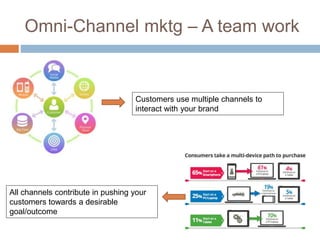
Omni-Channel mktg – A team work
Customers use multiple channels to
interact with your brand
All channels contribute in pushing your
customers towards a desirable
goal/outcome
Multi-Channel Attribution
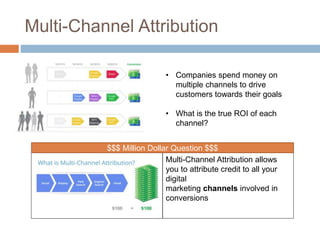
• Companies spend money on
multiple channels to drive
customers towards their goals
• What is the true ROI of each
channel?
Multi-Channel Attribution allows
you to attribute credit to all your
digital
marketing channels involved in
conversions
$$$ Million Dollar Question $$$
• Marketers who solely focus on lead generation and don’t rely on conversions
may find this model useful as it only highlights the campaigns that first
introduces the customers
• Using this model offers limited optimization as without the visibility of
campaigns driving conversions, marketers find it hard to understand
company’s bottom line
First Touch/Click Attribution
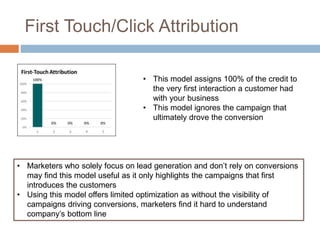
• This model assigns 100% of the credit to
the very first interaction a customer had
with your business
• This model ignores the campaign that
ultimately drove the conversion
Last Touch/Click Attribution
• 100% credit is assigned to the marketing
channel driving the conversion
• Using this model may give insights on
campaigns with high conversion rate, but
it may lose sight on any influences
leading up to the conversions.
• This model can be powerful for marketers who are solely focused on driving
conversions.
• This model completely ignores all other channels even if a customer interacts
with your brand a dozen times before conversion
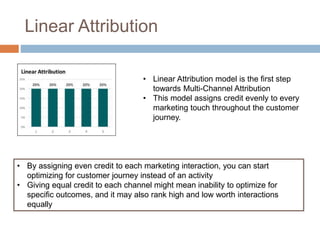
• By assigning even credit to each marketing interaction, you can start
optimizing for customer journey instead of an activity
• Giving equal credit to each channel might mean inability to optimize for
specific outcomes, and it may also rank high and low worth interactions
equally
Linear Attribution
• Linear Attribution model is the first step
towards Multi-Channel Attribution
• This model assigns credit evenly to every
marketing touch throughout the customer
journey.
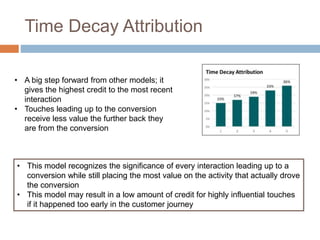
Time Decay Attribution
• A big step forward from other models; it
gives the highest credit to the most recent
interaction
• Touches leading up to the conversion
receive less value the further back they
are from the conversion
• This model recognizes the significance of every interaction leading up to a
conversion while still placing the most value on the activity that actually drove
the conversion
• This model may result in a low amount of credit for highly influential touches
if it happened too early in the customer journey
• This model ensures that every touch point in the customer journey receives a
portion of the credit while still allowing you to optimize for the first and last
touches
• Even though this is a major step up from other models, assigning a very high
credit for first and last touches can be dangerous.
Position Based Attribution
• This model combines the best features of
the linear and time decay models.
• In an example, it may give 40% credit to
the first and the last channels each, while
the remaining 20% is divided among the
others.
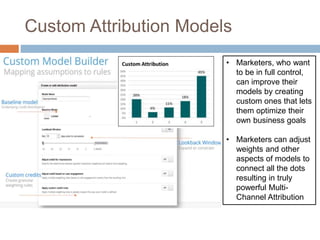
Custom Attribution Models
• Marketers, who want
to be in full control,
can improve their
models by creating
custom ones that lets
them optimize their
own business goals
• Marketers can adjust
weights and other
aspects of models to
connect all the dots
resulting in truly
powerful Multi-
Channel Attribution
Conclusion
• Marketers simply cannot rely on single touch attribution anymore
• Customers use
multiple channels to
interact with your
brand
• Even though companies are
spending on multiple
channels, they are still
oblivious to the true ROI of
their campaigns
• Multiple campaigns work
as a team to drive
customers towards
business goals
• Multi-Channel Attribution
models gives you
insights based on
customer journey
Thank you!

Multi channel attribution

  • 2.
    Football – Ateam sport While it’s easy to give the entire credit to a goal scorer It takes a winning effort from the entire team to win a championship where every individual contributes
  • 3.
    Omni-Channel mktg –A team work Customers use multiple channels to interact with your brand All channels contribute in pushing your customers towards a desirable goal/outcome
  • 4.
    Multi-Channel Attribution • Companiesspend money on multiple channels to drive customers towards their goals • What is the true ROI of each channel? Multi-Channel Attribution allows you to attribute credit to all your digital marketing channels involved in conversions $$$ Million Dollar Question $$$
  • 5.
    • Marketers whosolely focus on lead generation and don’t rely on conversions may find this model useful as it only highlights the campaigns that first introduces the customers • Using this model offers limited optimization as without the visibility of campaigns driving conversions, marketers find it hard to understand company’s bottom line First Touch/Click Attribution • This model assigns 100% of the credit to the very first interaction a customer had with your business • This model ignores the campaign that ultimately drove the conversion
  • 6.
    Last Touch/Click Attribution •100% credit is assigned to the marketing channel driving the conversion • Using this model may give insights on campaigns with high conversion rate, but it may lose sight on any influences leading up to the conversions. • This model can be powerful for marketers who are solely focused on driving conversions. • This model completely ignores all other channels even if a customer interacts with your brand a dozen times before conversion
  • 7.
    • By assigningeven credit to each marketing interaction, you can start optimizing for customer journey instead of an activity • Giving equal credit to each channel might mean inability to optimize for specific outcomes, and it may also rank high and low worth interactions equally Linear Attribution • Linear Attribution model is the first step towards Multi-Channel Attribution • This model assigns credit evenly to every marketing touch throughout the customer journey.
  • 8.
    Time Decay Attribution •A big step forward from other models; it gives the highest credit to the most recent interaction • Touches leading up to the conversion receive less value the further back they are from the conversion • This model recognizes the significance of every interaction leading up to a conversion while still placing the most value on the activity that actually drove the conversion • This model may result in a low amount of credit for highly influential touches if it happened too early in the customer journey
  • 9.
    • This modelensures that every touch point in the customer journey receives a portion of the credit while still allowing you to optimize for the first and last touches • Even though this is a major step up from other models, assigning a very high credit for first and last touches can be dangerous. Position Based Attribution • This model combines the best features of the linear and time decay models. • In an example, it may give 40% credit to the first and the last channels each, while the remaining 20% is divided among the others.
  • 10.
    Custom Attribution Models •Marketers, who want to be in full control, can improve their models by creating custom ones that lets them optimize their own business goals • Marketers can adjust weights and other aspects of models to connect all the dots resulting in truly powerful Multi- Channel Attribution
  • 11.
    Conclusion • Marketers simplycannot rely on single touch attribution anymore • Customers use multiple channels to interact with your brand • Even though companies are spending on multiple channels, they are still oblivious to the true ROI of their campaigns • Multiple campaigns work as a team to drive customers towards business goals • Multi-Channel Attribution models gives you insights based on customer journey Thank you!