


Let’s Talk Attribution
Peter O’Neill
Director
• I am a Digital Analyst, working in field for over 10 years
• I am a co-founder of LeapThree
• Formed from merger of two leading digital analytics consultancies
• We offer comprehensive skills & experience around:
• Google Analytics & Adobe Analytics
• Analytics – set-up, training, reporting, insights & recommendations
• Conversion rate optimisation, personalisation, data integration
• Both strategic & hands on practical experience
• Work with clients of all sizes and across all sectors
G’DAY, I’M PETER
How I ended up at Hero Conf
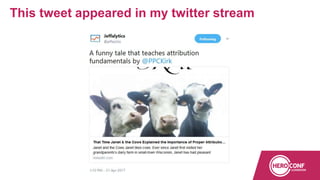
This tweet appeared in my twitter stream
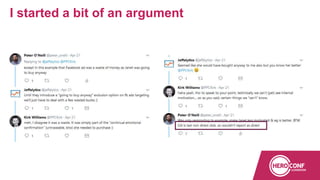
I started a bit of an argument
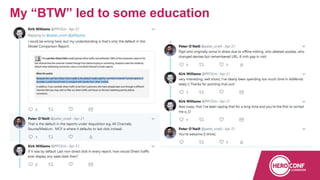
My “BTW” led to some education
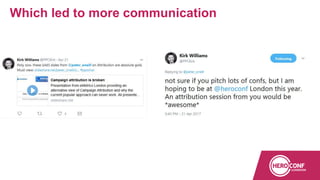
Which led to more communication
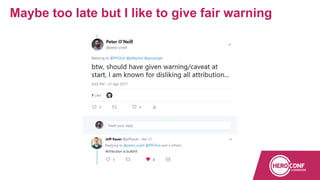
Maybe too late but I like to give fair warning
The basis of my arguments
Theoretical
Physicist
Experimental
Physicist
Defining the
business problem
To provide intelligence that informs
business actions leading to an
improvement in performance for online
organisations
The purpose of Digital Analytics
“What is the right attribution model for me?”
“How should I split revenue between my marketing sources”
“There is no perfect attribution model but there are better ones”
The comments I hear in meetings
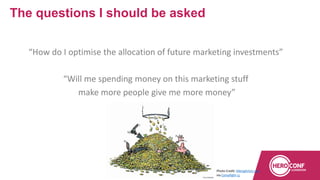
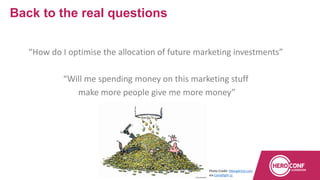
“How do I optimise the allocation of future marketing investments”
“Will me spending money on this marketing stuff
make more people give me more money”
The questions I should be asked
Photo Credit: HikingArtist.com
via Compfight cc
Understanding attribution
models via an analogy
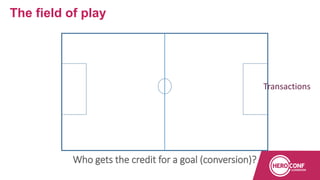
The field of play
Transactions
Who gets the credit for a goal (conversion)?
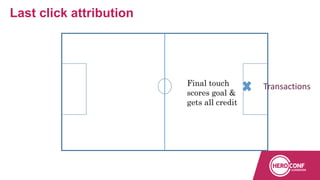
Final touch
scores goal &
gets all credit
Last click attribution
Transactions
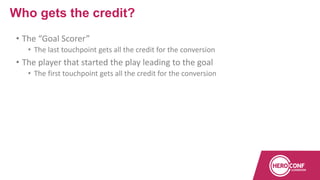
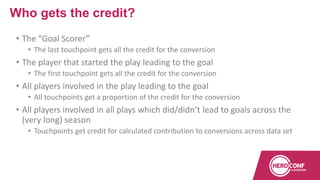
• The “Goal Scorer”
• The last touchpoint gets all the credit for the conversion
Who gets the credit for a goal (conversion)?
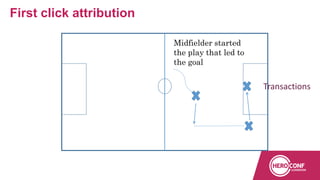
Midfielder started
the play that led to
the goal
First click attribution
Transactions
• The “Goal Scorer”
• The last touchpoint gets all the credit for the conversion
• The player that started the play leading to the goal
• The first touchpoint gets all the credit for the conversion
Who gets the credit?
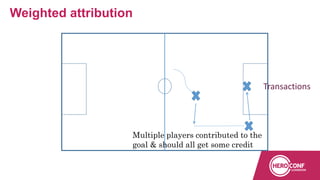
Multiple players contributed to the
goal & should all get some credit
Weighted attribution
Transactions
• The “Goal Scorer”
• The last touchpoint gets all the credit for the conversion
• The player that started the play leading to the goal
• The first touchpoint gets all the credit for the conversion
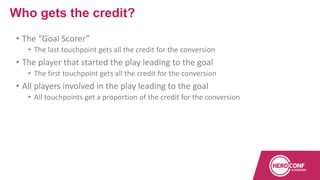
• All players involved in the play leading to the goal
• All touchpoints get a proportion of the credit for the conversion
Who gets the credit?
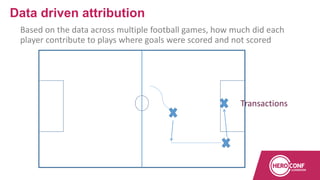
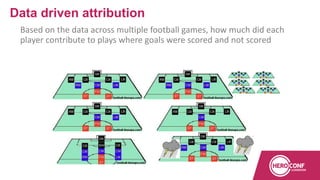
Data driven attribution
Transactions
Based on the data across multiple football games, how much did each
player contribute to plays where goals were scored and not scored
Data driven attribution
Based on the data across multiple football games, how much did each
player contribute to plays where goals were scored and not scored
• The “Goal Scorer”
• The last touchpoint gets all the credit for the conversion
• The player that started the play leading to the goal
• The first touchpoint gets all the credit for the conversion
• All players involved in the play leading to the goal
• All touchpoints get a proportion of the credit for the conversion
• All players involved in all plays which did/didn’t lead to goals across the
(very long) season
• Touchpoints get credit for calculated contribution to conversions across data set
Who gets the credit?
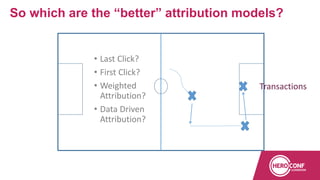
So which are the “better” attribution models?
Transactions
• Last Click?
• First Click?
• Weighted
Attribution?
• Data Driven
Attribution?
• Last click models are flawed as gives credit to a single touchpoint only,
ignoring all other influences
• First click models are flawed as gives credit to a single touchpoint only,
ignoring all other influences
• Weighted attribution models are all flawed as one set of logic cannot
reflect the contribution of touchpoints to all conversions
• Is all this solved with the use of data driven attribution models??
So which are the “better” attribution models?
Flaws in concept of all
attribution models
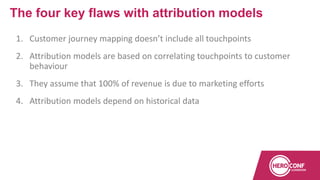
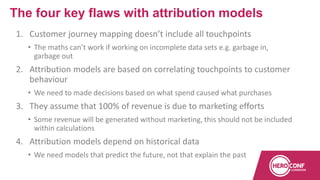
1. Customer journey mapping doesn’t include all touchpoints
2. Attribution models are based on correlating touchpoints to customer
behaviour
3. They assume that 100% of revenue is due to marketing efforts
4. Attribution models depend on historical data
The four key flaws with attribution models
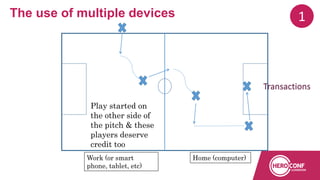
Play started on
the other side of
the pitch & these
players deserve
credit too
Home (computer)Work (or smart
phone, tablet, etc)
The use of multiple devices
Transactions
1
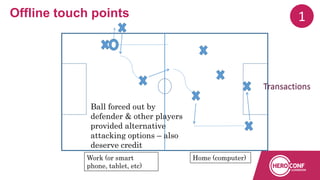
Ball forced out by
defender & other players
provided alternative
attacking options – also
deserve credit
Transactions
Offline touch points
Home (computer)Work (or smart
phone, tablet, etc)
1
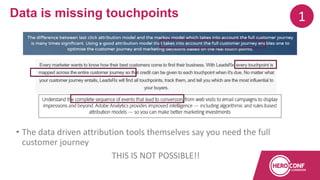
• The data driven attribution tools themselves say you need the full
customer journey
THIS IS NOT POSSIBLE!!
Data is missing touchpoints 1
• Very simplistic scenario
• High proportion of customers for a retailer research pre purchase
• 80% of eventual customer will have research visits
• 75% of these researchers do this on their lunch breaks at work (without logging
in) before purchasing at home
• The data will say that 80% of customers purchased on their first visit (20% no
research + 75% x 80% do research)
• The business strategy based on this data would be the wrong strategy
• If the entire customer journey is not mapped, data driven attribution fails
• Web Analytics data is incomplete but the sample reflects the population
• Strategies made based on web analytics data are the right strategies
The impact of the incomplete data 1
• Scenario taken from Gary Angel - bit.ly/1tSBM8s
• Company is a motors dealership
• Doing some research into customers, discovered a website that is quite
popular with 20% of customers viewing pre purchase
• Due to this, started advertising with display ads on this website
• This campaign delivered great numbers, 20% of sales occurred after
viewing these display ads on this website
• How much credit should this display campaign receive?
Which marketing touch points impact sales? 2
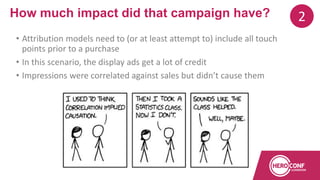
• Attribution models need to (or at least attempt to) include all touch
points prior to a purchase
• In this scenario, the display ads get a lot of credit
• Impressions were correlated against sales but didn’t cause them
How much impact did that campaign have? 2
• Scenario – company offers annual subscriptions
• Very high retention rates, typically 85% renew subscription
• Company starts new email programme for existing subscribers
• Most customers who receive email open this email
• No other marketing touchpoints for existing customers
• 85% of customers purchase a new subscription
• How much credit should the email programme get?
Are all customers equal? 3
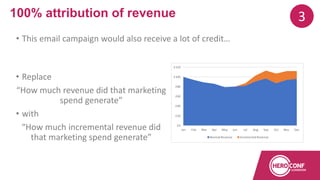
• This email campaign would also receive a lot of credit…
100% attribution of revenue
• Replace
“How much revenue did that marketing
spend generate”
• with
“How much incremental revenue did
that marketing spend generate”
3
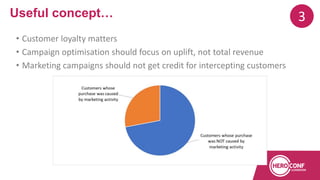
• Customer loyalty matters
• Campaign optimisation should focus on uplift, not total revenue
• Marketing campaigns should not get credit for intercepting customers
Useful concept… 3
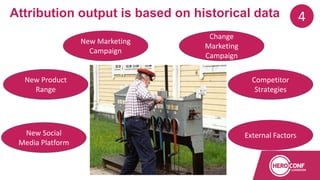
• Attribution models are forecasts built on historical data and statistical
modelling
• But the situation changes…
• If you can’t adjust the model based on known changes, the output is
going to be flawed
Attribution output is based on historical data 4
Attribution output is based on historical data
New Marketing
Campaign
New Product
Range
Competitor
Strategies
External FactorsNew Social
Media Platform
Change
Marketing
Campaign
4
1. Customer journey mapping doesn’t include all touchpoints
• The maths can’t work if working on incomplete data sets e.g. garbage in,
garbage out
2. Attribution models are based on correlating touchpoints to customer
behaviour
• We need to made decisions based on what spend caused what purchases
3. They assume that 100% of revenue is due to marketing efforts
• Some revenue will be generated without marketing, this should not be included
within calculations
4. Attribution models depend on historical data
• We need models that predict the future, not that explain the past
The four key flaws with attribution models
So where does that
leave us?
“How do I optimise the allocation of future marketing investments”
“Will me spending money on this marketing stuff
make more people give me more money”
Back to the real questions
Photo Credit: HikingArtist.com
via Compfight cc
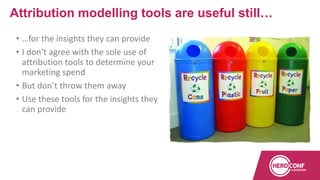
• …for the insights they can provide
• I don’t agree with the sole use of
attribution tools to determine your
marketing spend
• But don’t throw them away
• Use these tools for the insights they
can provide
Attribution modelling tools are useful still…
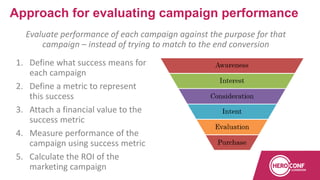
Evaluate performance of each campaign against the purpose for that
campaign – instead of trying to match to the end conversion
Approach for evaluating campaign performance
1. Define what success means for
each campaign
2. Define a metric to represent
this success
3. Attach a financial value to the
success metric
4. Measure performance of the
campaign using success metric
5. Calculate the ROI of the
marketing campaign
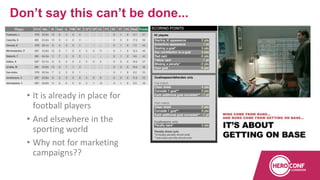
• It is already in place for
football players
• And elsewhere in the
sporting world
• Why not for marketing
campaigns??
Don’t say this can’t be done...
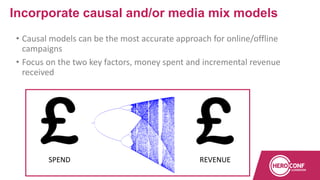
• Causal models can be the most accurate approach for online/offline
campaigns
• Focus on the two key factors, money spent and incremental revenue
received
Incorporate causal and/or media mix models
SPEND REVENUE
• Similar to testing website elements, test marketing campaigns
• How to test campaigns
• Different campaigns in different geographical regions
• Hold out tests
• Switch off/on keywords
• Pick similar trending products & promote half
• Learn what impact of campaign really is – use that insight to create your
optimal marketing plan
Test campaigns to calculate true ROI
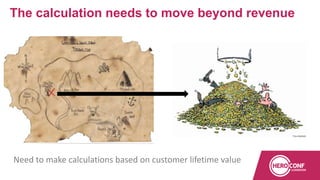
The calculation needs to move beyond revenue
Need to make calculations based on customer lifetime value
• I am starting to visualise a tool (no, am not building this)
• And maybe this is what attribution tools already do
• Users can input historical values for marketing campaigns or use data
driven solutions to provide this value
• Using interim success metric appropriate to each campaign
• The tool forecasts (incremental) sales based on marketing spend
• The forecast is actually of customer lifetime value (profitability) by campaign
• Users are able to adjust variables due to known changing factors
• Based on the output, users can optimise their marketing spend/activity
• Learning and improving as time goes on
The desired marketing optimisation tool
• Cons
• Much more hard work and thinking is required
• Pros
• You have control over your marketing
• You have a proper understanding of what does and doesn’t impact performance
This tool would be able to optimise future marketing spend & activity in a
way that truly maximises your ROI for the future…
What would this give you
I can be found at
• peter.oneill@leapthree.com
• @peter_oneill
• +44 7843 617 347
• www.linkedin.com/in/peteroneill
Thank you (and questions)

Let's Talk Attribution

  • 1.
  • 2.
    • I ama Digital Analyst, working in field for over 10 years • I am a co-founder of LeapThree • Formed from merger of two leading digital analytics consultancies • We offer comprehensive skills & experience around: • Google Analytics & Adobe Analytics • Analytics – set-up, training, reporting, insights & recommendations • Conversion rate optimisation, personalisation, data integration • Both strategic & hands on practical experience • Work with clients of all sizes and across all sectors G’DAY, I’M PETER
  • 3.
    How I endedup at Hero Conf
  • 4.
    This tweet appearedin my twitter stream
  • 5.
    I started abit of an argument
  • 6.
    My “BTW” ledto some education
  • 7.
    Which led tomore communication
  • 8.
    Maybe too latebut I like to give fair warning
  • 9.
    The basis ofmy arguments Theoretical Physicist Experimental Physicist
  • 10.
  • 11.
    To provide intelligencethat informs business actions leading to an improvement in performance for online organisations The purpose of Digital Analytics
  • 12.
    “What is theright attribution model for me?” “How should I split revenue between my marketing sources” “There is no perfect attribution model but there are better ones” The comments I hear in meetings
  • 13.
    “How do Ioptimise the allocation of future marketing investments” “Will me spending money on this marketing stuff make more people give me more money” The questions I should be asked Photo Credit: HikingArtist.com via Compfight cc
  • 14.
  • 15.
    The field ofplay Transactions Who gets the credit for a goal (conversion)?
  • 16.
    Final touch scores goal& gets all credit Last click attribution Transactions
  • 17.
    • The “GoalScorer” • The last touchpoint gets all the credit for the conversion Who gets the credit for a goal (conversion)?
  • 18.
    Midfielder started the playthat led to the goal First click attribution Transactions
  • 19.
    • The “GoalScorer” • The last touchpoint gets all the credit for the conversion • The player that started the play leading to the goal • The first touchpoint gets all the credit for the conversion Who gets the credit?
  • 20.
    Multiple players contributedto the goal & should all get some credit Weighted attribution Transactions
  • 21.
    • The “GoalScorer” • The last touchpoint gets all the credit for the conversion • The player that started the play leading to the goal • The first touchpoint gets all the credit for the conversion • All players involved in the play leading to the goal • All touchpoints get a proportion of the credit for the conversion Who gets the credit?
  • 22.
    Data driven attribution Transactions Basedon the data across multiple football games, how much did each player contribute to plays where goals were scored and not scored
  • 23.
    Data driven attribution Basedon the data across multiple football games, how much did each player contribute to plays where goals were scored and not scored
  • 24.
    • The “GoalScorer” • The last touchpoint gets all the credit for the conversion • The player that started the play leading to the goal • The first touchpoint gets all the credit for the conversion • All players involved in the play leading to the goal • All touchpoints get a proportion of the credit for the conversion • All players involved in all plays which did/didn’t lead to goals across the (very long) season • Touchpoints get credit for calculated contribution to conversions across data set Who gets the credit?
  • 25.
    So which arethe “better” attribution models? Transactions • Last Click? • First Click? • Weighted Attribution? • Data Driven Attribution?
  • 26.
    • Last clickmodels are flawed as gives credit to a single touchpoint only, ignoring all other influences • First click models are flawed as gives credit to a single touchpoint only, ignoring all other influences • Weighted attribution models are all flawed as one set of logic cannot reflect the contribution of touchpoints to all conversions • Is all this solved with the use of data driven attribution models?? So which are the “better” attribution models?
  • 27.
    Flaws in conceptof all attribution models
  • 28.
    1. Customer journeymapping doesn’t include all touchpoints 2. Attribution models are based on correlating touchpoints to customer behaviour 3. They assume that 100% of revenue is due to marketing efforts 4. Attribution models depend on historical data The four key flaws with attribution models
  • 29.
    Play started on theother side of the pitch & these players deserve credit too Home (computer)Work (or smart phone, tablet, etc) The use of multiple devices Transactions 1
  • 30.
    Ball forced outby defender & other players provided alternative attacking options – also deserve credit Transactions Offline touch points Home (computer)Work (or smart phone, tablet, etc) 1
  • 31.
    • The datadriven attribution tools themselves say you need the full customer journey THIS IS NOT POSSIBLE!! Data is missing touchpoints 1
  • 32.
    • Very simplisticscenario • High proportion of customers for a retailer research pre purchase • 80% of eventual customer will have research visits • 75% of these researchers do this on their lunch breaks at work (without logging in) before purchasing at home • The data will say that 80% of customers purchased on their first visit (20% no research + 75% x 80% do research) • The business strategy based on this data would be the wrong strategy • If the entire customer journey is not mapped, data driven attribution fails • Web Analytics data is incomplete but the sample reflects the population • Strategies made based on web analytics data are the right strategies The impact of the incomplete data 1
  • 33.
    • Scenario takenfrom Gary Angel - bit.ly/1tSBM8s • Company is a motors dealership • Doing some research into customers, discovered a website that is quite popular with 20% of customers viewing pre purchase • Due to this, started advertising with display ads on this website • This campaign delivered great numbers, 20% of sales occurred after viewing these display ads on this website • How much credit should this display campaign receive? Which marketing touch points impact sales? 2
  • 34.
    • Attribution modelsneed to (or at least attempt to) include all touch points prior to a purchase • In this scenario, the display ads get a lot of credit • Impressions were correlated against sales but didn’t cause them How much impact did that campaign have? 2
  • 35.
    • Scenario –company offers annual subscriptions • Very high retention rates, typically 85% renew subscription • Company starts new email programme for existing subscribers • Most customers who receive email open this email • No other marketing touchpoints for existing customers • 85% of customers purchase a new subscription • How much credit should the email programme get? Are all customers equal? 3
  • 36.
    • This emailcampaign would also receive a lot of credit… 100% attribution of revenue • Replace “How much revenue did that marketing spend generate” • with “How much incremental revenue did that marketing spend generate” 3
  • 37.
    • Customer loyaltymatters • Campaign optimisation should focus on uplift, not total revenue • Marketing campaigns should not get credit for intercepting customers Useful concept… 3
  • 38.
    • Attribution modelsare forecasts built on historical data and statistical modelling • But the situation changes… • If you can’t adjust the model based on known changes, the output is going to be flawed Attribution output is based on historical data 4
  • 39.
    Attribution output isbased on historical data New Marketing Campaign New Product Range Competitor Strategies External FactorsNew Social Media Platform Change Marketing Campaign 4
  • 40.
    1. Customer journeymapping doesn’t include all touchpoints • The maths can’t work if working on incomplete data sets e.g. garbage in, garbage out 2. Attribution models are based on correlating touchpoints to customer behaviour • We need to made decisions based on what spend caused what purchases 3. They assume that 100% of revenue is due to marketing efforts • Some revenue will be generated without marketing, this should not be included within calculations 4. Attribution models depend on historical data • We need models that predict the future, not that explain the past The four key flaws with attribution models
  • 41.
    So where doesthat leave us?
  • 42.
    “How do Ioptimise the allocation of future marketing investments” “Will me spending money on this marketing stuff make more people give me more money” Back to the real questions Photo Credit: HikingArtist.com via Compfight cc
  • 43.
    • …for theinsights they can provide • I don’t agree with the sole use of attribution tools to determine your marketing spend • But don’t throw them away • Use these tools for the insights they can provide Attribution modelling tools are useful still…
  • 44.
    Evaluate performance ofeach campaign against the purpose for that campaign – instead of trying to match to the end conversion Approach for evaluating campaign performance 1. Define what success means for each campaign 2. Define a metric to represent this success 3. Attach a financial value to the success metric 4. Measure performance of the campaign using success metric 5. Calculate the ROI of the marketing campaign
  • 45.
    • It isalready in place for football players • And elsewhere in the sporting world • Why not for marketing campaigns?? Don’t say this can’t be done...
  • 46.
    • Causal modelscan be the most accurate approach for online/offline campaigns • Focus on the two key factors, money spent and incremental revenue received Incorporate causal and/or media mix models SPEND REVENUE
  • 47.
    • Similar totesting website elements, test marketing campaigns • How to test campaigns • Different campaigns in different geographical regions • Hold out tests • Switch off/on keywords • Pick similar trending products & promote half • Learn what impact of campaign really is – use that insight to create your optimal marketing plan Test campaigns to calculate true ROI
  • 48.
    The calculation needsto move beyond revenue Need to make calculations based on customer lifetime value
  • 49.
    • I amstarting to visualise a tool (no, am not building this) • And maybe this is what attribution tools already do • Users can input historical values for marketing campaigns or use data driven solutions to provide this value • Using interim success metric appropriate to each campaign • The tool forecasts (incremental) sales based on marketing spend • The forecast is actually of customer lifetime value (profitability) by campaign • Users are able to adjust variables due to known changing factors • Based on the output, users can optimise their marketing spend/activity • Learning and improving as time goes on The desired marketing optimisation tool
  • 50.
    • Cons • Muchmore hard work and thinking is required • Pros • You have control over your marketing • You have a proper understanding of what does and doesn’t impact performance This tool would be able to optimise future marketing spend & activity in a way that truly maximises your ROI for the future… What would this give you
  • 51.
    I can befound at • peter.oneill@leapthree.com • @peter_oneill • +44 7843 617 347 • www.linkedin.com/in/peteroneill Thank you (and questions)