[Webinar]
SearchEngineMarketing101
Introductions:
2
Kyle Chandler
Manager, Demand Generation
kchandler@hileman.biz | @projectchandler
Agenda:
3
• What is Search Engine Marketing
• The Anatomy of a Search Engine Results Page (SERP)
• Organic Search Detail
• Paid Search Detail
• Tips and Tricks for SEM in 2015
• Key Takeaways
What is
Search Engine Marketing
4
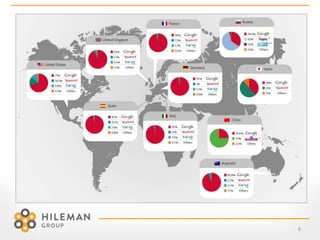
What is Search Engine Marketing
Definition: Search engine marketing, or SEM, is a form of Internet
marketing that seeks to promote websites by increasing their visibility in
both paid and organic search.
5
6
TheAnatomy of a
Search Engine Results Page
7
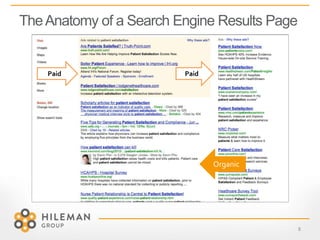
TheAnatomy of a Search Engine Results Page
Paid Paid
Organic
8
TheAnatomy of a Search Engine Results Page
Paid Paid
Organic
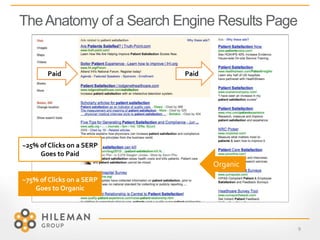
~25% of Clicks on a SERP
Goes to Paid
~75% of Clicks on a SERP
Goes to Organic
9
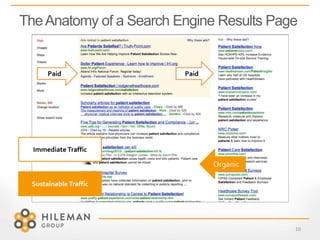
TheAnatomy of a Search Engine Results Page
Paid Paid
Organic
Immediate Traffic
Sustainable Traffic
10
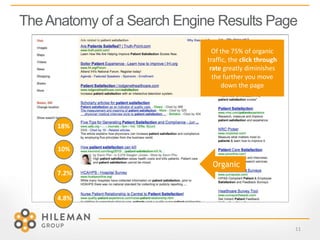
TheAnatomy of a Search Engine Results Page
Organic
Of the 75% of organic
traffic, the click through
rate greatly diminishes
the further you move
down the page
18%
10%
7.2%
4.8%
11
TheAnatomy of a Search Engine Results Page
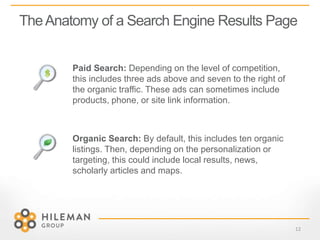
Paid Search: Depending on the level of competition,
this includes three ads above and seven to the right of
the organic traffic. These ads can sometimes include
products, phone, or site link information.
Organic Search: By default, this includes ten organic
listings. Then, depending on the personalization or
targeting, this could include local results, news,
scholarly articles and maps.
12
Organic Search Detail
13
Organic Search Detail: How Does it Work?
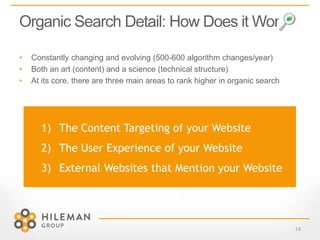
• Constantly changing and evolving (500-600 algorithm changes/year)
• Both an art (content) and a science (technical structure)
• At its core, there are three main areas to rank higher in organic search
1) The Content Targeting of your Website
2) The User Experience of your Website
3) External Websites that Mention your Website
14
Organic Search Detail: Content Targeting
15
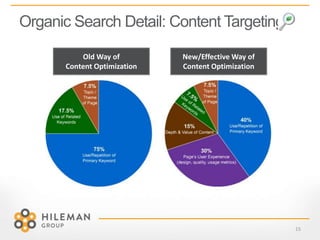
Old Way of
Content Optimization
New/Effective Way of
Content Optimization
Organic Search Detail: Content Targeting
16
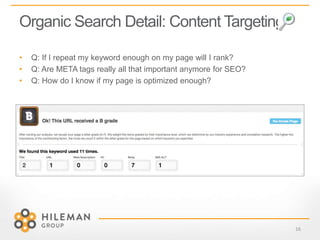
• Q: If I repeat my keyword enough on my page will I rank?
• Q: Are META tags really all that important anymore for SEO?
• Q: How do I know if my page is optimized enough?
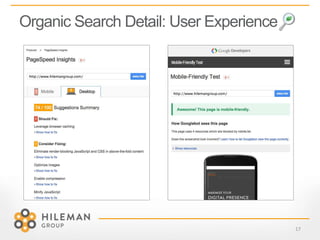
Organic Search Detail: User Experience
17
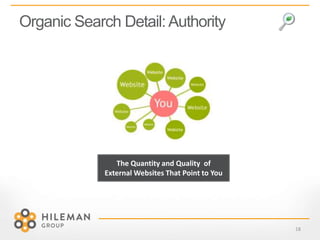
Organic Search Detail:Authority
The Quantity and Quality of
External Websites That Point to You
18
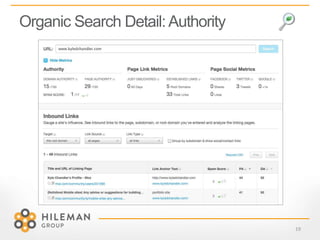
Organic Search Detail:Authority
19
Organic Search Detail:Authority
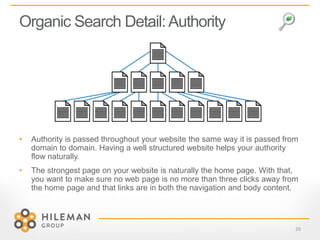
• Authority is passed throughout your website the same way it is passed from
domain to domain. Having a well structured website helps your authority
flow naturally.
• The strongest page on your website is naturally the home page. With that,
you want to make sure no web page is no more than three clicks away from
the home page and that links are in both the navigation and body content.
20
21
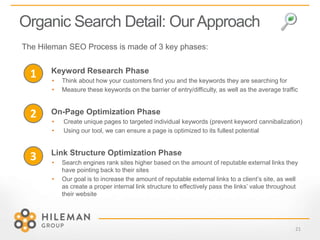
Keyword Research Phase
• Think about how your customers find you and the keywords they are searching for
• Measure these keywords on the barrier of entry/difficulty, as well as the average traffic
On-Page Optimization Phase
• Create unique pages to targeted individual keywords (prevent keyword cannibalization)
• Using our tool, we can ensure a page is optimized to its fullest potential
Link Structure Optimization Phase
• Search engines rank sites higher based on the amount of reputable external links they
have pointing back to their sites
• Our goal is to increase the amount of reputable external links to a client’s site, as well
as create a proper internal link structure to effectively pass the links’ value throughout
their website
1
2
3
The Hileman SEO Process is made of 3 key phases:
Organic Search Detail: OurApproach
Paid Search Detail
22
Paid Search Detail: How Does it Work?
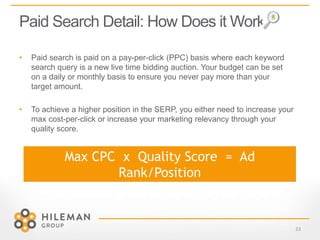
• Paid search is paid on a pay-per-click (PPC) basis where each keyword
search query is a new live time bidding auction. Your budget can be set
on a daily or monthly basis to ensure you never pay more than your
target amount.
• To achieve a higher position in the SERP, you either need to increase your
max cost-per-click or increase your marketing relevancy through your
quality score.
Max CPC x Quality Score = Ad
Rank/Position
23
Paid Search Detail: OurApproach
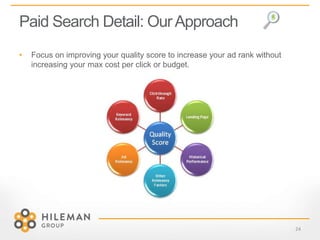
• Focus on improving your quality score to increase your ad rank without
increasing your max cost per click or budget.
24
Paid Search Detail: OurApproach
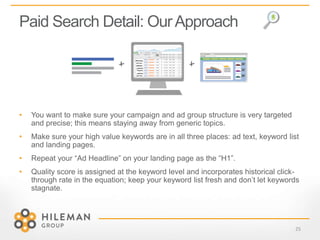
• You want to make sure your campaign and ad group structure is very targeted
and precise; this means staying away from generic topics.
• Make sure your high value keywords are in all three places: ad text, keyword list
and landing pages.
• Repeat your “Ad Headline” on your landing page as the “H1”.
• Quality score is assigned at the keyword level and incorporates historical click-
through rate in the equation; keep your keyword list fresh and don’t let keywords
stagnate.
25
Search Engine Marketing
Tips and Tricks for 2015
26
1. Negative KeywordsAre Key
27
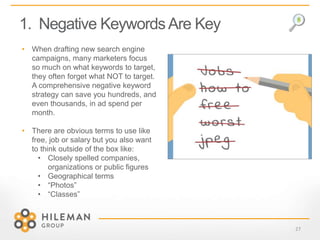
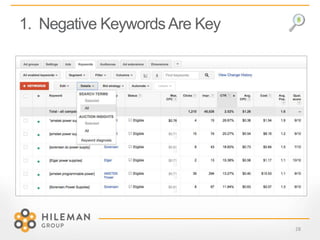
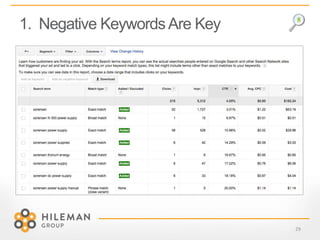
• When drafting new search engine
campaigns, many marketers focus
so much on what keywords to target,
they often forget what NOT to target.
A comprehensive negative keyword
strategy can save you hundreds, and
even thousands, in ad spend per
month.
• There are obvious terms to use like
free, job or salary but you also want
to think outside of the box like:
• Closely spelled companies,
organizations or public figures
• Geographical terms
• “Photos”
• “Classes”
28
1. Negative KeywordsAre Key
29
1. Negative KeywordsAre Key
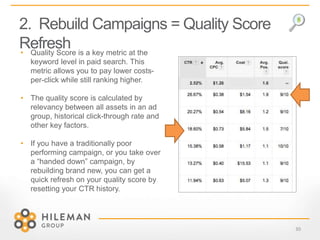
2. Rebuild Campaigns = Quality Score
Refresh
30
• Quality Score is a key metric at the
keyword level in paid search. This
metric allows you to pay lower costs-
per-click while still ranking higher.
• The quality score is calculated by
relevancy between all assets in an ad
group, historical click-through rate and
other key factors.
• If you have a traditionally poor
performing campaign, or you take over
a “handed down” campaign, by
rebuilding brand new, you can get a
quick refresh on your quality score by
resetting your CTR history.
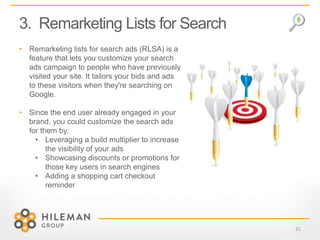
3. Remarketing Lists for Search
31
• Remarketing lists for search ads (RLSA) is a
feature that lets you customize your search
ads campaign to people who have previously
visited your site. It tailors your bids and ads
to these visitors when they're searching on
Google.
• Since the end user already engaged in your
brand, you could customize the search ads
for them by:
• Leveraging a build multiplier to increase
the visibility of your ads
• Showcasing discounts or promotions for
those key users in search engines
• Adding a shopping cart checkout
reminder
4. Link Reclamation
32
• One of the hardest parts of organic
search engine optimization is the
practice of building new links to your
website, while abiding by Google’s
search quality guidelines.
• However, one of the largest missed
opportunities is recovering the links
you used to have, but have lost
through human error, website
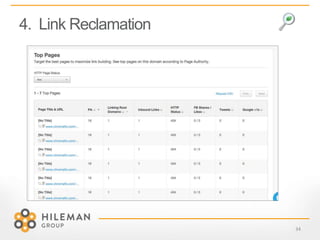
transitions or just plain bad luck.
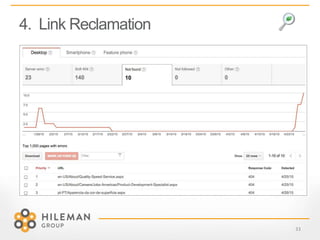
• The best place to find these links are
in Google Webmaster Tools, as well as
Open Sight Explorer. The first step is
finding all internal and external 404
errors and redirecting them to the
correct new pages on your website.
4. Link Reclamation
33
4. Link Reclamation
34
5. Infographic + Submission Site + Social
35
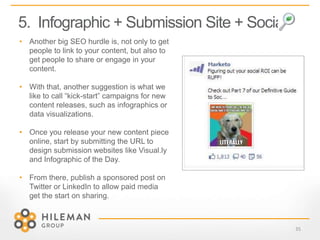
• Another big SEO hurdle is, not only to get
people to link to your content, but also to
get people to share or engage in your
content.
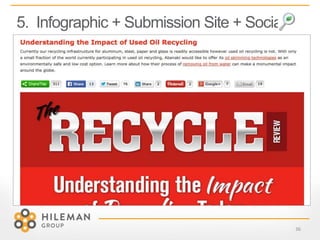
• With that, another suggestion is what we
like to call “kick-start” campaigns for new
content releases, such as infographics or
data visualizations.
• Once you release your new content piece
online, start by submitting the URL to
design submission websites like Visual.ly
and Infographic of the Day.
• From there, publish a sponsored post on
Twitter or LinkedIn to allow paid media
get the start on sharing.
5. Infographic + Submission Site + Social
36
Key Takeaways
Key Takeaways:
38
1. To be effective at both organic and paid search, you must first have high
quality content AND continue to publish new content over time.
2. When optimizing for search engines organically, do not forget about the
user experience or else it will hurt you in the long run.
3. Paid search is all about relevancy. Keep your campaigns and ad groups
reasonably sized and targeted.
4. Combining both tactics allows for a greater saturation of the SERPs,
which, in turn, provides you the most traffic on your targeted terms.
5. Before diving into any SEM campaign, do your research on your industry
and competitors to see if there are any untapped areas to focus on.
Questions?

Search Engine Marketing 101

  • 1.
  • 2.
    Introductions: 2 Kyle Chandler Manager, DemandGeneration kchandler@hileman.biz | @projectchandler
  • 3.
    Agenda: 3 • What isSearch Engine Marketing • The Anatomy of a Search Engine Results Page (SERP) • Organic Search Detail • Paid Search Detail • Tips and Tricks for SEM in 2015 • Key Takeaways
  • 4.
  • 5.
    What is SearchEngine Marketing Definition: Search engine marketing, or SEM, is a form of Internet marketing that seeks to promote websites by increasing their visibility in both paid and organic search. 5
  • 6.
  • 7.
    TheAnatomy of a SearchEngine Results Page 7
  • 8.
    TheAnatomy of aSearch Engine Results Page Paid Paid Organic 8
  • 9.
    TheAnatomy of aSearch Engine Results Page Paid Paid Organic ~25% of Clicks on a SERP Goes to Paid ~75% of Clicks on a SERP Goes to Organic 9
  • 10.
    TheAnatomy of aSearch Engine Results Page Paid Paid Organic Immediate Traffic Sustainable Traffic 10
  • 11.
    TheAnatomy of aSearch Engine Results Page Organic Of the 75% of organic traffic, the click through rate greatly diminishes the further you move down the page 18% 10% 7.2% 4.8% 11
  • 12.
    TheAnatomy of aSearch Engine Results Page Paid Search: Depending on the level of competition, this includes three ads above and seven to the right of the organic traffic. These ads can sometimes include products, phone, or site link information. Organic Search: By default, this includes ten organic listings. Then, depending on the personalization or targeting, this could include local results, news, scholarly articles and maps. 12
  • 13.
  • 14.
    Organic Search Detail:How Does it Work? • Constantly changing and evolving (500-600 algorithm changes/year) • Both an art (content) and a science (technical structure) • At its core, there are three main areas to rank higher in organic search 1) The Content Targeting of your Website 2) The User Experience of your Website 3) External Websites that Mention your Website 14
  • 15.
    Organic Search Detail:Content Targeting 15 Old Way of Content Optimization New/Effective Way of Content Optimization
  • 16.
    Organic Search Detail:Content Targeting 16 • Q: If I repeat my keyword enough on my page will I rank? • Q: Are META tags really all that important anymore for SEO? • Q: How do I know if my page is optimized enough?
  • 17.
    Organic Search Detail:User Experience 17
  • 18.
    Organic Search Detail:Authority TheQuantity and Quality of External Websites That Point to You 18
  • 19.
  • 20.
    Organic Search Detail:Authority •Authority is passed throughout your website the same way it is passed from domain to domain. Having a well structured website helps your authority flow naturally. • The strongest page on your website is naturally the home page. With that, you want to make sure no web page is no more than three clicks away from the home page and that links are in both the navigation and body content. 20
  • 21.
    21 Keyword Research Phase •Think about how your customers find you and the keywords they are searching for • Measure these keywords on the barrier of entry/difficulty, as well as the average traffic On-Page Optimization Phase • Create unique pages to targeted individual keywords (prevent keyword cannibalization) • Using our tool, we can ensure a page is optimized to its fullest potential Link Structure Optimization Phase • Search engines rank sites higher based on the amount of reputable external links they have pointing back to their sites • Our goal is to increase the amount of reputable external links to a client’s site, as well as create a proper internal link structure to effectively pass the links’ value throughout their website 1 2 3 The Hileman SEO Process is made of 3 key phases: Organic Search Detail: OurApproach
  • 22.
  • 23.
    Paid Search Detail:How Does it Work? • Paid search is paid on a pay-per-click (PPC) basis where each keyword search query is a new live time bidding auction. Your budget can be set on a daily or monthly basis to ensure you never pay more than your target amount. • To achieve a higher position in the SERP, you either need to increase your max cost-per-click or increase your marketing relevancy through your quality score. Max CPC x Quality Score = Ad Rank/Position 23
  • 24.
    Paid Search Detail:OurApproach • Focus on improving your quality score to increase your ad rank without increasing your max cost per click or budget. 24
  • 25.
    Paid Search Detail:OurApproach • You want to make sure your campaign and ad group structure is very targeted and precise; this means staying away from generic topics. • Make sure your high value keywords are in all three places: ad text, keyword list and landing pages. • Repeat your “Ad Headline” on your landing page as the “H1”. • Quality score is assigned at the keyword level and incorporates historical click- through rate in the equation; keep your keyword list fresh and don’t let keywords stagnate. 25
  • 26.
    Search Engine Marketing Tipsand Tricks for 2015 26
  • 27.
    1. Negative KeywordsAreKey 27 • When drafting new search engine campaigns, many marketers focus so much on what keywords to target, they often forget what NOT to target. A comprehensive negative keyword strategy can save you hundreds, and even thousands, in ad spend per month. • There are obvious terms to use like free, job or salary but you also want to think outside of the box like: • Closely spelled companies, organizations or public figures • Geographical terms • “Photos” • “Classes”
  • 28.
  • 29.
  • 30.
    2. Rebuild Campaigns= Quality Score Refresh 30 • Quality Score is a key metric at the keyword level in paid search. This metric allows you to pay lower costs- per-click while still ranking higher. • The quality score is calculated by relevancy between all assets in an ad group, historical click-through rate and other key factors. • If you have a traditionally poor performing campaign, or you take over a “handed down” campaign, by rebuilding brand new, you can get a quick refresh on your quality score by resetting your CTR history.
  • 31.
    3. Remarketing Listsfor Search 31 • Remarketing lists for search ads (RLSA) is a feature that lets you customize your search ads campaign to people who have previously visited your site. It tailors your bids and ads to these visitors when they're searching on Google. • Since the end user already engaged in your brand, you could customize the search ads for them by: • Leveraging a build multiplier to increase the visibility of your ads • Showcasing discounts or promotions for those key users in search engines • Adding a shopping cart checkout reminder
  • 32.
    4. Link Reclamation 32 •One of the hardest parts of organic search engine optimization is the practice of building new links to your website, while abiding by Google’s search quality guidelines. • However, one of the largest missed opportunities is recovering the links you used to have, but have lost through human error, website transitions or just plain bad luck. • The best place to find these links are in Google Webmaster Tools, as well as Open Sight Explorer. The first step is finding all internal and external 404 errors and redirecting them to the correct new pages on your website.
  • 33.
  • 34.
  • 35.
    5. Infographic +Submission Site + Social 35 • Another big SEO hurdle is, not only to get people to link to your content, but also to get people to share or engage in your content. • With that, another suggestion is what we like to call “kick-start” campaigns for new content releases, such as infographics or data visualizations. • Once you release your new content piece online, start by submitting the URL to design submission websites like Visual.ly and Infographic of the Day. • From there, publish a sponsored post on Twitter or LinkedIn to allow paid media get the start on sharing.
  • 36.
    5. Infographic +Submission Site + Social 36
  • 37.
  • 38.
    Key Takeaways: 38 1. Tobe effective at both organic and paid search, you must first have high quality content AND continue to publish new content over time. 2. When optimizing for search engines organically, do not forget about the user experience or else it will hurt you in the long run. 3. Paid search is all about relevancy. Keep your campaigns and ad groups reasonably sized and targeted. 4. Combining both tactics allows for a greater saturation of the SERPs, which, in turn, provides you the most traffic on your targeted terms. 5. Before diving into any SEM campaign, do your research on your industry and competitors to see if there are any untapped areas to focus on.
  • 39.