MYCOLOGY
Welcome to :
Chytridiomycotina & zygomycotina:
Characteristics & Ecology
By
N.Sannigrahi, associate professor
Deptt. Of botany, nistarini college,
purulia (w.B) India
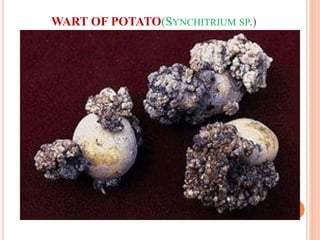
WART OF POTATO(SYNCHITRIUM SP.)
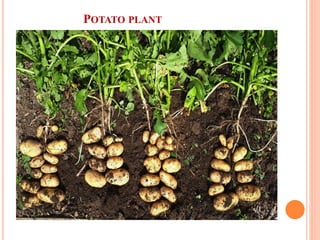
POTATO PLANT
CHYTRIDIOMYCOTINA & ZYGOMYCOTINA
 HABITAT
 Mostly found to grow in water, soil, wind, estuaries & sea,
 Saprophytic or biotrphic parasites of vascular plants like
Synchitrium endobioticumm on potato and Olpidium brassicae
in the roots of mustard
 Some are pathogen to mosquito larvae
 THALLUS
 Unicellular without mycelium with branching extension called
rhizomycelium
 Holocarpic
 Either monocentric or polycentric
 Coenocytes with many nuclei
REPRODUCTION
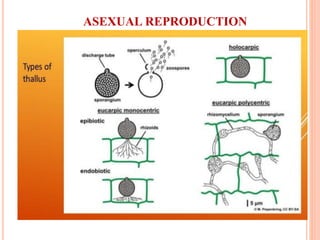
 ASEXUAL REPRODUCTION
 Zoospores produced in zoosporangium, spherical or pear
shaped like structure
 The whole cell may develop to the zoosporangium or in
eucarpic, a part of the thallus may develop into zoosporangium
 Sporangium is full of protoplasm and nuclei
 Zoospores uninucleate with single posterior whiplash flagellum
 Zoosporangium bears one or more discharge tubes either by
breakage of the tip or by papillae
 Zoospores generally develop a cyst around it , germination
either by monopolar or bipolar.
ASEXUAL REPRODUCTION
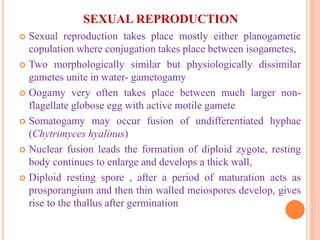
SEXUAL REPRODUCTION
 Sexual reproduction takes place mostly either planogametic
copulation where conjugation takes place between isogametes,
 Two morphologically similar but physiologically dissimilar
gametes unite in water- gametogamy
 Oogamy very often takes place between much larger non-
flagellate globose egg with active motile gamete
 Somatogamy may occur fusion of undifferentiated hyphae
(Chytrimyces hyalinus)
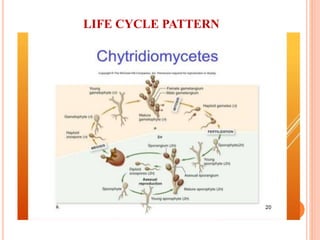
 Nuclear fusion leads the formation of diploid zygote, resting
body continues to enlarge and develops a thick wall,
 Diploid resting spore , after a period of maturation acts as
prosporangium and then thin walled meiospores develop, gives
rise to the thallus after germination
LIFE CYCLE PATTERN
ZYGOMYCOTINA
 A true fungi having non-motile aflagellate spores
in asexual reproduction and zygospores after
fusion of gametes in sexual reproduction.
 The most common are Mucor, Rhizopus,
Blakeslea, Mortierella etc.
 It has been divided into two classes-Zygomycetes
& Trichomycetes. Zygomycetes contain 870
species under 10 orders while Trichomycetes
have 218 species under 3 orders. Mucorale is is
the core order and Zygomycetes is the true class
in this regards. The Subdivision is a unique one
as it is the most turning point as far as the origin
and development is concerned.
ECOLOGY & OCCURENCE
 Abundant in soil and mostly saprophytic in nature,
coprophilous grow and develop on the dung of
herbivores.
 Early colonizers in fungal succession
 Sometimes act as pathogens and cause rot of sweet
potatoes, fruits like apples, tomatoes, strawberries etc
and cause fruit spoilage
 Rhizopus and Mucor cause human lesions
 Mucor on animals cause a disease called Mucormycosis
 Rhizopus is called bread mould
 Members of Glomales form mutuality association with
plant as mycorrhizal association
 Commensalism found with arthropods inhibiting on the
gut of the organism.
CHARACTERISTICS
 Mycelia thallus are coarse, coenocytes with dense
branching with tapering to fine points,
 Mostly aseptate and eucarpic,
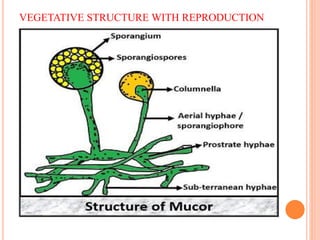
 Rhizoids are borne at the base of the
sporangiophores. The aerial hyphae touches the
substratum, bear rhizoids and sporangiophores
 Aerial hyphae are called stolen that run parallel
to the substratum,
 Mucor grows like yeast in aerobic culture but
reverts filamentous in presence of oxygen,
 Cell wall complex with chitin, micro fibrils and
other polysaccharides in the cell like proteins,
pyrimidines etc,
 Nuclei irregular in shape and divide by
constriction.
VEGETATIVE STRUCTURE WITH REPRODUCTION
REPRODUCTION
 Vegetative by means of usual fragmentation of
hyphae and each fragment grow into new thallus.
 ASEXUAL
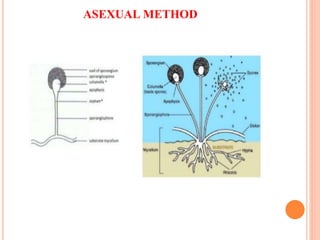
 The asexual spores called sporangiospores borne on
sporangia.
 The number of sporangiospores may be numerous or
reduced in number called sporangioa.
 Spores are aplanospores i.e. non-motile and borne on
the globosely sporangia at the tip of the
sporangiophore.
 The sporangium have distinct central columella over
arched by the spores and uninucleate in nature.
 Mostly the sporangial wall ruptures and dark,
elliptical spores discharge and geminate upon a
substratum.
 Very often thick walled chlamydospores may form
during the asexual method.
SEXUAL REPRODUCTION
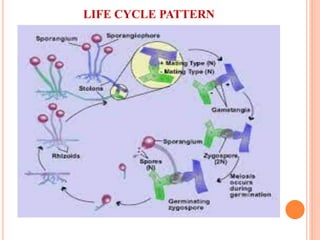
 The process of conjugation and isogamous nature
is exercised with a predominant haploid phase.
 Conjugation occurs between two identical
coenogametangia to form zygote and then
becomes zygospores,
 Both homothallic and heterothallic. In
heterothallic, two compatible strains rarely differ
to each other morphologically or physiologically
and may be labeled as (+) and (–) (Blakeslee,
1906).
 Two compatible strains differ in mating types
 A progamatangia develop followed by the
formation of Zygophores. A hormone trisporic
acid induces the process.
ASEXUAL METHOD
SEXUAL METHOD
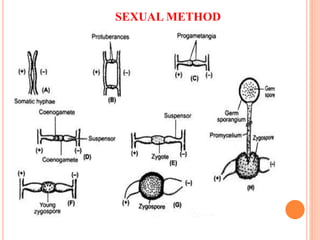
 The hyphal branch-like + & - strains contact to
each other, progametangia bears suspensor and
gametangium fuse together. The gametangia
called coenogametangia having mass of
undifferentiated mass of uninucleate protoplast,
 The separating wall dissolves and the mixing of
the protoplasm forms zygote , then swells and
develop a dark warty outer layer to become
zygospore
 The zygospores matures, breaks up gametangial
wall, zygospores germinate to form germ
sporangia having numerous spores inside it.
 The spores germinate and gives rise to the new
mycelia as asexual method told earlier.
SEXUAL METHOD
LIFE CYCLE PATTERN
CONCLUSION
 As per evolution is concerned, Zygomycota , in
turn probably has given rise to Ascomycota And
Basidiomycota in the passage of time. It is
believed that Zymycota emerged between 600-
1400 million years and it makes the passage of
the evolution of the higher fungi in due course.
Thus, Zygomycota is taxonomically evolutionary
and ecologically important group of fungi.
THANKS A LOT FOR YOUR JOURNEY
 Acknowledgement:
 Introduction to Mycology & Phytopathlogy by Mishra & Dash
 A Text Book of Botany by Maiti, Bhattacharya & Ghosh
 An introduction to Fungi- Vasistha
 Many contents from WebPages
 Images from Google
 Declaration:
 This presentation has been prepared for the academic interest virtually for UG
students of India & abroad especially in pandemic period without any financial
interest.

Chytridiomycotina & Zygomycotina- Ecology and Characteristics

  • 1.
    MYCOLOGY Welcome to : Chytridiomycotina& zygomycotina: Characteristics & Ecology By N.Sannigrahi, associate professor Deptt. Of botany, nistarini college, purulia (w.B) India
  • 2.
  • 3.
  • 4.
    CHYTRIDIOMYCOTINA & ZYGOMYCOTINA HABITAT  Mostly found to grow in water, soil, wind, estuaries & sea,  Saprophytic or biotrphic parasites of vascular plants like Synchitrium endobioticumm on potato and Olpidium brassicae in the roots of mustard  Some are pathogen to mosquito larvae  THALLUS  Unicellular without mycelium with branching extension called rhizomycelium  Holocarpic  Either monocentric or polycentric  Coenocytes with many nuclei
  • 5.
    REPRODUCTION  ASEXUAL REPRODUCTION Zoospores produced in zoosporangium, spherical or pear shaped like structure  The whole cell may develop to the zoosporangium or in eucarpic, a part of the thallus may develop into zoosporangium  Sporangium is full of protoplasm and nuclei  Zoospores uninucleate with single posterior whiplash flagellum  Zoosporangium bears one or more discharge tubes either by breakage of the tip or by papillae  Zoospores generally develop a cyst around it , germination either by monopolar or bipolar.
  • 6.
  • 7.
    SEXUAL REPRODUCTION  Sexualreproduction takes place mostly either planogametic copulation where conjugation takes place between isogametes,  Two morphologically similar but physiologically dissimilar gametes unite in water- gametogamy  Oogamy very often takes place between much larger non- flagellate globose egg with active motile gamete  Somatogamy may occur fusion of undifferentiated hyphae (Chytrimyces hyalinus)  Nuclear fusion leads the formation of diploid zygote, resting body continues to enlarge and develops a thick wall,  Diploid resting spore , after a period of maturation acts as prosporangium and then thin walled meiospores develop, gives rise to the thallus after germination
  • 8.
  • 9.
    ZYGOMYCOTINA  A truefungi having non-motile aflagellate spores in asexual reproduction and zygospores after fusion of gametes in sexual reproduction.  The most common are Mucor, Rhizopus, Blakeslea, Mortierella etc.  It has been divided into two classes-Zygomycetes & Trichomycetes. Zygomycetes contain 870 species under 10 orders while Trichomycetes have 218 species under 3 orders. Mucorale is is the core order and Zygomycetes is the true class in this regards. The Subdivision is a unique one as it is the most turning point as far as the origin and development is concerned.
  • 10.
    ECOLOGY & OCCURENCE Abundant in soil and mostly saprophytic in nature, coprophilous grow and develop on the dung of herbivores.  Early colonizers in fungal succession  Sometimes act as pathogens and cause rot of sweet potatoes, fruits like apples, tomatoes, strawberries etc and cause fruit spoilage  Rhizopus and Mucor cause human lesions  Mucor on animals cause a disease called Mucormycosis  Rhizopus is called bread mould  Members of Glomales form mutuality association with plant as mycorrhizal association  Commensalism found with arthropods inhibiting on the gut of the organism.
  • 11.
    CHARACTERISTICS  Mycelia thallusare coarse, coenocytes with dense branching with tapering to fine points,  Mostly aseptate and eucarpic,  Rhizoids are borne at the base of the sporangiophores. The aerial hyphae touches the substratum, bear rhizoids and sporangiophores  Aerial hyphae are called stolen that run parallel to the substratum,  Mucor grows like yeast in aerobic culture but reverts filamentous in presence of oxygen,  Cell wall complex with chitin, micro fibrils and other polysaccharides in the cell like proteins, pyrimidines etc,  Nuclei irregular in shape and divide by constriction.
  • 12.
  • 13.
    REPRODUCTION  Vegetative bymeans of usual fragmentation of hyphae and each fragment grow into new thallus.  ASEXUAL  The asexual spores called sporangiospores borne on sporangia.  The number of sporangiospores may be numerous or reduced in number called sporangioa.  Spores are aplanospores i.e. non-motile and borne on the globosely sporangia at the tip of the sporangiophore.  The sporangium have distinct central columella over arched by the spores and uninucleate in nature.  Mostly the sporangial wall ruptures and dark, elliptical spores discharge and geminate upon a substratum.  Very often thick walled chlamydospores may form during the asexual method.
  • 14.
    SEXUAL REPRODUCTION  Theprocess of conjugation and isogamous nature is exercised with a predominant haploid phase.  Conjugation occurs between two identical coenogametangia to form zygote and then becomes zygospores,  Both homothallic and heterothallic. In heterothallic, two compatible strains rarely differ to each other morphologically or physiologically and may be labeled as (+) and (–) (Blakeslee, 1906).  Two compatible strains differ in mating types  A progamatangia develop followed by the formation of Zygophores. A hormone trisporic acid induces the process.
  • 15.
  • 16.
    SEXUAL METHOD  Thehyphal branch-like + & - strains contact to each other, progametangia bears suspensor and gametangium fuse together. The gametangia called coenogametangia having mass of undifferentiated mass of uninucleate protoplast,  The separating wall dissolves and the mixing of the protoplasm forms zygote , then swells and develop a dark warty outer layer to become zygospore  The zygospores matures, breaks up gametangial wall, zygospores germinate to form germ sporangia having numerous spores inside it.  The spores germinate and gives rise to the new mycelia as asexual method told earlier.
  • 17.
  • 18.
  • 19.
    CONCLUSION  As perevolution is concerned, Zygomycota , in turn probably has given rise to Ascomycota And Basidiomycota in the passage of time. It is believed that Zymycota emerged between 600- 1400 million years and it makes the passage of the evolution of the higher fungi in due course. Thus, Zygomycota is taxonomically evolutionary and ecologically important group of fungi.
  • 20.
    THANKS A LOTFOR YOUR JOURNEY  Acknowledgement:  Introduction to Mycology & Phytopathlogy by Mishra & Dash  A Text Book of Botany by Maiti, Bhattacharya & Ghosh  An introduction to Fungi- Vasistha  Many contents from WebPages  Images from Google  Declaration:  This presentation has been prepared for the academic interest virtually for UG students of India & abroad especially in pandemic period without any financial interest.