
ANTI TUSSIVES
PREPARED BY:
USHA RANI KANDULA,
ASSISTANT PROFESSOR,
DEPARTMENT OF ADULT HEALTH NURSING,
ARSI UNIVERSITY,ASELLA,ETHIOPIA,
SOUTH EAST AFRICA.
ANTI TUSSIVES
 Antitussives are drugs used to
relieve cough by suppressing the
cough centre in the medulla.
 Coughing is caused by irritation
of the bronchial mucosa.
 Coughing is a protective
mechanism in that it helps to
remove foreign matter and
excessive secretions from the
airway.
 Antitussives are drugs used to
control or bring relief from cough.
 They are used to treat dry non-
productive cough, these agents
used in antitussive affect the
cough reflex.
 These drugs act in CNS to raise
the threshold of cough centre or
act peripherally in the respiratory
tract to reduce tarsal impulses or
both these actions.
MECHANISM OF ACTION
MECHANISM OF ACTION
 Opioid (narcotic) and nonopioid
antitussive suppress the cough
reflex by direct affecting the
cough center;
 Non-opioid antitussive do this
without the CNS suppression of
the opioid antitussives.
 Peripherally acting agents
(glycerin, ammonium chloride )
have local anesthetic effect to
decrease irritation of the
pharyngeal mucosa,
 They are available in gargles,
lozenges and syrups,
 Lozenges increase saliva flow and
therefore suppress the cough.
CLASSIFICATION
OF
ANTI TUSSIVES
THEY ARE CLASSIFIED INTO 2
GROUPS
1. NON- OPIOIDS
2. OPIOIDS
NON- OPIOIDS
 Non- opioids are the drugs that
interact with opioid receptors in
the CNS produce antagonistic
effect at these sites.
 As they displace the effect of
opioid molecule from the acceptor
site.
 So they are termed as opioid
antagonists.
NON- OPIOIDS
-DEXTROMETHORPHAN
-CHLOPHEDIANOL
-NOSCAPINE
DEXTROMETHORPHAN
 It has minimal CNS depressant
action and no analgesic effect.
 30 mg dose is equivalent to 15 mg
of codeine.
DOSE
 Lozenge/syrup
 Adults : 10-30 mg every 4-8 hours
maximum 120 mg/24 hours.
 Children : (6-12 year) 2.5-5mg
every 4 hours or 7.5-15 mg every
6-8 hours maximum 60 mg /24
hour.
 Children : (2-6 year) 1.25-2.5 mg
every 4 hours or 3.75-7.5 mg
every 6-8 hours maximum
30mg/24 hours.
CHLOPHEDIANOL
It has slow and longer duration of
antitussives action.
Dosage : Adults: 25 mg 3-4 times a
day.
Children : (6-12 years) 12.5-25 mg
3-4 times a day.
 Children : (2-6 years) 12.5 mg 3-4
times a day.
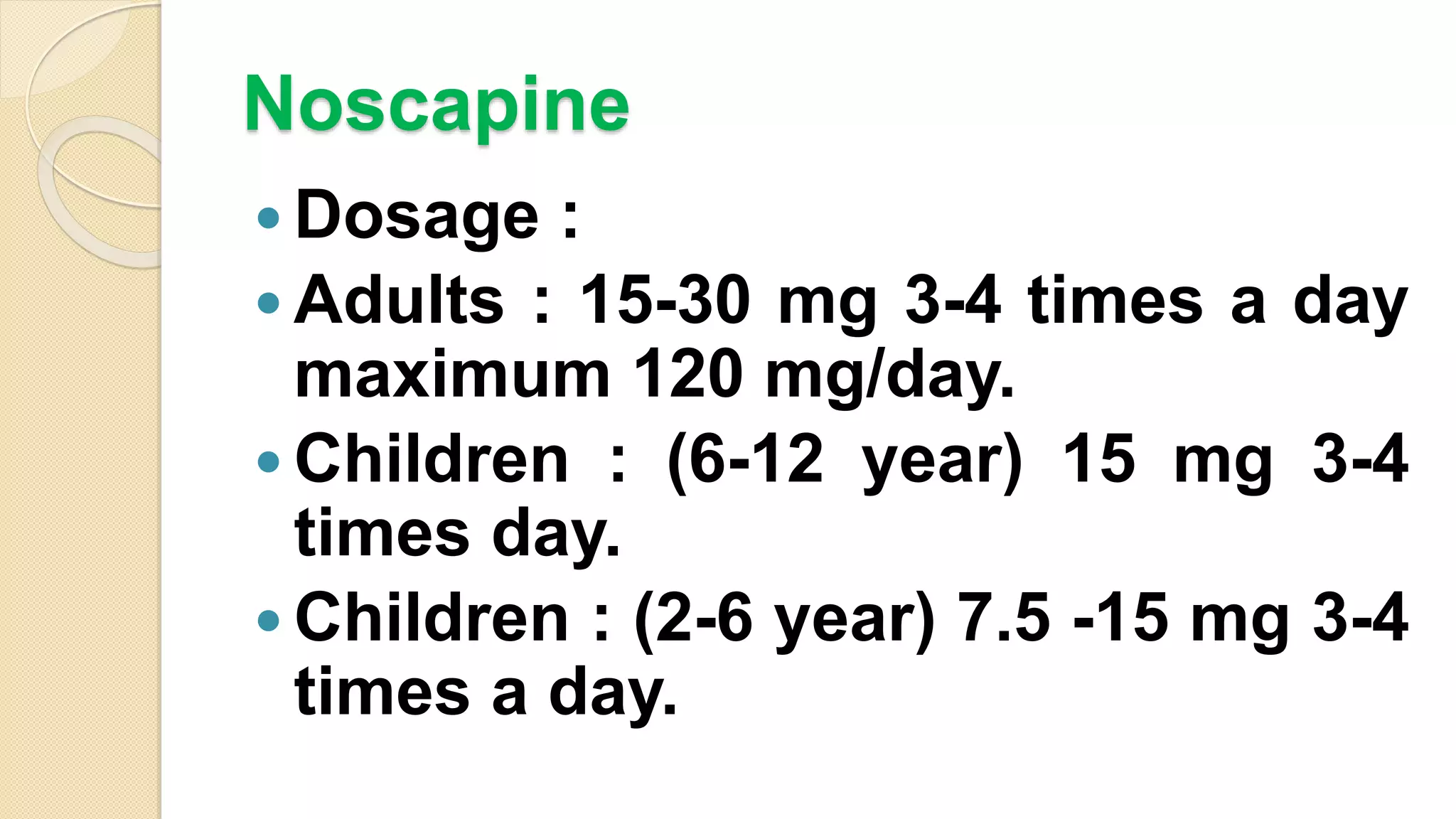
Noscapine
 Dosage :
 Adults : 15-30 mg 3-4 times a day
maximum 120 mg/day.
 Children : (6-12 year) 15 mg 3-4
times day.
 Children : (2-6 year) 7.5 -15 mg 3-4
times a day.
OPIOIDS
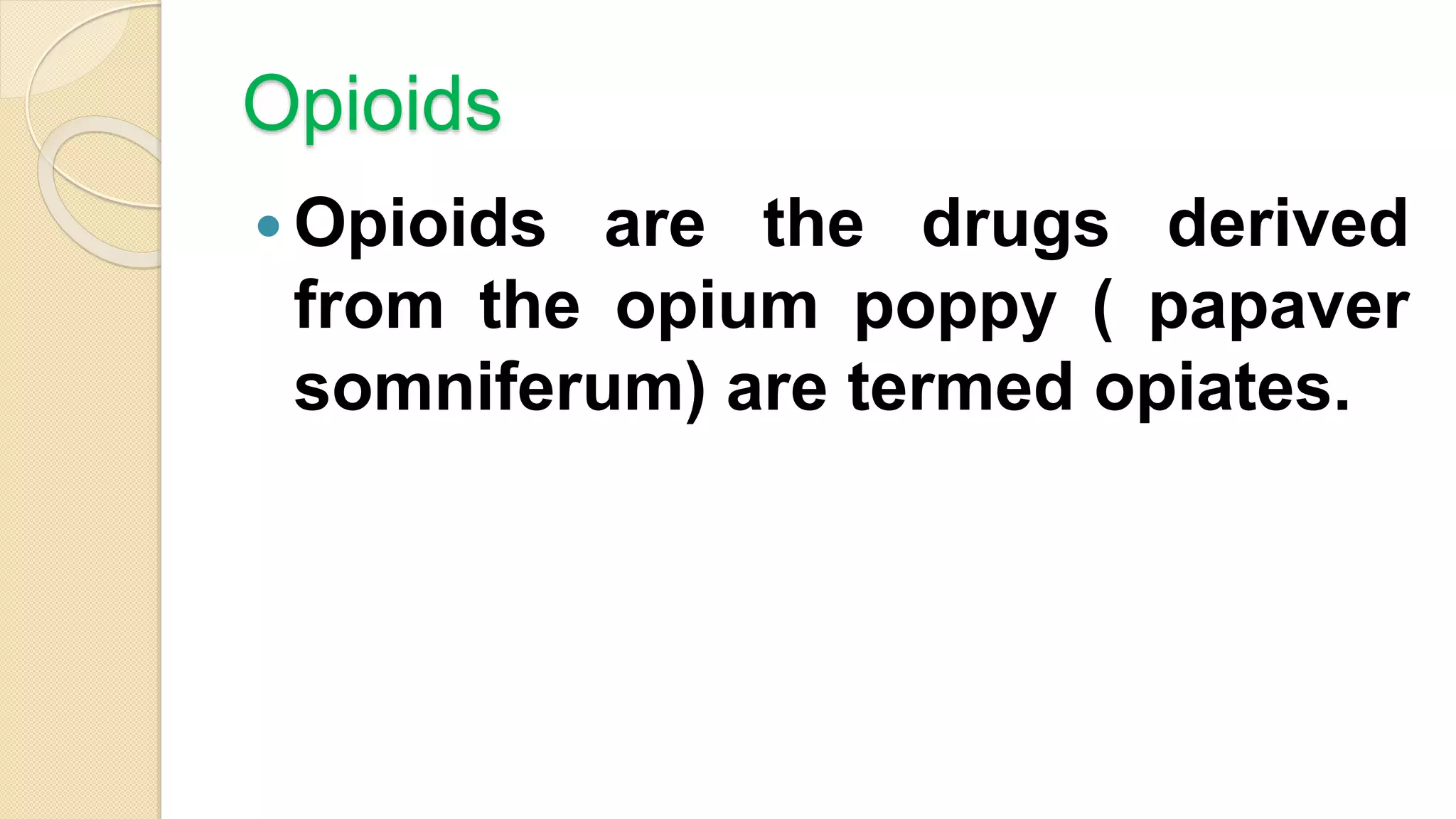
Opioids
 Opioids are the drugs derived
from the opium poppy ( papaver
somniferum) are termed opiates.
OPIOIDS
-CODEINE
-PHOLCODINE
-MORPHINE
-ETHYL MORPHINE
CODEINE
 Codein is more selective for
cough center and is treated as the
standard antitussives.
 Dose :
 Available in
lozenges/syrup/tablets:
 Adult : 10-20 mg every 4-6 hourly
maximum 120 mg / day.
 Children : (6-12 year old) 5-10 mg
every 4-6 hourly maximum 60
mg/day.
 Children : (2-6 year old) 2.5-5mg
every 4-6 hourly maximum 30
mg/day.
MECHANISM OF CODEINE
 Codein acts on U-receptors in
medulla oblongata.
 Inhibits release of excitatory
neuropeptides.
 Suppress cough.
PHALCODEINE
 Longer acting drug 12 hours or
more in dosage of 10-15 mg.
 ETHYLMORPHINE
 Similar to codein dose.
MORPHINE
 Morphine is rarely used.
 Dose : 2-4 mg IM.
THANKING YOU

Antitussive Drugs

  • 1.
    ANTI TUSSIVES PREPARED BY: USHARANI KANDULA, ASSISTANT PROFESSOR, DEPARTMENT OF ADULT HEALTH NURSING, ARSI UNIVERSITY,ASELLA,ETHIOPIA, SOUTH EAST AFRICA.
  • 2.
    ANTI TUSSIVES  Antitussivesare drugs used to relieve cough by suppressing the cough centre in the medulla.  Coughing is caused by irritation of the bronchial mucosa.
  • 3.
     Coughing isa protective mechanism in that it helps to remove foreign matter and excessive secretions from the airway.
  • 4.
     Antitussives aredrugs used to control or bring relief from cough.  They are used to treat dry non- productive cough, these agents used in antitussive affect the cough reflex.
  • 5.
     These drugsact in CNS to raise the threshold of cough centre or act peripherally in the respiratory tract to reduce tarsal impulses or both these actions.
  • 6.
  • 7.
    MECHANISM OF ACTION Opioid (narcotic) and nonopioid antitussive suppress the cough reflex by direct affecting the cough center;  Non-opioid antitussive do this without the CNS suppression of the opioid antitussives.
  • 8.
     Peripherally actingagents (glycerin, ammonium chloride ) have local anesthetic effect to decrease irritation of the pharyngeal mucosa,
  • 9.
     They areavailable in gargles, lozenges and syrups,  Lozenges increase saliva flow and therefore suppress the cough.
  • 10.
  • 11.
    THEY ARE CLASSIFIEDINTO 2 GROUPS 1. NON- OPIOIDS 2. OPIOIDS
  • 12.
    NON- OPIOIDS  Non-opioids are the drugs that interact with opioid receptors in the CNS produce antagonistic effect at these sites.
  • 13.
     As theydisplace the effect of opioid molecule from the acceptor site.  So they are termed as opioid antagonists.
  • 14.
  • 15.
    DEXTROMETHORPHAN  It hasminimal CNS depressant action and no analgesic effect.  30 mg dose is equivalent to 15 mg of codeine.
  • 16.
    DOSE  Lozenge/syrup  Adults: 10-30 mg every 4-8 hours maximum 120 mg/24 hours.  Children : (6-12 year) 2.5-5mg every 4 hours or 7.5-15 mg every 6-8 hours maximum 60 mg /24 hour.
  • 17.
     Children :(2-6 year) 1.25-2.5 mg every 4 hours or 3.75-7.5 mg every 6-8 hours maximum 30mg/24 hours.
  • 18.
    CHLOPHEDIANOL It has slowand longer duration of antitussives action. Dosage : Adults: 25 mg 3-4 times a day. Children : (6-12 years) 12.5-25 mg 3-4 times a day.
  • 19.
     Children :(2-6 years) 12.5 mg 3-4 times a day.
  • 20.
    Noscapine  Dosage : Adults : 15-30 mg 3-4 times a day maximum 120 mg/day.  Children : (6-12 year) 15 mg 3-4 times day.  Children : (2-6 year) 7.5 -15 mg 3-4 times a day.
  • 21.
  • 22.
    Opioids  Opioids arethe drugs derived from the opium poppy ( papaver somniferum) are termed opiates.
  • 23.
  • 24.
    CODEINE  Codein ismore selective for cough center and is treated as the standard antitussives.  Dose :  Available in lozenges/syrup/tablets:  Adult : 10-20 mg every 4-6 hourly maximum 120 mg / day.
  • 25.
     Children :(6-12 year old) 5-10 mg every 4-6 hourly maximum 60 mg/day.  Children : (2-6 year old) 2.5-5mg every 4-6 hourly maximum 30 mg/day.
  • 26.
  • 27.
    MECHANISM OF CODEINE Codein acts on U-receptors in medulla oblongata.  Inhibits release of excitatory neuropeptides.  Suppress cough.
  • 28.
    PHALCODEINE  Longer actingdrug 12 hours or more in dosage of 10-15 mg.  ETHYLMORPHINE  Similar to codein dose.
  • 29.
    MORPHINE  Morphine israrely used.  Dose : 2-4 mg IM.
  • 30.