Microsoft Word 2007
Introduction to Word Processors
Lesson Objectives
After completing this lesson, you will be able to:
 Perform basic tasks in a word processor.
 Edit and format text.
 Work with tables and pictures.
 Work with language tools.
Getting Started with Word
Processors
 Word processors
offer you the
flexibility to format
documents by
making changes to
the font, the page
layout, and the
page style.
Getting Started with Word
Processors
You can open Microsoft Word by clicking on the desktop icon…
… or by clicking the START button.
Getting Started with Word Processors
When you see the cursor blinking, you are ready to type.
Otherwise, use your mouse to click anywhere on the white
part of the page.
Navigating within a Document
 Use your mouse to click anywhere
that you have typed text.
 You can use the arrow keys on your
keyboard to move the cursor
vertically or horizontally.
 The HOME key moves the cursor to
the beginning of the line.
 The END key will take it to the end of
the line.
Saving a File
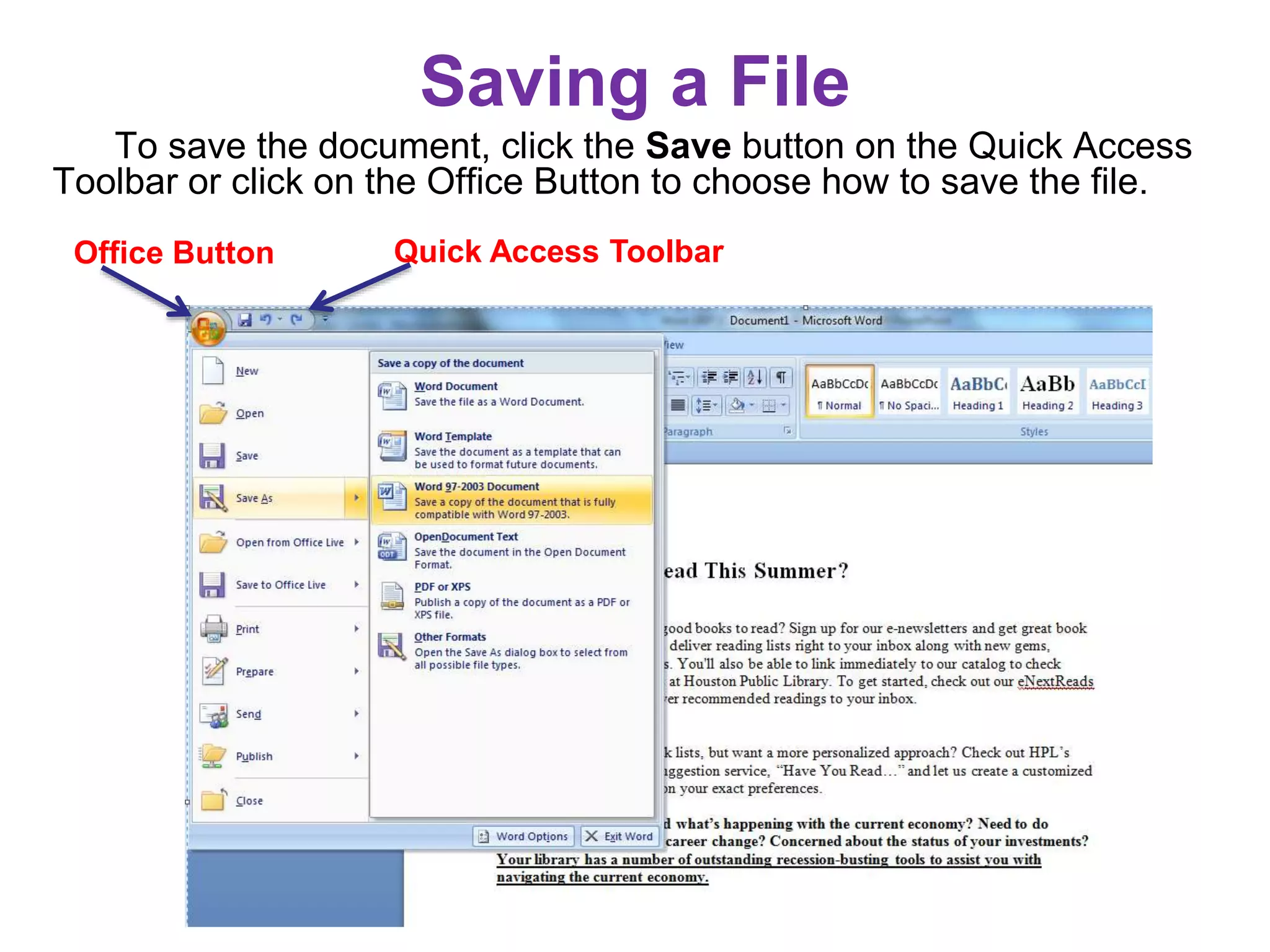
To save the document, click the Save button on the Quick Access
Toolbar or click on the Office Button to choose how to save the file.
Office Button Quick Access Toolbar
Opening an Existing File
On the Standard
toolbar, click the Open
button.
In the Open dialog box,
double-click the name of
the document you want
to open.
Printing Your File
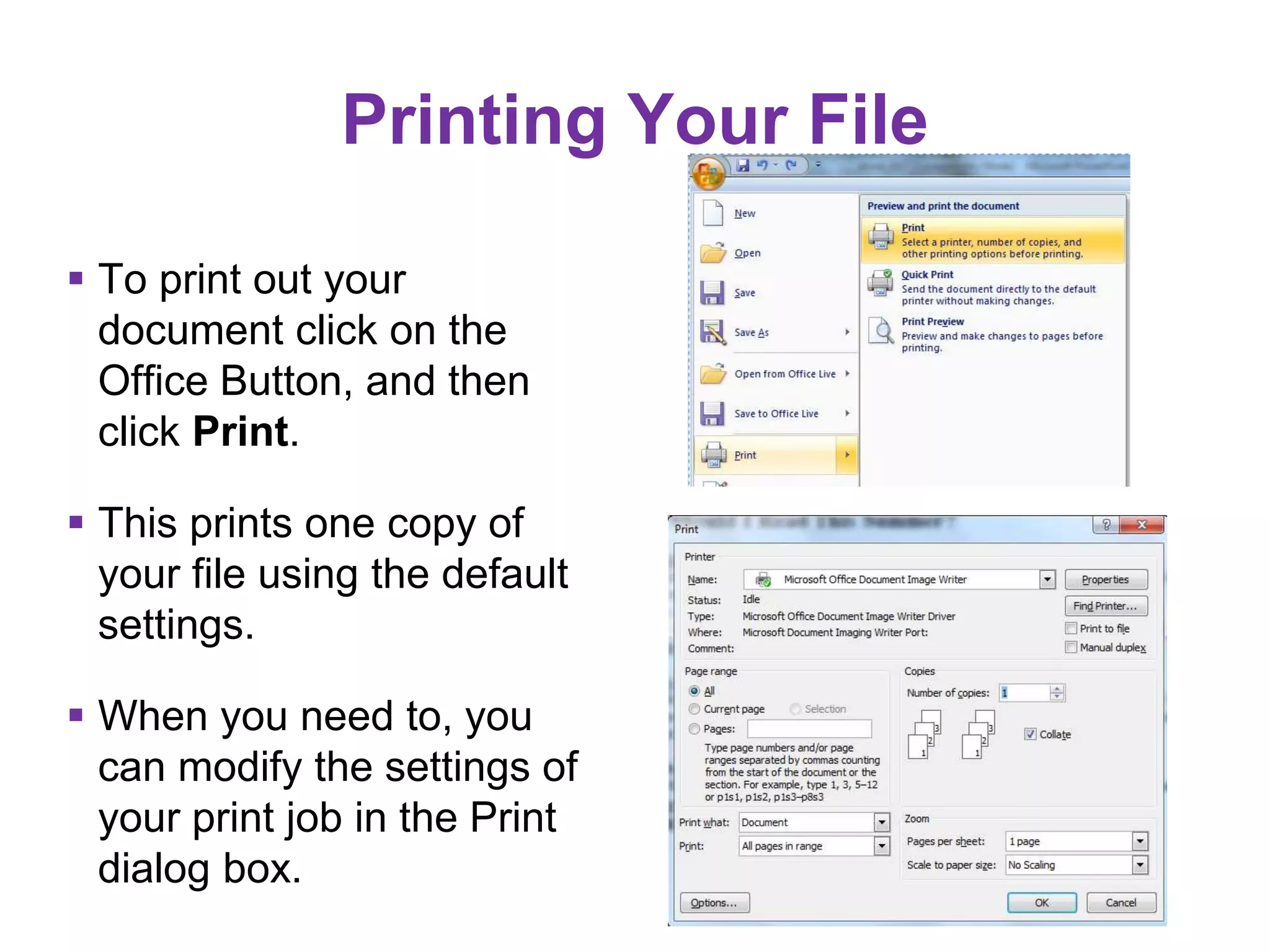
 To print out your
document click on the
Office Button, and then
click Print.
 This prints one copy of
your file using the default
settings.
 When you need to, you
can modify the settings of
your print job in the Print
dialog box.
Editing and Formatting Text
 Advanced word processors include special tools that
help you easily edit and format documents.
 Word processors can:
 cut, copy, and paste text
 undo and redo actions
 justify or re-align text
 change font parameters
 change paragraph spacing
 various other editing and formatting functions.
Copy + Paste
1.Select
Hold down the left mouse button and drag the cursor OR
Hold down SHIFT and use the arrow keys on the keyboard.
1.Copy
You can find the Copy and Paste commands under the
Home Tab.
1.Paste
You can also copy and paste by clicking with the
right mouse button on a word you have selected
to pull up a shortcut menu.
Cut + Paste
Using Cut + Paste is like moving text
from one location to a new one.
The cut command is located :
 in the Home Tab
 or in a shortcut menu when you
right-click on a selected word
Formatting Text
In the Font dialog box, you can
make changes to the type, style,
size, and color of font used in
the document.
Size
Font
You can change the “handwriting” of your
text.
Font style
Put a word in bold or italics for
emphasis.
Effects
Will let you add underlining,
shadows, or details like
strikethrough.
Formatting Text
Many of these text
options can also be
found on your Home
Ribbon in the Font
Group.
Font Size Color
Alignment
You can specify the arrangement of
objects, text, and graphics, in predetermined
positions using the alignment settings.
You can align the selected text to the left,
right, or center by using the left, right, and
center alignment buttons.
Bullets and Numbering
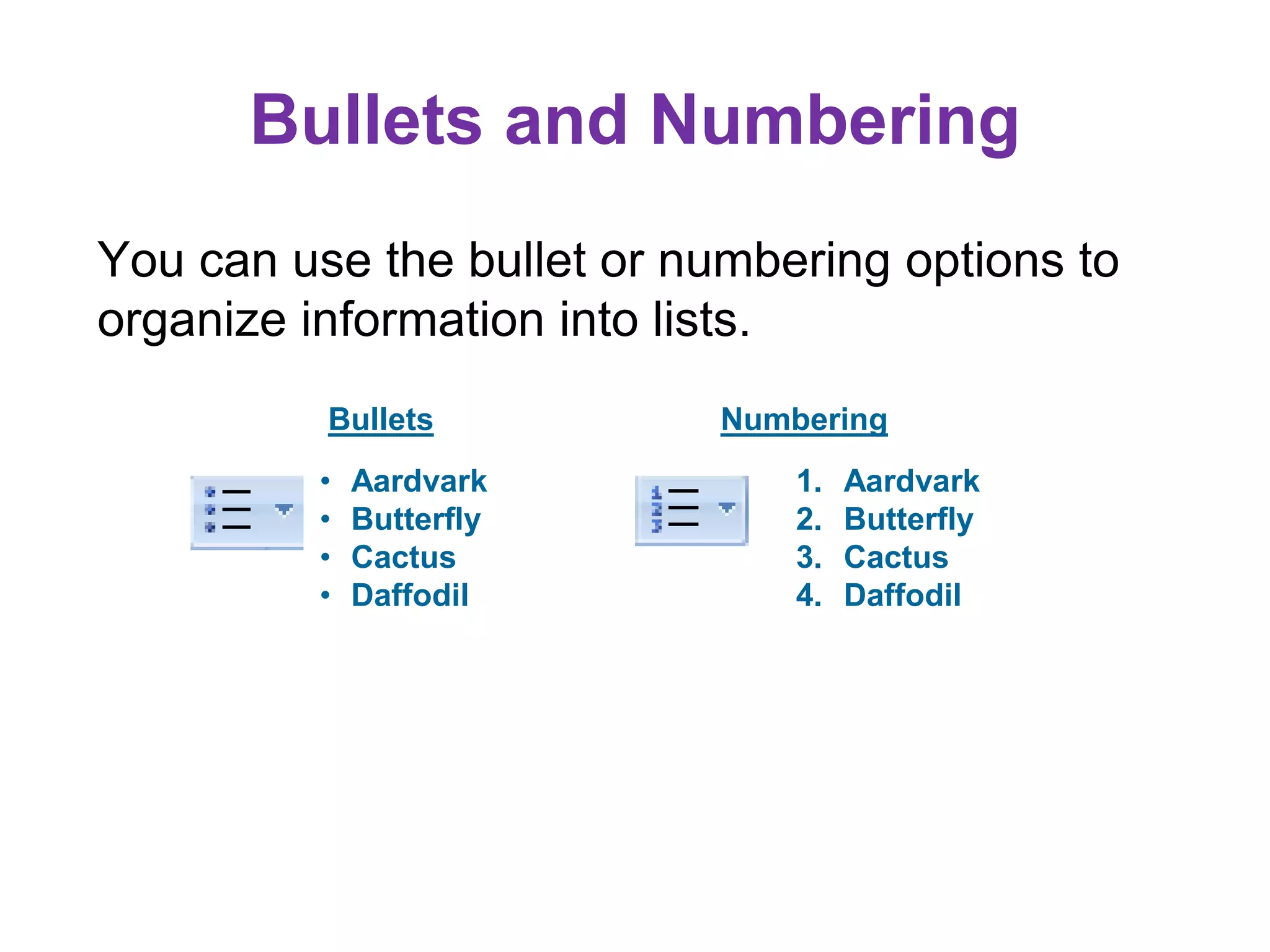
You can use the bullet or numbering options to
organize information into lists.
Bullets Numbering
• Aardvark
• Butterfly
• Cactus
• Daffodil
1. Aardvark
2. Butterfly
3. Cactus
4. Daffodil
Indenting and Spacing
Use indentation to
offset text away from
the margin or bring it
closer again.
Undoing Mistakes
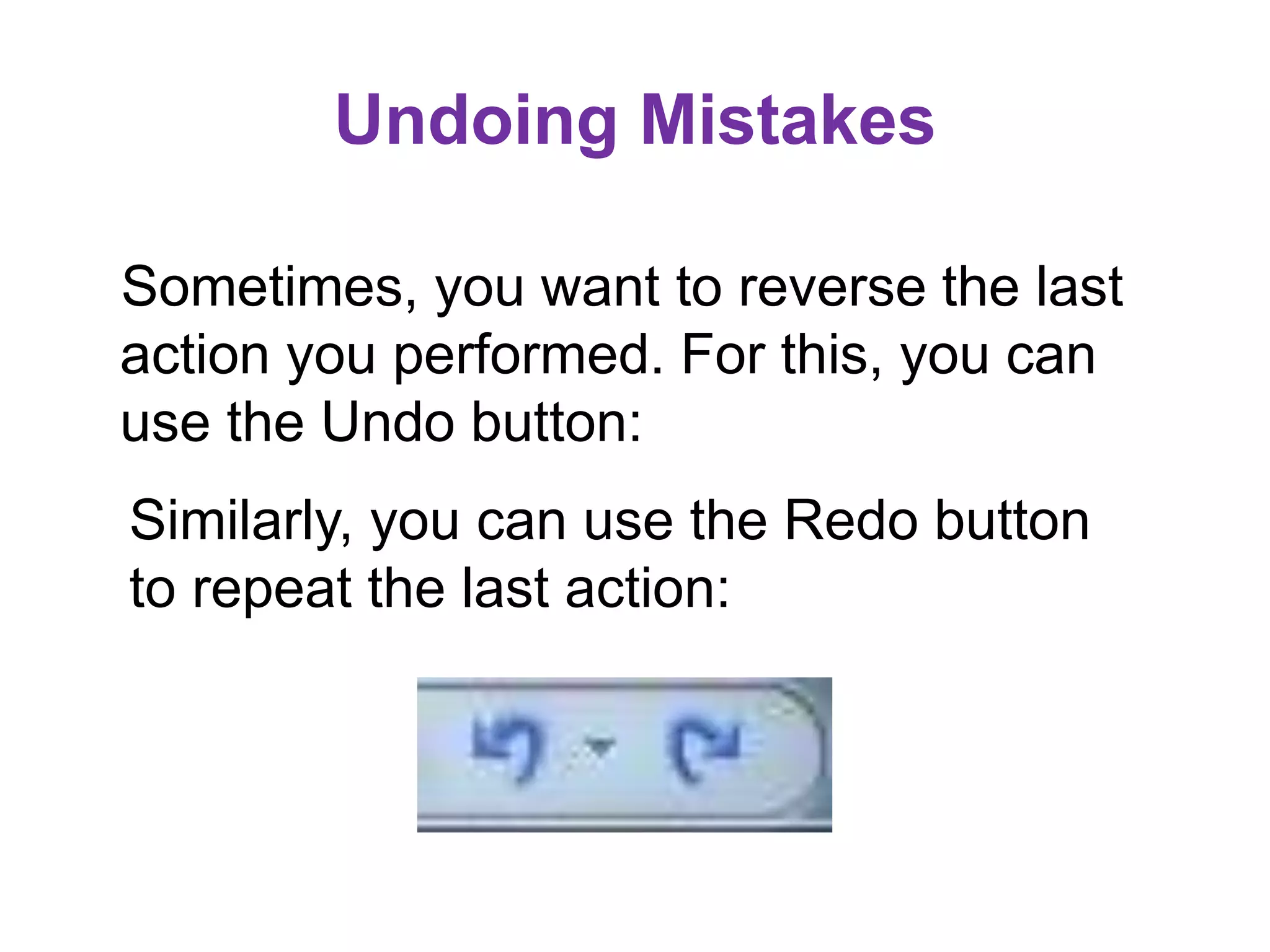
Sometimes, you want to reverse the last
action you performed. For this, you can
use the Undo button:
Similarly, you can use the Redo button
to repeat the last action:
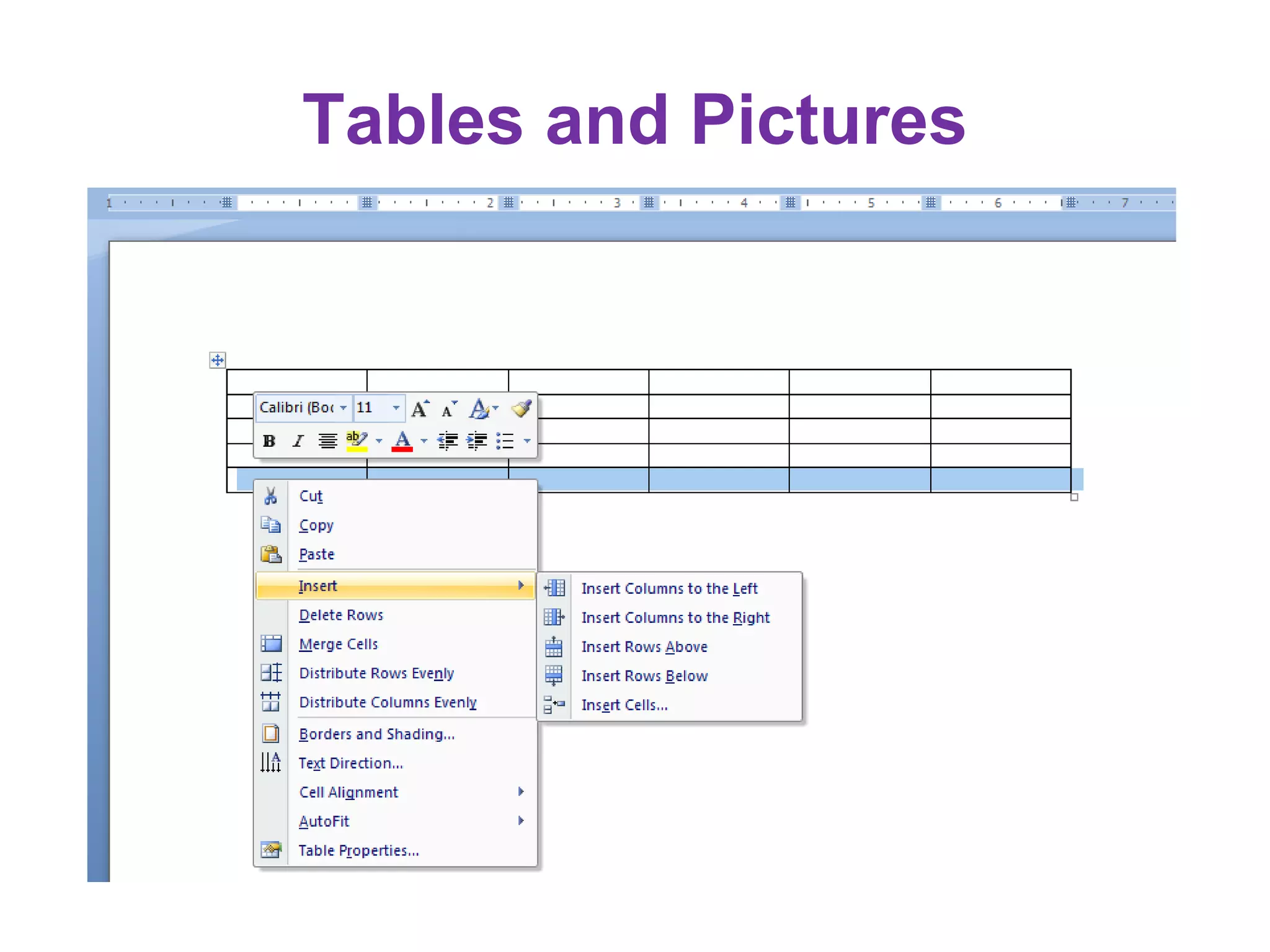
Tables and Pictures
Tables and Pictures
Tables and Pictures
Tables and Pictures
Page Layout
Using Language Tools
Advanced word processors, such
as Word, can automatically detect
the language of the typed text
and then use the spelling
dictionary, grammar checker, and
punctuation rules for that
language.
Language tools are a convenient
way to perform certain tasks
automatically as you type, such
as checking spelling and
grammar.
Spelling and Grammar Check
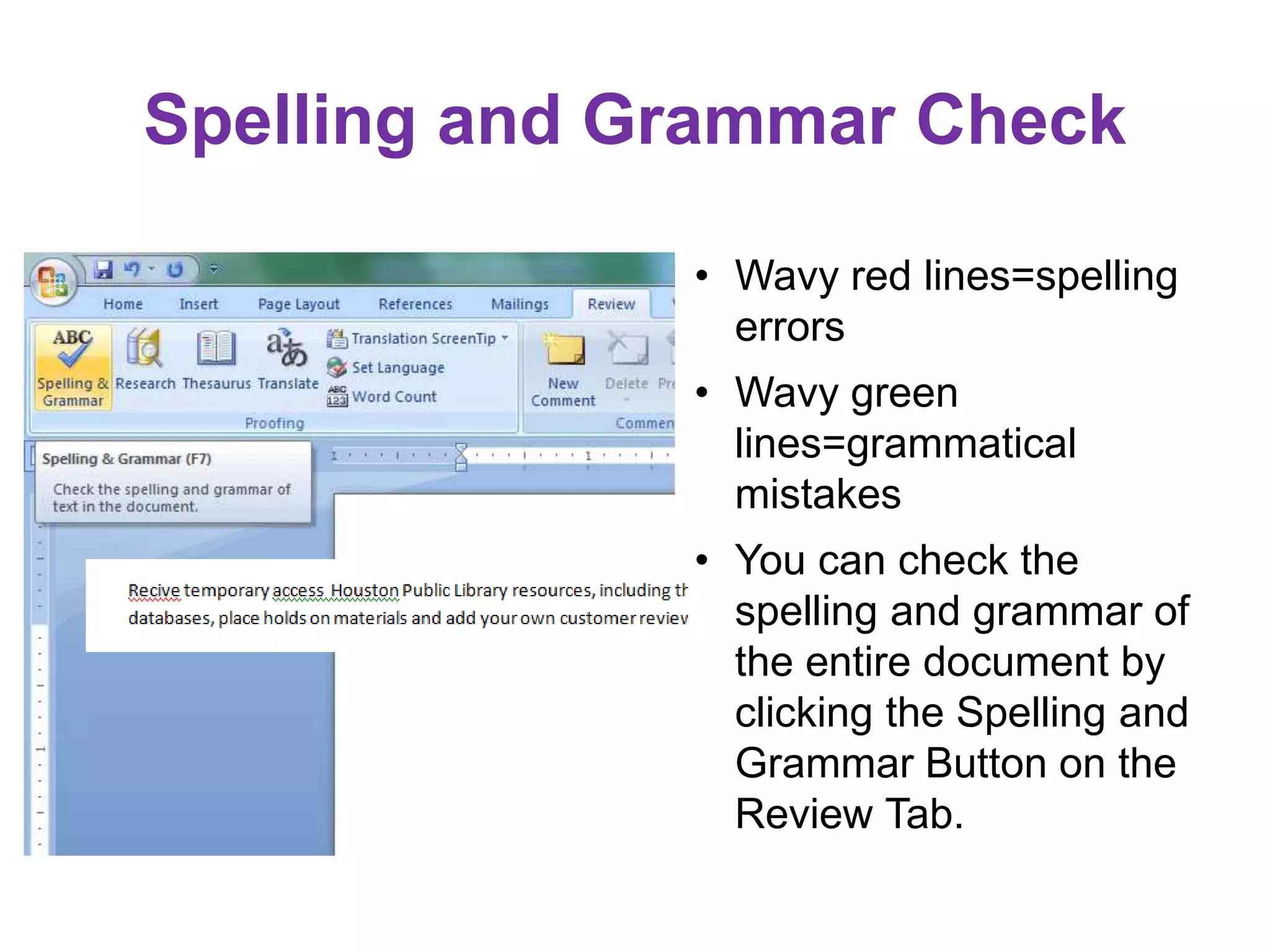
• Wavy red lines=spelling
errors
• Wavy green
lines=grammatical
mistakes
• You can check the
spelling and grammar of
the entire document by
clicking the Spelling and
Grammar Button on the
Review Tab.
Spelling and Grammar Check
 Spelling suggestions
 Change All
 AutoCorrect
 Grammar suggestions
 Custom dictionary
 Ignoring instances
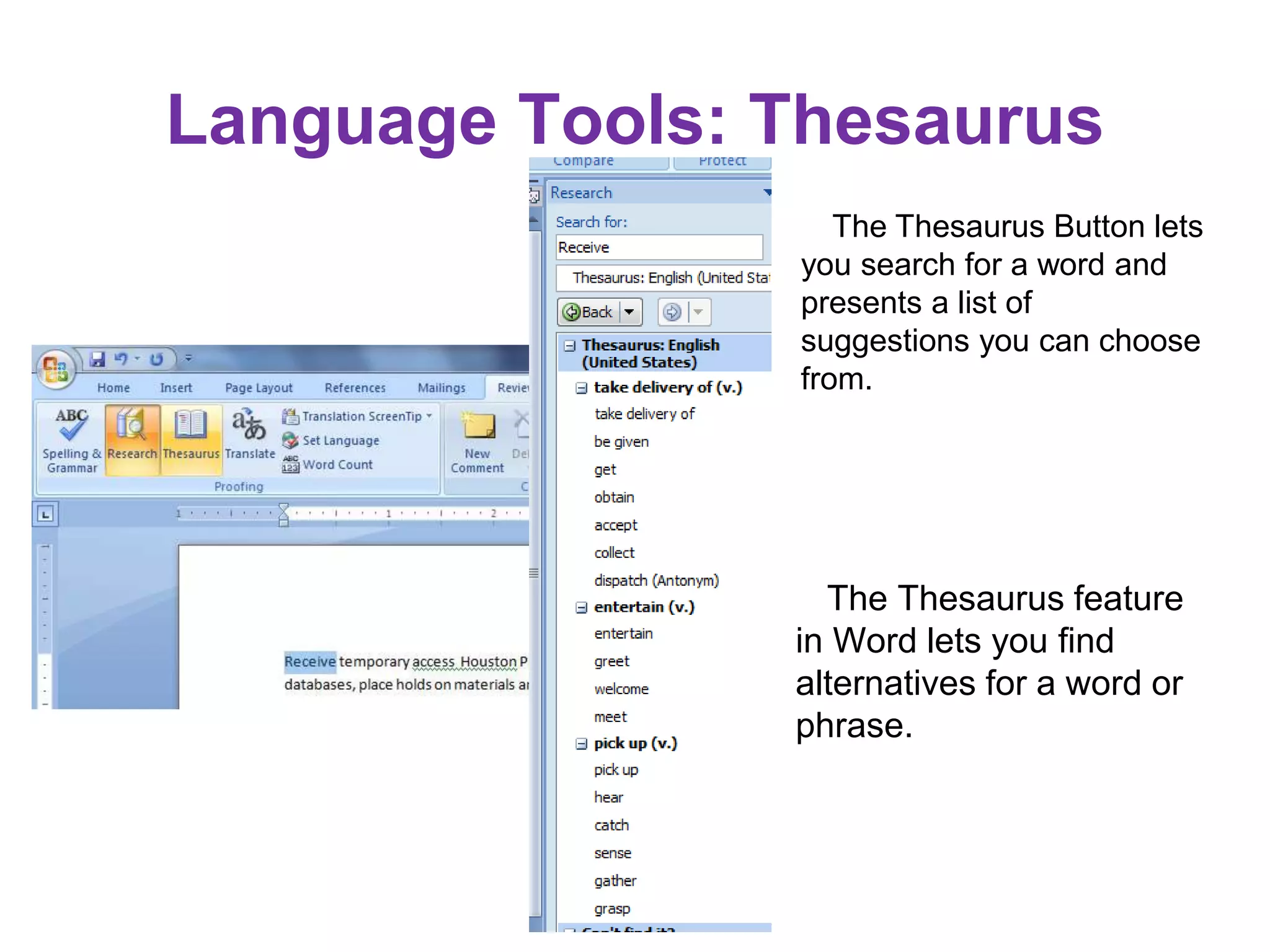
The Thesaurus feature
in Word lets you find
alternatives for a word or
phrase.
The Thesaurus Button lets
you search for a word and
presents a list of
suggestions you can choose
from.
Language Tools: Thesaurus
Questions

MS WORD LEARNING

  • 1.
  • 2.
    Lesson Objectives After completingthis lesson, you will be able to:  Perform basic tasks in a word processor.  Edit and format text.  Work with tables and pictures.  Work with language tools.
  • 3.
    Getting Started withWord Processors  Word processors offer you the flexibility to format documents by making changes to the font, the page layout, and the page style.
  • 4.
    Getting Started withWord Processors You can open Microsoft Word by clicking on the desktop icon… … or by clicking the START button.
  • 5.
    Getting Started withWord Processors When you see the cursor blinking, you are ready to type. Otherwise, use your mouse to click anywhere on the white part of the page.
  • 6.
    Navigating within aDocument  Use your mouse to click anywhere that you have typed text.  You can use the arrow keys on your keyboard to move the cursor vertically or horizontally.  The HOME key moves the cursor to the beginning of the line.  The END key will take it to the end of the line.
  • 7.
    Saving a File Tosave the document, click the Save button on the Quick Access Toolbar or click on the Office Button to choose how to save the file. Office Button Quick Access Toolbar
  • 8.
    Opening an ExistingFile On the Standard toolbar, click the Open button. In the Open dialog box, double-click the name of the document you want to open.
  • 9.
    Printing Your File To print out your document click on the Office Button, and then click Print.  This prints one copy of your file using the default settings.  When you need to, you can modify the settings of your print job in the Print dialog box.
  • 10.
    Editing and FormattingText  Advanced word processors include special tools that help you easily edit and format documents.  Word processors can:  cut, copy, and paste text  undo and redo actions  justify or re-align text  change font parameters  change paragraph spacing  various other editing and formatting functions.
  • 11.
    Copy + Paste 1.Select Holddown the left mouse button and drag the cursor OR Hold down SHIFT and use the arrow keys on the keyboard. 1.Copy You can find the Copy and Paste commands under the Home Tab. 1.Paste You can also copy and paste by clicking with the right mouse button on a word you have selected to pull up a shortcut menu.
  • 12.
    Cut + Paste UsingCut + Paste is like moving text from one location to a new one. The cut command is located :  in the Home Tab  or in a shortcut menu when you right-click on a selected word
  • 13.
    Formatting Text In theFont dialog box, you can make changes to the type, style, size, and color of font used in the document. Size Font You can change the “handwriting” of your text. Font style Put a word in bold or italics for emphasis. Effects Will let you add underlining, shadows, or details like strikethrough.
  • 14.
    Formatting Text Many ofthese text options can also be found on your Home Ribbon in the Font Group. Font Size Color
  • 15.
    Alignment You can specifythe arrangement of objects, text, and graphics, in predetermined positions using the alignment settings. You can align the selected text to the left, right, or center by using the left, right, and center alignment buttons.
  • 16.
    Bullets and Numbering Youcan use the bullet or numbering options to organize information into lists. Bullets Numbering • Aardvark • Butterfly • Cactus • Daffodil 1. Aardvark 2. Butterfly 3. Cactus 4. Daffodil
  • 17.
    Indenting and Spacing Useindentation to offset text away from the margin or bring it closer again.
  • 18.
    Undoing Mistakes Sometimes, youwant to reverse the last action you performed. For this, you can use the Undo button: Similarly, you can use the Redo button to repeat the last action:
  • 19.
  • 20.
  • 21.
  • 22.
  • 23.
  • 24.
    Using Language Tools Advancedword processors, such as Word, can automatically detect the language of the typed text and then use the spelling dictionary, grammar checker, and punctuation rules for that language. Language tools are a convenient way to perform certain tasks automatically as you type, such as checking spelling and grammar.
  • 25.
    Spelling and GrammarCheck • Wavy red lines=spelling errors • Wavy green lines=grammatical mistakes • You can check the spelling and grammar of the entire document by clicking the Spelling and Grammar Button on the Review Tab.
  • 26.
    Spelling and GrammarCheck  Spelling suggestions  Change All  AutoCorrect  Grammar suggestions  Custom dictionary  Ignoring instances
  • 27.
    The Thesaurus feature inWord lets you find alternatives for a word or phrase. The Thesaurus Button lets you search for a word and presents a list of suggestions you can choose from. Language Tools: Thesaurus
  • 28.