INTRODUCTION TO WORD
             PROCESSING
    Word Processing : Creation, editing, and/or printing of
    documents and texts by means of computer systems.

    Features and advantages :
•   Editing is possible before printing
•   Data can be made attractive by formatting, such as
    bold, italic, underline and many more.
•   Documents can easily be send electronically
•   Spell-check feature is provided
Application areas of word
 processing :
• Business - Legal Copies, Letterheads, Letters,
  Memos, Circulars etc.
• Education - To develop word processing skills
  from the very beginning
• Home - Dealing with assignments being
  completed at home, or occasionally
  recreational ex. Maintaining diary
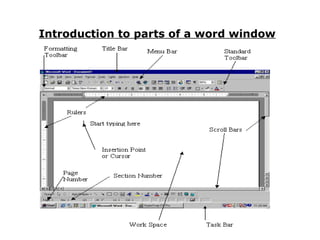
Introduction to parts of a word window
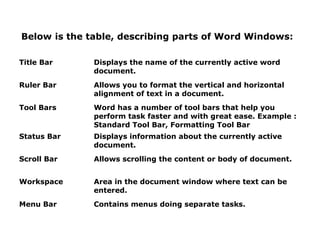
Below is the table, describing parts of Word Windows:

Title Bar     Displays the name of the currently active word
              document.
Ruler Bar     Allows you to format the vertical and horizontal
              alignment of text in a document.
Tool Bars     Word has a number of tool bars that help you
              perform task faster and with great ease. Example :
              Standard Tool Bar, Formatting Tool Bar
Status Bar    Displays information about the currently active
              document.
Scroll Bar    Allows scrolling the content or body of document.


Workspace     Area in the document window where text can be
              entered.
Menu Bar      Contains menus doing separate tasks.
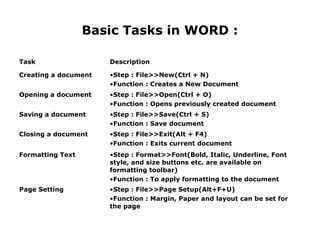
Basic Tasks in WORD :

Task                  Description

Creating a document   •Step : File>>New(Ctrl + N)
                      •Function : Creates a New Document
Opening a document    •Step : File>>Open(Ctrl + O)
                      •Function : Opens previously created document
Saving a document     •Step : File>>Save(Ctrl + S)
                      •Function : Save document
Closing a document    •Step : File>>Exit(Alt + F4)
                      •Function : Exits current document
Formatting Text       •Step : Format>>Font(Bold, Italic, Underline, Font
                      style, and size buttons etc. are available on
                      formatting toolbar)
                      •Function : To apply formatting to the document
Page Setting          •Step : File>>Page Setup(Alt+F+U)
                      •Function : Margin, Paper and layout can be set for
                      the page
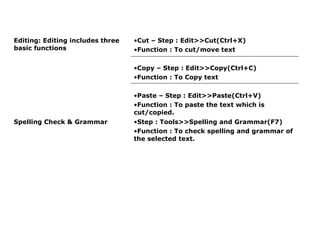
Editing: Editing includes three   •Cut – Step : Edit>>Cut(Ctrl+X)
basic functions                   •Function : To cut/move text

                                  •Copy – Step : Edit>>Copy(Ctrl+C)
                                  •Function : To Copy text

                                  •Paste – Step : Edit>>Paste(Ctrl+V)
                                  •Function : To paste the text which is
                                  cut/copied.
Spelling Check & Grammar          •Step : Tools>>Spelling and Grammar(F7)
                                  •Function : To check spelling and grammar of
                                  the selected text.
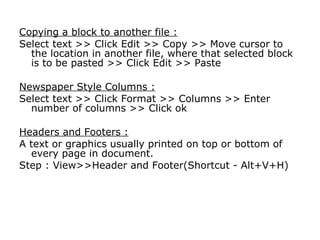
Copying a block to another file :
Select text >> Click Edit >> Copy >> Move cursor to
  the location in another file, where that selected block
  is to be pasted >> Click Edit >> Paste

Newspaper Style Columns :
Select text >> Click Format >> Columns >> Enter
  number of columns >> Click ok

Headers and Footers :
A text or graphics usually printed on top or bottom of
  every page in document.
Step : View>>Header and Footer(Shortcut - Alt+V+H)
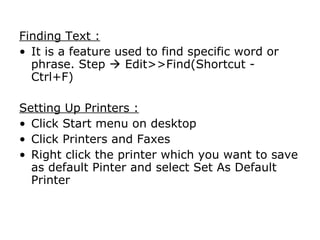
Finding Text :
• It is a feature used to find specific word or
  phrase. Step  Edit>>Find(Shortcut -
  Ctrl+F)

Setting Up Printers :
• Click Start menu on desktop
• Click Printers and Faxes
• Right click the printer which you want to save
  as default Pinter and select Set As Default
  Printer
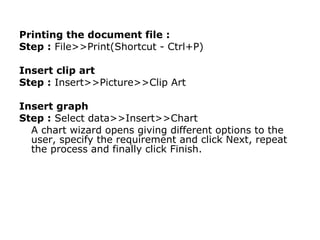
Printing the document file :
Step : File>>Print(Shortcut - Ctrl+P)

Insert clip art
Step : Insert>>Picture>>Clip Art

Insert graph
Step : Select data>>Insert>>Chart
  A chart wizard opens giving different options to the
  user, specify the requirement and click Next, repeat
  the process and finally click Finish.
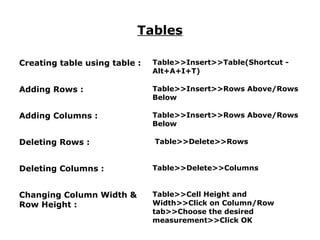
Tables

Creating table using table :   Table>>Insert>>Table(Shortcut -
                               Alt+A+I+T)

Adding Rows :                  Table>>Insert>>Rows Above/Rows
                               Below

Adding Columns :               Table>>Insert>>Rows Above/Rows
                               Below

Deleting Rows :                Table>>Delete>>Rows


Deleting Columns :             Table>>Delete>>Columns


Changing Column Width &        Table>>Cell Height and
Row Height :                   Width>>Click on Column/Row
                               tab>>Choose the desired
                               measurement>>Click OK
Mail Merge
• Mail Merge deals with three elements : Main
  document, List – Names and Address details of
  recipients, and the final document
• Main document contains information which is identical
  in each copy. And the placeholders for the unique data
  which will be different for each copy (Ex. Name &
  Address) as shown in figure.
• List is the database of recipients which can be
  imported from excel or created and saved in word
  only so that this information can be merged in the
  document as shown in figures
• Final Document
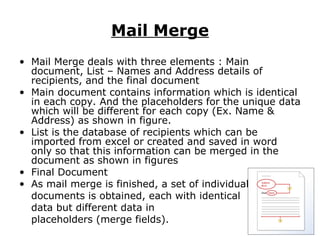
• As mail merge is finished, a set of individual
  documents is obtained, each with identical
  data but different data in
  placeholders (merge fields).

Word processing

  • 2.
    INTRODUCTION TO WORD PROCESSING Word Processing : Creation, editing, and/or printing of documents and texts by means of computer systems. Features and advantages : • Editing is possible before printing • Data can be made attractive by formatting, such as bold, italic, underline and many more. • Documents can easily be send electronically • Spell-check feature is provided
  • 3.
    Application areas ofword processing : • Business - Legal Copies, Letterheads, Letters, Memos, Circulars etc. • Education - To develop word processing skills from the very beginning • Home - Dealing with assignments being completed at home, or occasionally recreational ex. Maintaining diary
  • 4.
    Introduction to partsof a word window
  • 5.
    Below is thetable, describing parts of Word Windows: Title Bar Displays the name of the currently active word document. Ruler Bar Allows you to format the vertical and horizontal alignment of text in a document. Tool Bars Word has a number of tool bars that help you perform task faster and with great ease. Example : Standard Tool Bar, Formatting Tool Bar Status Bar Displays information about the currently active document. Scroll Bar Allows scrolling the content or body of document. Workspace Area in the document window where text can be entered. Menu Bar Contains menus doing separate tasks.
  • 6.
    Basic Tasks inWORD : Task Description Creating a document •Step : File>>New(Ctrl + N) •Function : Creates a New Document Opening a document •Step : File>>Open(Ctrl + O) •Function : Opens previously created document Saving a document •Step : File>>Save(Ctrl + S) •Function : Save document Closing a document •Step : File>>Exit(Alt + F4) •Function : Exits current document Formatting Text •Step : Format>>Font(Bold, Italic, Underline, Font style, and size buttons etc. are available on formatting toolbar) •Function : To apply formatting to the document Page Setting •Step : File>>Page Setup(Alt+F+U) •Function : Margin, Paper and layout can be set for the page
  • 7.
    Editing: Editing includesthree •Cut – Step : Edit>>Cut(Ctrl+X) basic functions •Function : To cut/move text •Copy – Step : Edit>>Copy(Ctrl+C) •Function : To Copy text •Paste – Step : Edit>>Paste(Ctrl+V) •Function : To paste the text which is cut/copied. Spelling Check & Grammar •Step : Tools>>Spelling and Grammar(F7) •Function : To check spelling and grammar of the selected text.
  • 8.
    Copying a blockto another file : Select text >> Click Edit >> Copy >> Move cursor to the location in another file, where that selected block is to be pasted >> Click Edit >> Paste Newspaper Style Columns : Select text >> Click Format >> Columns >> Enter number of columns >> Click ok Headers and Footers : A text or graphics usually printed on top or bottom of every page in document. Step : View>>Header and Footer(Shortcut - Alt+V+H)
  • 9.
    Finding Text : •It is a feature used to find specific word or phrase. Step  Edit>>Find(Shortcut - Ctrl+F) Setting Up Printers : • Click Start menu on desktop • Click Printers and Faxes • Right click the printer which you want to save as default Pinter and select Set As Default Printer
  • 10.
    Printing the documentfile : Step : File>>Print(Shortcut - Ctrl+P) Insert clip art Step : Insert>>Picture>>Clip Art Insert graph Step : Select data>>Insert>>Chart A chart wizard opens giving different options to the user, specify the requirement and click Next, repeat the process and finally click Finish.
  • 11.
    Tables Creating table usingtable : Table>>Insert>>Table(Shortcut - Alt+A+I+T) Adding Rows : Table>>Insert>>Rows Above/Rows Below Adding Columns : Table>>Insert>>Rows Above/Rows Below Deleting Rows : Table>>Delete>>Rows Deleting Columns : Table>>Delete>>Columns Changing Column Width & Table>>Cell Height and Row Height : Width>>Click on Column/Row tab>>Choose the desired measurement>>Click OK
  • 12.
    Mail Merge • MailMerge deals with three elements : Main document, List – Names and Address details of recipients, and the final document • Main document contains information which is identical in each copy. And the placeholders for the unique data which will be different for each copy (Ex. Name & Address) as shown in figure. • List is the database of recipients which can be imported from excel or created and saved in word only so that this information can be merged in the document as shown in figures • Final Document • As mail merge is finished, a set of individual documents is obtained, each with identical data but different data in placeholders (merge fields).