4.0) HEAT TREATMENT LECTURE OUTLINE: Define and purpose heat treatment. Heat treatment theory Stages of heat treatment. Heat treatment process. Case Hardening. TTT Diagram
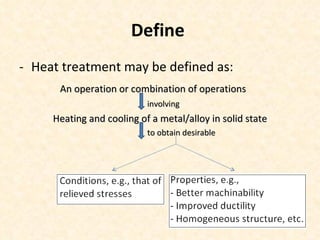
Define   Heat treatment may be defined as: An operation or combination of operations involving Heating and cooling of a metal/alloy in solid state to obtain desirable
Purpose Cause relief of internal stresses developed during cold working, welding, casting, forging etc. Harden and strengthen metals. Improve machinability. Change grain size Soften metals for further (cold) working as in wire drawing or cold rolling.
Purpose Improve ductility and toughness Increase , heat, wear and corrosion resistance of materials. Improve electrical and magnetic properties. Homogenise the structure to remove coring . Spheroidize tiny particales, such as those of Fe₃C in steel, by diffusion.
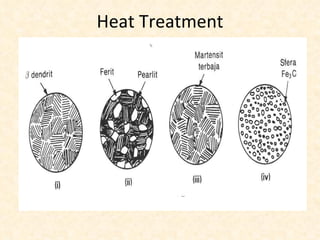
Heat Treatment Theory The various types of heat-treating processes are similar because they all involve the heating and cooling of metals; they differ in the heating temperatures and the cooling rates used and the final results.  Ferrous metals (metals with iron) are annealing, normalizing, hardening, and tempering. Nonferrous metals can be annealed, but never tempered, normalized, or case-hardened.
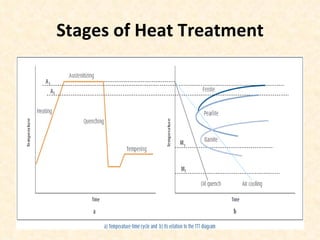
Stages of Heat Treatment Stage l —Heating the metal slowly to ensure a uniform temperature. Stage 2 —Soaking (holding) the metal at a given temperature for a given time and cooling the metal to room temperature. Stage 3 —Cooling the metal to room temperature.
Stages of Heat Treatment
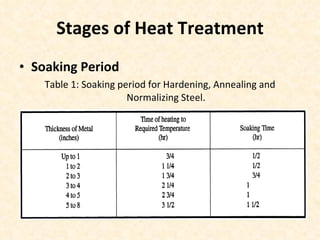
Stages of Heat Treatment Soaking Internal structural changes take place. soaking period depends on the chemical analysis of the metal and the mass of the part.  Cooling Stage -  To cool the metal, you can place it in direct contact with a COOLING MEDIUM composed of a gas, liquid, solid, or combination of these.
Soaking Period  Table 1: Soaking period for Hardening, Annealing and Normalizing Steel. Stages of Heat Treatment
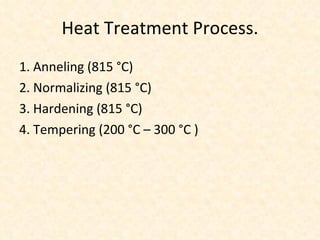
Heat Treatment Process. 1. Anneling (815 °C) 2. Normalizing (815 °C) 3. Hardening (815 °C)  4. Tempering (200 °C – 300 °C )
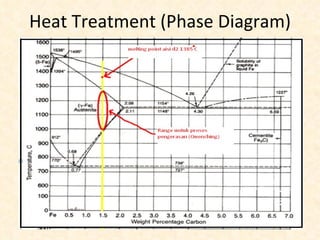
Heat Treatment (Phase Diagram)
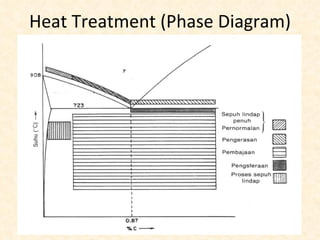
Heat Treatment
Heat Treatment
Heat Treatment
Heat Treatment Process Annealing Process Annealing is the opposite of hardening Relieve internal stresses, soften them, make them more ductile, and refine their grain structures. Cooling method depend on the metal. For command use are furnace cooled.
Heat Treatment Process Annealing Process As the weld cools, internal stresses occur along with hard spots and brittleness. Welding can actually weaken the metal. Annealing is just one of the methods for correcting these problems.
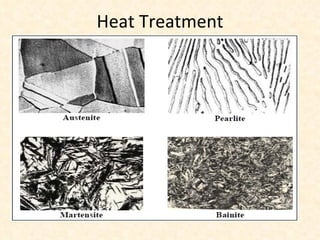
Heat Treatment Process 2. Normalizing Metal is heated to a higher temperature and  then removed from the furnace for air cooling. Remove the internal stresses induced by heat treating, welding, casting, forging, forming, or machining. low-carbon steels do not require normalizing (no harmful effects result).
Heat Treatment Process 3. Hardening Heating the steel to a set temperature and then cooling (quenching) it rapidly by plunging it into oil, water, or brine. Hardening increases the hardness and strength of the steel, but makes it less ductile. low-carbon steels do not require because no harmful effects result.(No transformation for martensitic structure)
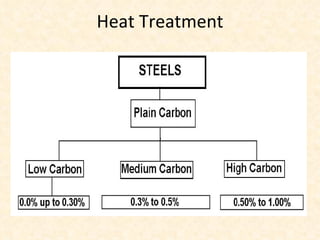
Heat Treatment Process 3. Hardening In practice, 0.80 % C is required for maximum hardness.  When you increase the carbon content beyond 0.80 per cent, there is no increase in hardness, but there is an increase in wear resistance.  This increase in wear resistance is due to the formation of a substance called hard cementite.
Heat Treatment Process 4. Tempering To relieve the internal stresses and reduce brittleness, you should temper the steel after it is hardened. Temperature (below its hardening temperature), holding length of time and cooling (instill air). Below the low-critical point Strength, hardness and ductility depend on the temperature (during the tempering process).
Heat Treatment Process 4. Tempering The minimum temperature time for tempering should be 1 hour. If the part is more than 1 inch thick, increase the time by 1 hour for each additional inch of thickness. Tempering relieves quenching stresses and reduces hardness and brittleness.
Heat Treatment Process 4. Tempering Actually, the tensile strength of a hardened steel may increase as the steel is tempered up to a temperature of about 450°F. Above this temperature it starts to decrease. Tempering increases softness, ductility,  malleability and impact resistance.
Case Hardening Case hardening produces a hard, wear-resistant surface or case over a strong, tough core.  Only ferrous metals are case-hardened. The steels best suited for case hardening are the low-carbon and low-alloy series. Surface of the metal chemically by introducing a high carbide or nitride content.
Case Hardening CARBURIZING Carbon is added to the surface of low-carbon steel. Two methods carburizing steel.  i ) Heating the steel in a furnace containing a carbon monoxide atmosphere.  ii) Steel placed in a container packed with charcoal or some other carbon-rich material and then heated in a furnace. -  To cool the parts, leave the container in the furnace to cool or remove it and let it air cool.
Case Hardening 2) CYANIDING Fast and efficient. Preheated steel is dipped into a heated cyanide bath and allowed to soak. Upon removal, it is quenched and then rinsed to remove any residual cyanide.  This process produces a thin, hard shell that is harder than the one produced by carburizing (completed in 20 to 30 minutes)  Cyanide salts are a deadly poison.
Case Hardening 3) NITRIDING Methods in that the individual parts have been heat-treated and tempered before nitriding. The parts are then heated in a furnace that has an ammonia gas atmosphere.  No quenching is required so there is no worry about warping or other types of distortion.
Case Hardening 3) NITRIDING This process is used to case harden items, such as gears, cylinder sleeves, camshafts and other engine parts, that need to be wear resistant and operate in high-heat areas.
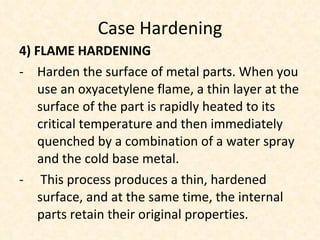
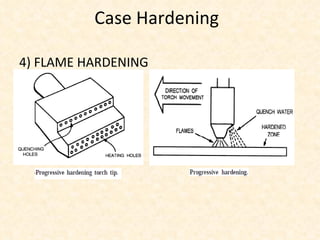
Case Hardening 4) FLAME HARDENING Harden the surface of metal parts. When you use an oxyacetylene flame, a thin layer at the surface of the part is rapidly heated to its critical temperature and then immediately quenched by a combination of a water spray and the cold base metal. This process produces a thin, hardened surface, and at the same time, the internal parts retain their original properties.
  Case Hardening 4) FLAME HARDENING
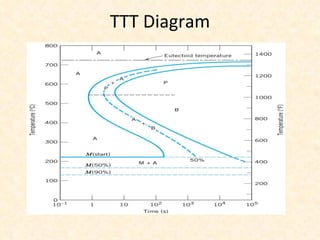
TTT Diagram
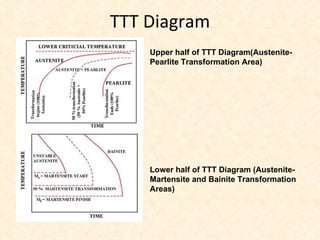
TTT Diagram Upper half of TTT Diagram(Austenite-Pearlite Transformation Area) Lower half of TTT Diagram (Austenite-Martensite and Bainite Transformation Areas)
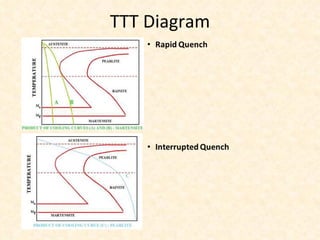
TTT Diagram
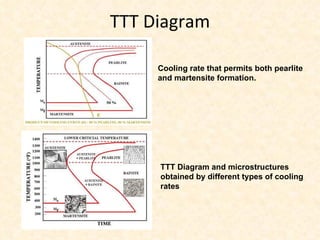
TTT Diagram TTT Diagram and microstructures obtained by different types of cooling rates Cooling rate that permits both pearlite and martensite formation.
Thank you

Heat treatment(Muda Ibrahim)

  • 1.
    4.0) HEAT TREATMENTLECTURE OUTLINE: Define and purpose heat treatment. Heat treatment theory Stages of heat treatment. Heat treatment process. Case Hardening. TTT Diagram
  • 2.
    Define Heat treatment may be defined as: An operation or combination of operations involving Heating and cooling of a metal/alloy in solid state to obtain desirable
  • 3.
    Purpose Cause reliefof internal stresses developed during cold working, welding, casting, forging etc. Harden and strengthen metals. Improve machinability. Change grain size Soften metals for further (cold) working as in wire drawing or cold rolling.
  • 4.
    Purpose Improve ductilityand toughness Increase , heat, wear and corrosion resistance of materials. Improve electrical and magnetic properties. Homogenise the structure to remove coring . Spheroidize tiny particales, such as those of Fe₃C in steel, by diffusion.
  • 5.
    Heat Treatment TheoryThe various types of heat-treating processes are similar because they all involve the heating and cooling of metals; they differ in the heating temperatures and the cooling rates used and the final results. Ferrous metals (metals with iron) are annealing, normalizing, hardening, and tempering. Nonferrous metals can be annealed, but never tempered, normalized, or case-hardened.
  • 6.
    Stages of HeatTreatment Stage l —Heating the metal slowly to ensure a uniform temperature. Stage 2 —Soaking (holding) the metal at a given temperature for a given time and cooling the metal to room temperature. Stage 3 —Cooling the metal to room temperature.
  • 7.
    Stages of HeatTreatment
  • 8.
    Stages of HeatTreatment Soaking Internal structural changes take place. soaking period depends on the chemical analysis of the metal and the mass of the part. Cooling Stage - To cool the metal, you can place it in direct contact with a COOLING MEDIUM composed of a gas, liquid, solid, or combination of these.
  • 9.
    Soaking Period Table 1: Soaking period for Hardening, Annealing and Normalizing Steel. Stages of Heat Treatment
  • 10.
    Heat Treatment Process.1. Anneling (815 °C) 2. Normalizing (815 °C) 3. Hardening (815 °C) 4. Tempering (200 °C – 300 °C )
  • 11.
  • 12.
  • 13.
  • 14.
  • 15.
  • 16.
    Heat Treatment ProcessAnnealing Process Annealing is the opposite of hardening Relieve internal stresses, soften them, make them more ductile, and refine their grain structures. Cooling method depend on the metal. For command use are furnace cooled.
  • 17.
    Heat Treatment ProcessAnnealing Process As the weld cools, internal stresses occur along with hard spots and brittleness. Welding can actually weaken the metal. Annealing is just one of the methods for correcting these problems.
  • 18.
    Heat Treatment Process2. Normalizing Metal is heated to a higher temperature and then removed from the furnace for air cooling. Remove the internal stresses induced by heat treating, welding, casting, forging, forming, or machining. low-carbon steels do not require normalizing (no harmful effects result).
  • 19.
    Heat Treatment Process3. Hardening Heating the steel to a set temperature and then cooling (quenching) it rapidly by plunging it into oil, water, or brine. Hardening increases the hardness and strength of the steel, but makes it less ductile. low-carbon steels do not require because no harmful effects result.(No transformation for martensitic structure)
  • 20.
    Heat Treatment Process3. Hardening In practice, 0.80 % C is required for maximum hardness. When you increase the carbon content beyond 0.80 per cent, there is no increase in hardness, but there is an increase in wear resistance. This increase in wear resistance is due to the formation of a substance called hard cementite.
  • 21.
    Heat Treatment Process4. Tempering To relieve the internal stresses and reduce brittleness, you should temper the steel after it is hardened. Temperature (below its hardening temperature), holding length of time and cooling (instill air). Below the low-critical point Strength, hardness and ductility depend on the temperature (during the tempering process).
  • 22.
    Heat Treatment Process4. Tempering The minimum temperature time for tempering should be 1 hour. If the part is more than 1 inch thick, increase the time by 1 hour for each additional inch of thickness. Tempering relieves quenching stresses and reduces hardness and brittleness.
  • 23.
    Heat Treatment Process4. Tempering Actually, the tensile strength of a hardened steel may increase as the steel is tempered up to a temperature of about 450°F. Above this temperature it starts to decrease. Tempering increases softness, ductility, malleability and impact resistance.
  • 24.
    Case Hardening Casehardening produces a hard, wear-resistant surface or case over a strong, tough core. Only ferrous metals are case-hardened. The steels best suited for case hardening are the low-carbon and low-alloy series. Surface of the metal chemically by introducing a high carbide or nitride content.
  • 25.
    Case Hardening CARBURIZINGCarbon is added to the surface of low-carbon steel. Two methods carburizing steel. i ) Heating the steel in a furnace containing a carbon monoxide atmosphere. ii) Steel placed in a container packed with charcoal or some other carbon-rich material and then heated in a furnace. - To cool the parts, leave the container in the furnace to cool or remove it and let it air cool.
  • 26.
    Case Hardening 2)CYANIDING Fast and efficient. Preheated steel is dipped into a heated cyanide bath and allowed to soak. Upon removal, it is quenched and then rinsed to remove any residual cyanide. This process produces a thin, hard shell that is harder than the one produced by carburizing (completed in 20 to 30 minutes) Cyanide salts are a deadly poison.
  • 27.
    Case Hardening 3)NITRIDING Methods in that the individual parts have been heat-treated and tempered before nitriding. The parts are then heated in a furnace that has an ammonia gas atmosphere. No quenching is required so there is no worry about warping or other types of distortion.
  • 28.
    Case Hardening 3)NITRIDING This process is used to case harden items, such as gears, cylinder sleeves, camshafts and other engine parts, that need to be wear resistant and operate in high-heat areas.
  • 29.
    Case Hardening 4)FLAME HARDENING Harden the surface of metal parts. When you use an oxyacetylene flame, a thin layer at the surface of the part is rapidly heated to its critical temperature and then immediately quenched by a combination of a water spray and the cold base metal. This process produces a thin, hardened surface, and at the same time, the internal parts retain their original properties.
  • 30.
    CaseHardening 4) FLAME HARDENING
  • 31.
  • 32.
    TTT Diagram Upperhalf of TTT Diagram(Austenite-Pearlite Transformation Area) Lower half of TTT Diagram (Austenite-Martensite and Bainite Transformation Areas)
  • 33.
  • 34.
    TTT Diagram TTTDiagram and microstructures obtained by different types of cooling rates Cooling rate that permits both pearlite and martensite formation.
  • 35.