Improving Student
Achievement: Leading Quality
Literacy across a System
Superintendents’	Round	Table	
MRLC	
Nov	3,	2015;	Feb	17	,	2016	
Faye	Brownlie	
www.slideshare.net/fayebrownlie/
mrlc.supers
Learning Intentions
•  I	have	a	beLer	understanding	of	reading	
assessment,	what	is	valued	and	what	is	
measured.	
•  I	have	a	plan	to	work	with	our	staff	on	USING	
the	data	from	our	reading	assessments.	
•  I	beLer	understand	what	works	in	teaching	
reading.
Reading Assessment
•  The	goal	of	teaching	reading	is	to	create	
readers	who	read	with	understanding	and	
who	choose	to	read.		
•  The	goal	of	a	formaRve	reading	assessment	is	
to	determine	the	strengths	and	areas	to	
strengthen	of	a	student’s	reading	with	
understanding.
What	reading	assessment	data	do	you	
collect?	
What	reading	assessments	do	you	
use?	
Why	do	you	collect	this?	
How	do	you	use	the	data?	
•  Teams	of	4	
•  15	minutes	
•  Report	out
•  What	are	your	assessment	goals?
•  Inform	pracRce,	change	teaching	
– formaRve	
•  Monitor	changes	over	Rme	
– summaRve
No plan, no point
Performance-based Reading
Assessment OF Learning
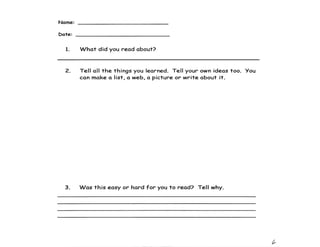
•  Select	a	text	
•  Choose	a	response	prompt(s)	
•  Score	with	a	scoring	rubric	
•  Look	for	trends	–	strengths	&	challenges	
•  Respond	to	the	trends	
•  Create	a	parallel	assessment	FOR	learning	and	
include	oral	reading	and	an	interview.	
•  Create	a	class	and	school	plan	of	acRon.
Standard Reading Assessment
•  As	described	in	Student	Diversity,	2nd	ed	
•  Brownlie,	Feniak	and	Schnellert	
•  As	described	in	It’s	All	about	Thinking	
•  All	3	books	(HumaniRes,	Math/Science,	Middle	Years)	
•  Brownlie,	Schnellert	et	al
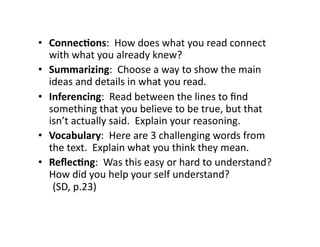
•  Connec&ons:		How	does	what	you	read	connect	
with	what	you	already	knew?	
•  Summarizing:		Choose	a	way	to	show	the	main	
ideas	and	details	in	what	you	read.	
•  Inferencing:		Read	between	the	lines	to	find	
something	that	you	believe	to	be	true,	but	that	
isn’t	actually	said.		Explain	your	reasoning.	
•  Vocabulary:		Here	are	3	challenging	words	from	
the	text.		Explain	what	you	think	they	mean.	
•  Reflec&ng:		Was	this	easy	or	hard	to	understand?		
How	did	you	help	your	self	understand? 	 	 	
	(SD,	p.23)
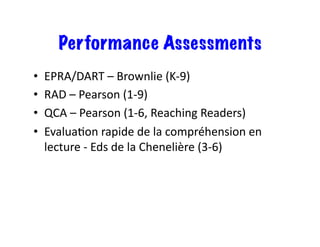
Performance Assessments
•  EPRA/DART	–	Brownlie	(K-9)	
•  RAD	–	Pearson	(1-9)	
•  QCA	–	Pearson	(1-6,	Reaching	Readers)	
•  EvaluaRon	rapide	de	la	compréhension	en	
lecture	-	Eds	de	la	Chenelière	(3-6)
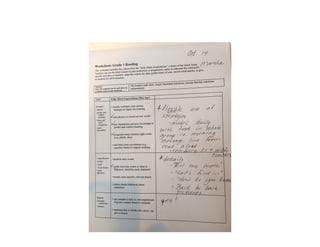
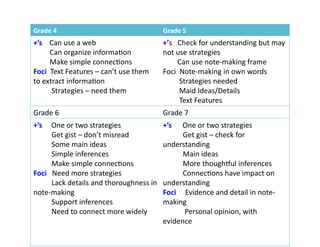
Grade	4	 Grade	5	
+’s				Can	use	a	web	
									Can	organize	informaRon	
									Make	simple	connecRons	
Foci		Text	Features	–	can’t	use	them	
to	extract	informaRon	
										Strategies	–	need	them	
+’s			Check	for	understanding	but	may	
not	use	strategies	
								Can	use	note-making	frame	
Foci		Note-making	in	own	words	
									Strategies	needed	
									Maid	Ideas/Details	
									Text	Features	
Grade	6	 Grade	7	
+’s					One	or	two	strategies	
										Get	gist	–	don’t	misread	
										Some	main	ideas	
										Simple	inferences	
										Make	simple	connecRons	
Foci			Need	more	strategies	
										Lack	details	and	thoroughness	in	
note-making	
										Support	inferences	
										Need	to	connect	more	widely	
+’s						One	or	two	strategies	
											Get	gist	–	check	for	
understanding	
											Main	ideas	
											More	thoughkul	inferences	
											ConnecRons	have	impact	on	
understanding	
Foci					Evidence	and	detail	in	note-
making	
												Personal	opinion,	with	
evidence
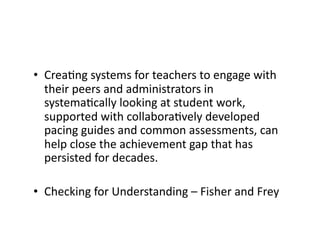
•  CreaRng	systems	for	teachers	to	engage	with	
their	peers	and	administrators	in	
systemaRcally	looking	at	student	work,	
supported	with	collaboraRvely	developed	
pacing	guides	and	common	assessments,	can	
help	close	the	achievement	gap	that	has	
persisted	for	decades.	
•  Checking	for	Understanding	–	Fisher	and	Frey
“Students	taught	by	teachers	who	used	
assessment	for	learning	achieved	in	six	or	
seven	months	what	would	otherwise	have	
taken	a	year.”		
-Black	&	Wiliam	(1998).		
“Feedback	[is]	in	the	top	ten	influences	on	
achievement.	Where	is	the	student	going?	
How	is	the	student	going?	Where	to	next?”	
-HaLe	(2012).
What	works	in	reading?
McKinsey Report, 2007
•  The	top-performing	school	systems	recognize	
that	the	only	way	to	improve	outcomes	is	to	
improve	instrucRon:		learning	occurs	when	
students	and	teachers	interact,	and	thus	to	
improve	learning	implies	improving	the	quality	
of	that	interacRon.
How the world’s most improved
school systems keep getting better
–McKinsey, 2010
Three	changes	collaboraRve	pracRce	brought	about:	
1.  Teachers	moved	from	being	private	emperors	to	
making	their	pracRce	public	and	the	enRre	teaching	
populaRon	sharing	responsibility	for	student	learning.	
2.  Focus	shimed	from	what	teachers	teach	to	what	
students	learn.	
3.  Systems	developed	a	model	of	‘good	instrucRon’	and	
teachers	became	custodians	of	the	model.	(p.	79-81)
What	is	fueling	this	focus	on	
reading?
PIRLS, 2011
Progress in International Reading Literacy Study
•  Grade	4,	every	5	years	
•  2011	–	45	countries	
•  2600	students	in	148	schools	in	BC	in	2011	
•  BC	also	parRcipated	in	2006	
•  Measures	trends	in	reading	achievement	
•  Examines	policies	and	pracRces	related	to	literacy	
hLp://www.bced.gov.bc.ca/assessment/nat_int_pubspirls.htm
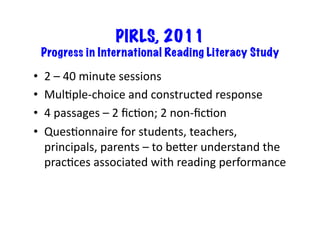
PIRLS, 2011
Progress in International Reading Literacy Study	
•  2	–	40	minute	sessions	
•  MulRple-choice	and	constructed	response	
•  4	passages	–	2	ficRon;	2	non-ficRon	
•  QuesRonnaire	for	students,	teachers,	
principals,	parents	–	to	beLer	understand	the	
pracRces	associated	with	reading	performance
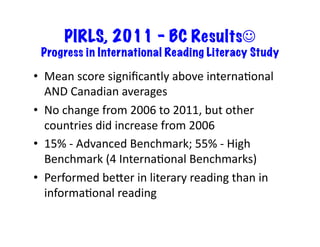
PIRLS, 2011 – BC Results☺
Progress in International Reading Literacy Study	
•  Mean	score	significantly	above	internaRonal	
AND	Canadian	averages	
•  No	change	from	2006	to	2011,	but	other	
countries	did	increase	from	2006	
•  15%	-	Advanced	Benchmark;	55%	-	High	
Benchmark	(4	InternaRonal	Benchmarks)	
•  Performed	beLer	in	literary	reading	than	in	
informaRonal	reading
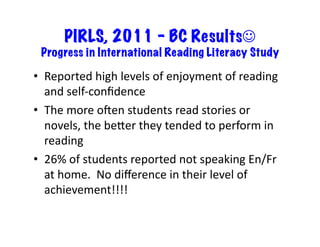
PIRLS, 2011 – BC Results☺
Progress in International Reading Literacy Study	
•  Reported	high	levels	of	enjoyment	of	reading	
and	self-confidence	
•  The	more	omen	students	read	stories	or	
novels,	the	beLer	they	tended	to	perform	in	
reading	
•  26%	of	students	reported	not	speaking	En/Fr	
at	home.		No	difference	in	their	level	of	
achievement!!!!
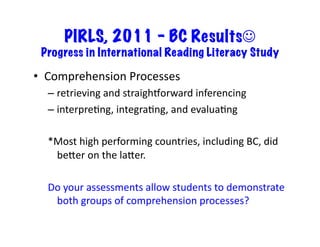
PIRLS, 2011 – BC Results☺
Progress in International Reading Literacy Study	
•  Comprehension	Processes	
– retrieving	and	straighkorward	inferencing	
– interpreRng,	integraRng,	and	evaluaRng	
*Most	high	performing	countries,	including	BC,	did	
beLer	on	the	laLer.		
Do	your	assessments	allow	students	to	demonstrate	
both	groups	of	comprehension	processes?
PCAP	-	2013	
•  “…a	fair	measurement	of	students'	abiliRes	to	
use	their	learning	skills	to	solve	real-life	
situaRons.”
•  Language	arts	curricula	across	Canada	idenRfy		
		 	-comprehension,		
		 	-interpretaRon,		
		 	-response	and	reflecRon		
as	major	organizing	aspects	of	reading	literacy.		
•  PCAP	2013	Contextual	Report
Comprehension:		
•  Students	understand	the	explicit	and	implicit	
informaRon	provided	by	the	text.	In	parRcular	
they	understand	the	vocabulary,	parts,	
elements,	and	events	of	the	text.
Interpreta0on:		
•  Students	make	meaning	by	analyzing	and	
synthesizing	the	parts/elements/events	to	
develop	a	broader	perspecRve	and/or	
meaning	for	the	text.	They	may	idenRfy	
theme/thesis	and	support	that	with	
references	to	details,	events,	symbols,	
paLerns,	and/or	text	features.
Response	to	text:		
•  In	responding,	the	readers	engage	with	the	
text	in	many	ways:	by	making	personal	
connecRons	between	aspects	of	the	text	and	
their	own	real/vicarious/prior	experiences,	
knowledge,	values,	and/or	points	of	view;	by	
responding	emoRonally	to	central	ideas	or	
aspects	of	the	text;	and/or	by	taking	an	
evaluaRve	stance	about	the	quality	or	value	of	
the	text,	possibly	in	relaRon	to	other	texts	
and/or	social	or	cultural	factors.
Less	Rme	on:	
•  Decoding	
•  Short	test	assessment	items	
•  Absenteeism	
MB	Contextual	Report,	amer	2007	results
A	challenge:	
•  Focus	on	reasoning	
•  Evidence-based	thinking
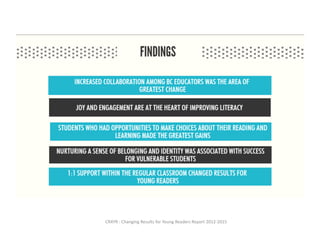
CR4YR	
Changing	Results	for	Young	Readers	
Report	2012-2015	
CR4YR	:	Changing	Results	for	Young	Readers	Report	2012-2015	by	Jennifer	Delvecchio	and	Sharon	Jeroski	
is	licensed	under	a		CreaRve	Commons	ALribuRon-NonDerivaRves	2.5	Canada	License			
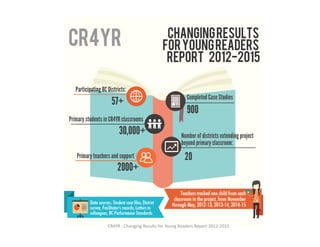
Changing	Results	for	Young	Readers,	a	collaboraRve	inquiry	project,	was	
iniRated	by	the	BC	Ministry	of	EducaRon	in	2012,	under	the	direcRon	of	
Maureen	Dockendorf,	to	increase	the	number	of	BC	children	who	are	
engaged,	successful	readers.	Teachers	in	57	parRcipaRng	districts	met	7	
Rmes	each	year,	to	explore	inquiry	quesRons	they	chose.
CR4YR	:	Changing	Results	for	Young	Readers	Report	2012-2015
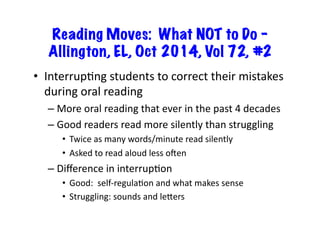
Reading Moves: What NOT to Do –
Allington, EL, Oct 2014, Vol 72, #2
•  InterrupRng	students	to	correct	their	mistakes	
during	oral	reading	
– More	oral	reading	that	ever	in	the	past	4	decades	
– Good	readers	read	more	silently	than	struggling	
•  Twice	as	many	words/minute	read	silently	
•  Asked	to	read	aloud	less	omen		
– Difference	in	interrupRon	
•  Good:		self-regulaRon	and	what	makes	sense	
•  Struggling:	sounds	and	leLers
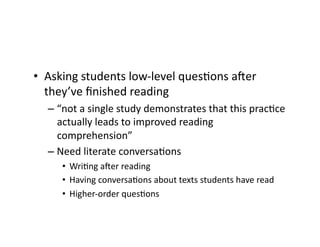
•  Asking	students	low-level	quesRons	amer	
they’ve	finished	reading	
– “not	a	single	study	demonstrates	that	this	pracRce	
actually	leads	to	improved	reading	
comprehension”	
– Need	literate	conversaRons	
•  WriRng	amer	reading	
•  Having	conversaRons	about	texts	students	have	read	
•  Higher-order	quesRons
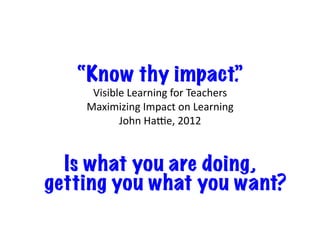
“Know thy impact.”
Visible	Learning	for	Teachers		
Maximizing	Impact	on	Learning		
John	Ha|e,	2012
Is what you are doing,
getting you what you want?
Leadership Roles
-keeping	the	vision	alive	
-providing	structures	and	supports	to	enable	
others	to	provide	rich	learning	environments	
-maintaining	a	strengths-based	perspecRve
How	common	is	the	understanding	
of	what	works	in	reading	in	your	
division?
•  Reading Next: A Vision for Action and
Research in Middle and High School
Literacy – Biancarosa & Snow, 2004
•  Instructional improvements
1.  Direct,	explicit	comprehension	instrucRon	
2.  EffecRve	instrucRonal	principles	embedded	in	
context	
3.  MoRvaRon	and	self-directed	learning	
4.  Text-based	collaboraRve	learning	
5.  Strategic	tutoring	
6.  Diverse	texts	
7.  Intensive	wriRng	
8.  A	technology	component	
9.  Ongoing	formaRve	assessment	of	students
•  Reading Next: A Vision for Action and
Research in Middle and High School
Literacy – Biancarosa & Snow, 2004
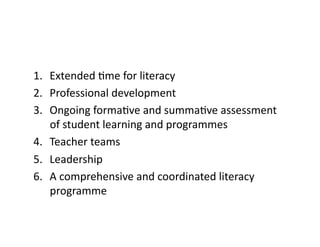
•  Infrastructural improvements
1.  Extended	Rme	for	literacy	
2.  Professional	development	
3.  Ongoing	formaRve	and	summaRve	assessment	
of	student	learning	and	programmes	
4.  Teacher	teams	
5.  Leadership	
6.  A	comprehensive	and	coordinated	literacy	
programme
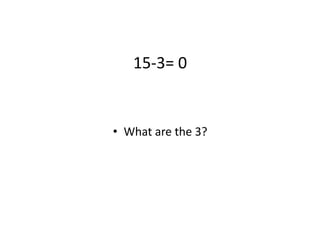
15-3=	0	
•  What	are	the	3?
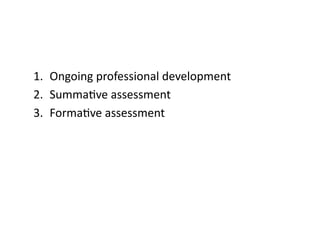
1.  Ongoing	professional	development	
2.  SummaRve	assessment	
3.  FormaRve	assessment
•  Working	together,	teachers	can	develop	
lessons	and	acRviRes	that	reach	more	
learners.		Most	importantly,	we	design	
learning	sequences	that	beLer	engage	our	
students	while	we	become	more	strategic	in	
our	teaching.	
•  It’s	all	About	Thinking	–	Brownlie	&	Schnellert
Resources		
•  Assessment	&	Instruc0on	of	ESL	Learners	–	Brownlie,	Feniak,	
&	McCarthy,	2004	
•  Grand	Conversa0ons,	ThoughCul	Responses	–	a	unique	
approach	to	literature	circles	–	Brownlie,	2005	
•  Student	Diversity,	2nd	ed.	–	Brownlie,	Feniak	&	Schnellert,	
2006	
•  Reading	and	Responding,	gr.	4,5,&6	–	Brownlie	&	Jeroski,	
2006	
•  It’s	All	about	Thinking	–	collabora0ng	to	support	all	learners	
(in	English,	Social	Studies	and	Humani0es)	–	Brownlie	&	
Schnellert,	2009	
•  It’s	All	about	Thinking	–	collabora0ng	to	support	all	learners	
(in	Math	and	Science)	-	Brownlie,	Fullerton	&	Schnellert,	2011	
•  Learning	in	Safe	Schools,	2nd	ed	–	Brownlie	&	King,	Oct.,	2011

Mrlc supers nov 2015