Students Demonstrate
Learning
Debbie Schraeder
ESU#3
Experience Connection
Students Demonstrate Learning
Teachers have a crucial role to play in designing
the situations in which learning takes place, but
only learners create learning.
-Dylan Wiliam, page 158 (2011)
As you make table group introductions, consider the quote below
and discuss:
 Do you agree or disagree with Dylan Wiliam?
 How do you get students more involved in their learning?
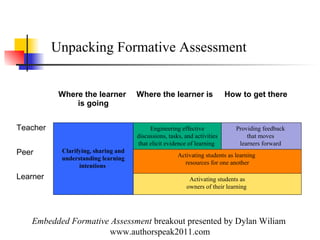
Unpacking Formative Assessment
Where the learner
is going
Where the learner is How to get there
Teacher
Peer
Learner
Clarifying, sharing and
understanding learning
intentions
Engineering effective
discussions, tasks, and activities
that elicit evidence of learning
Providing feedback
that moves
learners forward
Activating students as learning
resources for one another
Activating students as
owners of their learning
Embedded Formative Assessment breakout presented by Dylan Wiliam
www.authorspeak2011.com
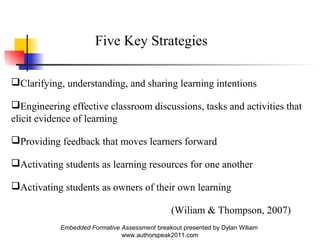
Clarifying, understanding, and sharing learning intentions
Engineering effective classroom discussions, tasks and activities that
elicit evidence of learning
Providing feedback that moves learners forward
Activating students as learning resources for one another
Activating students as owners of their own learning
(Wiliam & Thompson, 2007)
Embedded Formative Assessment breakout presented by Dylan Wiliam
www.authorspeak2011.com
Five Key Strategies
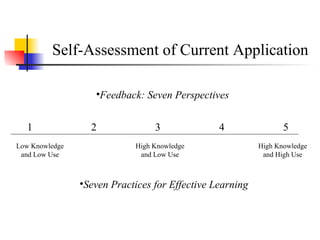
Self-Assessment of Current Application
•Feedback: Seven Perspectives
•Seven Practices for Effective Learning
Low Knowledge
and Low Use
1 2 3 4 5
High Knowledge
and Low Use
High Knowledge
and High Use
Seven Practices for Effective Learning
1. Use summative assessments to frame meaningful
performance goals.
2. Show criteria and models in advance.
3. Assess before teaching.
4. Offer appropriate choices.
5. Provide feedback early and often.
6. Encourage self-assessment and goal setting.
7. Allow new evidence of achievement to replace old
evidence.
McTighe, Jay and O’Connor, Ken .“Seven Practices for Effective Learning” Educational
Leadership, November, 2005; pp 10-17. ASCD.
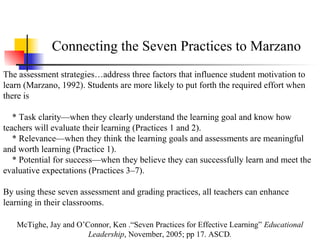
Connecting the Seven Practices to Marzano
The assessment strategies…address three factors that influence student motivation to
learn (Marzano, 1992). Students are more likely to put forth the required effort when
there is
* Task clarity—when they clearly understand the learning goal and know how
teachers will evaluate their learning (Practices 1 and 2).
* Relevance—when they think the learning goals and assessments are meaningful
and worth learning (Practice 1).
* Potential for success—when they believe they can successfully learn and meet the
evaluative expectations (Practices 3–7).
By using these seven assessment and grading practices, all teachers can enhance
learning in their classrooms.
McTighe, Jay and O’Connor, Ken .“Seven Practices for Effective Learning” Educational
Leadership, November, 2005; pp 17. ASCD.
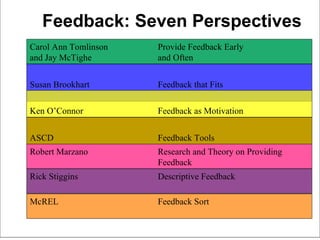
Feedback: Seven Perspectives
Rick Stiggins Descriptive Feedback
Susan Brookhart Feedback that Fits
Ken O’Connor Feedback as Motivation
Carol Ann Tomlinson Provide Feedback Early
and Jay McTighe and Often
Robert Marzano Research and Theory on Providing
Feedback
ASCD Feedback Tools
McREL Feedback Sort
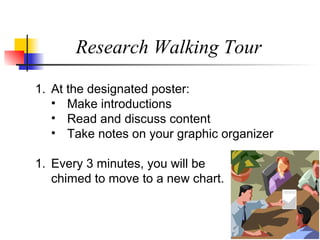
1. At the designated poster:
• Make introductions
• Read and discuss content
• Take notes on your graphic organizer
1. Every 3 minutes, you will be
chimed to move to a new chart.
Research Walking Tour
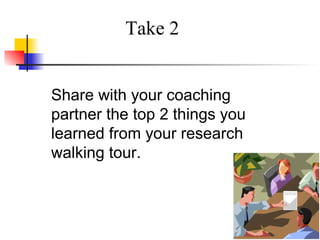
Share with your coaching
partner the top 2 things you
learned from your research
walking tour.
Take 2
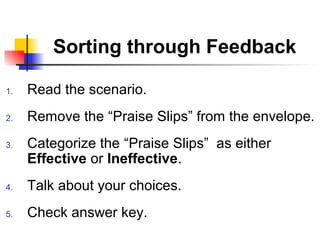
Sorting through Feedback
1. Read the scenario.
2. Remove the “Praise Slips” from the envelope.
3. Categorize the “Praise Slips” as either
Effective or Ineffective.
4. Talk about your choices.
5. Check answer key.
Related to the Seven Practices for Effective Learning,
Observations might look like:
Practice 1: Observing authentic assessment that connects instruction to
real-world application.
Practice 2: Sharing and discussing a rubric with students.
Practice 3: Using pre-assessment to inform instruction.
Practice 4: Student choice in demonstrating their learning.
Practice 5: Teacher providing timely and specific feedback to students.
(PLPs, student conferences…)
Practice 6: Observations of opportunities for learners to self-assess and/
or set goals.
Practice 7: Another opportunity for students to demonstrate their
learning.
Related to Effective Feedback
Observations might look like:
• Addressing Misconceptions
• Corrective Feedback
• Applying/Transferring/Enriching
• Instilling Confidence
• Aiding Retention
• Facilitating Student Improvement
• Taking the learner to the next level
Implementation
Planning
•What practice or perspective will you try?
•What will this look like in your learning
environment?
•As a coaching team, how will you provide feedback
to each other?
Fisher, Douglas; and Frey, Nancy. Checking for Understanding (2007) ASCD. Page 2.
When their teachers regularly
check for understanding, students
become increasingly aware of how
to monitor their own
understanding.
Seven Practices
Gallery Walk Posters
Discussion:
What kinds of assessment most accurately reflect the way students will likely
be required to perform in a real world situation?
Practice 1: Use summative assessments to frame meaningful performance goals.
To avoid the danger of viewing the standards and benchmarks [ELOs and assessments]
as inert content to “cover,” educators should frame the standards and benchmarks in
terms of desired performances and ensure that the performances are as authentic as
possible. Teachers should then present the summative performance assessment tasks to
students at the beginning of a new unit or course…summative assessments clarify the
targeted standards and benchmarks for teachers and learners.
Second, the performance assessment tasks yield evidence that reveals understanding...
we want students to transfer knowledge—to use what they know in a new situation.
Consider a sports analogy. Coaches routinely conduct practice drills that both develop
basic skills and purposefully point toward performance in the game. Too often,
classroom instruction and assessment overemphasize decontextualized drills and
provide too few opportunities for students to actually “play the game.” Authentic
performance tasks provide a worthy goal and help learners see a reason for their
learning.
McTighe, Jay and O’Connor, Ken .“Seven Practices for Effective
Learning” Educational Leadership, November, 2005; pp 12-13. ASCD.
Discussion:
What is your experience with rubrics or showing models of work?
Practice 2: Show criteria and models in advance.
A second assessment practice that supports learning involves presenting evaluative
criteria and models of work that illustrate different levels of quality… authentic
performance assessments are typically open-ended and do not yield a single, correct
answer or solution process.
A rubric is a widely used evaluation tool consisting of criteria… and descriptions of
the characteristics for each score point. Well-developed rubrics communicate the
important dimensions, or elements of quality, in a product or performance and guide
educators in evaluating student work…Rubrics also benefit students. When students
know the criteria in advance of their performance, they have clear goals for their work.
Providing a rubric to students in advance of the assessment is a necessary, but often
insufficient, condition to support their learning. Learners are more likely to understand
feedback and evaluations when teachers show several examples that display both
excellent and weak work. These models help translate the rubric's abstract language
into more specific, concrete, and understandable terms.
McTighe, Jay and O’Connor, Ken .“Seven Practices for Effective
Learning” Educational Leadership, November, 2005; pp 13-14. ASCD.
Discussion:
What ways have you pre-assessed?
Practice 3: Assess before teaching.
Diagnostic assessment is as important to teaching as a physical exam is to prescribing
an appropriate medical regimen. At the outset of any unit of study, certain students are
likely to have already mastered some of the skills that the teacher is about to introduce,
and others may already understand key concepts. Armed with this diagnostic
information, a teacher gains greater insight into what to teach, by knowing what skill
gaps to address or by skipping material previously mastered; into how to teach, by
using grouping options and initiating activities based on preferred learning styles and
interests; and into how to connect the content to students' interests and talents.
Teachers can use a variety of practical pre-assessment strategies, including pre-tests of
content knowledge, skills checks, concept maps, drawings, and K-W-L (Know-Want
to learn-Learn) charts. … A sizeable number of students come into school with
misconceptions about subject matter. To uncover existing misconceptions, teachers
can use a short, nongraded true-false diagnostic quiz that includes several potential
misconceptions related to the targeted learning.
McTighe, Jay and O’Connor, Ken .“Seven Practices for Effective
Learning” Educational Leadership, November, 2005; pp 14. ASCD.
Discussion:
What kinds of strategies do you use to make the process of assessing
for learning manageable?
Practice 4: Offer appropriate choices.
Students differ not only in how they prefer to take in and process information but also in
how they best demonstrate their learning. Some students need to “do”; others thrive on oral
explanations... A standardized approach to classroom assessment may be efficient, but it is
not fair because any chosen format will favor some students and penalize others.
Allow choices—but always with the intent of collecting needed and appropriate evidence
based on goals. Learners often put forth greater effort and produce higher-quality work
when given a variety of choices.
Three Cautions:
1. Collect appropriate evidence of learning on the basis of goals rather than simply offer a
“cool” menu of assessment choices.
2. Options must be worth the time and energy required. It would be inefficient to have
students develop an elaborate display for content that a multiple-choice quiz could easily
assess.
3. Teachers have only so much time and energy, so they must be judicious in determining
when it is important to offer product and performance options.
McTighe, Jay and O’Connor, Ken .“Seven Practices for Effective
Learning” Educational Leadership, November, 2005; pp 14-15. ASCD.
Discussion:
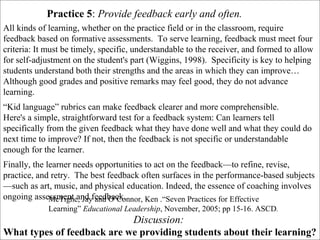
What types of feedback are we providing students about their learning?
Practice 5: Provide feedback early and often.
All kinds of learning, whether on the practice field or in the classroom, require
feedback based on formative assessments. To serve learning, feedback must meet four
criteria: It must be timely, specific, understandable to the receiver, and formed to allow
for self-adjustment on the student's part (Wiggins, 1998). Specificity is key to helping
students understand both their strengths and the areas in which they can improve…
Although good grades and positive remarks may feel good, they do not advance
learning.
“Kid language” rubrics can make feedback clearer and more comprehensible.
Here's a simple, straightforward test for a feedback system: Can learners tell
specifically from the given feedback what they have done well and what they could do
next time to improve? If not, then the feedback is not specific or understandable
enough for the learner.
Finally, the learner needs opportunities to act on the feedback—to refine, revise,
practice, and retry. The best feedback often surfaces in the performance-based subjects
—such as art, music, and physical education. Indeed, the essence of coaching involves
ongoing assessment and feedback.McTighe, Jay and O’Connor, Ken .“Seven Practices for Effective
Learning” Educational Leadership, November, 2005; pp 15-16. ASCD.
Discussion:
What is the result of students being actively involved in the
assessment process?
Practice 6: Encourage self-assessment and goal setting.
.The most effective learners set personal learning goals, employ proven strategies, and
self-assess their work. Teachers help cultivate such habits of mind by modeling
self-assessment and goal setting and by expecting students to apply these habits
regularly.
Rubrics can help students become more effective at honest self-appraisal and
productive self-improvement. Initially, the teacher models how to self-assess, set
goals, and plan improvements by asking such prompting questions as:
* What aspect of your work was most effective?
* What aspect of your work was least effective?
* What specific action or actions will improve your performance?
* What will you do differently next time?
Questions like these help focus student reflection and planning. Over time, students
assume greater responsibility for enacting these processes independently.
Educators who provide regular opportunities for learners to self-assess and set goals
often report a change in the classroom culture.
McTighe, Jay and O’Connor, Ken .“Seven Practices for Effective
Learning” Educational Leadership, November, 2005; pp 16-17. ASCD.
Discussion:
To more accurately report student learning; are there strategies you
utilize or could utilize to show recent evidence in lieu of an average
of evidence?
ractice 7: Allow new evidence of achievement to replace old evidence.
McTighe, Jay and O’Connor, Ken .“Seven Practices for Effective
Learning” Educational Leadership, November, 2005; pp 17. ASCD.
Classroom assessments and grading should focus on how well—not on when—the
student mastered the designated knowledge and skill. Two concerns may arise when
teachers provide students with multiple opportunities to demonstrate their learning.
Students may not take the first attempt seriously once they realize they'll have a second
chance. In addition, teachers often become overwhelmed by the logistical challenges
of providing multiple opportunities. To make this approach effective, teachers need to
require their students to provide some evidence of the corrective action they will take
—such as engaging in peer coaching, revising their report, or practicing the needed
skill in a given way—before embarking on their “second chance.”
As students work to achieve clearly defined learning goals and produce evidence of
their achievement, they need to know that teachers will not penalize them for either
their lack of knowledge at the beginning of a course of study or their initial attempts at
skill mastery. Allowing new evidence to replace old conveys an important message to
students—that teachers care about their successful learning, not merely their grades.
Seven Perspectives
Gallery Walk Posters

Formative assessment

  • 1.
  • 2.
    Experience Connection Students DemonstrateLearning Teachers have a crucial role to play in designing the situations in which learning takes place, but only learners create learning. -Dylan Wiliam, page 158 (2011) As you make table group introductions, consider the quote below and discuss:  Do you agree or disagree with Dylan Wiliam?  How do you get students more involved in their learning?
  • 3.
    Unpacking Formative Assessment Wherethe learner is going Where the learner is How to get there Teacher Peer Learner Clarifying, sharing and understanding learning intentions Engineering effective discussions, tasks, and activities that elicit evidence of learning Providing feedback that moves learners forward Activating students as learning resources for one another Activating students as owners of their learning Embedded Formative Assessment breakout presented by Dylan Wiliam www.authorspeak2011.com
  • 4.
    Clarifying, understanding, andsharing learning intentions Engineering effective classroom discussions, tasks and activities that elicit evidence of learning Providing feedback that moves learners forward Activating students as learning resources for one another Activating students as owners of their own learning (Wiliam & Thompson, 2007) Embedded Formative Assessment breakout presented by Dylan Wiliam www.authorspeak2011.com Five Key Strategies
  • 5.
    Self-Assessment of CurrentApplication •Feedback: Seven Perspectives •Seven Practices for Effective Learning Low Knowledge and Low Use 1 2 3 4 5 High Knowledge and Low Use High Knowledge and High Use
  • 6.
    Seven Practices forEffective Learning 1. Use summative assessments to frame meaningful performance goals. 2. Show criteria and models in advance. 3. Assess before teaching. 4. Offer appropriate choices. 5. Provide feedback early and often. 6. Encourage self-assessment and goal setting. 7. Allow new evidence of achievement to replace old evidence. McTighe, Jay and O’Connor, Ken .“Seven Practices for Effective Learning” Educational Leadership, November, 2005; pp 10-17. ASCD.
  • 7.
    Connecting the SevenPractices to Marzano The assessment strategies…address three factors that influence student motivation to learn (Marzano, 1992). Students are more likely to put forth the required effort when there is * Task clarity—when they clearly understand the learning goal and know how teachers will evaluate their learning (Practices 1 and 2). * Relevance—when they think the learning goals and assessments are meaningful and worth learning (Practice 1). * Potential for success—when they believe they can successfully learn and meet the evaluative expectations (Practices 3–7). By using these seven assessment and grading practices, all teachers can enhance learning in their classrooms. McTighe, Jay and O’Connor, Ken .“Seven Practices for Effective Learning” Educational Leadership, November, 2005; pp 17. ASCD.
  • 8.
    Feedback: Seven Perspectives RickStiggins Descriptive Feedback Susan Brookhart Feedback that Fits Ken O’Connor Feedback as Motivation Carol Ann Tomlinson Provide Feedback Early and Jay McTighe and Often Robert Marzano Research and Theory on Providing Feedback ASCD Feedback Tools McREL Feedback Sort
  • 9.
    1. At thedesignated poster: • Make introductions • Read and discuss content • Take notes on your graphic organizer 1. Every 3 minutes, you will be chimed to move to a new chart. Research Walking Tour
  • 10.
  • 11.
    Share with yourcoaching partner the top 2 things you learned from your research walking tour. Take 2
  • 12.
    Sorting through Feedback 1.Read the scenario. 2. Remove the “Praise Slips” from the envelope. 3. Categorize the “Praise Slips” as either Effective or Ineffective. 4. Talk about your choices. 5. Check answer key.
  • 13.
    Related to theSeven Practices for Effective Learning, Observations might look like: Practice 1: Observing authentic assessment that connects instruction to real-world application. Practice 2: Sharing and discussing a rubric with students. Practice 3: Using pre-assessment to inform instruction. Practice 4: Student choice in demonstrating their learning. Practice 5: Teacher providing timely and specific feedback to students. (PLPs, student conferences…) Practice 6: Observations of opportunities for learners to self-assess and/ or set goals. Practice 7: Another opportunity for students to demonstrate their learning.
  • 14.
    Related to EffectiveFeedback Observations might look like: • Addressing Misconceptions • Corrective Feedback • Applying/Transferring/Enriching • Instilling Confidence • Aiding Retention • Facilitating Student Improvement • Taking the learner to the next level
  • 15.
    Implementation Planning •What practice orperspective will you try? •What will this look like in your learning environment? •As a coaching team, how will you provide feedback to each other?
  • 16.
    Fisher, Douglas; andFrey, Nancy. Checking for Understanding (2007) ASCD. Page 2. When their teachers regularly check for understanding, students become increasingly aware of how to monitor their own understanding.
  • 17.
  • 18.
    Discussion: What kinds ofassessment most accurately reflect the way students will likely be required to perform in a real world situation? Practice 1: Use summative assessments to frame meaningful performance goals. To avoid the danger of viewing the standards and benchmarks [ELOs and assessments] as inert content to “cover,” educators should frame the standards and benchmarks in terms of desired performances and ensure that the performances are as authentic as possible. Teachers should then present the summative performance assessment tasks to students at the beginning of a new unit or course…summative assessments clarify the targeted standards and benchmarks for teachers and learners. Second, the performance assessment tasks yield evidence that reveals understanding... we want students to transfer knowledge—to use what they know in a new situation. Consider a sports analogy. Coaches routinely conduct practice drills that both develop basic skills and purposefully point toward performance in the game. Too often, classroom instruction and assessment overemphasize decontextualized drills and provide too few opportunities for students to actually “play the game.” Authentic performance tasks provide a worthy goal and help learners see a reason for their learning. McTighe, Jay and O’Connor, Ken .“Seven Practices for Effective Learning” Educational Leadership, November, 2005; pp 12-13. ASCD.
  • 19.
    Discussion: What is yourexperience with rubrics or showing models of work? Practice 2: Show criteria and models in advance. A second assessment practice that supports learning involves presenting evaluative criteria and models of work that illustrate different levels of quality… authentic performance assessments are typically open-ended and do not yield a single, correct answer or solution process. A rubric is a widely used evaluation tool consisting of criteria… and descriptions of the characteristics for each score point. Well-developed rubrics communicate the important dimensions, or elements of quality, in a product or performance and guide educators in evaluating student work…Rubrics also benefit students. When students know the criteria in advance of their performance, they have clear goals for their work. Providing a rubric to students in advance of the assessment is a necessary, but often insufficient, condition to support their learning. Learners are more likely to understand feedback and evaluations when teachers show several examples that display both excellent and weak work. These models help translate the rubric's abstract language into more specific, concrete, and understandable terms. McTighe, Jay and O’Connor, Ken .“Seven Practices for Effective Learning” Educational Leadership, November, 2005; pp 13-14. ASCD.
  • 20.
    Discussion: What ways haveyou pre-assessed? Practice 3: Assess before teaching. Diagnostic assessment is as important to teaching as a physical exam is to prescribing an appropriate medical regimen. At the outset of any unit of study, certain students are likely to have already mastered some of the skills that the teacher is about to introduce, and others may already understand key concepts. Armed with this diagnostic information, a teacher gains greater insight into what to teach, by knowing what skill gaps to address or by skipping material previously mastered; into how to teach, by using grouping options and initiating activities based on preferred learning styles and interests; and into how to connect the content to students' interests and talents. Teachers can use a variety of practical pre-assessment strategies, including pre-tests of content knowledge, skills checks, concept maps, drawings, and K-W-L (Know-Want to learn-Learn) charts. … A sizeable number of students come into school with misconceptions about subject matter. To uncover existing misconceptions, teachers can use a short, nongraded true-false diagnostic quiz that includes several potential misconceptions related to the targeted learning. McTighe, Jay and O’Connor, Ken .“Seven Practices for Effective Learning” Educational Leadership, November, 2005; pp 14. ASCD.
  • 21.
    Discussion: What kinds ofstrategies do you use to make the process of assessing for learning manageable? Practice 4: Offer appropriate choices. Students differ not only in how they prefer to take in and process information but also in how they best demonstrate their learning. Some students need to “do”; others thrive on oral explanations... A standardized approach to classroom assessment may be efficient, but it is not fair because any chosen format will favor some students and penalize others. Allow choices—but always with the intent of collecting needed and appropriate evidence based on goals. Learners often put forth greater effort and produce higher-quality work when given a variety of choices. Three Cautions: 1. Collect appropriate evidence of learning on the basis of goals rather than simply offer a “cool” menu of assessment choices. 2. Options must be worth the time and energy required. It would be inefficient to have students develop an elaborate display for content that a multiple-choice quiz could easily assess. 3. Teachers have only so much time and energy, so they must be judicious in determining when it is important to offer product and performance options. McTighe, Jay and O’Connor, Ken .“Seven Practices for Effective Learning” Educational Leadership, November, 2005; pp 14-15. ASCD.
  • 22.
    Discussion: What types offeedback are we providing students about their learning? Practice 5: Provide feedback early and often. All kinds of learning, whether on the practice field or in the classroom, require feedback based on formative assessments. To serve learning, feedback must meet four criteria: It must be timely, specific, understandable to the receiver, and formed to allow for self-adjustment on the student's part (Wiggins, 1998). Specificity is key to helping students understand both their strengths and the areas in which they can improve… Although good grades and positive remarks may feel good, they do not advance learning. “Kid language” rubrics can make feedback clearer and more comprehensible. Here's a simple, straightforward test for a feedback system: Can learners tell specifically from the given feedback what they have done well and what they could do next time to improve? If not, then the feedback is not specific or understandable enough for the learner. Finally, the learner needs opportunities to act on the feedback—to refine, revise, practice, and retry. The best feedback often surfaces in the performance-based subjects —such as art, music, and physical education. Indeed, the essence of coaching involves ongoing assessment and feedback.McTighe, Jay and O’Connor, Ken .“Seven Practices for Effective Learning” Educational Leadership, November, 2005; pp 15-16. ASCD.
  • 23.
    Discussion: What is theresult of students being actively involved in the assessment process? Practice 6: Encourage self-assessment and goal setting. .The most effective learners set personal learning goals, employ proven strategies, and self-assess their work. Teachers help cultivate such habits of mind by modeling self-assessment and goal setting and by expecting students to apply these habits regularly. Rubrics can help students become more effective at honest self-appraisal and productive self-improvement. Initially, the teacher models how to self-assess, set goals, and plan improvements by asking such prompting questions as: * What aspect of your work was most effective? * What aspect of your work was least effective? * What specific action or actions will improve your performance? * What will you do differently next time? Questions like these help focus student reflection and planning. Over time, students assume greater responsibility for enacting these processes independently. Educators who provide regular opportunities for learners to self-assess and set goals often report a change in the classroom culture. McTighe, Jay and O’Connor, Ken .“Seven Practices for Effective Learning” Educational Leadership, November, 2005; pp 16-17. ASCD.
  • 24.
    Discussion: To more accuratelyreport student learning; are there strategies you utilize or could utilize to show recent evidence in lieu of an average of evidence? ractice 7: Allow new evidence of achievement to replace old evidence. McTighe, Jay and O’Connor, Ken .“Seven Practices for Effective Learning” Educational Leadership, November, 2005; pp 17. ASCD. Classroom assessments and grading should focus on how well—not on when—the student mastered the designated knowledge and skill. Two concerns may arise when teachers provide students with multiple opportunities to demonstrate their learning. Students may not take the first attempt seriously once they realize they'll have a second chance. In addition, teachers often become overwhelmed by the logistical challenges of providing multiple opportunities. To make this approach effective, teachers need to require their students to provide some evidence of the corrective action they will take —such as engaging in peer coaching, revising their report, or practicing the needed skill in a given way—before embarking on their “second chance.” As students work to achieve clearly defined learning goals and produce evidence of their achievement, they need to know that teachers will not penalize them for either their lack of knowledge at the beginning of a course of study or their initial attempts at skill mastery. Allowing new evidence to replace old conveys an important message to students—that teachers care about their successful learning, not merely their grades.
  • 25.

Editor's Notes

  • #2 Hard Copy handout Graphic Organizer Article? January, 2012
  • #3 January, 2012
  • #5 Clarifying, understanding, and sharing learning intentions curriculum philosophy Engineering effective classroom discussions, tasks and activities that elicit evidence of learning classroom discourse, interactive whole-class teaching Providing feedback that moves learners forward feedback Activating students as learning resources for one another collaborative learning, reciprocal teaching, peer-assessment Activating students as owners of their own learning metacognition, motivation, interest, attribution, self-assessment January, 2012
  • #7 January, 2012
  • #9 January, 2010
  • #10 .
  • #11 Coaching team select a cut-out.
  • #12 Big “aha”- more time later
  • #17 January, 2012