Re-­‐Focusing	
  on	
  Learning:	
  
Collabora4on	
  
Differen4a4on	
  
Miles	
  Macdonell	
  Collegiate	
  
Monday,	
  November	
  21st,	
  2010	
  
Faye	
  Brownlie	
  
Learning Intentions
•  I	
  have	
  a	
  beFer	
  understanding	
  of	
  what	
  
differen4a4on	
  can	
  look	
  like	
  in	
  the	
  classroom	
  
and	
  how	
  to	
  support	
  it.	
  
•  I	
  have	
  a	
  plan	
  to	
  ini4ate	
  a	
  collabora4on	
  with	
  a	
  
colleague	
  –	
  or	
  a	
  plan	
  to	
  extend	
  an	
  exis4ng	
  
collabora4on.	
  
Why?	
  
•  Diversity	
  of	
  student	
  popula4on	
  
•  Research	
  on	
  learning	
  
•  Research	
  on	
  teaching	
  
•  Gradua4on	
  demands	
  –	
  curriculum	
  demands	
  
•  Employer	
  expecta4ons	
  
•  Complexity	
  of	
  the	
  job	
  –	
  isola4on	
  vs	
  team	
  
Professional	
  Collabora4on	
  
•  Interac4ve	
  and	
  on-­‐going	
  process	
  
•  Mutually	
  agreed	
  upon	
  challenges	
  
•  Capitalizes	
  on	
  different	
  exper4se,	
  knowledge	
  and	
  
experience	
  
•  Roles	
  are	
  blurred	
  
•  Mutual	
  trust	
  and	
  respect	
  
•  Create	
  and	
  deliver	
  targeted	
  instruc4on	
  
•  GOAL:	
  	
  beFer	
  meet	
  the	
  needs	
  of	
  diverse	
  learners	
  
Big Ideas…
As	
  a	
  school	
  community	
  we	
  want	
  to	
  work	
  together	
  to	
  meet	
  the	
  
needs	
  of	
  all	
  students.	
  
Inclusion	
  is	
  not	
  a	
  special	
  educa4on	
  model;	
  it	
  is	
  a	
  school	
  model.	
  
As	
  professionals	
  we	
  want	
  to	
  constantly	
  examine	
  and	
  refine	
  our	
  
prac4ce.	
  
Collabora4ve	
  problem-­‐solving	
  and	
  teaching	
  results	
  in	
  new	
  ideas,	
  
new	
  products	
  and	
  a	
  feeling	
  of	
  connec4on.	
  	
  
Our	
  students	
  con4nue	
  to	
  change	
  and	
  learn	
  and	
  their	
  needs,	
  just	
  
like	
  the	
  school’s,	
  will	
  change	
  over	
  the	
  course	
  of	
  the	
  year.	
  
Brownlie	
  &	
  Schnellert	
  	
  Suppor&ng	
  Diversity:	
  	
  Working	
  Together	
  to	
  Support	
  All	
  Learners	
  
___	
  
Where did you start this year…
What actions have you taken:
-roles
-schedules
-timetables
-instruction
-assessment
-class reviews, collaborative planning
-collaborative teaching
Share in group/share out
Teach Content to All	
  
  "RETSD"
Differen4a4on	
  
“…	
  a	
  process	
  approach	
  to	
  teaching	
  and	
  learning	
  
for	
  students	
  of	
  differing	
  abili4es	
  in	
  the	
  same	
  
class.	
  	
  The	
  intent	
  is	
  to	
  maximize	
  each	
  student’s	
  
growth	
  and	
  individual	
  success	
  by	
  mee4ng	
  
each	
  student	
  where	
  he	
  or	
  she	
  is	
  …	
  rather	
  than	
  
expec4ng	
  students	
  to	
  modify	
  themselves	
  for	
  
the	
  curriculum.”	
  	
  
(Hall,	
  2002)	
  
Frameworks
It’s All about Thinking – Brownlie & Schnellert, 2009
Universal Design for Learning
Mul4ple	
  means:	
  
-­‐to	
  tap	
  into	
  background	
  knowledge,	
  to	
  ac4vate	
  
prior	
  knowledge,	
  to	
  increase	
  engagement	
  and	
  
mo4va4on	
  
-­‐to	
  acquire	
  the	
  informa4on	
  and	
  knowledge	
  to	
  
process	
  new	
  ideas	
  and	
  informa4on	
  
-­‐to	
  express	
  what	
  they	
  know.	


  Rose	
  &	
  Meyer,	
  2002	
  
Backwards Design
•  What	
  important	
  ideas	
  and	
  enduring	
  
understandings	
  do	
  you	
  want	
  the	
  students	
  to	
  
know?	
  
•  What	
  thinking	
  strategies	
  will	
  students	
  need	
  to	
  
demonstrate	
  these	
  understandings?	


  McTighe	
  &	
  Wiggins,	
  2001	
  
Approaches
•  Assessment	
  for	
  learning	
  
•  Open-­‐ended	
  strategies	
  
•  Gradual	
  release	
  of	
  responsibility	
  
•  Coopera4ve	
  learning	
  
•  Literature	
  circles	
  and	
  informa4on	
  circles	
  
•  Inquiry	
  
It’s All about Thinking – Brownlie & Schnellert, 2009
Assessment for Learning
•  Learning	
  Inten4ons	
  
•  Criteria	
  
•  Ques4oning	
  
•  Descrip4ve	
  Feedback	
  
•  Peer	
  and	
  Self	
  Assessment	
  
•  Ownership	
  
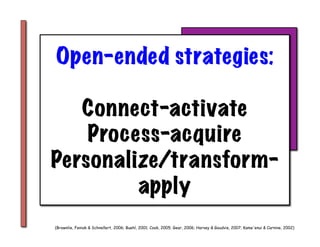
Open-ended strategies:
Connect-activate
Process-acquire
Personalize/transform-
apply
(Brownlie, Feniak & Schnellert, 2006; Buehl, 2001; Cook, 2005; Gear, 2006; Harvey & Goudvis, 2007; Kame'enui & Carnine, 2002)
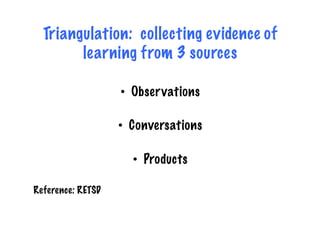
Triangulation: collecting evidence of
learning from 3 sources
•  Observations
•  Conversations
•  Products
Reference: RETSD
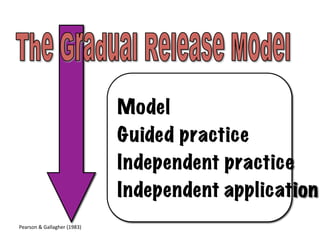
Model
Guided practice
Independent practice
Independent application	
  
Pearson	
  &	
  Gallagher	
  (1983)	
  
Collabora4on	
  
•  Co-­‐planning	
  
•  Co-­‐teaching	
  
•  Co-­‐assessing	
  
Inquiry	
  Research	
  
SD	
  67,	
  Okanagan	
  Skaha	
  
Teams	
  of	
  4:	
  	
  teachers	
  +	
  admin	
  
“If	
  middle	
  and	
  secondary	
  school	
  students	
  are	
  
permiFed	
  and	
  encouraged	
  to	
  demonstrate	
  their	
  
knowledge	
  in	
  alterna4ve	
  ways,	
  how	
  will	
  it	
  
impact	
  their	
  learning	
  and	
  their	
  knowledge	
  
about	
  themselves	
  as	
  learners?”	


•  3rd	
  year	
  of	
  a	
  district	
  inquiry	
  focus	
  on	
  AFL	
  
prac4ces	
  
•  District	
  focus:	
  	
  differen4a4on	
  
•  Teams	
  (school-­‐based)	
  meet	
  4-­‐5	
  4mes	
  per	
  year	
  
•  Research	
  conducted	
  in	
  teachers’	
  classrooms	
  
•  Teachers	
  choose	
  their	
  own	
  research	
  ques4on	
  
Andrea	
  DeVito,	
  Pen4cton	
  High	
  
•  My	
  findings	
  are	
  based	
  24	
  students	
  randomly	
  
selected	
  from	
  four	
  classes:	
  an	
  English	
  9,	
  two	
  
11’s,	
  and	
  one	
  12.	
  	
  The	
  students	
  were	
  first	
  
given	
  a	
  wriBng-­‐response	
  to	
  a	
  piece	
  of	
  
literature,	
  and	
  then	
  the	
  end-­‐task	
  with	
  choice	
  
to	
  a	
  piece	
  of	
  literature.	


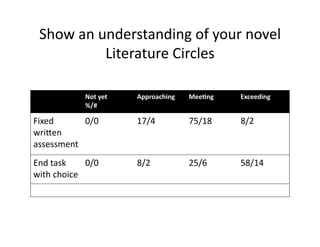
Show	
  an	
  understanding	
  of	
  your	
  novel	
  
Literature	
  Circles	
  
Not	
  yet	
  
%/#	
  	
  
Approaching	
   MeeBng	
   Exceeding	
  
Fixed	
  
wriFen	
  	
  
assessment	
  
0/0	
  	
   17/4	
   75/18	
   8/2	
  
End	
  task	
  
with	
  choice	
  
0/0	
   8/2	
   25/6	
   58/14	
  
Andrea’s	
  reflec4ons	
  
•  Some	
  challenged	
  by	
  finding	
  a	
  meaningful	
  
connec4on	
  between	
  themselves	
  and	
  the	
  novel	
  
•  Some	
  challenged	
  by	
  the	
  idea	
  of	
  students	
  doing	
  
different	
  products	
  for	
  the	
  same	
  assignment	
  
•  Most	
  wanted	
  to	
  do	
  this	
  kind	
  of	
  assignment	
  
again.	
  
Naryn	
  Searcy	
  &	
  Pat	
  Whitely,	
  
	
  Princess	
  Margaret	
  Secondary	
  
•  Co-­‐taught	
  English	
  12	
  and	
  IT	
  9	
  
•  Assignment:	
  	
  demonstrate	
  the	
  key	
  elements	
  of	
  a	
  
grade	
  12	
  poem	
  in	
  a	
  video	
  montage	
  
•  12’s	
  responsible	
  for	
  the	
  poem’s	
  key	
  elements	
  and	
  
the	
  vision;	
  9’s	
  for	
  the	
  technical	
  aspects	
  
•  12’s	
  teach	
  the	
  poem;	
  9’s	
  teach	
  the	
  technical	
  
aspects	
  
•  Subjects:	
  	
  8	
  grade	
  12	
  students,	
  2	
  NY,	
  2A,	
  2M,	
  2E	
  
on	
  a	
  tradi4onal	
  wri4ng	
  assignment	
  of	
  poetry	
  	
  
•  Projects	
  shown	
  to	
  both	
  classes.	
  	
  Grade	
  12	
  
students	
  introduced	
  and	
  explained	
  the	
  video	
  
•  AFL	
  strategies:	


– descrip4ve	
  feedback	
  at	
  each	
  stage	
  (i.e.,	
  
storyboard)	
  
– ownership	
  
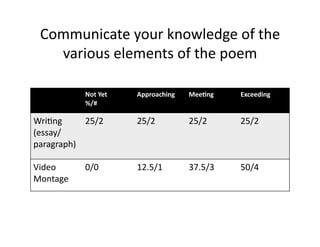
Communicate	
  your	
  knowledge	
  of	
  the	
  
various	
  elements	
  of	
  the	
  poem	
  
Not	
  Yet	
  
%/#	
  
Approaching	
   MeeBng	
  	
   Exceeding	
  
Wri4ng	
  
(essay/
paragraph)	
  
25/2	
   25/2	
   25/2	
   25/2	
  
Video	
  
Montage	
  
0/0	
   12.5/1	
   37.5/3	
   50/4	
  
Naryn	
  and	
  Pat’s	
  Reflec4ons	
  
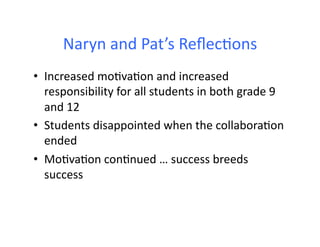
•  Increased	
  mo4va4on	
  and	
  increased	
  
responsibility	
  for	
  all	
  students	
  in	
  both	
  grade	
  9	
  
and	
  12	
  
•  Students	
  disappointed	
  when	
  the	
  collabora4on	
  
ended	
  
•  Mo4va4on	
  con4nued	
  …	
  success	
  breeds	
  
success	
  
Erica	
  Foote,	
  
	
  Princess	
  Margaret	
  Secondary	
  
•  If	
  students	
  were	
  given	
  the	
  opportunity	
  (4	
  
4mes	
  per	
  semester)	
  to	
  show	
  what	
  they	
  know	
  
in	
  different	
  ways,	
  would	
  it	
  not	
  only	
  increase	
  
their	
  interest	
  and	
  effort	
  but	
  also	
  increase	
  their	
  
understanding?	
  	
  
English	
  10	
  
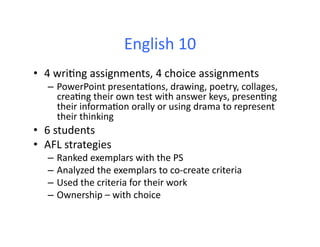
•  4	
  wri4ng	
  assignments,	
  4	
  choice	
  assignments	
  
–  PowerPoint	
  presenta4ons,	
  drawing,	
  poetry,	
  collages,	
  
crea4ng	
  their	
  own	
  test	
  with	
  answer	
  keys,	
  presen4ng	
  
their	
  informa4on	
  orally	
  or	
  using	
  drama	
  to	
  represent	
  
their	
  thinking	
  	
  
•  6	
  students	
  	
  
•  AFL	
  strategies	
  
–  Ranked	
  exemplars	
  with	
  the	
  PS	
  
–  Analyzed	
  the	
  exemplars	
  to	
  co-­‐create	
  criteria	
  
–  Used	
  the	
  criteria	
  for	
  their	
  work	
  
–  Ownership	
  –	
  with	
  choice	
  
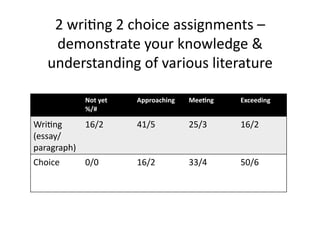
2	
  wri4ng	
  2	
  choice	
  assignments	
  –	
  	
  
demonstrate	
  your	
  knowledge	
  &	
  
understanding	
  of	
  various	
  literature	
  
Not	
  yet	
  
%/#	
  
Approaching	
   MeeBng	
   Exceeding	
  
Wri4ng	
  
(essay/
paragraph)	
  
16/2	
   41/5	
   25/3	
   16/2	
  
Choice	
   0/0	
   16/2	
   33/4	
   50/6	
  
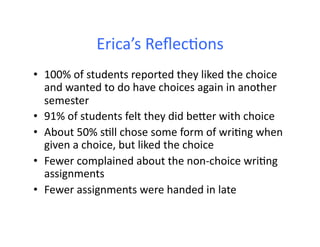
Erica’s	
  Reflec4ons	
  
•  100%	
  of	
  students	
  reported	
  they	
  liked	
  the	
  choice	
  
and	
  wanted	
  to	
  do	
  have	
  choices	
  again	
  in	
  another	
  
semester	
  
•  91%	
  of	
  students	
  felt	
  they	
  did	
  beFer	
  with	
  choice	
  
•  About	
  50%	
  s4ll	
  chose	
  some	
  form	
  of	
  wri4ng	
  when	
  
given	
  a	
  choice,	
  but	
  liked	
  the	
  choice	
  
•  Fewer	
  complained	
  about	
  the	
  non-­‐choice	
  wri4ng	
  
assignments	
  
•  Fewer	
  assignments	
  were	
  handed	
  in	
  late	
  
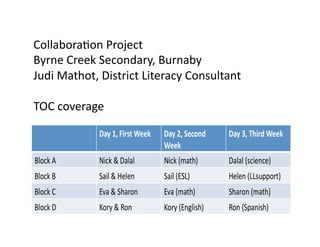
Collabora4on	
  Project	
  
Byrne	
  Creek	
  Secondary,	
  Burnaby	
  
Judi	
  Mathot,	
  District	
  Literacy	
  Consultant	
  
TOC	
  coverage	
  
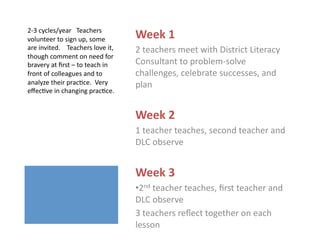
Week	
  1	
  
2	
  teachers	
  meet	
  with	
  District	
  Literacy	
  
Consultant	
  to	
  problem-­‐solve	
  
challenges,	
  celebrate	
  successes,	
  and	
  
plan	
  
Week	
  2	
  
1	
  teacher	
  teaches,	
  second	
  teacher	
  and	
  
DLC	
  observe	
  
Week	
  3	
  
• 2nd	
  teacher	
  teaches,	
  first	
  teacher	
  and	
  
DLC	
  observe	
  
3	
  teachers	
  reflect	
  together	
  on	
  each	
  
lesson	
  
2-­‐3	
  cycles/year	
  	
  	
  Teachers	
  
volunteer	
  to	
  sign	
  up,	
  some	
  
are	
  invited.	


  Teachers	
  love	
  it,	
  
though	
  comment	
  on	
  need	
  for	
  
bravery	
  at	
  first	
  –	
  to	
  teach	
  in	
  
front	
  of	
  colleagues	
  and	
  to	
  
analyze	
  their	
  prac4ce.	
  	
  Very	
  
effec4ve	
  in	
  changing	
  prac4ce.	
  
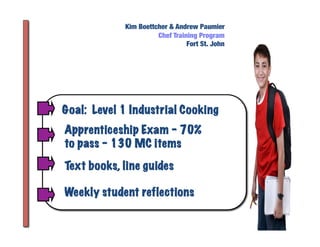
Kim Boettcher & Andrew Paumier
Chef Training Program
Fort St. John
Goal: Level 1 Industrial Cooking
Apprenticeship Exam - 70%
to pass - 130 MC items
Text books, line guides
Weekly student reflections
Lesson designed by district
literacy support teacher;
taught by classroom
teacher
CT gave feedback on
lesson
Student reflection cards:
I think I am starting to…
Please notice…
Parallel strategies for all lessons
Connecting Strategy:
Find the Ficton -
3 statements; which is false
Processing Strategy:
Jigsaw, chart, groups teach to each
other
Result: all passed
Gulf Islands Secondary
Resource team

-invitation to consult 

-choose your class

-co-plan an intervention
InstrucBonal	
  
ConsideraBons	
  
Try	
  to…	
  
-­‐have	
  the	
  students	
  use	
  the	
  
vocabulary	
  NOT	
  just	
  the	
  
teacher!	
  
Questioning/Ownership
Faye & Deiter
Resource & CT
45	
  seconds	
  
Brainstorm	
  the	
  
words	
  you	
  know	
  
about	
  mo4on	
  
Stand	
  if	
  you	
  have	
  more	
  than	
  10.	
  
Share	
  with	
  partner	
  –	
  get	
  a	
  few	
  more	
  words.	
  
Move	
  and	
  share	
  with	
  someone	
  NOT	
  at	
  your	
  table	
  –	
  get	
  a	
  few	
  
more	
  words.	
  
Add	
  a	
  scenario,	
  an	
  image,	
  …	
  
Grade 10 Science –
intro to physics: motion
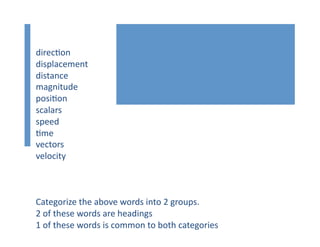
direc4on	
  
displacement	
  
distance	
  
magnitude	
  
posi4on	
  
scalars	
  
speed	
  
4me	
  
vectors	
  
velocity	
  
Categorize	
  the	
  above	
  words	
  into	
  2	
  groups.	
  
2	
  of	
  these	
  words	
  are	
  headings	
  
1	
  of	
  these	
  words	
  is	
  common	
  to	
  both	
  categories	
  
Tammy Renyard & Graham Scargall
Grade 9
A Mid-Summer Night’s Dream
Mt. Prevost Middle School
Cowichan Valey
A/B partner talk
Daily learning intentions
Expanded definitions of the text
Student reflections on their
learning processes
Goals of the
collaboration:
Different	
  Ways	
  to	
  Access	
  Informa4on	
  
•  Listening	
  to	
  the	
  play	
  and	
  ac4ng	
  out	
  roles	
  in	
  
the	
  play	
  
•  Reading	
  a	
  graphic	
  novel	
  
•  Watching	
  movie	
  clips	
  
•  Listening	
  to	
  the	
  teacher	
  
•  Working	
  in	
  small	
  groups	
  to	
  analyze	
  pieces	
  
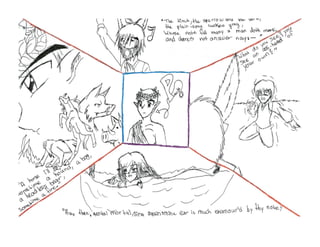
Graphic	
  Representa4ons	
  
•  Learning	
  Inten4on:	
  	
  I	
  can	
  interpret	
  lines	
  of	
  text	
  using	
  graphics	
  
•  Each	
  student	
  has	
  several	
  lines	
  to	
  represent	
  
•  Done	
  first	
  without	
  clear	
  criteria	
  
•  Analyzed	
  their	
  work	
  in	
  a	
  carousel	
  
•  Created	
  criteria	
  and	
  1-­‐4	
  rubric	
  
•  Coded	
  own	
  work	
  -­‐	
  descrip4ve	
  feedback	
  
•  New	
  lines,	
  represented	
  again,	
  with	
  criteria	
  
Wri4ng	
  in	
  Role	
  
•  Learning	
  Inten4on:	
  	
  I	
  can	
  write	
  in	
  role	
  to	
  
another	
  character	
  
•  Students	
  developed	
  criteria	
  
•  Wrote	
  their	
  leFers	
  
•  Self	
  and	
  peer	
  assessed	
  with	
  criteria	
  and	
  
descrip4ve	
  feedback	
  
•  Wrote	
  second	
  leFer	
  
Dear Aunt,
I have some news that may distress you in the worst way. My
fair Hermia and I are forbidden to wed. We must elope, but
have nowhere to stay. I seek you intelligence and hospitality.
You are my dearest and most beloved relative and I offer my
greatest apologies for such short notice. I have won the love of
a woman whose beauty many a man only dreamed of. My dear
Hermia will be forced to wed another who she does not love or
be sentenced to live as a nun if we do not flee. Her third option
is one that makes my skin crawl and my heart break just
thinking about it. Death is thee punishment – O hell! What
would I do without her? The true desire of my heart is to be
wed to Hermia for all eternity. Alas, I cannot do so without your
help. Deeply and without judgment, in two moons time, the
sunset will mark my arrival.
Sincerely,
Lysander
Culmina4ng	
  Project:	


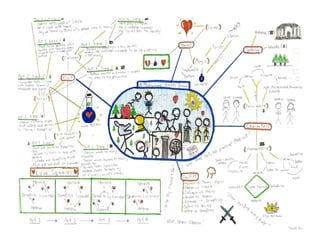
Mind	
  Map	
  
•  Learning	
  Inten4on:	
  	
  I	
  can	
  represent	
  my	
  
understanding	
  of	
  the	
  play	
  through	
  a	
  mind	
  map	
  
•  Built	
  criteria	
  
•  Gave	
  descrip4ve	
  feedback	
  while	
  students	
  
worked	
  
•  Students	
  included	
  a	
  personal	
  reflec4on	
  on	
  
their	
  learning	
  style	
  and	
  the	
  unit	
  
Learning Intentions
Joni	
  Tsui	
  and	
  Alissa	
  Sarte,	
  Port	
  Moody	
  Secondary	
  
Teacher	
  and	
  Department	
  Head	
  
•  At	
  the	
  beginning	
  of	
  each	
  class	
  we	
  write	
  the	
  
learning	
  inten4ons	
  for	
  the	
  day	
  on	
  the	
  board	
  
– e.g.	
  	
  	
  By	
  the	
  end	
  of	
  class	
  today	
  you	
  will	
  be	
  able	
  to:
	
   	
  1.	
  	
  Define	
  the	
  term	
  ionic	
  compound.	


  2.	
  	
  Determine	
  the	
  chemical	
  formulae	
  for	


ionic	
  compounds.	


  3.	
  	
  Name	
  ionic	
  compounds.	
  
•  Have	
  students	
  write	
  the	
  learning	
  inten4ons	
  
down	
  in	
  a	
  journal.	
  
•  During	
  class,	
  we	
  refer	
  to	
  the	
  inten4ons	
  as	
  we	
  
progress	
  through	
  the	
  lesson	
  and	
  point	
  out	
  
when	
  we	
  have	
  hit	
  each	
  outcome.	
  
•  Refer	
  to	
  them	
  again	
  at	
  the	
  end	
  of	
  class	
  and	
  
occasionally	
  stop	
  and	
  do	
  a	
  quick	
  check	
  for	
  
understanding.	
  
•  Student	
  feedback:	
  
– They	
  like	
  to	
  know	
  why	
  we	
  are	
  doing	
  certain	
  
ac4vi4es	
  
– They	
  look	
  back	
  at	
  the	
  learning	
  inten4ons	
  
when	
  doing	
  review.	
  
– If	
  I	
  forget	
  to	
  write	
  them	
  down,	
  they	
  tell	
  me	
  
right	
  away!	
  	
  It	
  has	
  become	
  the	
  star4ng	
  
paFern	
  for	
  my	
  classes.	
  
•  What	
  we	
  found:	
  
–  Students	
  had	
  a	
  focus	
  for	
  the	
  lessons.	
  	
  They	
  would	
  
ouen	
  interrupt	
  me	
  to	
  say	
  “so	
  that’s	
  the	
  second	
  
learning	
  inten4on,	
  right?”	
  
–  They	
  didn’t	
  ques4on	
  “why	
  are	
  we	
  doing	
  this?”	
  
because	
  I	
  told	
  them	
  right	
  from	
  the	
  start.	
  
–  When	
  we	
  reminded	
  the	
  kids	
  at	
  the	
  end	
  of	
  class	
  that	
  
these	
  were	
  the	
  things	
  that	
  they	
  should	
  now	
  know,	
  we	
  
had	
  an	
  increase	
  in	
  students	
  asking	
  for	
  clarifica4on	
  or	
  
coming	
  in	
  for	
  help.	
  	
  Students	
  became	
  beFer	
  at	
  the	
  
metacogni4on	
  of	
  understanding	
  whether	
  or	
  not	
  they	
  
had	
  learned	
  things.	
  
Questioning through Pictures
•  I	
  used	
  this	
  ac4vity	
  as	
  an	
  introduc4on	
  to	
  
earthquakes	
  in	
  geology	
  12.	
  	
  
•  Students	
  have	
  all	
  seen	
  earthquakes	
  in	
  
previous	
  classes	
  (some	
  more	
  than	
  others).	
  
•  We	
  completed	
  the	
  ac4vity	
  and	
  I	
  made	
  sure	
  
every	
  student	
  in	
  class	
  wondered	
  at	
  least	
  one	
  
thing.	


  Let’s	
  try	
  it….	
  
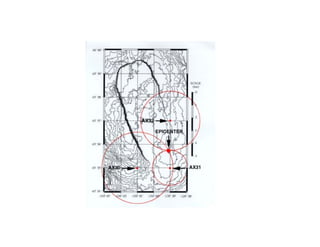
Earthquakes	
  
•  You	
  may	
  ask	
  ques4ons	
  out	
  loud.	
  
•  You	
  may	
  NOT	
  ANSWER	
  any	
  ques4ons.	
  	
  EVEN	
  IF	
  
YOU	
  KNOW	
  THE	
  ANSWER!!!!	
  
•  All	
  ques4ons	
  should	
  start	
  with	
  “I	
  wonder”…	
  
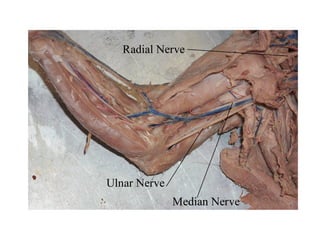
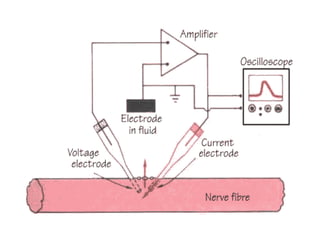
Example	
  2	
  
Nerves	
  –	
  Biology	
  12	
  
What	
  I	
  Found:	
  
•  Every	
  student	
  could	
  contribute.	
  	
  There	
  is	
  no	
  risk	
  
in	
  asking	
  a	
  ques4on	
  that	
  no	
  one	
  is	
  supposed	
  to	
  
answer.	
  
•  Students	
  remembered	
  a	
  lot	
  of	
  previous	
  
informa4on.	
  
•  When	
  moving	
  on	
  to	
  the	
  lesson,	
  they	
  actually	
  
cared	
  about	
  the	
  material!!!	
  
•  The	
  ques4ons	
  that	
  they	
  asked	
  were	
  ouen	
  very	
  
good	
  and	
  related	
  to	
  the	
  content	
  that	
  I	
  was	
  
subsequently	
  teaching.	


Challenge	
  
• 	
   increase	
  risk-­‐taking,	
  speaking,	
  applying	
  
knowledge	
  rather	
  than	
  one	
  right	
  answer	
  
ques4ons,	
  mo4va4on	
  
•  Amanda	
  (socials)	
  and	
  Faye	
  (resource)	
  
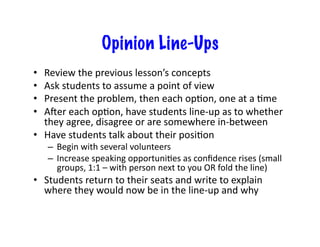
Opinion Line-Ups
•  Review	
  the	
  previous	
  lesson’s	
  concepts	
  
•  Ask	
  students	
  to	
  assume	
  a	
  point	
  of	
  view	
  
•  Present	
  the	
  problem,	
  then	
  each	
  op4on,	
  one	
  at	
  a	
  4me	
  
•  Auer	
  each	
  op4on,	
  have	
  students	
  line-­‐up	
  as	
  to	
  whether	
  
they	
  agree,	
  disagree	
  or	
  are	
  somewhere	
  in-­‐between	
  
•  Have	
  students	
  talk	
  about	
  their	
  posi4on	
  
–  Begin	
  with	
  several	
  volunteers	
  
–  Increase	
  speaking	
  opportuni4es	
  as	
  confidence	
  rises	
  (small	
  
groups,	
  1:1	
  –	
  with	
  person	
  next	
  to	
  you	
  OR	
  fold	
  the	
  line)	
  
•  Students	
  return	
  to	
  their	
  seats	
  and	
  write	
  to	
  explain	
  
where	
  they	
  would	
  now	
  be	
  in	
  the	
  line-­‐up	
  and	
  why	
  
Bryn	
  Williams	
  (Math	
  Dept	
  Head)	
  &Rae	
  
Figursky	
  (teacher)	
  	
  
•  Ques4oning	
  
•  Descrip4ve	
  feedback	
  
•  Criteria	
  
•  Ownership	
  
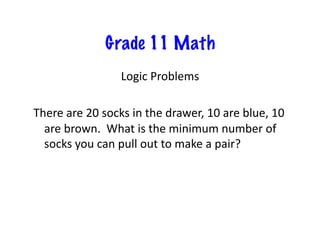
Grade 11 Math
Logic	
  Problems	
  
There	
  are	
  20	
  socks	
  in	
  the	
  drawer,	
  10	
  are	
  blue,	
  10	
  
are	
  brown.	
  	
  What	
  is	
  the	
  minimum	
  number	
  of	
  
socks	
  you	
  can	
  pull	
  out	
  to	
  make	
  a	
  pair?	
  
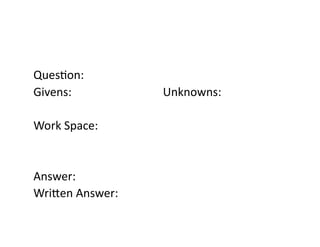
Ques4on:	
  
Givens:	


  Unknowns:	
  
Work	
  Space:	
  
Answer:	
  
WriFen	
  Answer:	
  
•  Learning intentions
•  Descriptive feedback
•  Questioning
•  Ownership
Reading	
  and	
  Thinking	
  with	
  Different	
  
Texts	
  
•  Making	
  Inferences	
  
•  Asking	
  ques4ons	
  
•  Using	
  evidence	
  to	
  support	
  your	
  thinking	
  
•  Learning	
  Inten4ons:	


  -­‐I	
  can	
  use	
  world	
  currency	
  informa4on	
  to	
  
explain	
  what	
  this	
  means	
  to	
  average	
  people.	


  -­‐I	
  can	
  interpret	
  this	
  informa4on,	
  providing	
  
reasoning	
  for	
  my	
  interpreta4ons	
  
A	
  Comparison	
  of	
  World	
  Currencies	
  –	
  
what	
  does	
  it	
  mean	
  to	
  the	
  average	
  
ci4zen?	
  
•  Ci4es	
  being	
  compared:	
  
–  Athens,	
  Frankfurt,	
  Manila,	
  Shanghai,	
  Toronto	
  
•  Number	
  of	
  minutes	
  to	
  work	
  to	
  buy	
  a	
  Big	
  Mac:	
  
	
  -­‐12,	
  15,	
  30,	
  30,	
  88	
  
•  Number	
  of	
  hours	
  to	
  work	
  to	
  buy	
  an	
  8gb	
  iPod	
  
	
  -­‐10.5,	
  13.5,	
  24.5,	
  56.5,	
  128.5	
  
•  Annual	
  average	
  hours	
  worked:	
  
	
  -­‐1704,	
  1827,	
  1868,	
  1946,	
  2032	
  
•  Cost	
  of	
  living	
  (rela4ve	
  to	
  NYC)	
  
	
  -­‐28.7%,	
  48.9%,	
  54.6%,	
  63%,	
  70.6%	
  
ar&cles.moneycentral.msn.com/SmartSpending/
ConsumerAc&onGuide/burgernomics-­‐whats-­‐a-­‐big-­‐
mac-­‐worth.aspx	
  
15-3=0
Without -
•  professional development
•  ongoing formative assessment of
students and
•  ongoing summative assessment of
students and programs
Reading Next - Biancarosa & Snow, 2004	
  

Miles mac.nov.2010

  • 1.
    Re-­‐Focusing  on  Learning:   Collabora4on   Differen4a4on   Miles  Macdonell  Collegiate   Monday,  November  21st,  2010   Faye  Brownlie  
  • 2.
    Learning Intentions •  I  have  a  beFer  understanding  of  what   differen4a4on  can  look  like  in  the  classroom   and  how  to  support  it.   •  I  have  a  plan  to  ini4ate  a  collabora4on  with  a   colleague  –  or  a  plan  to  extend  an  exis4ng   collabora4on.  
  • 3.
    Why?   •  Diversity  of  student  popula4on   •  Research  on  learning   •  Research  on  teaching   •  Gradua4on  demands  –  curriculum  demands   •  Employer  expecta4ons   •  Complexity  of  the  job  –  isola4on  vs  team  
  • 4.
    Professional  Collabora4on   • Interac4ve  and  on-­‐going  process   •  Mutually  agreed  upon  challenges   •  Capitalizes  on  different  exper4se,  knowledge  and   experience   •  Roles  are  blurred   •  Mutual  trust  and  respect   •  Create  and  deliver  targeted  instruc4on   •  GOAL:    beFer  meet  the  needs  of  diverse  learners  
  • 5.
    Big Ideas… As  a  school  community  we  want  to  work  together  to  meet  the   needs  of  all  students.   Inclusion  is  not  a  special  educa4on  model;  it  is  a  school  model.   As  professionals  we  want  to  constantly  examine  and  refine  our   prac4ce.   Collabora4ve  problem-­‐solving  and  teaching  results  in  new  ideas,   new  products  and  a  feeling  of  connec4on.     Our  students  con4nue  to  change  and  learn  and  their  needs,  just   like  the  school’s,  will  change  over  the  course  of  the  year.   Brownlie  &  Schnellert    Suppor&ng  Diversity:    Working  Together  to  Support  All  Learners   ___  
  • 6.
    Where did youstart this year… What actions have you taken: -roles -schedules -timetables -instruction -assessment -class reviews, collaborative planning -collaborative teaching Share in group/share out
  • 7.
    Teach Content toAll     "RETSD"
  • 8.
    Differen4a4on   “…  a  process  approach  to  teaching  and  learning   for  students  of  differing  abili4es  in  the  same   class.    The  intent  is  to  maximize  each  student’s   growth  and  individual  success  by  mee4ng   each  student  where  he  or  she  is  …  rather  than   expec4ng  students  to  modify  themselves  for   the  curriculum.”     (Hall,  2002)  
  • 9.
    Frameworks It’s All aboutThinking – Brownlie & Schnellert, 2009
  • 10.
    Universal Design forLearning Mul4ple  means:   -­‐to  tap  into  background  knowledge,  to  ac4vate   prior  knowledge,  to  increase  engagement  and   mo4va4on   -­‐to  acquire  the  informa4on  and  knowledge  to   process  new  ideas  and  informa4on   -­‐to  express  what  they  know.                        Rose  &  Meyer,  2002  
  • 11.
    Backwards Design •  What  important  ideas  and  enduring   understandings  do  you  want  the  students  to   know?   •  What  thinking  strategies  will  students  need  to   demonstrate  these  understandings?                      McTighe  &  Wiggins,  2001  
  • 12.
    Approaches •  Assessment  for  learning   •  Open-­‐ended  strategies   •  Gradual  release  of  responsibility   •  Coopera4ve  learning   •  Literature  circles  and  informa4on  circles   •  Inquiry   It’s All about Thinking – Brownlie & Schnellert, 2009
  • 13.
    Assessment for Learning • Learning  Inten4ons   •  Criteria   •  Ques4oning   •  Descrip4ve  Feedback   •  Peer  and  Self  Assessment   •  Ownership  
  • 14.
    Open-ended strategies: Connect-activate Process-acquire Personalize/transform- apply (Brownlie, Feniak& Schnellert, 2006; Buehl, 2001; Cook, 2005; Gear, 2006; Harvey & Goudvis, 2007; Kame'enui & Carnine, 2002)
  • 15.
    Triangulation: collecting evidenceof learning from 3 sources •  Observations •  Conversations •  Products Reference: RETSD
  • 16.
    Model Guided practice Independent practice Independentapplication   Pearson  &  Gallagher  (1983)  
  • 17.
    Collabora4on   •  Co-­‐planning   •  Co-­‐teaching   •  Co-­‐assessing  
  • 18.
    Inquiry  Research   SD  67,  Okanagan  Skaha   Teams  of  4:    teachers  +  admin   “If  middle  and  secondary  school  students  are   permiFed  and  encouraged  to  demonstrate  their   knowledge  in  alterna4ve  ways,  how  will  it   impact  their  learning  and  their  knowledge   about  themselves  as  learners?”      
  • 19.
    •  3rd  year  of  a  district  inquiry  focus  on  AFL   prac4ces   •  District  focus:    differen4a4on   •  Teams  (school-­‐based)  meet  4-­‐5  4mes  per  year   •  Research  conducted  in  teachers’  classrooms   •  Teachers  choose  their  own  research  ques4on  
  • 20.
    Andrea  DeVito,  Pen4cton  High   •  My  findings  are  based  24  students  randomly   selected  from  four  classes:  an  English  9,  two   11’s,  and  one  12.    The  students  were  first   given  a  wriBng-­‐response  to  a  piece  of   literature,  and  then  the  end-­‐task  with  choice   to  a  piece  of  literature.      
  • 21.
    Show  an  understanding  of  your  novel   Literature  Circles   Not  yet   %/#     Approaching   MeeBng   Exceeding   Fixed   wriFen     assessment   0/0     17/4   75/18   8/2   End  task   with  choice   0/0   8/2   25/6   58/14  
  • 22.
    Andrea’s  reflec4ons   • Some  challenged  by  finding  a  meaningful   connec4on  between  themselves  and  the  novel   •  Some  challenged  by  the  idea  of  students  doing   different  products  for  the  same  assignment   •  Most  wanted  to  do  this  kind  of  assignment   again.  
  • 23.
    Naryn  Searcy  &  Pat  Whitely,    Princess  Margaret  Secondary   •  Co-­‐taught  English  12  and  IT  9   •  Assignment:    demonstrate  the  key  elements  of  a   grade  12  poem  in  a  video  montage   •  12’s  responsible  for  the  poem’s  key  elements  and   the  vision;  9’s  for  the  technical  aspects   •  12’s  teach  the  poem;  9’s  teach  the  technical   aspects   •  Subjects:    8  grade  12  students,  2  NY,  2A,  2M,  2E   on  a  tradi4onal  wri4ng  assignment  of  poetry    
  • 24.
    •  Projects  shown  to  both  classes.    Grade  12   students  introduced  and  explained  the  video   •  AFL  strategies:       – descrip4ve  feedback  at  each  stage  (i.e.,   storyboard)   – ownership  
  • 25.
    Communicate  your  knowledge  of  the   various  elements  of  the  poem   Not  Yet   %/#   Approaching   MeeBng     Exceeding   Wri4ng   (essay/ paragraph)   25/2   25/2   25/2   25/2   Video   Montage   0/0   12.5/1   37.5/3   50/4  
  • 26.
    Naryn  and  Pat’s  Reflec4ons   •  Increased  mo4va4on  and  increased   responsibility  for  all  students  in  both  grade  9   and  12   •  Students  disappointed  when  the  collabora4on   ended   •  Mo4va4on  con4nued  …  success  breeds   success  
  • 27.
    Erica  Foote,    Princess  Margaret  Secondary   •  If  students  were  given  the  opportunity  (4   4mes  per  semester)  to  show  what  they  know   in  different  ways,  would  it  not  only  increase   their  interest  and  effort  but  also  increase  their   understanding?    
  • 28.
    English  10   • 4  wri4ng  assignments,  4  choice  assignments   –  PowerPoint  presenta4ons,  drawing,  poetry,  collages,   crea4ng  their  own  test  with  answer  keys,  presen4ng   their  informa4on  orally  or  using  drama  to  represent   their  thinking     •  6  students     •  AFL  strategies   –  Ranked  exemplars  with  the  PS   –  Analyzed  the  exemplars  to  co-­‐create  criteria   –  Used  the  criteria  for  their  work   –  Ownership  –  with  choice  
  • 29.
    2  wri4ng  2  choice  assignments  –     demonstrate  your  knowledge  &   understanding  of  various  literature   Not  yet   %/#   Approaching   MeeBng   Exceeding   Wri4ng   (essay/ paragraph)   16/2   41/5   25/3   16/2   Choice   0/0   16/2   33/4   50/6  
  • 30.
    Erica’s  Reflec4ons   • 100%  of  students  reported  they  liked  the  choice   and  wanted  to  do  have  choices  again  in  another   semester   •  91%  of  students  felt  they  did  beFer  with  choice   •  About  50%  s4ll  chose  some  form  of  wri4ng  when   given  a  choice,  but  liked  the  choice   •  Fewer  complained  about  the  non-­‐choice  wri4ng   assignments   •  Fewer  assignments  were  handed  in  late  
  • 31.
    Collabora4on  Project   Byrne  Creek  Secondary,  Burnaby   Judi  Mathot,  District  Literacy  Consultant   TOC  coverage  
  • 32.
    Week  1   2  teachers  meet  with  District  Literacy   Consultant  to  problem-­‐solve   challenges,  celebrate  successes,  and   plan   Week  2   1  teacher  teaches,  second  teacher  and   DLC  observe   Week  3   • 2nd  teacher  teaches,  first  teacher  and   DLC  observe   3  teachers  reflect  together  on  each   lesson   2-­‐3  cycles/year      Teachers   volunteer  to  sign  up,  some   are  invited.        Teachers  love  it,   though  comment  on  need  for   bravery  at  first  –  to  teach  in   front  of  colleagues  and  to   analyze  their  prac4ce.    Very   effec4ve  in  changing  prac4ce.  
  • 33.
    Kim Boettcher &Andrew Paumier Chef Training Program Fort St. John Goal: Level 1 Industrial Cooking Apprenticeship Exam - 70% to pass - 130 MC items Text books, line guides Weekly student reflections
  • 34.
    Lesson designed bydistrict literacy support teacher; taught by classroom teacher CT gave feedback on lesson Student reflection cards: I think I am starting to… Please notice… Parallel strategies for all lessons
  • 35.
    Connecting Strategy: Find theFicton - 3 statements; which is false Processing Strategy: Jigsaw, chart, groups teach to each other Result: all passed
  • 36.
    Gulf Islands Secondary Resourceteam -invitation to consult -choose your class -co-plan an intervention
  • 37.
    InstrucBonal   ConsideraBons   Try  to…   -­‐have  the  students  use  the   vocabulary  NOT  just  the   teacher!   Questioning/Ownership Faye & Deiter Resource & CT
  • 38.
    45  seconds   Brainstorm  the   words  you  know   about  mo4on   Stand  if  you  have  more  than  10.   Share  with  partner  –  get  a  few  more  words.   Move  and  share  with  someone  NOT  at  your  table  –  get  a  few   more  words.   Add  a  scenario,  an  image,  …   Grade 10 Science – intro to physics: motion
  • 39.
    direc4on   displacement   distance   magnitude   posi4on   scalars   speed   4me   vectors   velocity   Categorize  the  above  words  into  2  groups.   2  of  these  words  are  headings   1  of  these  words  is  common  to  both  categories  
  • 40.
    Tammy Renyard &Graham Scargall Grade 9 A Mid-Summer Night’s Dream Mt. Prevost Middle School Cowichan Valey A/B partner talk Daily learning intentions Expanded definitions of the text Student reflections on their learning processes Goals of the collaboration:
  • 41.
    Different  Ways  to  Access  Informa4on   •  Listening  to  the  play  and  ac4ng  out  roles  in   the  play   •  Reading  a  graphic  novel   •  Watching  movie  clips   •  Listening  to  the  teacher   •  Working  in  small  groups  to  analyze  pieces  
  • 42.
    Graphic  Representa4ons   • Learning  Inten4on:    I  can  interpret  lines  of  text  using  graphics   •  Each  student  has  several  lines  to  represent   •  Done  first  without  clear  criteria   •  Analyzed  their  work  in  a  carousel   •  Created  criteria  and  1-­‐4  rubric   •  Coded  own  work  -­‐  descrip4ve  feedback   •  New  lines,  represented  again,  with  criteria  
  • 44.
    Wri4ng  in  Role   •  Learning  Inten4on:    I  can  write  in  role  to   another  character   •  Students  developed  criteria   •  Wrote  their  leFers   •  Self  and  peer  assessed  with  criteria  and   descrip4ve  feedback   •  Wrote  second  leFer  
  • 45.
    Dear Aunt, I havesome news that may distress you in the worst way. My fair Hermia and I are forbidden to wed. We must elope, but have nowhere to stay. I seek you intelligence and hospitality. You are my dearest and most beloved relative and I offer my greatest apologies for such short notice. I have won the love of a woman whose beauty many a man only dreamed of. My dear Hermia will be forced to wed another who she does not love or be sentenced to live as a nun if we do not flee. Her third option is one that makes my skin crawl and my heart break just thinking about it. Death is thee punishment – O hell! What would I do without her? The true desire of my heart is to be wed to Hermia for all eternity. Alas, I cannot do so without your help. Deeply and without judgment, in two moons time, the sunset will mark my arrival. Sincerely, Lysander
  • 46.
    Culmina4ng  Project:       Mind  Map   •  Learning  Inten4on:    I  can  represent  my   understanding  of  the  play  through  a  mind  map   •  Built  criteria   •  Gave  descrip4ve  feedback  while  students   worked   •  Students  included  a  personal  reflec4on  on   their  learning  style  and  the  unit  
  • 48.
    Learning Intentions Joni  Tsui  and  Alissa  Sarte,  Port  Moody  Secondary   Teacher  and  Department  Head  
  • 49.
    •  At  the  beginning  of  each  class  we  write  the   learning  inten4ons  for  the  day  on  the  board   – e.g.      By  the  end  of  class  today  you  will  be  able  to:    1.    Define  the  term  ionic  compound.          2.    Determine  the  chemical  formulae  for                   ionic  compounds.        3.    Name  ionic  compounds.  
  • 50.
    •  Have  students  write  the  learning  inten4ons   down  in  a  journal.   •  During  class,  we  refer  to  the  inten4ons  as  we   progress  through  the  lesson  and  point  out   when  we  have  hit  each  outcome.   •  Refer  to  them  again  at  the  end  of  class  and   occasionally  stop  and  do  a  quick  check  for   understanding.  
  • 51.
    •  Student  feedback:   – They  like  to  know  why  we  are  doing  certain   ac4vi4es   – They  look  back  at  the  learning  inten4ons   when  doing  review.   – If  I  forget  to  write  them  down,  they  tell  me   right  away!    It  has  become  the  star4ng   paFern  for  my  classes.  
  • 52.
    •  What  we  found:   –  Students  had  a  focus  for  the  lessons.    They  would   ouen  interrupt  me  to  say  “so  that’s  the  second   learning  inten4on,  right?”   –  They  didn’t  ques4on  “why  are  we  doing  this?”   because  I  told  them  right  from  the  start.   –  When  we  reminded  the  kids  at  the  end  of  class  that   these  were  the  things  that  they  should  now  know,  we   had  an  increase  in  students  asking  for  clarifica4on  or   coming  in  for  help.    Students  became  beFer  at  the   metacogni4on  of  understanding  whether  or  not  they   had  learned  things.  
  • 53.
  • 54.
    •  I  used  this  ac4vity  as  an  introduc4on  to   earthquakes  in  geology  12.     •  Students  have  all  seen  earthquakes  in   previous  classes  (some  more  than  others).   •  We  completed  the  ac4vity  and  I  made  sure   every  student  in  class  wondered  at  least  one   thing.        Let’s  try  it….  
  • 55.
    Earthquakes   •  You  may  ask  ques4ons  out  loud.   •  You  may  NOT  ANSWER  any  ques4ons.    EVEN  IF   YOU  KNOW  THE  ANSWER!!!!   •  All  ques4ons  should  start  with  “I  wonder”…  
  • 59.
    Example  2   Nerves  –  Biology  12  
  • 63.
    What  I  Found:   •  Every  student  could  contribute.    There  is  no  risk   in  asking  a  ques4on  that  no  one  is  supposed  to   answer.   •  Students  remembered  a  lot  of  previous   informa4on.   •  When  moving  on  to  the  lesson,  they  actually   cared  about  the  material!!!   •  The  ques4ons  that  they  asked  were  ouen  very   good  and  related  to  the  content  that  I  was   subsequently  teaching.      
  • 64.
    Challenge   •   increase  risk-­‐taking,  speaking,  applying   knowledge  rather  than  one  right  answer   ques4ons,  mo4va4on   •  Amanda  (socials)  and  Faye  (resource)  
  • 65.
    Opinion Line-Ups •  Review  the  previous  lesson’s  concepts   •  Ask  students  to  assume  a  point  of  view   •  Present  the  problem,  then  each  op4on,  one  at  a  4me   •  Auer  each  op4on,  have  students  line-­‐up  as  to  whether   they  agree,  disagree  or  are  somewhere  in-­‐between   •  Have  students  talk  about  their  posi4on   –  Begin  with  several  volunteers   –  Increase  speaking  opportuni4es  as  confidence  rises  (small   groups,  1:1  –  with  person  next  to  you  OR  fold  the  line)   •  Students  return  to  their  seats  and  write  to  explain   where  they  would  now  be  in  the  line-­‐up  and  why  
  • 69.
    Bryn  Williams  (Math  Dept  Head)  &Rae   Figursky  (teacher)     •  Ques4oning   •  Descrip4ve  feedback   •  Criteria   •  Ownership  
  • 70.
    Grade 11 Math Logic  Problems   There  are  20  socks  in  the  drawer,  10  are  blue,  10   are  brown.    What  is  the  minimum  number  of   socks  you  can  pull  out  to  make  a  pair?  
  • 71.
    Ques4on:   Givens:                      Unknowns:   Work  Space:   Answer:   WriFen  Answer:  
  • 72.
    •  Learning intentions • Descriptive feedback •  Questioning •  Ownership
  • 73.
    Reading  and  Thinking  with  Different   Texts   •  Making  Inferences   •  Asking  ques4ons   •  Using  evidence  to  support  your  thinking   •  Learning  Inten4ons:            -­‐I  can  use  world  currency  informa4on  to   explain  what  this  means  to  average  people.        -­‐I  can  interpret  this  informa4on,  providing   reasoning  for  my  interpreta4ons  
  • 74.
    A  Comparison  of  World  Currencies  –   what  does  it  mean  to  the  average   ci4zen?   •  Ci4es  being  compared:   –  Athens,  Frankfurt,  Manila,  Shanghai,  Toronto   •  Number  of  minutes  to  work  to  buy  a  Big  Mac:    -­‐12,  15,  30,  30,  88   •  Number  of  hours  to  work  to  buy  an  8gb  iPod    -­‐10.5,  13.5,  24.5,  56.5,  128.5  
  • 75.
    •  Annual  average  hours  worked:    -­‐1704,  1827,  1868,  1946,  2032   •  Cost  of  living  (rela4ve  to  NYC)    -­‐28.7%,  48.9%,  54.6%,  63%,  70.6%   ar&cles.moneycentral.msn.com/SmartSpending/ ConsumerAc&onGuide/burgernomics-­‐whats-­‐a-­‐big-­‐ mac-­‐worth.aspx  
  • 76.
    15-3=0 Without - •  professionaldevelopment •  ongoing formative assessment of students and •  ongoing summative assessment of students and programs Reading Next - Biancarosa & Snow, 2004