1
2
JOURNAL CLUB ON
ULTRASOUND IN
DENTISTRY – A REVIEW
Dr Sourav Malhotra
2nd year P.G
3
Sonography was
introduced in the Medical
field in early 1950's with
steady development and
requirement of Ultrasound
equipment for diagnosis
has improved the Medical
field & now in dentistry.
4
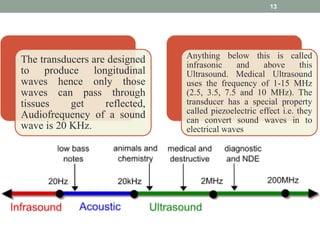
Anything below this is called infrasonic and above this
Ultrasound.
The transducers are designed to produce longitudinal
waves hence only those waves can pass through tissues get
reflected, Audiofrequency of a sound wave is 20 KHz.
In diagnostic Ultrasound high frequency sound waves are
transmitted in to the body by a transducer and echoes from
tissue interface are detected and displayed on a screen.
5
6
The
following
Modes are
in use :
• A Mode Amplitute mode –
not in use
• B Mode Brightness Mode
– Producing different
echogenicity
• TM Mode Motion mode –
used in foetal
• Time Motion ECG and
Doppler study.
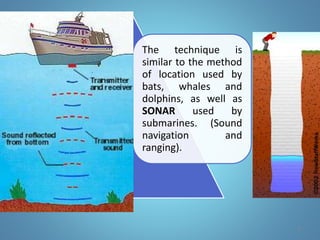
The technique is
similar to the method
of location used by
bats, whales and
dolphins, as well as
SONAR used by
submarines. (Sound
navigation and
ranging).
8
The phenomenon perceived as sound is the
result of periodic changes in the pressure of air
against the eardrum.
The periodicity of these changes lies anywhere
between 1500 and 20,000 cycles per second
([Hz]).
By definition, ultrasound has a periodicity greater
than 20 kHz.
Diagnostic ultrasonography (sonography), the
clinical application of ultrasound, uses vibratory
frequencies in the range of 1 to 20 MHz.
9
10
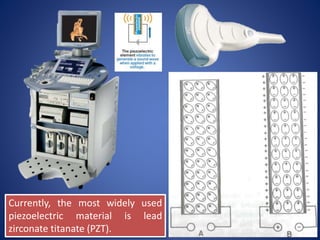
Currently, the most widely used
piezoelectric material is lead
zirconate titanate (PZT).
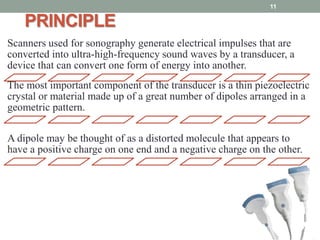
PRINCIPLE
Scanners used for sonography generate electrical impulses that are
converted into ultra-high-frequency sound waves by a transducer, a
device that can convert one form of energy into another.
The most important component of the transducer is a thin piezoelectric
crystal or material made up of a great number of dipoles arranged in a
geometric pattern.
A dipole may be thought of as a distorted molecule that appears to
have a positive charge on one end and a negative charge on the other.
11
12
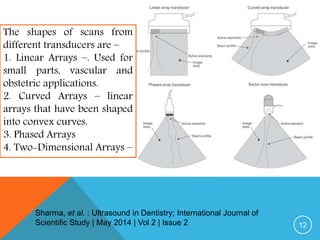
The shapes of scans from
different transducers are –
1. Linear Arrays –. Used for
small parts, vascular and
obstetric applications.
2. Curved Arrays – linear
arrays that have been shaped
into convex curves.
3. Phased Arrays
4. Two-Dimensional Arrays –
Sharma, et al. : Ultrasound in Dentistry; International Journal of
Scientific Study | May 2014 | Vol 2 | Issue 2
The transducers are designed
to produce longitudinal
waves hence only those
waves can pass through
tissues get reflected,
Audiofrequency of a sound
wave is 20 KHz.
Anything below this is called
infrasonic and above this
Ultrasound. Medical Ultrasound
uses the frequency of 1-15 MHz
(2.5, 3.5, 7.5 and 10 MHz). The
transducer has a special property
called piezoelectric effect i.e. they
can convert sound waves in to
electrical waves
13
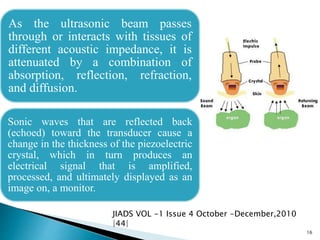
As the ultrasonic beam passes
through or interacts with tissues of
different acoustic impedance, it is
attenuated by a combination of
absorption, reflection, refraction,
and diffusion.
Sonic waves that are reflected back
(echoed) toward the transducer cause a
change in the thickness of the piezoelectric
crystal, which in turn produces an
electrical signal that is amplified,
processed, and ultimately displayed as an
image on, a monitor.
16
JIADS VOL -1 Issue 4 October -December,2010
|44|
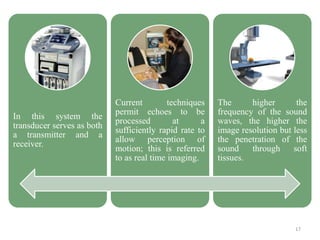
In this system the
transducer serves as both
a transmitter and a
receiver.
Current techniques
permit echoes to be
processed at a
sufficiently rapid rate to
allow perception of
motion; this is referred
to as real time imaging.
The higher the
frequency of the sound
waves, the higher the
image resolution but less
the penetration of the
sound through soft
tissues.
17
18
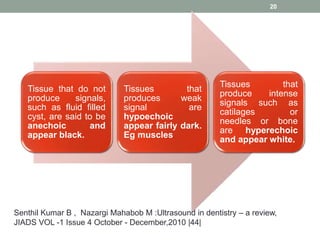
Tissue that do not
produce signals,
such as fluid filled
cyst, are said to be
anechoic and
appear black.
Tissues that
produces weak
signal are
hypoechoic
appear fairly dark.
Eg muscles
Tissues that
produce intense
signals such as
catilages or
needles or bone
are hyperechoic
and appear white.
20
Senthil Kumar B , Nazargi Mahabob M :Ultrasound in dentistry – a review,
JIADS VOL -1 Issue 4 October - December,2010 |44|
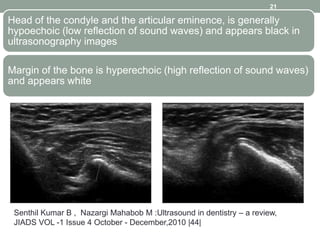
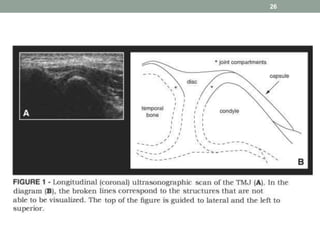
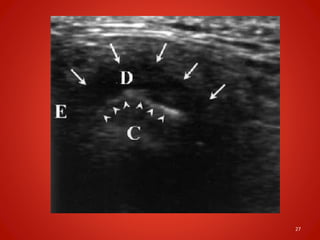
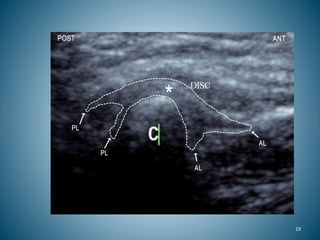
Head of the condyle and the articular eminence, is generally
hypoechoic (low reflection of sound waves) and appears black in
ultrasonography images
Margin of the bone is hyperechoic (high reflection of sound waves)
and appears white
21
Senthil Kumar B , Nazargi Mahabob M :Ultrasound in dentistry – a review,
JIADS VOL -1 Issue 4 October - December,2010 |44|
Therapeutic ultrasound
Diagnostic
ultrasound
23
DEPENDING ON THE APPLICATION AND
ULTRASONIC INTENSITIES IT IS DIVIDED
INTO TWO-
Diagnostic ultrasound – the ultrasonic intensities used are
typically 5 to 500 mW/cm2 and it includes:
 Swellings in orofacial region
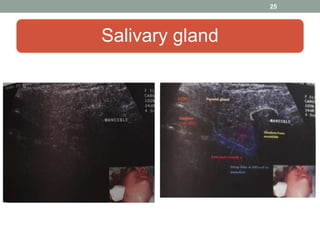
 Salivary glands disorders
 Periapical lesions
 Lymph nodes – benign/malignant
 Intraosseous lesions
 Temporomandibular disorders
 Primary lesions of the tongue
24
Salivary gland
25
26
27
28
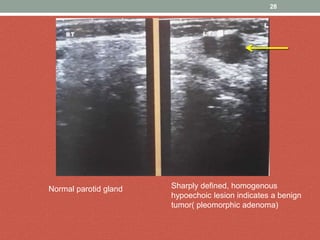
Normal parotid gland Sharply defined, homogenous
hypoechoic lesion indicates a benign
tumor( pleomorphic adenoma)
29
30
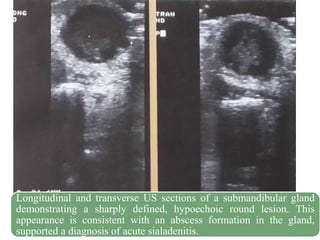
Longitudinal and transverse US sections of a submandibular gland
demonstrating a sharply defined, hypoechoic round lesion. This
appearance is consistent with an abscess formation in the gland,
supported a diagnosis of acute sialadenitis.
31
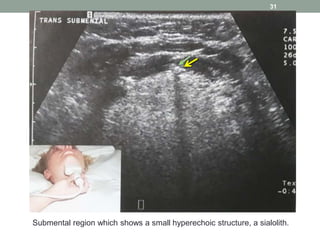
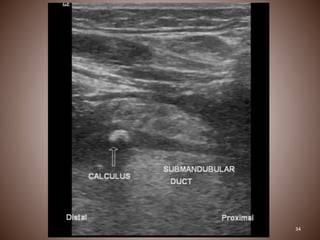
Submental region which shows a small hyperechoic structure, a sialolith.
32
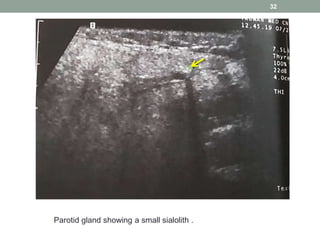
Parotid gland showing a small sialolith .
33
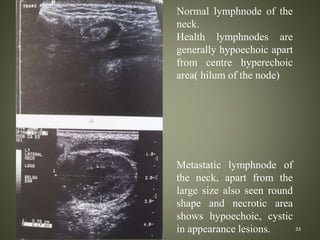
Normal lymphnode of the
neck.
Health lymphnodes are
generally hypoechoic apart
from centre hyperechoic
area( hilum of the node)
Metastatic lymphnode of
the neck, apart from the
large size also seen round
shape and necrotic area
shows hypoechoic, cystic
in appearance lesions.
34
Therapeutic
ultrasound – use
intensities of 1 to 3
W/cm2
35
Increased
vascular and
fluid circulation
Increase in cell
permeability
Increase in
pain threshold
and a break in
pain cycle
36
THERAPEUTIC RESULTS OBTAINED BY ULTRASONIC
ENERGY ARE THOUGHT TO BE DUE TO:
It is estimated that thermal effects can occur with
elevation of tissue temperature to 40-45°C for at least
5 min.
Excessive thermal effects, seen in particular with higher
ultrasound intensities, may damage the tissue
Atef Abd El Hameed:The Journal of Oral and Maxillofacial Surgery. Photon
117 (2014) 232-237
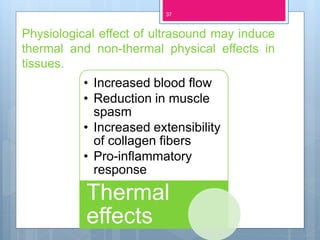
Physiological effect of ultrasound may induce
thermal and non-thermal physical effects in
tissues.
• Increased blood flow
• Reduction in muscle
spasm
• Increased extensibility
of collagen fibers
• Pro-inflammatory
response
Thermal
effects
37
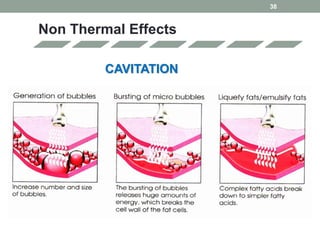
Non Thermal Effects
38
CAVITATION
39
ACOUSTIC MICROSTREAMING
The unidirectional movement of fluids along
cell membranes, within the ultrasound field as
a result of mechanical pressure.
It may alter cell membrane structure, function
and permeability which have been suggested
to stimulate tissue repair.
41
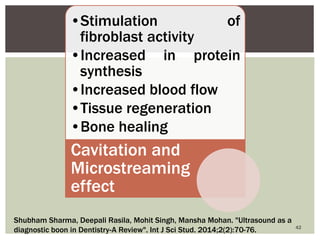
•Stimulation of
fibroblast activity
•Increased in protein
synthesis
•Increased blood flow
•Tissue regeneration
•Bone healing
Cavitation and
Microstreaming
effect
42
Shubham Sharma, Deepali Rasila, Mohit Singh, Mansha Mohan. "Ultrasound as a
diagnostic boon in Dentistry-A Review". Int J Sci Stud. 2014;2(2):70-76.
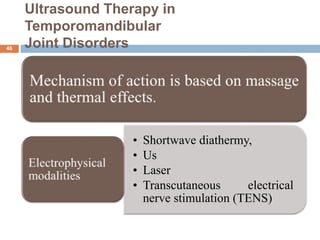
Ultrasound Therapy in
Temporomandibular
Joint Disorders46
• Shortwave diathermy,
• Us
• Laser
• Transcutaneous electrical
nerve stimulation (TENS)
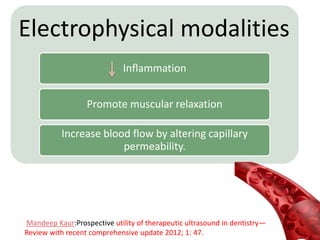
Electrophysical modalities
Inflammation
Promote muscular relaxation
Increase blood flow by altering capillary
permeability.
47
Mandeep Kaur:Prospective utility of therapeutic ultrasound in dentistry—
Review with recent comprehensive update 2012; 1: 47.
48
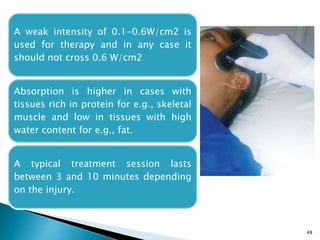
A weak intensity of 0.1-0.6W/cm2 is
used for therapy and in any case it
should not cross 0.6 W/cm2
Absorption is higher in cases with
tissues rich in protein for e.g., skeletal
muscle and low in tissues with high
water content for e.g., fat.
A typical treatment session lasts
between 3 and 10 minutes depending
on the injury.
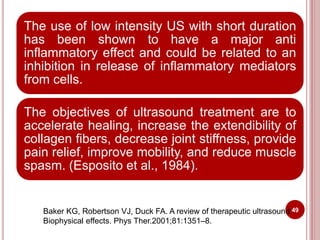
The use of low intensity US with short duration
has been shown to have a major anti
inflammatory effect and could be related to an
inhibition in release of inflammatory mediators
from cells.
The objectives of ultrasound treatment are to
accelerate healing, increase the extendibility of
collagen fibers, decrease joint stiffness, provide
pain relief, improve mobility, and reduce muscle
spasm. (Esposito et al., 1984).
49Baker KG, Robertson VJ, Duck FA. A review of therapeutic ultrasound:
Biophysical effects. Phys Ther.2001;81:1351–8.
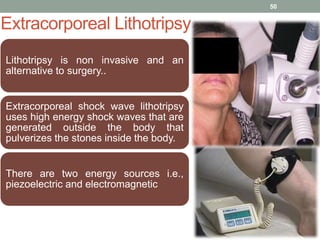
Extracorporeal Lithotripsy
Lithotripsy is non invasive and an
alternative to surgery..
Extracorporeal shock wave lithotripsy
uses high energy shock waves that are
generated outside the body that
pulverizes the stones inside the body.
There are two energy sources i.e.,
piezoelectric and electromagnetic
50
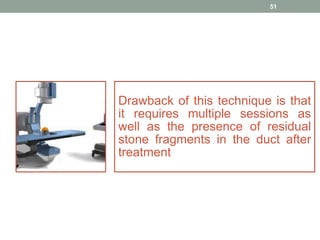
Drawback of this technique is that
it requires multiple sessions as
well as the presence of residual
stone fragments in the duct after
treatment
51
Ultrasound therapy in bone healing
and osteointegration
Therapeutic low intensity
pulsed ultrasound has been
shown to accelerate bone
fracture healing indicating that
ultrasound may be used as a
tool to facilitate hard tissue
regeneration.
52
Certain studies on animals
were carried out on bilateral
midshaft femur fractures and
showed an 16.9% greater
bone mineral content, 81.3%
greater mechanical strength,
25.8% increase in bone size at
active ultrasound-treated
fracture site and increased
vascularity around the fracture
sites.
53
Ultrasound on the healing of full
thickness excised lesions
54
Ultrasound is widely used as a
therapeutic agent in medicine and
dentistry to accelerate repair, modify scar
tissue production, and to reduce pain.
Young in his study suggested that US
therapy can be useful in accelerating the
inflammatory and early proliferative
stages of repair.
• Recently, drainage with the help of images produced
by USG has become a promising therapeutic aid.
• With USG, the vital structures are preserved which
could otherwise be damaged during blind exploration
of an abscess.
• Thus, there is an advantage of minimal or no scar
formation.
• Further, Biron et al. reported that this procedure can be
performed under local anesthesia or conscious
sedation.
55
Ultrasound-Guided Drainage of Deep Neck Space
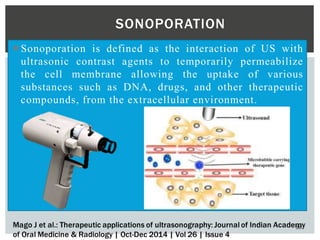
 Sonoporation is defined as the interaction of US with
ultrasonic contrast agents to temporarily permeabilize
the cell membrane allowing the uptake of various
substances such as DNA, drugs, and other therapeutic
compounds, from the extracellular environment.
56
SONOPORATION
After exposure to US, the
compound remains trapped
inside the cell following a
transient alteration in the cell
membrane.
With the help of sonoporation,
gene and drug transfer can be
enhanced restricting the effect
to the desired area and the
desired time
57
Mago J et al.: Therapeutic applications of ultrasonography: Journal of Indian Academy
of Oral Medicine & Radiology | Oct-Dec 2014 | Vol 26 | Issue 4
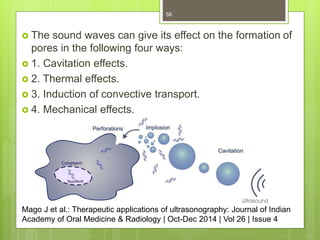
 The sound waves can give its effect on the formation of
pores in the following four ways:
 1. Cavitation effects.
 2. Thermal effects.
 3. Induction of convective transport.
 4. Mechanical effects.
58
Mago J et al.: Therapeutic applications of ultrasonography: Journal of Indian
Academy of Oral Medicine & Radiology | Oct-Dec 2014 | Vol 26 | Issue 4
These are cost effective.
These techniques show a promising role of
USG in maxillofacial radiology as well as in
other arena of radiology.
Lewis et al. in 2002 reported that there has
been little research published on the value of
ablation of metastatic cervical lymph nodes.
60
ULTRASOUND GUIDED ABLATION
ADVANTAGES OVER CONVENTIONAL X-RAY
IMAGING
 Sound waves are NOT ionizing radiation.
 There are no known harmful effects on any tissues at the energies
and doses currently used in diagnostic ultrasound.
 Images show good differentiation between different soft tissues
and are very sensitive for detecting focal disease in the salivary
glands.
 Technique is widely available and relatively inexpensive
61
Eric Whaites; Essentials of Dental Radiography and Radiology:FOURTH
EDITION Page 237-240
DISADVANTAGES
 Ultrasound has limited use in the head and neck region because
sound waves are absorbed by bone. Its use is therefore restricted
to the superficial structures.
 Technique is operator dependent.
 Images can be difficult to interpret for inexperienced operators.
 Real-time imaging means that the radiologist must be present
during the investigation.
62
Conclusion
Ultrasound is an inexpensive, non-
invasive and readily available imaging
technique, that can be used as an
primary investigative Imaging technique
So as to avoid radiation hazards caused
by X-ray radiation (or) MRI which may be
highly economical to the patients. So
proper application and Utilization of this
technique can be of great use in dentistry.
63
References
64
• White SC, Pharoah MJ. Oral radiology: Advanced imaging, (6th
ed); 2004.
• Eric Whaites; Essentials of Dental Radiography and
Radiology:FOURTH EDITION Page 237-240
• Sharma, et al. : Ultrasound in Dentistry; International Journal of
Scientific Study | May 2014 | Vol 2 | Issue 2
• Senthil Kumar B , Nazargi Mahabob M :Ultrasound in
dentistry – a review, JIADS VOL -1 Issue 4 October -
December,2010 |44|
• Mago J et al.: Therapeutic applications of ultrasonography: Journal of
Indian Academy of Oral Medicine & Radiology | Oct-Dec 2014 | Vol
26 | Issue 4
• Baker KG, Robertson VJ, Duck FA. A review of therapeutic
ultrasound: Biophysical effects. Phys Ther.2001;81:1351–8.
• Atef Abd El Hameed:The Journal of Oral and Maxillofacial Surgery.
Photon 117 (2014) 232-237
• Melis et al: Use of ultrasonography for the diagnosis of
temporomandibular joint disorders: A review ,American Journal of
Dentistry, Vol. 20, No. 2, April, 2007
65
• Shubham Sharma, Deepali Rasila, Mohit Singh, Mansha
Mohan. "Ultrasound as a diagnostic boon in Dentistry-A
Review". Int J Sci Stud. 2014;2(2):70-76.
66
67

ultrasound in dentistry

  • 1.
  • 2.
  • 3.
    JOURNAL CLUB ON ULTRASOUNDIN DENTISTRY – A REVIEW Dr Sourav Malhotra 2nd year P.G 3
  • 4.
    Sonography was introduced inthe Medical field in early 1950's with steady development and requirement of Ultrasound equipment for diagnosis has improved the Medical field & now in dentistry. 4
  • 5.
    Anything below thisis called infrasonic and above this Ultrasound. The transducers are designed to produce longitudinal waves hence only those waves can pass through tissues get reflected, Audiofrequency of a sound wave is 20 KHz. In diagnostic Ultrasound high frequency sound waves are transmitted in to the body by a transducer and echoes from tissue interface are detected and displayed on a screen. 5
  • 6.
    6 The following Modes are in use: • A Mode Amplitute mode – not in use • B Mode Brightness Mode – Producing different echogenicity • TM Mode Motion mode – used in foetal • Time Motion ECG and Doppler study.
  • 7.
    The technique is similarto the method of location used by bats, whales and dolphins, as well as SONAR used by submarines. (Sound navigation and ranging). 8
  • 8.
    The phenomenon perceivedas sound is the result of periodic changes in the pressure of air against the eardrum. The periodicity of these changes lies anywhere between 1500 and 20,000 cycles per second ([Hz]). By definition, ultrasound has a periodicity greater than 20 kHz. Diagnostic ultrasonography (sonography), the clinical application of ultrasound, uses vibratory frequencies in the range of 1 to 20 MHz. 9
  • 9.
    10 Currently, the mostwidely used piezoelectric material is lead zirconate titanate (PZT).
  • 10.
    PRINCIPLE Scanners used forsonography generate electrical impulses that are converted into ultra-high-frequency sound waves by a transducer, a device that can convert one form of energy into another. The most important component of the transducer is a thin piezoelectric crystal or material made up of a great number of dipoles arranged in a geometric pattern. A dipole may be thought of as a distorted molecule that appears to have a positive charge on one end and a negative charge on the other. 11
  • 11.
    12 The shapes ofscans from different transducers are – 1. Linear Arrays –. Used for small parts, vascular and obstetric applications. 2. Curved Arrays – linear arrays that have been shaped into convex curves. 3. Phased Arrays 4. Two-Dimensional Arrays – Sharma, et al. : Ultrasound in Dentistry; International Journal of Scientific Study | May 2014 | Vol 2 | Issue 2
  • 12.
    The transducers aredesigned to produce longitudinal waves hence only those waves can pass through tissues get reflected, Audiofrequency of a sound wave is 20 KHz. Anything below this is called infrasonic and above this Ultrasound. Medical Ultrasound uses the frequency of 1-15 MHz (2.5, 3.5, 7.5 and 10 MHz). The transducer has a special property called piezoelectric effect i.e. they can convert sound waves in to electrical waves 13
  • 13.
    As the ultrasonicbeam passes through or interacts with tissues of different acoustic impedance, it is attenuated by a combination of absorption, reflection, refraction, and diffusion. Sonic waves that are reflected back (echoed) toward the transducer cause a change in the thickness of the piezoelectric crystal, which in turn produces an electrical signal that is amplified, processed, and ultimately displayed as an image on, a monitor. 16 JIADS VOL -1 Issue 4 October -December,2010 |44|
  • 14.
    In this systemthe transducer serves as both a transmitter and a receiver. Current techniques permit echoes to be processed at a sufficiently rapid rate to allow perception of motion; this is referred to as real time imaging. The higher the frequency of the sound waves, the higher the image resolution but less the penetration of the sound through soft tissues. 17
  • 15.
  • 16.
    Tissue that donot produce signals, such as fluid filled cyst, are said to be anechoic and appear black. Tissues that produces weak signal are hypoechoic appear fairly dark. Eg muscles Tissues that produce intense signals such as catilages or needles or bone are hyperechoic and appear white. 20 Senthil Kumar B , Nazargi Mahabob M :Ultrasound in dentistry – a review, JIADS VOL -1 Issue 4 October - December,2010 |44|
  • 17.
    Head of thecondyle and the articular eminence, is generally hypoechoic (low reflection of sound waves) and appears black in ultrasonography images Margin of the bone is hyperechoic (high reflection of sound waves) and appears white 21 Senthil Kumar B , Nazargi Mahabob M :Ultrasound in dentistry – a review, JIADS VOL -1 Issue 4 October - December,2010 |44|
  • 18.
    Therapeutic ultrasound Diagnostic ultrasound 23 DEPENDING ONTHE APPLICATION AND ULTRASONIC INTENSITIES IT IS DIVIDED INTO TWO-
  • 19.
    Diagnostic ultrasound –the ultrasonic intensities used are typically 5 to 500 mW/cm2 and it includes:  Swellings in orofacial region  Salivary glands disorders  Periapical lesions  Lymph nodes – benign/malignant  Intraosseous lesions  Temporomandibular disorders  Primary lesions of the tongue 24
  • 20.
  • 21.
  • 22.
  • 23.
    28 Normal parotid glandSharply defined, homogenous hypoechoic lesion indicates a benign tumor( pleomorphic adenoma)
  • 24.
  • 25.
    30 Longitudinal and transverseUS sections of a submandibular gland demonstrating a sharply defined, hypoechoic round lesion. This appearance is consistent with an abscess formation in the gland, supported a diagnosis of acute sialadenitis.
  • 26.
    31 Submental region whichshows a small hyperechoic structure, a sialolith.
  • 27.
    32 Parotid gland showinga small sialolith .
  • 28.
    33 Normal lymphnode ofthe neck. Health lymphnodes are generally hypoechoic apart from centre hyperechoic area( hilum of the node) Metastatic lymphnode of the neck, apart from the large size also seen round shape and necrotic area shows hypoechoic, cystic in appearance lesions.
  • 29.
  • 30.
  • 31.
    Increased vascular and fluid circulation Increasein cell permeability Increase in pain threshold and a break in pain cycle 36 THERAPEUTIC RESULTS OBTAINED BY ULTRASONIC ENERGY ARE THOUGHT TO BE DUE TO: It is estimated that thermal effects can occur with elevation of tissue temperature to 40-45°C for at least 5 min. Excessive thermal effects, seen in particular with higher ultrasound intensities, may damage the tissue Atef Abd El Hameed:The Journal of Oral and Maxillofacial Surgery. Photon 117 (2014) 232-237
  • 32.
    Physiological effect ofultrasound may induce thermal and non-thermal physical effects in tissues. • Increased blood flow • Reduction in muscle spasm • Increased extensibility of collagen fibers • Pro-inflammatory response Thermal effects 37
  • 33.
  • 34.
  • 35.
    ACOUSTIC MICROSTREAMING The unidirectionalmovement of fluids along cell membranes, within the ultrasound field as a result of mechanical pressure. It may alter cell membrane structure, function and permeability which have been suggested to stimulate tissue repair. 41
  • 36.
    •Stimulation of fibroblast activity •Increasedin protein synthesis •Increased blood flow •Tissue regeneration •Bone healing Cavitation and Microstreaming effect 42 Shubham Sharma, Deepali Rasila, Mohit Singh, Mansha Mohan. "Ultrasound as a diagnostic boon in Dentistry-A Review". Int J Sci Stud. 2014;2(2):70-76.
  • 37.
    Ultrasound Therapy in Temporomandibular JointDisorders46 • Shortwave diathermy, • Us • Laser • Transcutaneous electrical nerve stimulation (TENS)
  • 38.
    Electrophysical modalities Inflammation Promote muscularrelaxation Increase blood flow by altering capillary permeability. 47 Mandeep Kaur:Prospective utility of therapeutic ultrasound in dentistry— Review with recent comprehensive update 2012; 1: 47.
  • 39.
    48 A weak intensityof 0.1-0.6W/cm2 is used for therapy and in any case it should not cross 0.6 W/cm2 Absorption is higher in cases with tissues rich in protein for e.g., skeletal muscle and low in tissues with high water content for e.g., fat. A typical treatment session lasts between 3 and 10 minutes depending on the injury.
  • 40.
    The use oflow intensity US with short duration has been shown to have a major anti inflammatory effect and could be related to an inhibition in release of inflammatory mediators from cells. The objectives of ultrasound treatment are to accelerate healing, increase the extendibility of collagen fibers, decrease joint stiffness, provide pain relief, improve mobility, and reduce muscle spasm. (Esposito et al., 1984). 49Baker KG, Robertson VJ, Duck FA. A review of therapeutic ultrasound: Biophysical effects. Phys Ther.2001;81:1351–8.
  • 41.
    Extracorporeal Lithotripsy Lithotripsy isnon invasive and an alternative to surgery.. Extracorporeal shock wave lithotripsy uses high energy shock waves that are generated outside the body that pulverizes the stones inside the body. There are two energy sources i.e., piezoelectric and electromagnetic 50
  • 42.
    Drawback of thistechnique is that it requires multiple sessions as well as the presence of residual stone fragments in the duct after treatment 51
  • 43.
    Ultrasound therapy inbone healing and osteointegration Therapeutic low intensity pulsed ultrasound has been shown to accelerate bone fracture healing indicating that ultrasound may be used as a tool to facilitate hard tissue regeneration. 52
  • 44.
    Certain studies onanimals were carried out on bilateral midshaft femur fractures and showed an 16.9% greater bone mineral content, 81.3% greater mechanical strength, 25.8% increase in bone size at active ultrasound-treated fracture site and increased vascularity around the fracture sites. 53
  • 45.
    Ultrasound on thehealing of full thickness excised lesions 54 Ultrasound is widely used as a therapeutic agent in medicine and dentistry to accelerate repair, modify scar tissue production, and to reduce pain. Young in his study suggested that US therapy can be useful in accelerating the inflammatory and early proliferative stages of repair.
  • 46.
    • Recently, drainagewith the help of images produced by USG has become a promising therapeutic aid. • With USG, the vital structures are preserved which could otherwise be damaged during blind exploration of an abscess. • Thus, there is an advantage of minimal or no scar formation. • Further, Biron et al. reported that this procedure can be performed under local anesthesia or conscious sedation. 55 Ultrasound-Guided Drainage of Deep Neck Space
  • 47.
     Sonoporation isdefined as the interaction of US with ultrasonic contrast agents to temporarily permeabilize the cell membrane allowing the uptake of various substances such as DNA, drugs, and other therapeutic compounds, from the extracellular environment. 56 SONOPORATION
  • 48.
    After exposure toUS, the compound remains trapped inside the cell following a transient alteration in the cell membrane. With the help of sonoporation, gene and drug transfer can be enhanced restricting the effect to the desired area and the desired time 57 Mago J et al.: Therapeutic applications of ultrasonography: Journal of Indian Academy of Oral Medicine & Radiology | Oct-Dec 2014 | Vol 26 | Issue 4
  • 49.
     The soundwaves can give its effect on the formation of pores in the following four ways:  1. Cavitation effects.  2. Thermal effects.  3. Induction of convective transport.  4. Mechanical effects. 58 Mago J et al.: Therapeutic applications of ultrasonography: Journal of Indian Academy of Oral Medicine & Radiology | Oct-Dec 2014 | Vol 26 | Issue 4
  • 50.
    These are costeffective. These techniques show a promising role of USG in maxillofacial radiology as well as in other arena of radiology. Lewis et al. in 2002 reported that there has been little research published on the value of ablation of metastatic cervical lymph nodes. 60 ULTRASOUND GUIDED ABLATION
  • 51.
    ADVANTAGES OVER CONVENTIONALX-RAY IMAGING  Sound waves are NOT ionizing radiation.  There are no known harmful effects on any tissues at the energies and doses currently used in diagnostic ultrasound.  Images show good differentiation between different soft tissues and are very sensitive for detecting focal disease in the salivary glands.  Technique is widely available and relatively inexpensive 61 Eric Whaites; Essentials of Dental Radiography and Radiology:FOURTH EDITION Page 237-240
  • 52.
    DISADVANTAGES  Ultrasound haslimited use in the head and neck region because sound waves are absorbed by bone. Its use is therefore restricted to the superficial structures.  Technique is operator dependent.  Images can be difficult to interpret for inexperienced operators.  Real-time imaging means that the radiologist must be present during the investigation. 62
  • 53.
    Conclusion Ultrasound is aninexpensive, non- invasive and readily available imaging technique, that can be used as an primary investigative Imaging technique So as to avoid radiation hazards caused by X-ray radiation (or) MRI which may be highly economical to the patients. So proper application and Utilization of this technique can be of great use in dentistry. 63
  • 54.
    References 64 • White SC,Pharoah MJ. Oral radiology: Advanced imaging, (6th ed); 2004. • Eric Whaites; Essentials of Dental Radiography and Radiology:FOURTH EDITION Page 237-240 • Sharma, et al. : Ultrasound in Dentistry; International Journal of Scientific Study | May 2014 | Vol 2 | Issue 2 • Senthil Kumar B , Nazargi Mahabob M :Ultrasound in dentistry – a review, JIADS VOL -1 Issue 4 October - December,2010 |44|
  • 55.
    • Mago Jet al.: Therapeutic applications of ultrasonography: Journal of Indian Academy of Oral Medicine & Radiology | Oct-Dec 2014 | Vol 26 | Issue 4 • Baker KG, Robertson VJ, Duck FA. A review of therapeutic ultrasound: Biophysical effects. Phys Ther.2001;81:1351–8. • Atef Abd El Hameed:The Journal of Oral and Maxillofacial Surgery. Photon 117 (2014) 232-237 • Melis et al: Use of ultrasonography for the diagnosis of temporomandibular joint disorders: A review ,American Journal of Dentistry, Vol. 20, No. 2, April, 2007 65
  • 56.
    • Shubham Sharma,Deepali Rasila, Mohit Singh, Mansha Mohan. "Ultrasound as a diagnostic boon in Dentistry-A Review". Int J Sci Stud. 2014;2(2):70-76. 66
  • 57.

Editor's Notes

  • #10 The phenomenon perceived as sound is the result of periodic changes in the pressure of air against the eardrum. The periodicity of these changes lies anywhere between 1500 and 20,000 cycles per second ([Hz]). By definition, ultrasound has a periodicity greater than 20 kHz. Thus it is distinguished from other mechanical wave forms simply by having a vibratory frequency greater than the audible range. Diagnostic ultrasonography (sonography), the clinical application of ultrasound, uses vibratory frequencies in the range of 1 to 20 MHz.