MOVEMENTS IN BIRDS
DR. C. BEULAH JAYARANI
M.Sc., M.A, M.Ed, M.Phil (Edn), M.Phil (ZOO), NET, Ph.D (Edn)
ASST. PROFESSOR,
LOYOLA COLLEGE OF EDUCATION, CHENNAI - 34
BIRDS
Birds are also
known as Aves
A group of
endothermic
vertebrate.
Birds are categorised as the
biological class Aves in Linnaean
taxonomy.
01-06-2021 Dr. C. Beulah Jayarani 2
• Feather filled body
• Toothless beaked jaw
• Lays hard shelled egg
• Has 4 chambered heart
• Strong yet light weight skeleton
ChaRaCTERISTICS Of BIRDS
01-06-2021 Dr. C. Beulah Jayarani 3
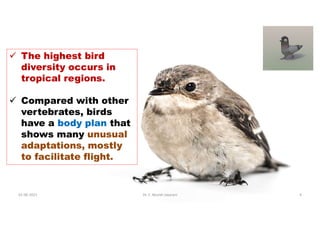
 The highest bird
diversity occurs in
tropical regions.
 Compared with other
vertebrates, birds
have a body plan that
shows many unusual
adaptations, mostly
to facilitate flight.
01-06-2021 Dr. C. Beulah Jayarani 4
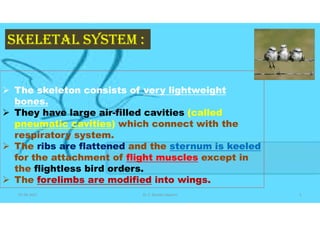
 The skeleton consists of very lightweight
bones.
 They have large air-filled cavities (called
pneumatic cavities) which connect with the
respiratory system.
 The ribs are flattened and the sternum is keeled
for the attachment of flight muscles except in
the flightless bird orders.
 The forelimbs are modified into wings.
SkElETal SySTEM :
01-06-2021 Dr. C. Beulah Jayarani 5
 Like the reptiles, birds are primarily uricotelic,
i.e, kidneys extract nitrogenous waste from
their blood stream and excrete it as uric acid
instead of urea or ammonia through the
ureters into the intestine.
 Birds do not have a urinary bladder or
external urethral opening and (with exception
of the ostrich) uric acid is excreted along
with faeces as a semisolid waste.
ExCRETORy SySTEM :
01-06-2021 Dr. C. Beulah Jayarani 6
RESpIRaTORy SySTEMS
• Most complex respiratory systems of all
animal groups.
• Upon inhalation, 75% of the fresh air
bypasses the lungs and flows directly
into a posterior air sac which extends
from the lungs and connects with air
spaces in the bones and fills them with
air.
• The other 25% of the air goes directly into
the lungs.
01-06-2021 Dr. C. Beulah Jayarani 7
CIRCulaTORy SySTEMS
• Unlike in mammals, the circulating red
blood cells in birds retain their nucleus
01-06-2021 Dr. C. Beulah Jayarani 8
NERVOuS SySTEM
• The nervous system is large relative to the
bird's size.
• The most developed part of the brain is the
one that controls the flight-related functions,
• while the cerebellum coordinates
movement and
• The cerebrum controls behaviour patterns,
navigation, mating and nest building.
01-06-2021 Dr. C. Beulah Jayarani 9
fEaThERS, pluMagE, aND SCalES
 Feathers are a feature characteristic of birds .
 They facilitate flight, provide insulation that aids in
thermoregulation, and are used in display,
camouflage, and signalling.
 The arrangement and appearance of feathers on the
body, called plumage, may vary within species by
age, social status, and sex.
 Feathers require maintenance and birds preen or
groom them daily.
01-06-2021 Dr. C. Beulah Jayarani 10
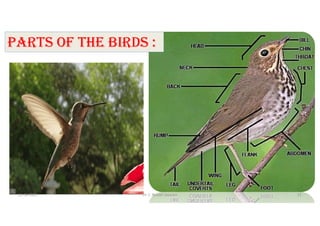
paRTS Of ThE BIRDS :
01-06-2021 Dr. C. Beulah Jayarani 11
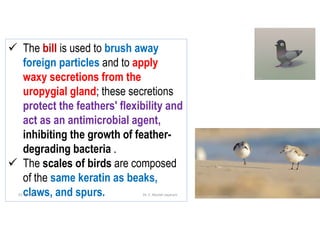
 The bill is used to brush away
foreign particles and to apply
waxy secretions from the
uropygial gland; these secretions
protect the feathers' flexibility and
act as an antimicrobial agent,
inhibiting the growth of feather-
degrading bacteria .
 The scales of birds are composed
of the same keratin as beaks,
claws, and spurs.
01-06-2021 Dr. C. Beulah Jayarani 12
Flight in birds
01-06-2021 Dr. C. Beulah Jayarani 13
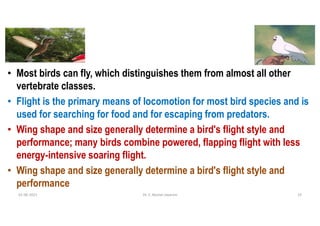
• Most birds can fly, which distinguishes them from almost all other
vertebrate classes.
• Flight is the primary means of locomotion for most bird species and is
used for searching for food and for escaping from predators.
• Wing shape and size generally determine a bird's flight style and
performance; many birds combine powered, flapping flight with less
energy-intensive soaring flight.
• Wing shape and size generally determine a bird's flight style and
performance
01-06-2021 Dr. C. Beulah Jayarani 14
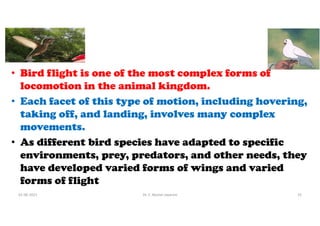
• Bird flight is one of the most complex forms of
locomotion in the animal kingdom.
• Each facet of this type of motion, including hovering,
taking off, and landing, involves many complex
movements.
• As different bird species have adapted to specific
environments, prey, predators, and other needs, they
have developed varied forms of wings and varied
forms of flight
01-06-2021 Dr. C. Beulah Jayarani 15
WINg
• The bird's forelimbs (the wings) are the key to flight.
• Each wing has a central vane to hit the wind, composed
of three limb bones, the humerus, ulna and radius.
• The hand, or manus, which ancestrally was composed of
five digits, is reduced to three digits (digit II, III and IV
or I, II, III depending on the scheme followed[3]), which
serves as an anchor for the primaries, one of two groups
of flight feathers responsible for the wing's air foil
shape.
• The other set of flight feathers, behind the carpal joint
on the ulna, are called the secondaries.
01-06-2021 Dr. C. Beulah Jayarani 16
• Take-off is one of the most energetically
demanding aspects of flight, as the bird must
generate enough airflow across the wing to create
lift.
• Small birds do this with a simple upward jump.
• That doesn't work for larger birds, which must
take a run up to generate sufficient airflow.
• Large birds take off by facing into the wind, or, if
they can, by perching on a branch or cliff so they
can just drop off into the air.
flIghT
01-06-2021 Dr. C. Beulah Jayarani 17
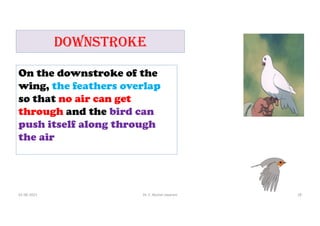
DOWNSTROkE
On the downstroke of the
wing, the feathers overlap
so that no air can get
through and the bird can
push itself along through
the air
01-06-2021 Dr. C. Beulah Jayarani 18
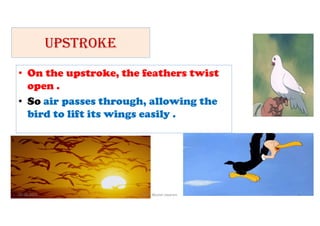
upSTROkE
• On the upstroke, the feathers twist
open .
• So air passes through, allowing the
bird to lift its wings easily .
01-06-2021 Dr. C. Beulah Jayarani 19
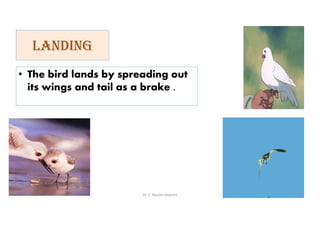
laNDINg
• The bird lands by spreading out
its wings and tail as a brake .
01-06-2021 Dr. C. Beulah Jayarani 20
REFERENCE
“SCIENCE READER”
 Tamil Nadu text book
 NCERT Books
01-06-2021 Dr. C. Beulah Jayarani 21

Movements in birds

  • 1.
    MOVEMENTS IN BIRDS DR.C. BEULAH JAYARANI M.Sc., M.A, M.Ed, M.Phil (Edn), M.Phil (ZOO), NET, Ph.D (Edn) ASST. PROFESSOR, LOYOLA COLLEGE OF EDUCATION, CHENNAI - 34
  • 2.
    BIRDS Birds are also knownas Aves A group of endothermic vertebrate. Birds are categorised as the biological class Aves in Linnaean taxonomy. 01-06-2021 Dr. C. Beulah Jayarani 2
  • 3.
    • Feather filledbody • Toothless beaked jaw • Lays hard shelled egg • Has 4 chambered heart • Strong yet light weight skeleton ChaRaCTERISTICS Of BIRDS 01-06-2021 Dr. C. Beulah Jayarani 3
  • 4.
     The highestbird diversity occurs in tropical regions.  Compared with other vertebrates, birds have a body plan that shows many unusual adaptations, mostly to facilitate flight. 01-06-2021 Dr. C. Beulah Jayarani 4
  • 5.
     The skeletonconsists of very lightweight bones.  They have large air-filled cavities (called pneumatic cavities) which connect with the respiratory system.  The ribs are flattened and the sternum is keeled for the attachment of flight muscles except in the flightless bird orders.  The forelimbs are modified into wings. SkElETal SySTEM : 01-06-2021 Dr. C. Beulah Jayarani 5
  • 6.
     Like thereptiles, birds are primarily uricotelic, i.e, kidneys extract nitrogenous waste from their blood stream and excrete it as uric acid instead of urea or ammonia through the ureters into the intestine.  Birds do not have a urinary bladder or external urethral opening and (with exception of the ostrich) uric acid is excreted along with faeces as a semisolid waste. ExCRETORy SySTEM : 01-06-2021 Dr. C. Beulah Jayarani 6
  • 7.
    RESpIRaTORy SySTEMS • Mostcomplex respiratory systems of all animal groups. • Upon inhalation, 75% of the fresh air bypasses the lungs and flows directly into a posterior air sac which extends from the lungs and connects with air spaces in the bones and fills them with air. • The other 25% of the air goes directly into the lungs. 01-06-2021 Dr. C. Beulah Jayarani 7
  • 8.
    CIRCulaTORy SySTEMS • Unlikein mammals, the circulating red blood cells in birds retain their nucleus 01-06-2021 Dr. C. Beulah Jayarani 8
  • 9.
    NERVOuS SySTEM • Thenervous system is large relative to the bird's size. • The most developed part of the brain is the one that controls the flight-related functions, • while the cerebellum coordinates movement and • The cerebrum controls behaviour patterns, navigation, mating and nest building. 01-06-2021 Dr. C. Beulah Jayarani 9
  • 10.
    fEaThERS, pluMagE, aNDSCalES  Feathers are a feature characteristic of birds .  They facilitate flight, provide insulation that aids in thermoregulation, and are used in display, camouflage, and signalling.  The arrangement and appearance of feathers on the body, called plumage, may vary within species by age, social status, and sex.  Feathers require maintenance and birds preen or groom them daily. 01-06-2021 Dr. C. Beulah Jayarani 10
  • 11.
    paRTS Of ThEBIRDS : 01-06-2021 Dr. C. Beulah Jayarani 11
  • 12.
     The billis used to brush away foreign particles and to apply waxy secretions from the uropygial gland; these secretions protect the feathers' flexibility and act as an antimicrobial agent, inhibiting the growth of feather- degrading bacteria .  The scales of birds are composed of the same keratin as beaks, claws, and spurs. 01-06-2021 Dr. C. Beulah Jayarani 12
  • 13.
    Flight in birds 01-06-2021Dr. C. Beulah Jayarani 13
  • 14.
    • Most birdscan fly, which distinguishes them from almost all other vertebrate classes. • Flight is the primary means of locomotion for most bird species and is used for searching for food and for escaping from predators. • Wing shape and size generally determine a bird's flight style and performance; many birds combine powered, flapping flight with less energy-intensive soaring flight. • Wing shape and size generally determine a bird's flight style and performance 01-06-2021 Dr. C. Beulah Jayarani 14
  • 15.
    • Bird flightis one of the most complex forms of locomotion in the animal kingdom. • Each facet of this type of motion, including hovering, taking off, and landing, involves many complex movements. • As different bird species have adapted to specific environments, prey, predators, and other needs, they have developed varied forms of wings and varied forms of flight 01-06-2021 Dr. C. Beulah Jayarani 15
  • 16.
    WINg • The bird'sforelimbs (the wings) are the key to flight. • Each wing has a central vane to hit the wind, composed of three limb bones, the humerus, ulna and radius. • The hand, or manus, which ancestrally was composed of five digits, is reduced to three digits (digit II, III and IV or I, II, III depending on the scheme followed[3]), which serves as an anchor for the primaries, one of two groups of flight feathers responsible for the wing's air foil shape. • The other set of flight feathers, behind the carpal joint on the ulna, are called the secondaries. 01-06-2021 Dr. C. Beulah Jayarani 16
  • 17.
    • Take-off isone of the most energetically demanding aspects of flight, as the bird must generate enough airflow across the wing to create lift. • Small birds do this with a simple upward jump. • That doesn't work for larger birds, which must take a run up to generate sufficient airflow. • Large birds take off by facing into the wind, or, if they can, by perching on a branch or cliff so they can just drop off into the air. flIghT 01-06-2021 Dr. C. Beulah Jayarani 17
  • 18.
    DOWNSTROkE On the downstrokeof the wing, the feathers overlap so that no air can get through and the bird can push itself along through the air 01-06-2021 Dr. C. Beulah Jayarani 18
  • 19.
    upSTROkE • On theupstroke, the feathers twist open . • So air passes through, allowing the bird to lift its wings easily . 01-06-2021 Dr. C. Beulah Jayarani 19
  • 20.
    laNDINg • The birdlands by spreading out its wings and tail as a brake . 01-06-2021 Dr. C. Beulah Jayarani 20
  • 21.
    REFERENCE “SCIENCE READER”  TamilNadu text book  NCERT Books 01-06-2021 Dr. C. Beulah Jayarani 21