D Block Elements
BS-III Chemistry 5th Semester CHE-3561
Dr. Asif Ali Bhatti
GC UNIVERSITY HYDERABAD
Department of Chemistry
Molecular Orbital Theory – Octahedral,
Tetrahedral or Square Planar Complexes
• The molecular orbital theory is highly dependent on the geometry of
the complex and can successfully be used for describing octahedral
complexes, tetrahedral and square-planar complexes
• The crystal field theory fails to explain many physical properties of the
transition metal complexes because it does not consider the
interaction between the metal and ligand orbitals
• A transition metal ion has nine valence atomic orbitals which are
consisted of five nd, three (n+1)p, and one (n+1)s orbitals
• These orbitals are of appropriate energy to form bonding interaction
with ligands
The main features of molecular orbital theory
• The atomic orbital of the metal center and of surrounding ligands
combine to form new orbitals, known as molecular orbitals.
• The number of molecular orbitals formed is the same as that of the
number of atomic orbitals combined.
• The additive overlap results in the bonding molecular orbital while
the subtractive overlap results in the antibonding overlap.
• The energy of bonding molecular orbitals is lower than their
nonbonding counterparts while the energy of antibonding molecular
orbitals is higher than that of nonbonding orbitals.
The main features of molecular orbital theory
• The energy of nonbonding orbitals remains the same.
• The ionic character of the covalent bond arises from the difference in
the energy of combining orbitals.
• If the energy of a molecular orbital is comparable to an atomic
orbital, it will not be very much different in nature from atomic
orbital.
Octahedral Complexes
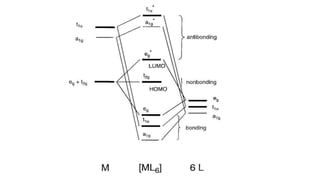
• the molecular orbitals created by the coordination of metal center
can be seen as resulting from the donation of two electrons by each
of six σ-donor ligands to the d-orbitals on the metal
• The metal orbitals taking part in this type of bonding are nd, (n+1)p
and (n+1)s.
x −y
x −y
dz2, dx2-y2 – eg
s – a1g
px, py, pz – t1u
dxy, dxz, dyz
– t2g
Octahedral Complexes
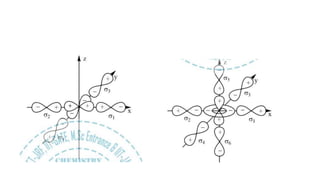
• not all nd-orbitals but only dz2 and d x2-y2 orbitals are capable of
participating in the σ-overlap.
• The dxy, dxz and dyz orbitals remain non-bonding orbitals
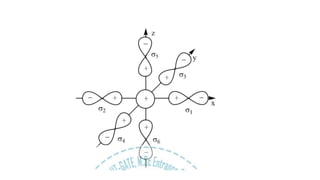
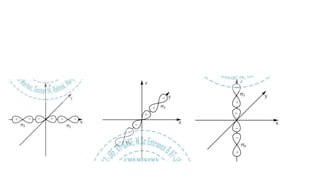
• The ligands approach the metal center along the x, y and z-axes in such a
way that their σ-symmetry orbitals form bonding and anti-bonding
combinations with metal’s s, px, py, pz, dz2 and dx2-y2 orbitals.
• A total of six bonding and six anti-bonding molecular orbitals formed
Tetrahedral Complexes
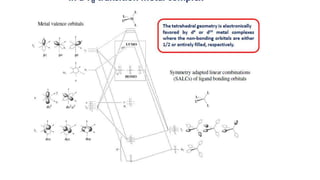
• The visualization of the composite orbital of a tetrahedral complex in
the molecular orbital framework is quite difficult because of the
absence of the centre of symmetry. However, the symmetry
designations of different metal orbitals taking part in this type of
overlap can still be given as
s – a1
px, py, pz – t2
dxy, dxz, dyz – t2
dz2, dx2 y2
− – e
Coordinate system for the tetrahedral ligand field
Characteristics of Bonding Molecular Orbitals
•The probability of finding the electron in the internuclear region of the bonding molecular orbital is greater than that
of combining atomic orbitals.
•The electrons present in the bonding molecular orbital result in the attraction between the two atoms.
•The bonding molecular orbital has lower energy as a result of attraction and hence has greater stability than that
of the combining atomic orbitals.
•They are formed by the additive effect of the atomic orbitals so that the amplitude of the new wave is given
by Φ= ΨA + ΨB
•They are represented by σ, π, and δ.
Characteristics of Anti-bonding Molecular Orbitals
•The probability of finding the electron in the internuclear region decreases in the anti-bonding molecular orbitals.
• The electrons present in the anti-bonding molecular orbital result in the repulsion between the two atoms.
•The anti-bonding molecular orbitals have higher energy because of the repulsive forces and lower stability.
•They are formed by the subtractive effect of the atomic orbitals. The amplitude of the new wave is given by Φ
´= ΨA – ΨB
•They are represented by σ∗, π∗, δ∗
Why are Antibonding Orbitals Higher in Energy?
The energy levels of bonding molecular orbitals are always lower than those of anti-bonding molecular orbitals. This is
because the electrons in the orbital are attracted by the nuclei in the case of bonding Molecular Orbitals whereas the nuclei
repel each other in the case of the anti-bonding Molecular Orbitals.
MOT.pptx
MOT.pptx
MOT.pptx
MOT.pptx
MOT.pptx
MOT.pptx

MOT.pptx

  • 1.
    D Block Elements BS-IIIChemistry 5th Semester CHE-3561 Dr. Asif Ali Bhatti GC UNIVERSITY HYDERABAD Department of Chemistry
  • 2.
    Molecular Orbital Theory– Octahedral, Tetrahedral or Square Planar Complexes • The molecular orbital theory is highly dependent on the geometry of the complex and can successfully be used for describing octahedral complexes, tetrahedral and square-planar complexes • The crystal field theory fails to explain many physical properties of the transition metal complexes because it does not consider the interaction between the metal and ligand orbitals • A transition metal ion has nine valence atomic orbitals which are consisted of five nd, three (n+1)p, and one (n+1)s orbitals • These orbitals are of appropriate energy to form bonding interaction with ligands
  • 3.
    The main featuresof molecular orbital theory • The atomic orbital of the metal center and of surrounding ligands combine to form new orbitals, known as molecular orbitals. • The number of molecular orbitals formed is the same as that of the number of atomic orbitals combined. • The additive overlap results in the bonding molecular orbital while the subtractive overlap results in the antibonding overlap. • The energy of bonding molecular orbitals is lower than their nonbonding counterparts while the energy of antibonding molecular orbitals is higher than that of nonbonding orbitals.
  • 4.
    The main featuresof molecular orbital theory • The energy of nonbonding orbitals remains the same. • The ionic character of the covalent bond arises from the difference in the energy of combining orbitals. • If the energy of a molecular orbital is comparable to an atomic orbital, it will not be very much different in nature from atomic orbital.
  • 5.
    Octahedral Complexes • themolecular orbitals created by the coordination of metal center can be seen as resulting from the donation of two electrons by each of six σ-donor ligands to the d-orbitals on the metal • The metal orbitals taking part in this type of bonding are nd, (n+1)p and (n+1)s. x −y x −y dz2, dx2-y2 – eg s – a1g px, py, pz – t1u dxy, dxz, dyz – t2g
  • 7.
    Octahedral Complexes • notall nd-orbitals but only dz2 and d x2-y2 orbitals are capable of participating in the σ-overlap. • The dxy, dxz and dyz orbitals remain non-bonding orbitals • The ligands approach the metal center along the x, y and z-axes in such a way that their σ-symmetry orbitals form bonding and anti-bonding combinations with metal’s s, px, py, pz, dz2 and dx2-y2 orbitals. • A total of six bonding and six anti-bonding molecular orbitals formed
  • 9.
    Tetrahedral Complexes • Thevisualization of the composite orbital of a tetrahedral complex in the molecular orbital framework is quite difficult because of the absence of the centre of symmetry. However, the symmetry designations of different metal orbitals taking part in this type of overlap can still be given as s – a1 px, py, pz – t2 dxy, dxz, dyz – t2 dz2, dx2 y2 − – e
  • 10.
    Coordinate system forthe tetrahedral ligand field
  • 12.
    Characteristics of BondingMolecular Orbitals •The probability of finding the electron in the internuclear region of the bonding molecular orbital is greater than that of combining atomic orbitals. •The electrons present in the bonding molecular orbital result in the attraction between the two atoms. •The bonding molecular orbital has lower energy as a result of attraction and hence has greater stability than that of the combining atomic orbitals. •They are formed by the additive effect of the atomic orbitals so that the amplitude of the new wave is given by Φ= ΨA + ΨB •They are represented by σ, π, and δ. Characteristics of Anti-bonding Molecular Orbitals •The probability of finding the electron in the internuclear region decreases in the anti-bonding molecular orbitals. • The electrons present in the anti-bonding molecular orbital result in the repulsion between the two atoms. •The anti-bonding molecular orbitals have higher energy because of the repulsive forces and lower stability. •They are formed by the subtractive effect of the atomic orbitals. The amplitude of the new wave is given by Φ ´= ΨA – ΨB •They are represented by σ∗, π∗, δ∗
  • 13.
    Why are AntibondingOrbitals Higher in Energy? The energy levels of bonding molecular orbitals are always lower than those of anti-bonding molecular orbitals. This is because the electrons in the orbital are attracted by the nuclei in the case of bonding Molecular Orbitals whereas the nuclei repel each other in the case of the anti-bonding Molecular Orbitals.