1
2
Asif Ali Bhatti
Supervisors
Dr. Shahabuddin Memon & Dr. Najma Memon
Synthesis of Macrocyclic Chelating
Agents for the Removal and
Preconcentration of Perchlorate
3
Background
Objectives
Experimental
Results and Discussion
Conclusion
Future Plan
Outlines
4
The environment constituent essential life support
system on which we depend.
The chemicals used for industrial processes often create
dangerous forms of waste.
The amount of these chemicals has risen heavily in the
past, as more areas of the world are being industrialized
and new products are produced.
Background of Study
5
Perchlorate
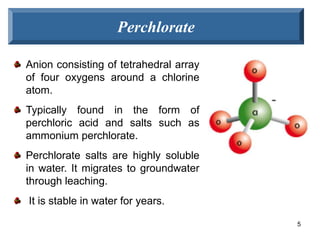
Anion consisting of tetrahedral array
of four oxygens around a chlorine
atom.
Typically found in the form of
perchloric acid and salts such as
ammonium perchlorate.
Perchlorate salts are highly soluble
in water. It migrates to groundwater
through leaching.
It is stable in water for years.
6
Rocket Fuel
Fireworks
High explosives
Flares
Herbicides
Automobile airbags
Detergents
Uses of Perchlorate
7
It acts as a competitive inhibitor of iodide
uptake by the NIS [sodium (Na+) iodide (I-)
symporter (S)] in humans.
Perchlorate can disrupt the production of thyroid
hormones and thus disrupt metabolism.
EPA considers the inhibition of
iodide uptake as the critical effect.
Health Hazards
8
The chemical was placed on the EPA Office of
Water's Contaminant Candidate List (CCL) in
1998.
In 2002, the EPA recommended a maximum
containment level (MCL) for perchlorate of 1 ppb
in drinking water
Guidelines
9
Brine Treatment
Biological Reduction Process
Membrane/Filtration Technologies
Biologically Active Carbon
Reverse Osmosis
Ion Exchange Resins
Remediation Technology
10
In recent years, much attention has been paid to chemical
separation techniques and the design and synthesis of new
extraction reagents for ions and molecules. This attention results
from environmental concerns and efforts to save energy and
enhance recycling at the industrial level.
Among synthetically available materials, macrocyclic oligomers
containing phenolic rings well known as calixarenes have
generated significant interest in the field of host–guest chemistry
as trapping agents for ionic as well as neutral species.
Immobilization of calixarene framework onto a particular resin
not only reduce their solubility but at the same time makes them
efficient for the remediation of industrial undesired molecules
11
 However, it has been planned to synthesize and immobilize
various modified calixarenes onto the polymeric supports in order
to enhance their thermal and extraction properties from organic as
well as aqueous media.
 It has also been planned to synthesize such type of material which
should be regenerated and can be used in multi-disciplines, such
as analytical and industrial fields.
 The “Supramolecular Chemistry” has provided a much better
solution to the search for molecular structures that can serve as
building blocks for producing sophisticated molecules by
anchoring functional groups oriented in such a way that they
delineate a suitable binding site for the recognition of harmful
and toxic species (ions or neutral molecules).
12
This was achieved with the development of macrocyclic molecules such as
synthetic crown ethers, cyclophanes, and cyclodextrins etc.
A relatively new class of synthetic macrocyclic building blocks has recently
been emerged:
“The Calixarenes”
13
Calixarenes
14
Members
OH O
H
O
H
O
H
O
H
OH
OH
OH
t-but
t-but
t-but
t-but
t-but
t-but
t-but
t-but
OH
OH
OH
t-but
t-but
t-but
O
H
O
H
OH
t-but
t-but
t-but
OH
OH
t-but
t-but O
H
OH
t-but
t-but
p-tert-Butylcalix[4]arene p-tert-Butylcalix[6]arene p-tert-Butylcalix[8]arene
15
Synthesis and characterization of
calix[4]arene based polymeric materials.
Application of synthesized calix[4]arene
based polymeric materials for the removal
and preconcentration of perchlorate from
water, soil and complex matrices.
Objectives
16
1. Synthesis and characterization of
Calix[4]arene based polymeric
materials.
2. Application of synthesized Calix[4]arene
based polymeric materials for the
removal of perchlorate.
Experimental
17
18
M.Yilmaz et al. Journal of Macromolecular Science, Part A: Pure and Applied Chemistry, (2006), 43, 477–486.
Scheme 1
O
H
O
H
O
H
OH
OH
O
H
O
H
O
H
OH
O
H
O
H
O
H
OH
CH2
N CH2
N
CH2
N
CH2
N
O
H
O
H
O
H
O
CH2
N CH2
N
CH2
N
CH2
N
CH2
CH CH2
1 2
3
4
i ii
iii
iv
n
i. HCHO/NaOH ii.C6H6O/AlCl3 iii. C6H10N/HCHO. Iv NaH/Merrifield Resin
19
Elemental Analysis
FT-IR Spectroscopy
Scanning Electron Microscopy (SEM)
Characterization
20
OH
OH
O
H
OH
CH2
N CH2
N
CH2
N
CH2
N
3
Elemental Analysis
C52H68N4O4
Elements Calc: Exp:
% of N 6.89 6.59
% of C 76.81 81.45
% of H 8.43 8.715
21
FT-IR Spectra
OH
OH
O
H
OH
CH2
N
CH2
N
CH2
N
CH2
N
3
5,11,17,23-Tetrakis(N-piperidinomethyl)-25,26,27,28-tetrahydroxycalix[4]arene
22
A B
SEM
Before After
24
The column sorption technique is more efficient
than batch sorption because of systematic
surface contact between sorbate and sorbent.
It can be kept in continual operation for long time.
It has large scale industrial application in various
engineering processes.
Column Study
25
Height: 60 cm
Diameter: 8 mm
Flow Rate: 2 ml/min
Bed heights : 3.5 mm
: 4.5 mm
: 5.7 mm
Effluent
Bed
Glass Wool
Column Parameters
26
Ion Chromatography
Sensitivity
Selectivity
Simultaneous Determination
Stability of Separator
Perchlorate Determination
Results and Discussion
28
R
2
= 0.9699
0
5
10
15
20
25
0 1 2 3 4 5 6
Conc. (ppm)
Peak
Area
(
uS/cm*sec
)
Concentration range: 0.05 ppm - 5 ppm
Calibration Curve
29
2ml/min, 5 ppm Perchlorate
50
55
60
65
70
75
80
85
90
95
100
0 1 2 3 4 5 6 7 8
pH
%Sorption
pH Effect
30
Breakthrough curve can be defined as “ it is a
plot of concentration measured at fixed point in
column versus time”
It gives insight picture of the column sorption
process i.e. column exhaustion or equilibrium of
sorption etc.
Breakthrough Curve
31
0
0.5
1
1.5
2
2.5
3
3.5
0 5 10 15 20 25 30 35 40
Time (min)
Ceff/Co
3mg
5mg
7mg
Theoritical 3mg
Breakthrough Curve
32
Q
(Lmin-1)
Ƭ
(min)
Co
(mgL-1)
qo
(mg/g)
0.002
13.8 5 0.14
20.5 5 0.21
26.0 5 0.26
Adsorption Capacity

 Q
C
Q
C
q o
o
o 
 )
2
(
2
1
33
Hutchins originally developed this model based
on the physically measuring the capacity of the
bed at different breakthrough values.
The rate of adsorption is controlled by the
surface reaction between adsorbate and the
unused capacity of the adsorbent.
Adsorbate is adsorbed only on the surface of the
adsorbent.
Bed Depth Service Time (BDST) Model
34
• C = Effluent Concentration (mg/L)
• Co = Initial Concentration (mg/L)
• No = Adsorption Capacity (mg/L)
• K = Rate Constant (L/mg.min)
• X = Bed Depth (mm)
• t = Service time (min)
• V = Flow Rate (ml/min)
t
KC
V
X
KN
C
C
C
o
o
o










ln
35
y = 4.533x - 0.7005
R
2
= 0.9973
0
5
10
15
20
25
30
3 3.5 4 4.5 5 5.5 6
Bed Heights
Service
Time
36
BDST Parameters
No
(mgL-1)
K
(L.mg-1.min-1)
R2
55.13 0.054 0.99
37
Single Component analysis.
YN
ln k
t
k
C
C
C
YN
o




kYN = Rate constant (Lmin-
1)
 = Time required for 50% breakthrough (min)
t = breakthrough time (min)
Yoon-Nelson Model
38
-1.0
-0.5
0.0
0.5
1.0
1.5
2.0
2.5
3.0
3.5
0 10 20 30 40 50
Time (min)
ln(C/Co-C)
3 mg
5 mg
7 mg
Theoritical
Concentration: 5 ppm, Flow Rate: 2mL/min
39
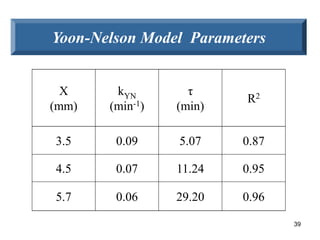
X
(mm)
kYN
(min-1)
τ
(min)
R2
3.5 0.09 5.07 0.87
4.5 0.07 11.24 0.95
5.7 0.06 29.20 0.96
Yoon-Nelson Model Parameters
40
Results achieved from present study reveals
that calix[4]arene based resin possess high
efficiency for the removal of perchlorate from
water.
The models used for mechanism of sorption best
fit the experimental data.
The study will find its applicability in the field of
material, analytical, and environmental sciences
Conclusion
41
Synthesis and characterization of calix[4]arene
based resins that are selective for perchlorate, in
this regard two schemes are under process of
synthesis in our synthetic labs.
The study will be extended to evaluate the
efficacy of the resins toward the real samples of
drinking water through preconcentration.
Future Plan
42
 It has been proposed that new convenient methods will
be developed to synthesize the novel polymeric calixarene
compounds.
 The synthesized compounds will be characterized by
applying different analytical techniques, for instance,
chromatographic techniques, FTIR, NMR, MALDI-MS
and elemental analysis.
 For analytical applications of synthesized compounds, it
has been planned to use them in the field of separation
science and their properties will be explored with the help
of UV-Visible spectrophotometer, FTIR, DSC, TGA and
AAS.
Future plan
43
OH
OH
O
H
OH
OH
OH O
OH
NO2
NO2
OR
OR
O
OH
NH2
OR
OR
O
OH
NO2
Br
N
H
OR
OR
O
OH
O
N
H
OR
OR
O
OH
O
n
m
O
Cl
1 2
3
4
Acetonitrile
Acetone/ K2CO3
Ethyl acetate/Methanol
Raney-Ni/N2H4 H2O
.
(i) BrCH2COOC2H5
(ii) R-NH2
Toluene/Methanol
R = CH2CONH(CH2)3N(CH2CH2CH3)2
5
6
CH2=CH-C Pyridine
CHCl3
Toluene
AIBN / styrene
/
R = CH2CONH(CH2)3N(CH2CH2CH3)2
44
45

6-8-10 Presentation1 - Copy.ppt

  • 1.
  • 2.
    2 Asif Ali Bhatti Supervisors Dr.Shahabuddin Memon & Dr. Najma Memon Synthesis of Macrocyclic Chelating Agents for the Removal and Preconcentration of Perchlorate
  • 3.
  • 4.
    4 The environment constituentessential life support system on which we depend. The chemicals used for industrial processes often create dangerous forms of waste. The amount of these chemicals has risen heavily in the past, as more areas of the world are being industrialized and new products are produced. Background of Study
  • 5.
    5 Perchlorate Anion consisting oftetrahedral array of four oxygens around a chlorine atom. Typically found in the form of perchloric acid and salts such as ammonium perchlorate. Perchlorate salts are highly soluble in water. It migrates to groundwater through leaching. It is stable in water for years.
  • 6.
  • 7.
    7 It acts asa competitive inhibitor of iodide uptake by the NIS [sodium (Na+) iodide (I-) symporter (S)] in humans. Perchlorate can disrupt the production of thyroid hormones and thus disrupt metabolism. EPA considers the inhibition of iodide uptake as the critical effect. Health Hazards
  • 8.
    8 The chemical wasplaced on the EPA Office of Water's Contaminant Candidate List (CCL) in 1998. In 2002, the EPA recommended a maximum containment level (MCL) for perchlorate of 1 ppb in drinking water Guidelines
  • 9.
    9 Brine Treatment Biological ReductionProcess Membrane/Filtration Technologies Biologically Active Carbon Reverse Osmosis Ion Exchange Resins Remediation Technology
  • 10.
    10 In recent years,much attention has been paid to chemical separation techniques and the design and synthesis of new extraction reagents for ions and molecules. This attention results from environmental concerns and efforts to save energy and enhance recycling at the industrial level. Among synthetically available materials, macrocyclic oligomers containing phenolic rings well known as calixarenes have generated significant interest in the field of host–guest chemistry as trapping agents for ionic as well as neutral species. Immobilization of calixarene framework onto a particular resin not only reduce their solubility but at the same time makes them efficient for the remediation of industrial undesired molecules
  • 11.
    11  However, ithas been planned to synthesize and immobilize various modified calixarenes onto the polymeric supports in order to enhance their thermal and extraction properties from organic as well as aqueous media.  It has also been planned to synthesize such type of material which should be regenerated and can be used in multi-disciplines, such as analytical and industrial fields.  The “Supramolecular Chemistry” has provided a much better solution to the search for molecular structures that can serve as building blocks for producing sophisticated molecules by anchoring functional groups oriented in such a way that they delineate a suitable binding site for the recognition of harmful and toxic species (ions or neutral molecules).
  • 12.
    12 This was achievedwith the development of macrocyclic molecules such as synthetic crown ethers, cyclophanes, and cyclodextrins etc. A relatively new class of synthetic macrocyclic building blocks has recently been emerged: “The Calixarenes”
  • 13.
  • 14.
  • 15.
    15 Synthesis and characterizationof calix[4]arene based polymeric materials. Application of synthesized calix[4]arene based polymeric materials for the removal and preconcentration of perchlorate from water, soil and complex matrices. Objectives
  • 16.
    16 1. Synthesis andcharacterization of Calix[4]arene based polymeric materials. 2. Application of synthesized Calix[4]arene based polymeric materials for the removal of perchlorate. Experimental
  • 17.
  • 18.
    18 M.Yilmaz et al.Journal of Macromolecular Science, Part A: Pure and Applied Chemistry, (2006), 43, 477–486. Scheme 1 O H O H O H OH OH O H O H O H OH O H O H O H OH CH2 N CH2 N CH2 N CH2 N O H O H O H O CH2 N CH2 N CH2 N CH2 N CH2 CH CH2 1 2 3 4 i ii iii iv n i. HCHO/NaOH ii.C6H6O/AlCl3 iii. C6H10N/HCHO. Iv NaH/Merrifield Resin
  • 19.
    19 Elemental Analysis FT-IR Spectroscopy ScanningElectron Microscopy (SEM) Characterization
  • 20.
    20 OH OH O H OH CH2 N CH2 N CH2 N CH2 N 3 Elemental Analysis C52H68N4O4 ElementsCalc: Exp: % of N 6.89 6.59 % of C 76.81 81.45 % of H 8.43 8.715
  • 21.
  • 22.
  • 24.
    24 The column sorptiontechnique is more efficient than batch sorption because of systematic surface contact between sorbate and sorbent. It can be kept in continual operation for long time. It has large scale industrial application in various engineering processes. Column Study
  • 25.
    25 Height: 60 cm Diameter:8 mm Flow Rate: 2 ml/min Bed heights : 3.5 mm : 4.5 mm : 5.7 mm Effluent Bed Glass Wool Column Parameters
  • 26.
  • 27.
  • 28.
    28 R 2 = 0.9699 0 5 10 15 20 25 0 12 3 4 5 6 Conc. (ppm) Peak Area ( uS/cm*sec ) Concentration range: 0.05 ppm - 5 ppm Calibration Curve
  • 29.
    29 2ml/min, 5 ppmPerchlorate 50 55 60 65 70 75 80 85 90 95 100 0 1 2 3 4 5 6 7 8 pH %Sorption pH Effect
  • 30.
    30 Breakthrough curve canbe defined as “ it is a plot of concentration measured at fixed point in column versus time” It gives insight picture of the column sorption process i.e. column exhaustion or equilibrium of sorption etc. Breakthrough Curve
  • 31.
    31 0 0.5 1 1.5 2 2.5 3 3.5 0 5 1015 20 25 30 35 40 Time (min) Ceff/Co 3mg 5mg 7mg Theoritical 3mg Breakthrough Curve
  • 32.
    32 Q (Lmin-1) Ƭ (min) Co (mgL-1) qo (mg/g) 0.002 13.8 5 0.14 20.55 0.21 26.0 5 0.26 Adsorption Capacity   Q C Q C q o o o   ) 2 ( 2 1
  • 33.
    33 Hutchins originally developedthis model based on the physically measuring the capacity of the bed at different breakthrough values. The rate of adsorption is controlled by the surface reaction between adsorbate and the unused capacity of the adsorbent. Adsorbate is adsorbed only on the surface of the adsorbent. Bed Depth Service Time (BDST) Model
  • 34.
    34 • C =Effluent Concentration (mg/L) • Co = Initial Concentration (mg/L) • No = Adsorption Capacity (mg/L) • K = Rate Constant (L/mg.min) • X = Bed Depth (mm) • t = Service time (min) • V = Flow Rate (ml/min) t KC V X KN C C C o o o           ln
  • 35.
    35 y = 4.533x- 0.7005 R 2 = 0.9973 0 5 10 15 20 25 30 3 3.5 4 4.5 5 5.5 6 Bed Heights Service Time
  • 36.
  • 37.
    37 Single Component analysis. YN lnk t k C C C YN o     kYN = Rate constant (Lmin- 1)  = Time required for 50% breakthrough (min) t = breakthrough time (min) Yoon-Nelson Model
  • 38.
    38 -1.0 -0.5 0.0 0.5 1.0 1.5 2.0 2.5 3.0 3.5 0 10 2030 40 50 Time (min) ln(C/Co-C) 3 mg 5 mg 7 mg Theoritical Concentration: 5 ppm, Flow Rate: 2mL/min
  • 39.
    39 X (mm) kYN (min-1) τ (min) R2 3.5 0.09 5.070.87 4.5 0.07 11.24 0.95 5.7 0.06 29.20 0.96 Yoon-Nelson Model Parameters
  • 40.
    40 Results achieved frompresent study reveals that calix[4]arene based resin possess high efficiency for the removal of perchlorate from water. The models used for mechanism of sorption best fit the experimental data. The study will find its applicability in the field of material, analytical, and environmental sciences Conclusion
  • 41.
    41 Synthesis and characterizationof calix[4]arene based resins that are selective for perchlorate, in this regard two schemes are under process of synthesis in our synthetic labs. The study will be extended to evaluate the efficacy of the resins toward the real samples of drinking water through preconcentration. Future Plan
  • 42.
    42  It hasbeen proposed that new convenient methods will be developed to synthesize the novel polymeric calixarene compounds.  The synthesized compounds will be characterized by applying different analytical techniques, for instance, chromatographic techniques, FTIR, NMR, MALDI-MS and elemental analysis.  For analytical applications of synthesized compounds, it has been planned to use them in the field of separation science and their properties will be explored with the help of UV-Visible spectrophotometer, FTIR, DSC, TGA and AAS. Future plan
  • 43.
    43 OH OH O H OH OH OH O OH NO2 NO2 OR OR O OH NH2 OR OR O OH NO2 Br N H OR OR O OH O N H OR OR O OH O n m O Cl 1 2 3 4 Acetonitrile Acetone/K2CO3 Ethyl acetate/Methanol Raney-Ni/N2H4 H2O . (i) BrCH2COOC2H5 (ii) R-NH2 Toluene/Methanol R = CH2CONH(CH2)3N(CH2CH2CH3)2 5 6 CH2=CH-C Pyridine CHCl3 Toluene AIBN / styrene / R = CH2CONH(CH2)3N(CH2CH2CH3)2
  • 44.
  • 45.