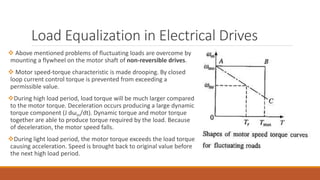
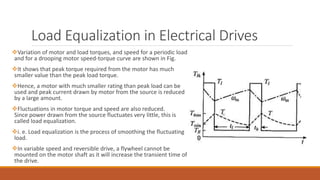
This document discusses load equalization in electrical drives. It explains that some drives experience widely fluctuating load torque over short periods of time, such as pressing machines. This can require high peak motor torque and cause current pulses that affect other loads on the supply line. To overcome this, a flywheel is mounted on the motor shaft of non-reversible drives. The motor torque is made drooping while current control prevents it from exceeding limits. During high loads, the flywheel stores energy to help meet torque demands, while during low loads it returns energy to accelerate the motor back to its original speed before the next high load period. This smoothing of torque fluctuations is called load equalization.