Motives and theories of
Motives
Motives
A motive is something that causes us to act or behave in order to reach a a goal or desired endpoint. It comes from the
latin word that means 'moving'. A motive is the reason WHY you do something.
For example, a motive for exercise is better health and weight loss.
Types of Motives
Psychologists have divided motives into three types—
Biological motives,
social motives and
personal motives!
The goal here may be fulfillment of a want or a need. Whenever a need arises the organism is
driven to fulfil that want or need.
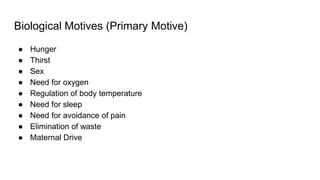
Biological Motives (Primary Motive)
● Hunger
● Thirst
● Sex
● Need for oxygen
● Regulation of body temperature
● Need for sleep
● Need for avoidance of pain
● Elimination of waste
● Maternal Drive
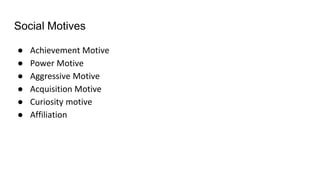
Social Motives
● Achievement Motive
● Power Motive
● Aggressive Motive
● Acquisition Motive
● Curiosity motive
● Affiliation
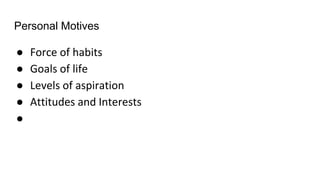
Personal Motives
● Force of habits
● Goals of life
● Levels of aspiration
● Attitudes and Interests
●
Theories of Motives
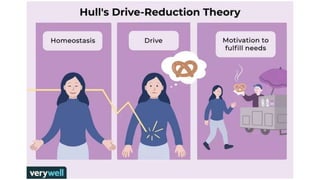
Drive-Reduction Theory - Clark Hull
According to drive-reduction theory:
a physiological need creates an aroused tension state (a
drive) that motivates an organism to satisfy the need.
2. AROUSAL THEORY
We are motivated by seeking an optimum level of
excitement or arousal.
We are driven by the need to explore, to satisfy
our curiosity. Each of us has an optimum level of
stimulation that we like to maintain. Look out how
your relax when you are stressed out? Do you go
for a walk, read a book, or do you workout?
INCENTIVE THEORY
Incentive
a positive or negative environmental stimulus that motivates behavior
Behavior is not pushed by a need but pulled by a desire for
achievement. We are motivated to seek the rewards. We are
attracted to particular goals or motives. Culture and experiences
are important determining factors.
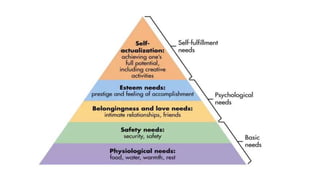
5. Maslow’s Hierarchy of Needs
Abraham Maslow (1908-1970) was a humanistic
psychologist. Humanists focus on fulfilling one’s
potential. Humans strive for personal growth..that basic
needs must be satisfied before moving on to the next level.
Maslow believed that not all needs are created equal. He
described a hierarchy of needs that predicts which needs
we are motivated to satisfy first.
begins at the base with physiological needs that must first be
satisfied
then higher-level safety needs become active
then psychological needs become active

Motives and theory.pptx

  • 1.
  • 2.
    Motives A motive issomething that causes us to act or behave in order to reach a a goal or desired endpoint. It comes from the latin word that means 'moving'. A motive is the reason WHY you do something. For example, a motive for exercise is better health and weight loss.
  • 3.
    Types of Motives Psychologistshave divided motives into three types— Biological motives, social motives and personal motives! The goal here may be fulfillment of a want or a need. Whenever a need arises the organism is driven to fulfil that want or need.
  • 4.
    Biological Motives (PrimaryMotive) ● Hunger ● Thirst ● Sex ● Need for oxygen ● Regulation of body temperature ● Need for sleep ● Need for avoidance of pain ● Elimination of waste ● Maternal Drive
  • 5.
    Social Motives ● AchievementMotive ● Power Motive ● Aggressive Motive ● Acquisition Motive ● Curiosity motive ● Affiliation
  • 6.
    Personal Motives ● Forceof habits ● Goals of life ● Levels of aspiration ● Attitudes and Interests ●
  • 7.
  • 8.
    Drive-Reduction Theory -Clark Hull According to drive-reduction theory: a physiological need creates an aroused tension state (a drive) that motivates an organism to satisfy the need.
  • 10.
    2. AROUSAL THEORY Weare motivated by seeking an optimum level of excitement or arousal. We are driven by the need to explore, to satisfy our curiosity. Each of us has an optimum level of stimulation that we like to maintain. Look out how your relax when you are stressed out? Do you go for a walk, read a book, or do you workout?
  • 11.
    INCENTIVE THEORY Incentive a positiveor negative environmental stimulus that motivates behavior Behavior is not pushed by a need but pulled by a desire for achievement. We are motivated to seek the rewards. We are attracted to particular goals or motives. Culture and experiences are important determining factors.
  • 12.
    5. Maslow’s Hierarchyof Needs Abraham Maslow (1908-1970) was a humanistic psychologist. Humanists focus on fulfilling one’s potential. Humans strive for personal growth..that basic needs must be satisfied before moving on to the next level. Maslow believed that not all needs are created equal. He described a hierarchy of needs that predicts which needs we are motivated to satisfy first.
  • 14.
    begins at thebase with physiological needs that must first be satisfied then higher-level safety needs become active then psychological needs become active