
MOTIVATION
Presented By-
Mr.Vivekananda D S
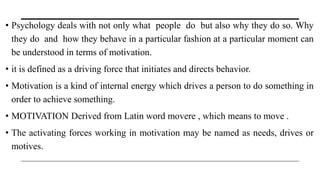
• Psychology deals with not only what people do but also why they do so. Why
they do and how they behave in a particular fashion at a particular moment can
be understood in terms of motivation.
• it is defined as a driving force that initiates and directs behavior.
• Motivation is a kind of internal energy which drives a person to do something in
order to achieve something.
• MOTIVATION Derived from Latin word movere , which means to move .
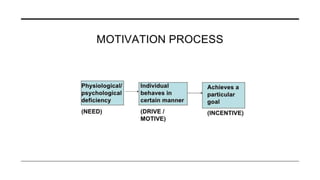
• The activating forces working in motivation may be named as needs, drives or
motives.
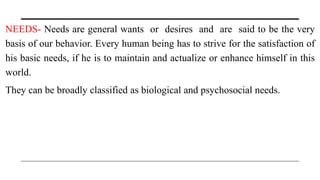
NEEDS- Needs are general wants or desires and are said to be the very
basis of our behavior. Every human being has to strive for the satisfaction of
his basic needs, if he is to maintain and actualize or enhance himself in this
world.
They can be broadly classified as biological and psychosocial needs.
• Biological Needs
Biological needs are necessary for the survival of the individual. These are
also called physiological or unlearned needs. The biological needs include
all our bodily or organic needs like need for oxygen, food, water,
temperature, rest, sleep and sex, etc. These needs must be met at least to the
minimum for maintaining life.
• Psychosocial Needs
The psychosocial needs are acquired through social learning and contact
with others.
These are linked with socio-cultural environment and psychological make
up of an individual. These are also termed as secondary needs.
The needs, which fall under this category are need for freedom, security,
love and affection, recognition and social approval, social company, self-
assertion and self-actualization.
DRIVES- propel individuals to attain their goals or satisfy their needs.
Drives of any nature are divided into two categories:
• Biological or primary drive
• Socio-psychological or secondary drive
• Biological Drive
Biological needs give birth to biological drives such as hunger, thirst, sex and
escape from pain. The biological drives are basically unlearned in nature.
They arise from our biological needs as a result of a biological mechanism
called homeostasis.
• Socio-psychological or Secondary Drive
It includes fear or anxiety, desire for approval, striving for achievement,
aggression and dependence.
These drives move an individual to act for the satisfaction of his socio-
psychological needs, which in turn act as a reinforcer of the behavior for the
continuity and maintenance of the behavior. Thus, drives act as basic
activating force behind a behavior.
INCENTIVES- Anything that incites rouses or encourages a person is
termed as an incentive. Drives are influenced and guided by incentives.
Praise, appreciation, regards, bonus, etc. are examples of incentives.
• Whether primary or secondary drive, it is greatly affected and directed by
the incentives.
MOTIVES
A motive etymologically means that ‘which moves’. A motive may be
considered as an energetic force or tendency (learned or innate) working
within the individual to compel, persuade or inspire him to act for the
satisfaction of his basic needs or attainment of some specific purpose.
OR
A reason for doing something.
Definitions
• A need gives rise to one or more motives. A motive is a rather specific
process, which has been learned. It is directed towards a goal. (Carol)
• The driving force within individuals by which they attempt to achieve
some goal in order to fulfill some needs or expectation.
TYPES OF MOTIVATION- two main categories:
• Intrinsic or Natural Motivation
• Extrinsic or Unnatural Motivation
Intrinsic Motivation
• Defined as self-respect of accomplishment and personal growth. That is, the emotional
and personal benefits of the job itself are known as intrinsic rewards. -Ellis
• Intrinsic motivation refers to motivation that comes from inside an individual rather
than from any external or outside rewards, such as money or grades.
• The motivation comes from the pleasure one gets from the task itself or from the sense
of satisfaction in completing or even working on a task.
• Social-contextual events such as feedback, communications, rewards which cause
feelings of competence foster intrinsic motivation
• While positive performance feedback increases intrinsic motivation, negative
performance feedback decreases it.
Extrinsic Motivation
•Extrinsic Motivation is said to be less effective because source of pleasure
does not lie within task.
Individual learns or does something not for his own sake, but as a means of
obtaining goals or getting rewards.
•"Tangible benefits" related to job such as salary, fringe benefits and job
security are known as extrinsic motivation.
THEORIES OF MOTIVATION
Instinct Theory of Motivation(Freud’s viewpoint)
According to instinct theories, people are motivated to behave in certain
ways because they are evolutionarily programmed to do so.
Example of this in the animal world is seasonal migration. These animals do
not learn to do this; it is instead an inborn pattern of behavior.
Human instincts that included are attachment, play, shame, anger, fear,
shyness, modesty and love. The main problem with this theory is that it did
not really explain behavior.
According to William McDougall all behavioral acts are essentially
instinctive and this instinctive behavior is found to have three aspects:
• Cognitive (knowing)
• Affecting (feeling)
• Conative (acting or doing)
For example, when a child sees a monkey coming towards him, first, he sees
the monkey, second, he experiences an emotion of fear and third, he tries
to run away.
Drive Theory (Push Theory of Motivation)- Behaviorist's viewpoint
• Watson, Clark, Hull & Skinner
• Needs and Drives work as stimuli to evoke responses in the form of
motivational behaviour. For example, a person might be motivated to
drink a glass of water in order to reduce the internal state of thirst.
• Humans and other animals are motivated by four drives: hunger, thirst,
sex and the avoidance of pain.
• The problem with the drive theory of motivation is that these behaviors
are not always motivated purely by physiological needs. For example,
people often eat even when they are not really hungry.
Motivation consists of:
• A drive state.
• Goal-directed behavior initiated by the drive state.
• The attainment of an appropriate goal.
• The reduction of the drive state and subjective satisfaction and
relief when the goal is reached.
Arousal Theory of Motivation
Arousal is the level of alertness, wakefulness and activation caused by
activity in the central nervous system. The optimal level of arousal varies
with the person and the activity. The arousal theory of motivation suggests
that people take certain actions to either decrease or increase levels of
arousal.
According to this theory, we are motivated to maintain an optimal level of
arousal, although this level can vary based on the individual or the situation.
Incentive Theory of Motivation (Pull Theory of Motivation)
• This theory proposed by Thorndike, Pavlov, Watson and BF Skinner.
• The incentive theory suggests that people are motivated to do things
because of external rewards. This theory emphasizes that an attractive
incentive energizes us to do something, while an unattractive incentive
discourages us to do something.
• We are pushed by our drives and pulled by incentives.
• The drive is the need and the incentive is the reward.
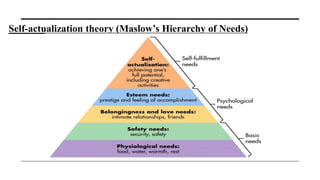
Self-actualization theory (Maslow’s Hierarchy of Needs)
MOTIVES AND BEHAVIOUR
• Motive is an inner state of mind or an aroused feeling.
• It is generated through basic needs or drives.
• It compels an individual to respond by creating tension/urge to act.
• Motives act as the immediate force to energize, direct, sustain and
stop a behavior.
• Motives are a powerful tool for explaining behavior.
• Motives help us to make predictions about behavior in many
different situations.
• Motives are inner forces that control an individual’s behavior in a
subtle manner.
• It is a goal-directed activity, pursued till the attainment of the goal.
• A change in goal may bring changes in the nature and strength of
the motive.
• The attainment of a goal helps in the release of tension aroused by
specific motive.
IMPLICATIONS FOR NURSES
• The nurse should know how behavior is motivated by different needs.
• The nurse should understand the role of primary, social, personal and
unconscious motives in human behavior.
• Helps to understand her own motives.
• Role of motivation in the process of learning and training.
• To recognize motive behind the behavior of the patient.
• To recognize patient’s needs and desires.
• To build a good relationship between the patient and the health
team members.
• To provide priority care (i.e. meeting primary needs before
meeting other needs).
• To satisfy patient needs.
• To promote healing and health in the patient.
• Knowledge of the human needs assists nurses in responding
therapeutically to patient’s behavior.

Motivation

  • 1.
  • 3.
    • Psychology dealswith not only what people do but also why they do so. Why they do and how they behave in a particular fashion at a particular moment can be understood in terms of motivation. • it is defined as a driving force that initiates and directs behavior. • Motivation is a kind of internal energy which drives a person to do something in order to achieve something. • MOTIVATION Derived from Latin word movere , which means to move . • The activating forces working in motivation may be named as needs, drives or motives.
  • 5.
    NEEDS- Needs aregeneral wants or desires and are said to be the very basis of our behavior. Every human being has to strive for the satisfaction of his basic needs, if he is to maintain and actualize or enhance himself in this world. They can be broadly classified as biological and psychosocial needs.
  • 6.
    • Biological Needs Biologicalneeds are necessary for the survival of the individual. These are also called physiological or unlearned needs. The biological needs include all our bodily or organic needs like need for oxygen, food, water, temperature, rest, sleep and sex, etc. These needs must be met at least to the minimum for maintaining life.
  • 7.
    • Psychosocial Needs Thepsychosocial needs are acquired through social learning and contact with others. These are linked with socio-cultural environment and psychological make up of an individual. These are also termed as secondary needs. The needs, which fall under this category are need for freedom, security, love and affection, recognition and social approval, social company, self- assertion and self-actualization.
  • 8.
    DRIVES- propel individualsto attain their goals or satisfy their needs. Drives of any nature are divided into two categories: • Biological or primary drive • Socio-psychological or secondary drive • Biological Drive Biological needs give birth to biological drives such as hunger, thirst, sex and escape from pain. The biological drives are basically unlearned in nature. They arise from our biological needs as a result of a biological mechanism called homeostasis.
  • 9.
    • Socio-psychological orSecondary Drive It includes fear or anxiety, desire for approval, striving for achievement, aggression and dependence. These drives move an individual to act for the satisfaction of his socio- psychological needs, which in turn act as a reinforcer of the behavior for the continuity and maintenance of the behavior. Thus, drives act as basic activating force behind a behavior.
  • 10.
    INCENTIVES- Anything thatincites rouses or encourages a person is termed as an incentive. Drives are influenced and guided by incentives. Praise, appreciation, regards, bonus, etc. are examples of incentives. • Whether primary or secondary drive, it is greatly affected and directed by the incentives.
  • 11.
    MOTIVES A motive etymologicallymeans that ‘which moves’. A motive may be considered as an energetic force or tendency (learned or innate) working within the individual to compel, persuade or inspire him to act for the satisfaction of his basic needs or attainment of some specific purpose. OR A reason for doing something.
  • 12.
    Definitions • A needgives rise to one or more motives. A motive is a rather specific process, which has been learned. It is directed towards a goal. (Carol) • The driving force within individuals by which they attempt to achieve some goal in order to fulfill some needs or expectation. TYPES OF MOTIVATION- two main categories: • Intrinsic or Natural Motivation • Extrinsic or Unnatural Motivation
  • 13.
    Intrinsic Motivation • Definedas self-respect of accomplishment and personal growth. That is, the emotional and personal benefits of the job itself are known as intrinsic rewards. -Ellis • Intrinsic motivation refers to motivation that comes from inside an individual rather than from any external or outside rewards, such as money or grades. • The motivation comes from the pleasure one gets from the task itself or from the sense of satisfaction in completing or even working on a task. • Social-contextual events such as feedback, communications, rewards which cause feelings of competence foster intrinsic motivation • While positive performance feedback increases intrinsic motivation, negative performance feedback decreases it.
  • 14.
    Extrinsic Motivation •Extrinsic Motivationis said to be less effective because source of pleasure does not lie within task. Individual learns or does something not for his own sake, but as a means of obtaining goals or getting rewards. •"Tangible benefits" related to job such as salary, fringe benefits and job security are known as extrinsic motivation.
  • 15.
    THEORIES OF MOTIVATION InstinctTheory of Motivation(Freud’s viewpoint) According to instinct theories, people are motivated to behave in certain ways because they are evolutionarily programmed to do so. Example of this in the animal world is seasonal migration. These animals do not learn to do this; it is instead an inborn pattern of behavior. Human instincts that included are attachment, play, shame, anger, fear, shyness, modesty and love. The main problem with this theory is that it did not really explain behavior.
  • 16.
    According to WilliamMcDougall all behavioral acts are essentially instinctive and this instinctive behavior is found to have three aspects: • Cognitive (knowing) • Affecting (feeling) • Conative (acting or doing) For example, when a child sees a monkey coming towards him, first, he sees the monkey, second, he experiences an emotion of fear and third, he tries to run away.
  • 17.
    Drive Theory (PushTheory of Motivation)- Behaviorist's viewpoint • Watson, Clark, Hull & Skinner • Needs and Drives work as stimuli to evoke responses in the form of motivational behaviour. For example, a person might be motivated to drink a glass of water in order to reduce the internal state of thirst. • Humans and other animals are motivated by four drives: hunger, thirst, sex and the avoidance of pain. • The problem with the drive theory of motivation is that these behaviors are not always motivated purely by physiological needs. For example, people often eat even when they are not really hungry.
  • 18.
    Motivation consists of: •A drive state. • Goal-directed behavior initiated by the drive state. • The attainment of an appropriate goal. • The reduction of the drive state and subjective satisfaction and relief when the goal is reached.
  • 19.
    Arousal Theory ofMotivation Arousal is the level of alertness, wakefulness and activation caused by activity in the central nervous system. The optimal level of arousal varies with the person and the activity. The arousal theory of motivation suggests that people take certain actions to either decrease or increase levels of arousal. According to this theory, we are motivated to maintain an optimal level of arousal, although this level can vary based on the individual or the situation.
  • 20.
    Incentive Theory ofMotivation (Pull Theory of Motivation) • This theory proposed by Thorndike, Pavlov, Watson and BF Skinner. • The incentive theory suggests that people are motivated to do things because of external rewards. This theory emphasizes that an attractive incentive energizes us to do something, while an unattractive incentive discourages us to do something. • We are pushed by our drives and pulled by incentives. • The drive is the need and the incentive is the reward.
  • 21.
  • 22.
    MOTIVES AND BEHAVIOUR •Motive is an inner state of mind or an aroused feeling. • It is generated through basic needs or drives. • It compels an individual to respond by creating tension/urge to act. • Motives act as the immediate force to energize, direct, sustain and stop a behavior. • Motives are a powerful tool for explaining behavior.
  • 23.
    • Motives helpus to make predictions about behavior in many different situations. • Motives are inner forces that control an individual’s behavior in a subtle manner. • It is a goal-directed activity, pursued till the attainment of the goal. • A change in goal may bring changes in the nature and strength of the motive. • The attainment of a goal helps in the release of tension aroused by specific motive.
  • 24.
    IMPLICATIONS FOR NURSES •The nurse should know how behavior is motivated by different needs. • The nurse should understand the role of primary, social, personal and unconscious motives in human behavior. • Helps to understand her own motives. • Role of motivation in the process of learning and training. • To recognize motive behind the behavior of the patient. • To recognize patient’s needs and desires.
  • 25.
    • To builda good relationship between the patient and the health team members. • To provide priority care (i.e. meeting primary needs before meeting other needs). • To satisfy patient needs. • To promote healing and health in the patient. • Knowledge of the human needs assists nurses in responding therapeutically to patient’s behavior.