Group 3
Abdirahman
saed sh. elmi
Bashir aidid
hazzan Asia Abdi farax
Zulema Abdi
elmi
Zuhuur Yousuf
maxamoud
01 Introduction to
motivation
02
OPTIO
N
Components of
motivation
03
OPTION
Important of motivation 04
OPTION
Categories of motivation
05
OPTION
Types of motivation 06
OPTION
Perspectives of
Motivation
07
OPTION
?
Introduction
• The term 'MOTIVATION' has been derived from the Latin word MOVERE'
which means 'TO MOVE’.
• motivation The factors that direct and energize the behavior of humans
and other organisms.
• Motivation means a process of stimulating people to action to accomplish
desired goals.
Cont’
• MOTIVATION is a set of processes that moves a person toward a goal.
• Motive: need or want that causes us to act (energize us).
Money is the motive
Importance of motivation
• Generates energy to be productive, creative
• Helps us accomplish tasks/ goals
• Enables us to maintain productivity
• Improves performance level of individuals
• Increases job satisfaction
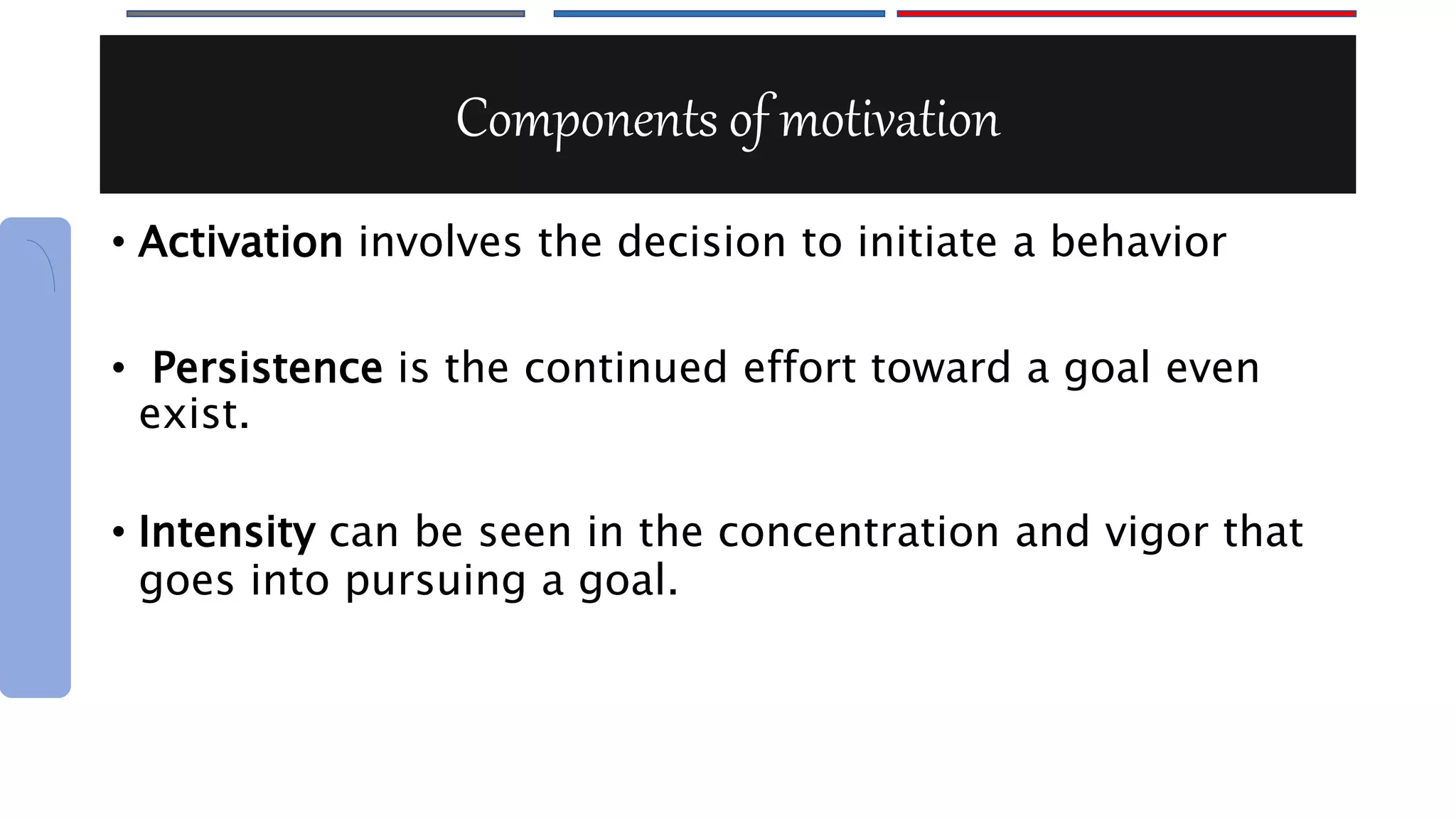
Components of motivation
• Activation involves the decision to initiate a behavior
• Persistence is the continued effort toward a goal even
exist.
• Intensity can be seen in the concentration and vigor that
goes into pursuing a goal.
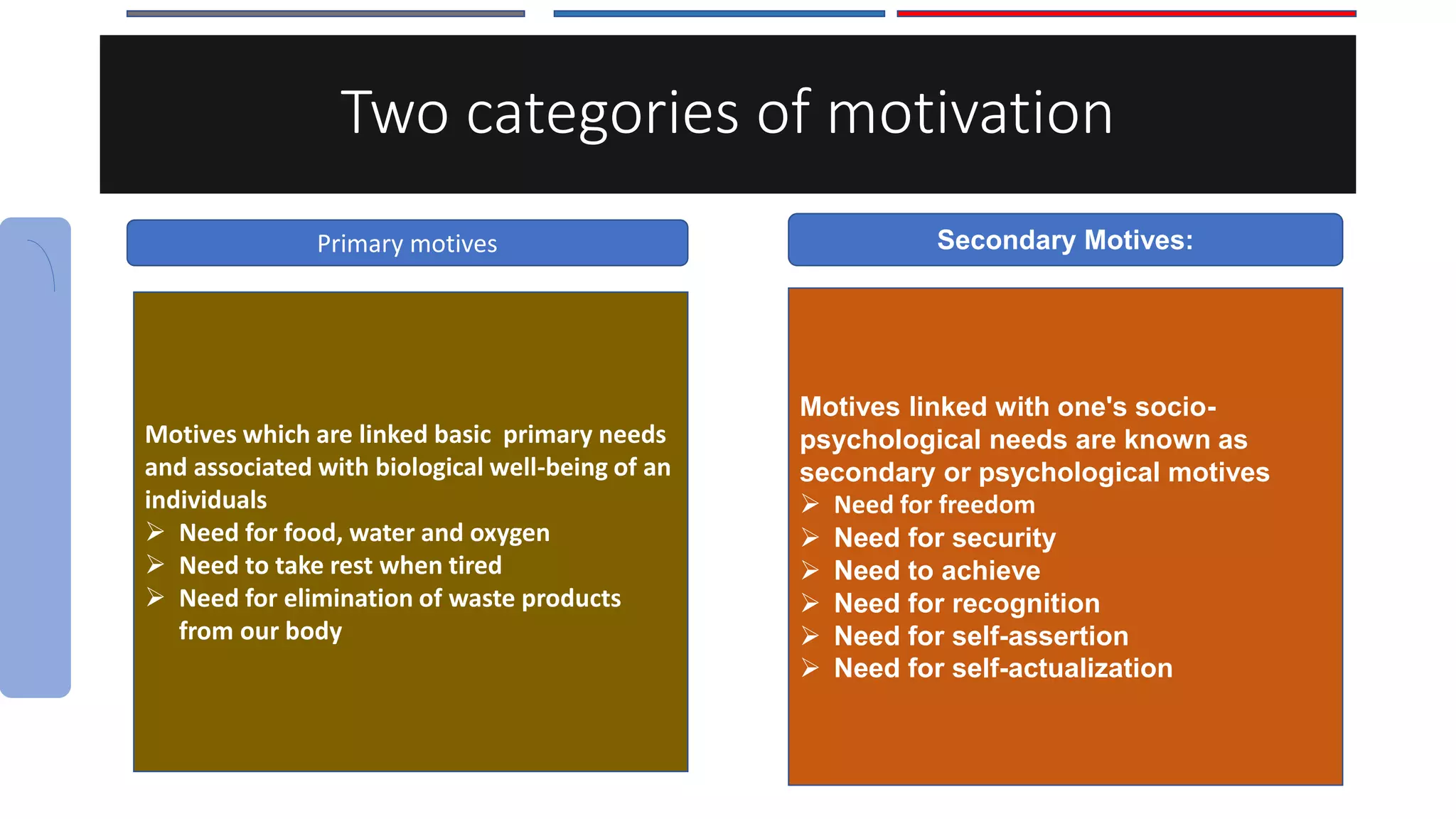
Two categories of motivation
Motives which are linked basic primary needs
and associated with biological well-being of an
individuals
 Need for food, water and oxygen
 Need to take rest when tired
 Need for elimination of waste products
from our body
Motives linked with one's socio-
psychological needs are known as
secondary or psychological motives
 Need for freedom
 Need for security
 Need to achieve
 Need for recognition
 Need for self-assertion
 Need for self-actualization
Primary motives Secondary Motives:
Types of motivation
Types of motivation
on the basis of source On the basis of approach
Extrinsic motivation Intrinsic motivation Positive motivation Negative motivation
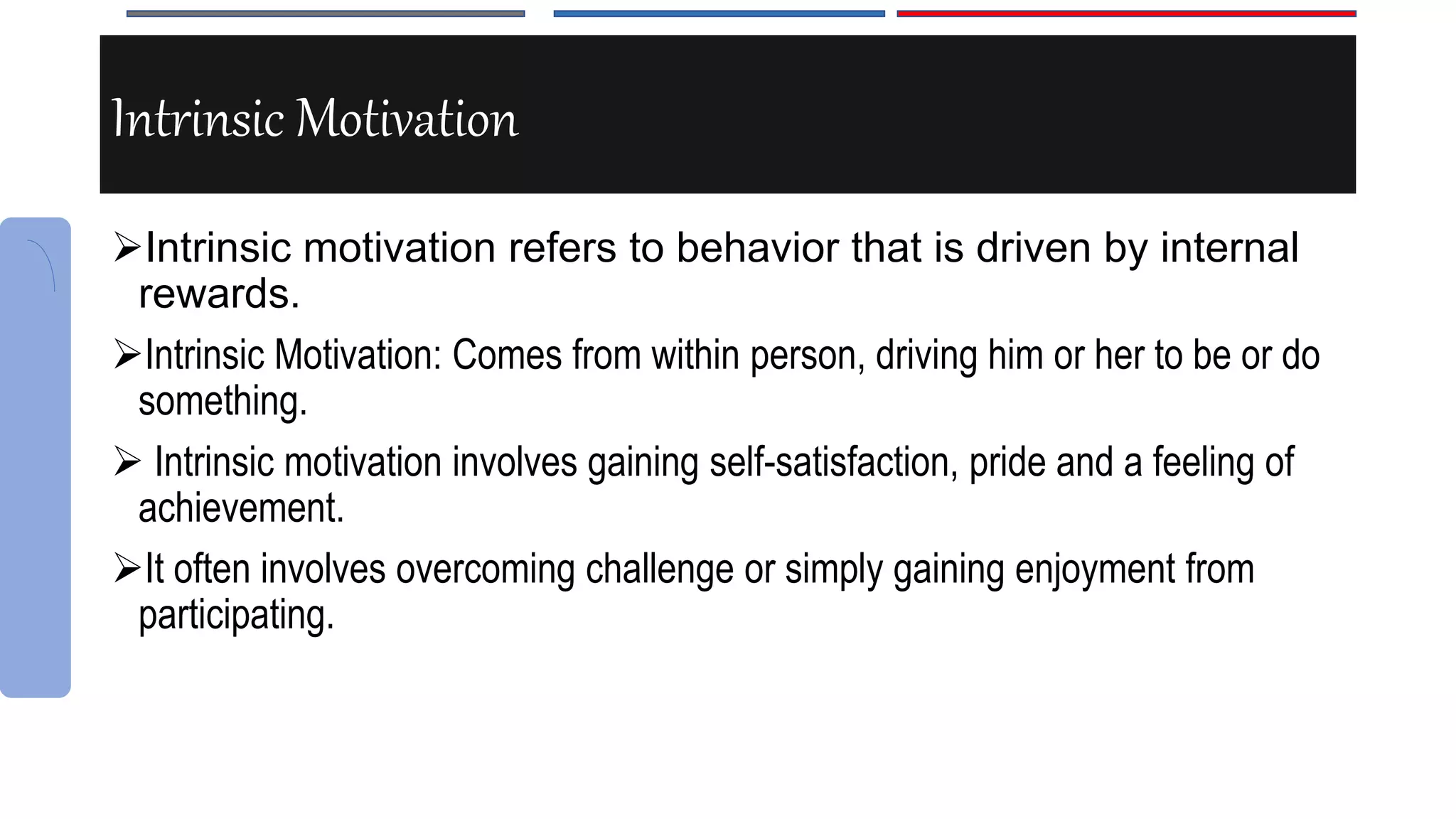
Intrinsic Motivation
Intrinsic motivation refers to behavior that is driven by internal
rewards.
Intrinsic Motivation: Comes from within person, driving him or her to be or do
something.
 Intrinsic motivation involves gaining self-satisfaction, pride and a feeling of
achievement.
It often involves overcoming challenge or simply gaining enjoyment from
participating.
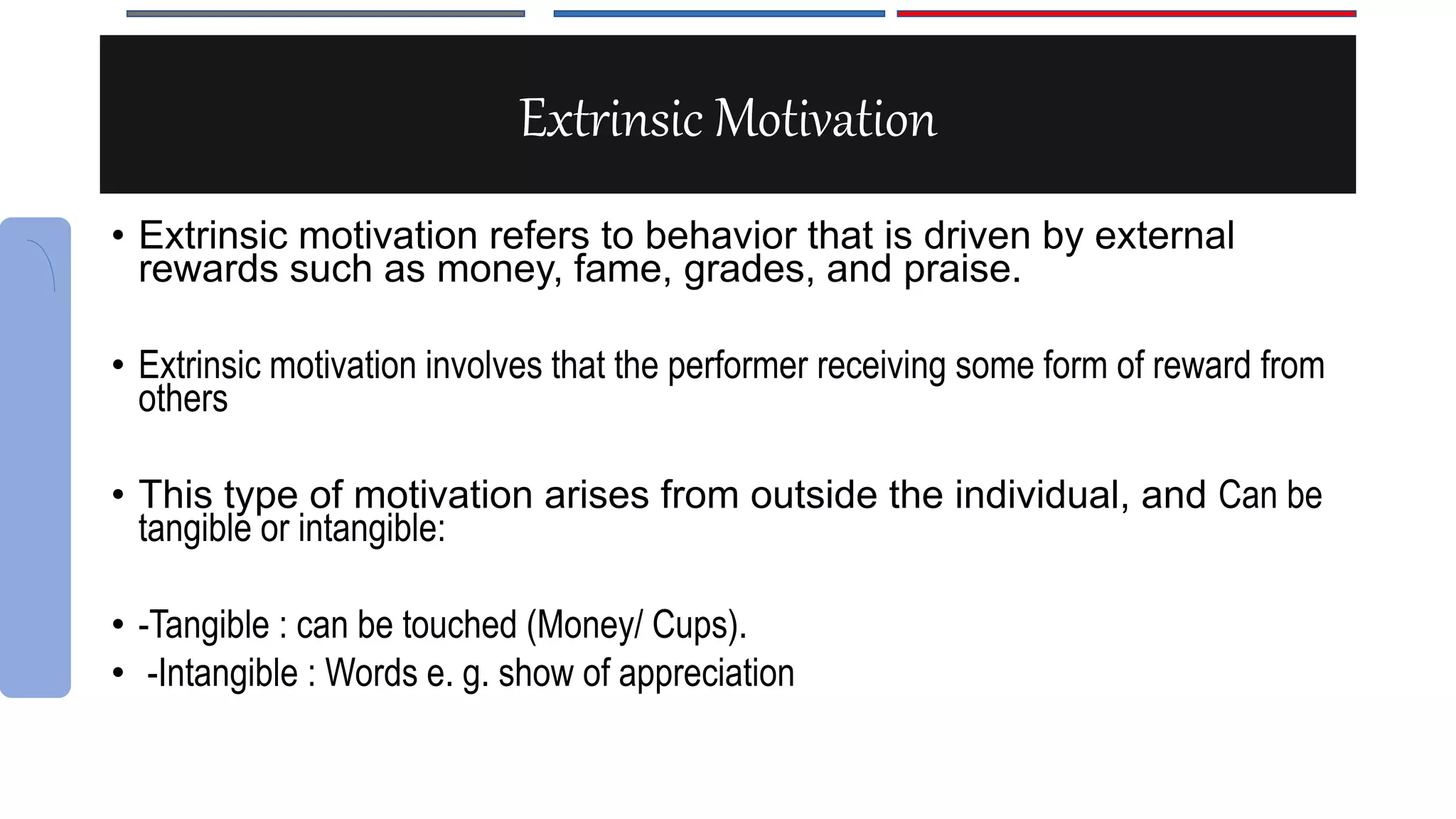
Extrinsic Motivation
• Extrinsic motivation refers to behavior that is driven by external
rewards such as money, fame, grades, and praise.
• Extrinsic motivation involves that the performer receiving some form of reward from
others
• This type of motivation arises from outside the individual, and Can be
tangible or intangible:
• -Tangible : can be touched (Money/ Cups).
• -Intangible : Words e. g. show of appreciation
Positive Motivation
• POSITIVE motivation is the type of motivation person feels when he
expects certain reward
• It’s Based on reward
• They are feeling happiness
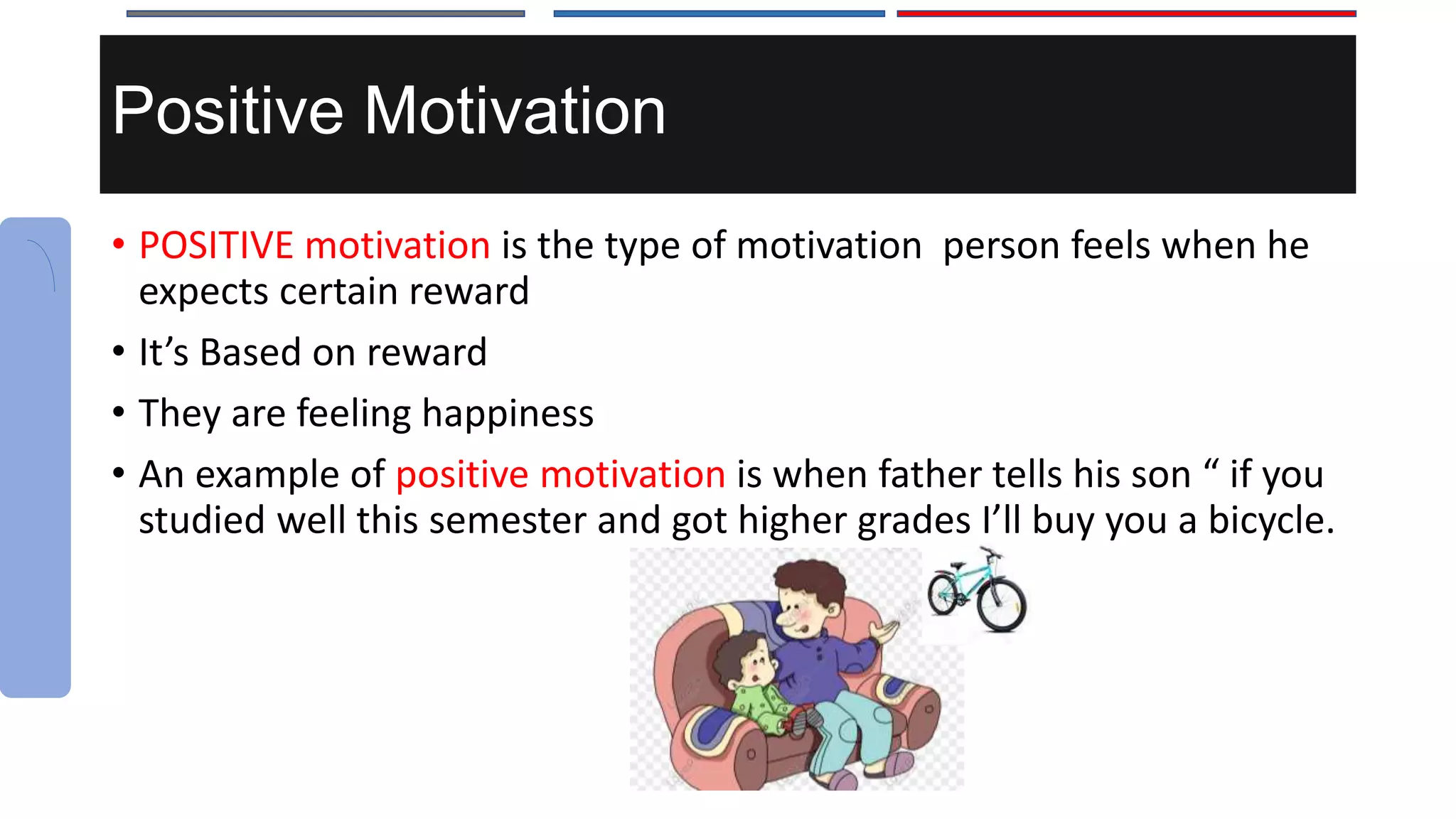
• An example of positive motivation is when father tells his son “ if you
studied well this semester and got higher grades I’ll buy you a bicycle.
Negative Motivation
• Negative motivation is type motivation person gets
when he/she expects punishment.
• Based on force and fear
• Caused anger and frustration.
• An Example of negative motivation is when telling your
son "if you didn't study, I won’t let you to travel this
summer"
Write this report
and you will get
bones
I really want to
write this report
Write this report
or you’ll get fired
I really don’t
want to write this
report
Positive motivation
Extrinsic
motivation
Intrinsic
motivation
Negative motivation
Perspectives of Motivation
Instinct Theory.
Drive‐Reduction Theory.
Incentive theory
 Arousal Theory.
• Cognitive Approaches: The Thoughts Behind Motivation
• Two Factor theory
• Hierarchy of Motives.
Instinct Theory
• According to instinct theories, people are
motivated to behave in certain ways because
they are evolutionarily programmed to do so.
• According to this theory motivation is in born
pattern of behavior.
• An example of this in the animal world is
seasonal migration. These animals do not learn
to do this, it is instead an inborn pattern of
behavior
• In humans example, instincts may include
behaviors such as an infant’s rooting for a
nipple and sucking.
Drive‐Reduction Theory.
• People are motivated to take certain actions in order to reduce
the internal tension that is caused by unmet needs.
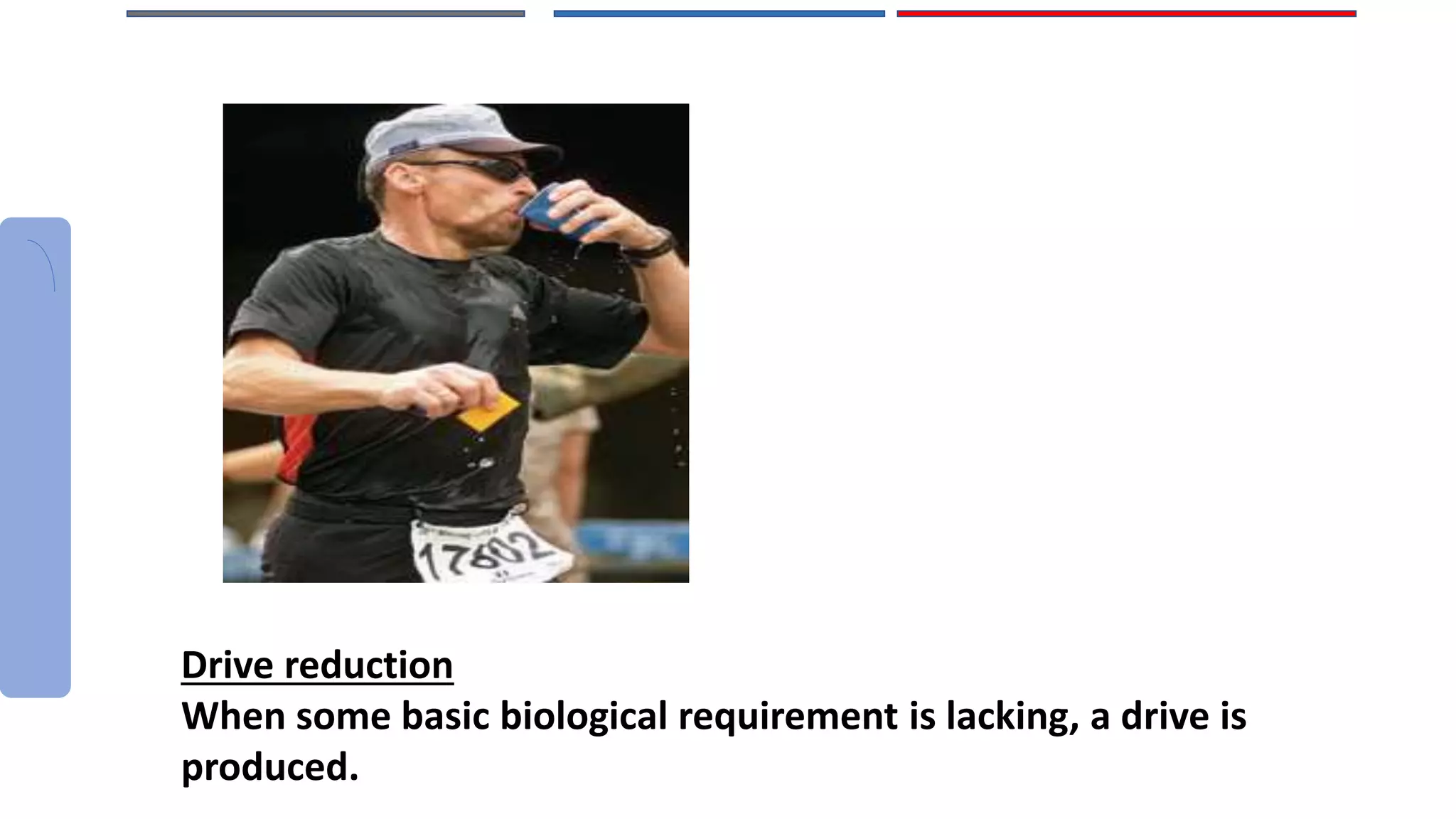
• For example, you might be motivated to drink a glass of water
in order to reduce the internal state of thirst.
• Our behavior is motivated by biological need
Need
e.g. need
for food
and water
Drive e.g.
Hunger
and thirsty
Drive reduction
behavior e.g.
Eating and
drinking
Drive reduction
When some basic biological requirement is lacking, a drive is
produced.
Incentive theory
• an external goal that has the potential to motivate a behavior.
• While Drive Theory describes an internal state PUSHING you in a
specific direction, Incentive Theory describes how an external
stimulus PULLS you in a certain direction.
• Example.
• What motivates you to eat chocolate chip cookies?
smell (incentive)
Drive INCENTIVE
Arousal Theory
• Arousal: Physiological state of alertness & anticipation which
prepares the body for action
• It suggest to people take certain actions to either decrease or
increase levels of arousal.
• When arousal levels get too low, for example, a person might watch
and exciting movie or take a bath or may hangout with their friends.
• When arousal levels get too high, on the other hand, a person would
probably look for ways to relax such as sleeping, being quiet.
• According t this There’s optimal level of arousal to produce
optimal performance
• According to this theory, we are motivated to maintain an
optimal level of arousal, although this level can vary based on
the individual or the situation.
• our levels of arousal have an influence on our performance
Hertzberg’s Two-Factor Theory
Motivator factors – Simply put, these are factors that lead to
satisfaction and motivate employees to work harder.
Examples might include enjoying your work, feeling recognized
and career progression.
Hygiene factors – These factors can lead to dissatisfaction
and a lack of motivation if they are absent. Examples include
salary, company policies, benefits, relationships with managers
and co-workers.
Cognitive theory
• This Theory is suggesting that motivation is a product of people’s
thoughts, expectations.
• focus on the role of our thoughts, expectations, and understanding of the
world.
• based on two kinds of cognitions.
1. Our expectation that a behavior will cause us reach a particular goal.
2. Our understanding of the value of that goal to us.
Hierarchal Need Theory
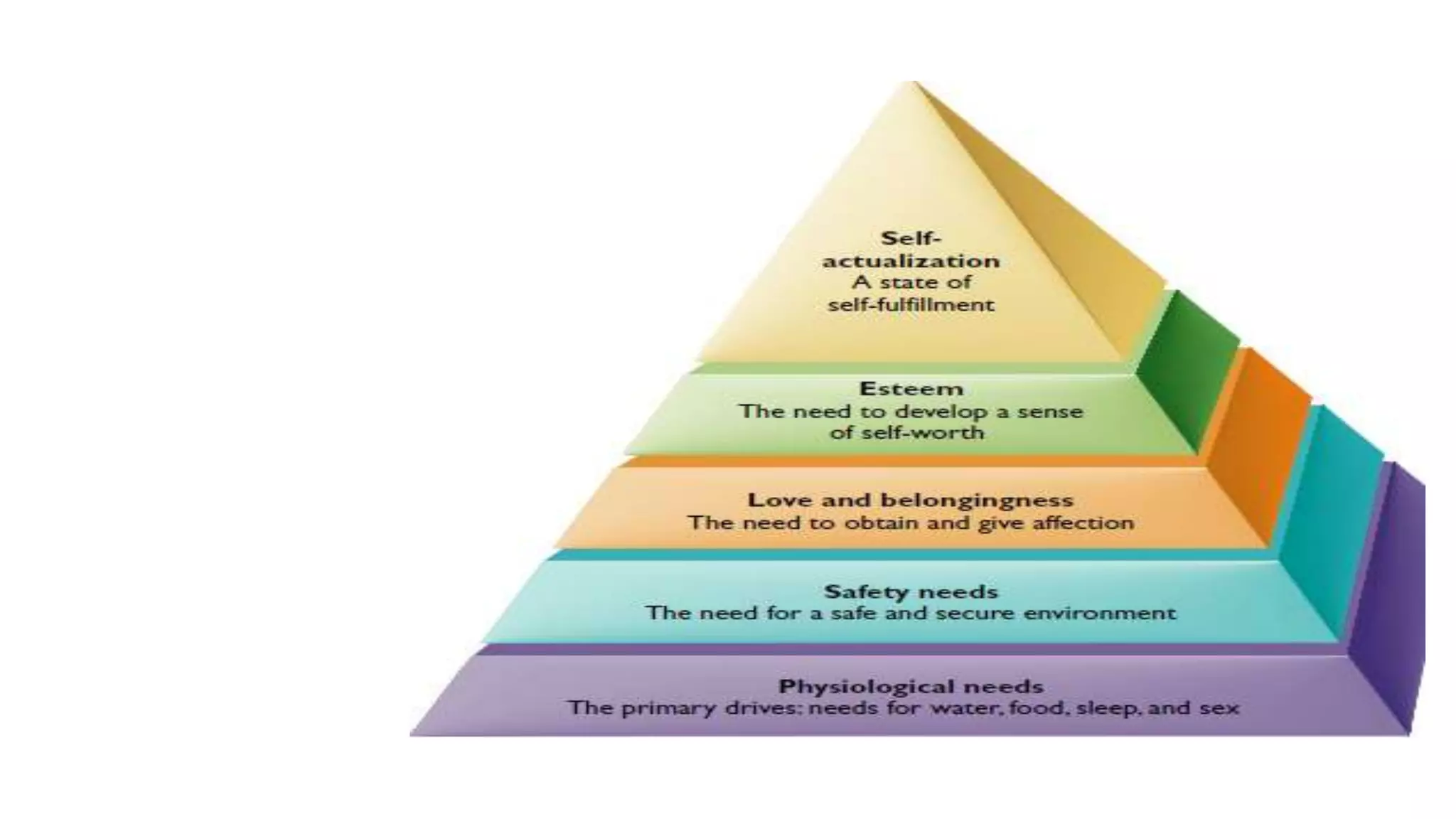
• Abraham Maslow (1970) suggested some needs have priority
over others.
• Physiological needs like breathing, thirst and hunger come
before psychological needs like achievement, self‐esteem and
need for recognition.
• Only after meeting the basic lower-order needs can a person consider
fulfilling higher-order needs, such as the needs for love and a sense of
belonging, esteem, and self-actualization.
The hierarchy is made up of 5 levels
1.Physiological – these needs must be met in order for a person
to survive, such as food, water and shelter.
2. Safety – including personal and financial security
3. Love/belonging – the need for friendships, relationships and
family.
4. Esteem – the need to feel confident and be respected by
others.
5. Self-actualization – the desire to achieve everything you
possibly can and become the most that you can be
Thank you
1
Q
ADD YOUR TITLE
Lorem ipsum dolor sit amet, consectetuer adipiscing
elit. Maecenas porttitor congue massa.
AN
OPTION
ADD YOUR TITLE
Lorem ipsum dolor sit amet, consectetuer adipiscing
elit. Maecenas porttitor congue massa.
03
OPTION
ADD YOUR TITLE
Lorem ipsum dolor sit amet, consectetuer adipiscing
elit. Maecenas porttitor congue massa.
04
OPTION
ADD YOUR TITLE
Lorem ipsum dolor sit amet, consectetuer adipiscing
elit. Maecenas porttitor congue massa.
05
OPTION
ADD YOUR TITLE
Lorem ipsum dolor sit amet, consectetuer adipiscing
elit. Maecenas porttitor congue massa.
06
OPTION
ADD YOUR TITLE
Lorem ipsum dolor sit amet, consectetuer adipiscing
elit. Maecenas porttitor congue massa.
07
OPTION
ADD YOUR TITLE
Lorem ipsum dolor sit amet, consectetuer adipiscing
elit. Maecenas porttitor congue massa.
08
OPTION
ADD YOUR TITLE
Lorem ipsum dolor sit amet, consectetuer adipiscing
elit. Maecenas porttitor congue massa.
Reference
• Cofer, C. N., & Appley, M. H. (1964). Motivation: Theory and
research.
• Ross, B. H. (2009). The psychology of learning and motivation:
Advances in research and theory. Academic Press.
• Katzell, R. A., & Thompson, D. E. (1990). Work motivation:
Theory and practice. American psychologist, 45(2), 144.
• Kornadt, H. J. (1984). Motivation theory of aggression and its
relation to social psychological approaches. In Social
psychology of aggression (pp. 21-31). Springer, Berlin,
Heidelberg.

Motivation in psychology & theory

  • 1.
  • 2.
    Abdirahman saed sh. elmi Bashiraidid hazzan Asia Abdi farax Zulema Abdi elmi Zuhuur Yousuf maxamoud
  • 3.
    01 Introduction to motivation 02 OPTIO N Componentsof motivation 03 OPTION Important of motivation 04 OPTION Categories of motivation 05 OPTION Types of motivation 06 OPTION Perspectives of Motivation 07 OPTION ?
  • 4.
    Introduction • The term'MOTIVATION' has been derived from the Latin word MOVERE' which means 'TO MOVE’. • motivation The factors that direct and energize the behavior of humans and other organisms. • Motivation means a process of stimulating people to action to accomplish desired goals.
  • 5.
    Cont’ • MOTIVATION isa set of processes that moves a person toward a goal. • Motive: need or want that causes us to act (energize us). Money is the motive
  • 6.
    Importance of motivation •Generates energy to be productive, creative • Helps us accomplish tasks/ goals • Enables us to maintain productivity • Improves performance level of individuals • Increases job satisfaction
  • 7.
    Components of motivation •Activation involves the decision to initiate a behavior • Persistence is the continued effort toward a goal even exist. • Intensity can be seen in the concentration and vigor that goes into pursuing a goal.
  • 8.
    Two categories ofmotivation Motives which are linked basic primary needs and associated with biological well-being of an individuals  Need for food, water and oxygen  Need to take rest when tired  Need for elimination of waste products from our body Motives linked with one's socio- psychological needs are known as secondary or psychological motives  Need for freedom  Need for security  Need to achieve  Need for recognition  Need for self-assertion  Need for self-actualization Primary motives Secondary Motives:
  • 9.
    Types of motivation Typesof motivation on the basis of source On the basis of approach Extrinsic motivation Intrinsic motivation Positive motivation Negative motivation
  • 10.
    Intrinsic Motivation Intrinsic motivationrefers to behavior that is driven by internal rewards. Intrinsic Motivation: Comes from within person, driving him or her to be or do something.  Intrinsic motivation involves gaining self-satisfaction, pride and a feeling of achievement. It often involves overcoming challenge or simply gaining enjoyment from participating.
  • 11.
    Extrinsic Motivation • Extrinsicmotivation refers to behavior that is driven by external rewards such as money, fame, grades, and praise. • Extrinsic motivation involves that the performer receiving some form of reward from others • This type of motivation arises from outside the individual, and Can be tangible or intangible: • -Tangible : can be touched (Money/ Cups). • -Intangible : Words e. g. show of appreciation
  • 12.
    Positive Motivation • POSITIVEmotivation is the type of motivation person feels when he expects certain reward • It’s Based on reward • They are feeling happiness • An example of positive motivation is when father tells his son “ if you studied well this semester and got higher grades I’ll buy you a bicycle.
  • 13.
    Negative Motivation • Negativemotivation is type motivation person gets when he/she expects punishment. • Based on force and fear • Caused anger and frustration. • An Example of negative motivation is when telling your son "if you didn't study, I won’t let you to travel this summer"
  • 14.
    Write this report andyou will get bones I really want to write this report Write this report or you’ll get fired I really don’t want to write this report Positive motivation Extrinsic motivation Intrinsic motivation Negative motivation
  • 15.
    Perspectives of Motivation InstinctTheory. Drive‐Reduction Theory. Incentive theory  Arousal Theory. • Cognitive Approaches: The Thoughts Behind Motivation • Two Factor theory • Hierarchy of Motives.
  • 16.
    Instinct Theory • Accordingto instinct theories, people are motivated to behave in certain ways because they are evolutionarily programmed to do so. • According to this theory motivation is in born pattern of behavior. • An example of this in the animal world is seasonal migration. These animals do not learn to do this, it is instead an inborn pattern of behavior • In humans example, instincts may include behaviors such as an infant’s rooting for a nipple and sucking.
  • 17.
    Drive‐Reduction Theory. • Peopleare motivated to take certain actions in order to reduce the internal tension that is caused by unmet needs. • For example, you might be motivated to drink a glass of water in order to reduce the internal state of thirst. • Our behavior is motivated by biological need Need e.g. need for food and water Drive e.g. Hunger and thirsty Drive reduction behavior e.g. Eating and drinking
  • 18.
    Drive reduction When somebasic biological requirement is lacking, a drive is produced.
  • 19.
    Incentive theory • anexternal goal that has the potential to motivate a behavior. • While Drive Theory describes an internal state PUSHING you in a specific direction, Incentive Theory describes how an external stimulus PULLS you in a certain direction. • Example. • What motivates you to eat chocolate chip cookies? smell (incentive) Drive INCENTIVE
  • 20.
    Arousal Theory • Arousal:Physiological state of alertness & anticipation which prepares the body for action • It suggest to people take certain actions to either decrease or increase levels of arousal. • When arousal levels get too low, for example, a person might watch and exciting movie or take a bath or may hangout with their friends. • When arousal levels get too high, on the other hand, a person would probably look for ways to relax such as sleeping, being quiet.
  • 21.
    • According tthis There’s optimal level of arousal to produce optimal performance • According to this theory, we are motivated to maintain an optimal level of arousal, although this level can vary based on the individual or the situation. • our levels of arousal have an influence on our performance
  • 22.
    Hertzberg’s Two-Factor Theory Motivatorfactors – Simply put, these are factors that lead to satisfaction and motivate employees to work harder. Examples might include enjoying your work, feeling recognized and career progression. Hygiene factors – These factors can lead to dissatisfaction and a lack of motivation if they are absent. Examples include salary, company policies, benefits, relationships with managers and co-workers.
  • 24.
    Cognitive theory • ThisTheory is suggesting that motivation is a product of people’s thoughts, expectations. • focus on the role of our thoughts, expectations, and understanding of the world. • based on two kinds of cognitions. 1. Our expectation that a behavior will cause us reach a particular goal. 2. Our understanding of the value of that goal to us.
  • 25.
    Hierarchal Need Theory •Abraham Maslow (1970) suggested some needs have priority over others. • Physiological needs like breathing, thirst and hunger come before psychological needs like achievement, self‐esteem and need for recognition. • Only after meeting the basic lower-order needs can a person consider fulfilling higher-order needs, such as the needs for love and a sense of belonging, esteem, and self-actualization.
  • 27.
    The hierarchy ismade up of 5 levels 1.Physiological – these needs must be met in order for a person to survive, such as food, water and shelter. 2. Safety – including personal and financial security 3. Love/belonging – the need for friendships, relationships and family. 4. Esteem – the need to feel confident and be respected by others. 5. Self-actualization – the desire to achieve everything you possibly can and become the most that you can be
  • 28.
  • 29.
    1 Q ADD YOUR TITLE Loremipsum dolor sit amet, consectetuer adipiscing elit. Maecenas porttitor congue massa. AN OPTION ADD YOUR TITLE Lorem ipsum dolor sit amet, consectetuer adipiscing elit. Maecenas porttitor congue massa. 03 OPTION ADD YOUR TITLE Lorem ipsum dolor sit amet, consectetuer adipiscing elit. Maecenas porttitor congue massa. 04 OPTION ADD YOUR TITLE Lorem ipsum dolor sit amet, consectetuer adipiscing elit. Maecenas porttitor congue massa. 05 OPTION ADD YOUR TITLE Lorem ipsum dolor sit amet, consectetuer adipiscing elit. Maecenas porttitor congue massa. 06 OPTION ADD YOUR TITLE Lorem ipsum dolor sit amet, consectetuer adipiscing elit. Maecenas porttitor congue massa. 07 OPTION ADD YOUR TITLE Lorem ipsum dolor sit amet, consectetuer adipiscing elit. Maecenas porttitor congue massa. 08 OPTION ADD YOUR TITLE Lorem ipsum dolor sit amet, consectetuer adipiscing elit. Maecenas porttitor congue massa.
  • 30.
    Reference • Cofer, C.N., & Appley, M. H. (1964). Motivation: Theory and research. • Ross, B. H. (2009). The psychology of learning and motivation: Advances in research and theory. Academic Press. • Katzell, R. A., & Thompson, D. E. (1990). Work motivation: Theory and practice. American psychologist, 45(2), 144. • Kornadt, H. J. (1984). Motivation theory of aggression and its relation to social psychological approaches. In Social psychology of aggression (pp. 21-31). Springer, Berlin, Heidelberg.

Editor's Notes

  • #8 Activation example such as enrolling in a particular class. An example of persistence would be taking medicine in order to earn a degree although it requires a significant investment of time, energy, and resources Intensity For example, one student might pass without much effort, while another student will study regularly, participate in discussions, and take advantage of research opportunities outside of class. The first student lacks intensity, while the second pursues his educational goals with greater intensity.