Intrinsically
Motivating
Assessment
Objective
 I can explain the difference between
 understand how my intrinsic motivations
will impact my assessment in this class
Background
The two most important women in my life are also two of the greatest teachers around. My
Mom taught kindergarten for over 30 years and has left an undeniable impact on kids. My
wife is newer to teaching but she already has a track record of creating little people exited
and ready to rock kindergarten. I look at their students and the first thing that stands out is just
how much all those kids love coming to school, are ready to challenge themselves, and how
their little developing minds are bursting with creativity. When you compare this with most
high school students, they barely resemble the little learner that they were less than a
decade before. I have been caught asking myself, What happened between then and now
to extinguish the spark?
While there are many reasons for this, it seems to me that the role of grades seem to play a
central role in the warping of motivation for modern high school students. While students
begin their education excited about exploring the world, they quickly learn what a grade is
and why it is important. You have all been in classes that have assigned grades to your skills
and you are easily the most tested generation that our country has ever seen. For many of
you, these grades and scores on tests have come to define your identity, both positively and
negatively, as a student and person. This form of grading has warped the motivations that my
Mom and Wife work so hard to impart in their little people.
I fear that many of you lack a true purpose in coming to school, this class included, beyond
earning grade and moving on with your life. While I hope this isn’t always the case, I feel want
to push you all to find meaning in the tasks we engage in. To accomplish this, I will be
attempting a new type of grading which I have shaped and created with the hope of
rekindling that fire that your preschool and kindergarten teachers left you with.
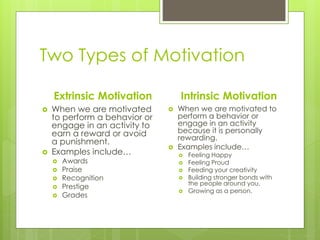
Two Types of Motivation
Extrinsic Motivation
 When we are motivated
to perform a behavior or
engage in an activity to
earn a reward or avoid
a punishment.
 Examples include…
 Awards
 Praise
 Recognition
 Prestige
 Grades
Intrinsic Motivation
 When we are motivated to
perform a behavior or
engage in an activity
because it is personally
rewarding.
 Examples include…
 Feeling Happy
 Feeling Proud
 Feeding your creativity
 Building stronger bonds with
the people around you.
 Growing as a person.
When Grades are only based
on External Motivations
 When grades are only based on External
Motivations, students are less likely to…
 Take risks or challenge themselves because they
simply want to do enough to get the grade.
 Explore new topics and ask questions.
 Think creatively or challenge themselves in new
ways.
 Be honest with themselves and their teacher.
 Work collaboratively with classmates and
teachers.
 Feel responsible for their actions and
performance in class.
When Grades are also based
on Intrinsic Motivations
 When grades are based on intrinsic
motivations, students are more likely to…
 Ask questions and challenge themselves to
explore new topics.
 Take risks and think creatively.
 Grow as people, not just as students.
 To be honest and reflect on their actions.
 Hold and feel responsibility for their evaluation in
their class.
 Look forward to learning!
Intrinsic Grading in this course
 In this course, your intrinsic motivations will be a key and very
important portion of determining your final grade. During this
process you will be responsible for…
 Creating and reflecting on personal goals.
 Using information and skills learned to improve your
relationships with your friends, classmates, family, and
others.
 Using information and skills learned to better your
community.
 Thinking creatively about the topics we discuss and
applying them to real world, and personal examples.
 Participating in Intrinsic Reflection Sessions.
 Writing Semester Reflections on your Intrinsic Goals and
Accomplishments.
How Your Grade will be
Determined
 You will be responsible to shaping your grade
in this course by completing and reflecting
tasks and your Intrinsic motivations for taking
this course each quarter.
 For each area of Intrinsic Motivations, you
reflect on your actions and will determine
your grade through reflections that will help to
justify your decision.
 Your determined grades will make up 40% of
your grade.
Where will the other 60% of my
grade come from?
 Faced with the realities of our educational
system and the goals set forth by IB, Mr.
Bonica will be grading you on essential
skills. These skills will includes…
 Content Knowledge
 Short Written Responses
 Extended Written Responses
How will this impact the
teaching in this course?
 I will still be dedicating our time together and
assessment towards common core essential
skills (or IB curriculum) and I will help prepare
you with academic skills that will help you
success inside and outside of the classroom.
 The purpose of this form of assessment is to
provide you with a feeling of control,
responsibility, enrichment, and freedom in
evaluating your performance in this course.
Possible Issues
 What if students simply give themselves 100% when they do not
deserve such high scores.
 I trust that all students will be honest with themselves. Students will
also need to provide justifications to me for their scores. If these
justifications do not match the grade, we will discuss and come to a
compromise.
 What if students do not liking having control over their grade.
 Stress at the outset of the year will be expected but I am confident
that it will dissipate as the year goes on. Remember, if you try full
heartedly to apply these ideas and concepts to your life, that is
enough.
 What if placing extrinsic rewards (grades) on these intrinsic goals
makes them a chore?
 Much of this will come from your own perspective on this issue. View
this as a chance to explore and challenge yourself, not as a means
of being critical of yourself.

Intrinsically motivated grading

  • 1.
  • 2.
    Objective  I canexplain the difference between  understand how my intrinsic motivations will impact my assessment in this class
  • 3.
    Background The two mostimportant women in my life are also two of the greatest teachers around. My Mom taught kindergarten for over 30 years and has left an undeniable impact on kids. My wife is newer to teaching but she already has a track record of creating little people exited and ready to rock kindergarten. I look at their students and the first thing that stands out is just how much all those kids love coming to school, are ready to challenge themselves, and how their little developing minds are bursting with creativity. When you compare this with most high school students, they barely resemble the little learner that they were less than a decade before. I have been caught asking myself, What happened between then and now to extinguish the spark? While there are many reasons for this, it seems to me that the role of grades seem to play a central role in the warping of motivation for modern high school students. While students begin their education excited about exploring the world, they quickly learn what a grade is and why it is important. You have all been in classes that have assigned grades to your skills and you are easily the most tested generation that our country has ever seen. For many of you, these grades and scores on tests have come to define your identity, both positively and negatively, as a student and person. This form of grading has warped the motivations that my Mom and Wife work so hard to impart in their little people. I fear that many of you lack a true purpose in coming to school, this class included, beyond earning grade and moving on with your life. While I hope this isn’t always the case, I feel want to push you all to find meaning in the tasks we engage in. To accomplish this, I will be attempting a new type of grading which I have shaped and created with the hope of rekindling that fire that your preschool and kindergarten teachers left you with.
  • 4.
    Two Types ofMotivation Extrinsic Motivation  When we are motivated to perform a behavior or engage in an activity to earn a reward or avoid a punishment.  Examples include…  Awards  Praise  Recognition  Prestige  Grades Intrinsic Motivation  When we are motivated to perform a behavior or engage in an activity because it is personally rewarding.  Examples include…  Feeling Happy  Feeling Proud  Feeding your creativity  Building stronger bonds with the people around you.  Growing as a person.
  • 5.
    When Grades areonly based on External Motivations  When grades are only based on External Motivations, students are less likely to…  Take risks or challenge themselves because they simply want to do enough to get the grade.  Explore new topics and ask questions.  Think creatively or challenge themselves in new ways.  Be honest with themselves and their teacher.  Work collaboratively with classmates and teachers.  Feel responsible for their actions and performance in class.
  • 6.
    When Grades arealso based on Intrinsic Motivations  When grades are based on intrinsic motivations, students are more likely to…  Ask questions and challenge themselves to explore new topics.  Take risks and think creatively.  Grow as people, not just as students.  To be honest and reflect on their actions.  Hold and feel responsibility for their evaluation in their class.  Look forward to learning!
  • 7.
    Intrinsic Grading inthis course  In this course, your intrinsic motivations will be a key and very important portion of determining your final grade. During this process you will be responsible for…  Creating and reflecting on personal goals.  Using information and skills learned to improve your relationships with your friends, classmates, family, and others.  Using information and skills learned to better your community.  Thinking creatively about the topics we discuss and applying them to real world, and personal examples.  Participating in Intrinsic Reflection Sessions.  Writing Semester Reflections on your Intrinsic Goals and Accomplishments.
  • 8.
    How Your Gradewill be Determined  You will be responsible to shaping your grade in this course by completing and reflecting tasks and your Intrinsic motivations for taking this course each quarter.  For each area of Intrinsic Motivations, you reflect on your actions and will determine your grade through reflections that will help to justify your decision.  Your determined grades will make up 40% of your grade.
  • 9.
    Where will theother 60% of my grade come from?  Faced with the realities of our educational system and the goals set forth by IB, Mr. Bonica will be grading you on essential skills. These skills will includes…  Content Knowledge  Short Written Responses  Extended Written Responses
  • 10.
    How will thisimpact the teaching in this course?  I will still be dedicating our time together and assessment towards common core essential skills (or IB curriculum) and I will help prepare you with academic skills that will help you success inside and outside of the classroom.  The purpose of this form of assessment is to provide you with a feeling of control, responsibility, enrichment, and freedom in evaluating your performance in this course.
  • 11.
    Possible Issues  Whatif students simply give themselves 100% when they do not deserve such high scores.  I trust that all students will be honest with themselves. Students will also need to provide justifications to me for their scores. If these justifications do not match the grade, we will discuss and come to a compromise.  What if students do not liking having control over their grade.  Stress at the outset of the year will be expected but I am confident that it will dissipate as the year goes on. Remember, if you try full heartedly to apply these ideas and concepts to your life, that is enough.  What if placing extrinsic rewards (grades) on these intrinsic goals makes them a chore?  Much of this will come from your own perspective on this issue. View this as a chance to explore and challenge yourself, not as a means of being critical of yourself.