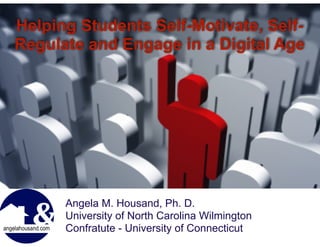
Helping students self motivate, self-regulate, and engage
1. Helping Students Self-Motivate, Self-
Regulate and Engage in a Digital Age
!
Angela M. Housand, Ph. D.
University of North Carolina Wilmington
Confratute - University of Connecticut
8. Motivation
(Malone & Lepper, 1987)
Curiosity
Control
Optimal Challenge
Fantasy
Interpersonal
(Cooperation, Competition, & Recognition)
9. • Curious
• Independent
• Attracted to
complexity
• Originality in
thought and action
• Willing to take risks
• Aware of their own
creativeness
• Need to produce
Creatively
Gifted
10. Motivation is Complex
Perception of Competence
Experience of Autonomy
Sense of Control
Willingness to Pursue Goals
Persistence when Challenged
Enjoyment or Interest
15. • Tied to Student’s
Identity
• Personally
Interesting
• Integral to the
Student’s Vision
of the future
• Viewed as Useful
(Eccles & Wigfield)
Personally Meaningful
21. COMPETENCE…
Feelings of competence shape a person’s
willingness to actively engage and persist in
different behaviors.
(Bandura 1986, 1997)
22. Self-efficacy influences:
! What activities we select
! How much effort we put forth
! How persistent we are in the face of difficulties
! The difficulty of the goals we set
24. Autonomy
The more autonomous (self-
determined) a person
believes their behavior to be
the greater the personal
satisfaction and enjoyment
from engaging in that
behavior.
26. Autonomous Learners
(Reeve, 2002)
• Achieve highly
• Learn conceptually
• Stay in school
!
• In large part, because their teachers
support their autonomy rather than
control their behavior
30. ONTARGET
Educational Benefits of
Autonomy-Supportive Teachers
(Reeve, 2002)
• Greater conceptual understanding
• Greater flexibility in thinking
• More information processing
• Greater creativity
• Higher rates of retention
31. ONTARGET
In Short…
(Reeve, 2002)
• Autonomously motivated
students thrive in
educational settings
!
• Students benefit when
teachers support their
autonomy
32. • Autonomy support is not:
–Permissiveness
–Neglect
–Independence
–Laissez-faire interaction style
Avoid Misconceptions
33. Avoid Misconceptions
• Autonomy support and
structure are two different
classroom elements which
have different aims and
different effects
• They are NOT the same, but
can be mutually supportive
34. • Spend less time holding
instructional materials
• Provide time for independent
work
• Provide hints but resist giving
answers
• Encourage conversation
• Listen – even more than you
do now
Tips for Teachers
35. • In conversation w/ students
• Praise mastery
• Respond to student generated
questions
• Make statements that are
empathetic and rich in perspective
taking
Tips for Teachers
36. • Avoid
• Directives or “Taking Charge”
• Steering students toward a right
answer
• Being critical or evaluative
• Motivating through external rewards
• Motivating through pressure
Tips for Teachers
37. Parents and students
rate controlling teachers as
significantly
more competent than
autonomy-‐suppor.ve teachers.
39. Thinking about Achieving
• What skills do I need to achieve this?
• What help or assistance do I need?
• What resources do I need?
• What can block progress?
• How will I maintain focus in
order to achieve this?
40. Reflecting on Achievement
• Did I accomplish what I planned to
achieve?
• Was I distracted and how did I get back to
my task?
• Did I plan enough time?
• In which situation did I accomplish
the most?
49. Learning contracts allow
students to work on a
process that extends over
.me, requiring planning,
regula.on of effort,
reflec.on, and adapta.on
to successfully complete.
57. Mindfulness
! Jon Kabat-Zinn, Ph.D.
! From the field of behavioral medicine
! Used to control
! Stress
! Pain
! Illness
! Initial research conducted at the
University of Massachusetts Medical
Center
58. Mindfulness Attitudes
! Non-judging
! Impartial witness to our own experience
! Cultivates emotional intelligence
! Patience
! Things unfold in their own time
! Delay of gratification
! Beginner’s Mind
! What we think we “know” impedes
understanding
! Avoiding pre-conceived notions
59. Emotional Intelligence
The ability to monitor
one’s own and other’s
feelings and emotions, to
discriminate among them
and to use that information
to guide one’s thinking and
actions.
!
(Salovey & Mayer, 1990, p. 189)
60. Mindfulness Attitudes
! Trust
! Developing a trust of yourself and your
feelings
! Non-striving
! Seems counter intuitive
! Focusing on being clarifies what to strive for
! Acceptance
! Seeing things as they are
! Enables one to act appropriately no matter
what is happening around them
61. Mindfulness Attitudes
! Letting Go
! Put aside the tendency to elevate some life
experiences and reject others
! Cultivates emotional intelligence
!
! Mindfulness is mind training.
! “I am not thinking about that right now, I am
observing – training my mind”
! “I am here to work on my mind”
62. Goal of Mindfulness
! Achieve a state of stability and calm
! Increase self-discipline
! Increase feelings of well-being
! Reduce feelings of dysphoria
! Increase self-awareness
63. Mindfulness How To
! Release Tension
! Sit comfortably, spine erect, feet on floor
! Allow arms to hang straight down with hands
about 10-12 inches from body
! Close your eyes if it feels comfortable
! Identify areas of tension in your mind or body
! As you identify areas of tension, allow them to
dissolve and flow down the arms and out the
finger tips
64. Mindfulness How To
! Mind Training
! Sit comfortably, spine erect, feet on floor
! Close your eyes if it feels comfortable
! Bring your attention to your breath
! Nose, mouth, lungs, or belly – wherever you sense
your breath
! Do not control breath, just observe
! Maintain your attention on your breathing
! When your mind wanders, simply let the
thought go and return your focus to your
breath
65. Mindfulness How To
! Focusing the mind is easier said than
done
! Requires consistent practice
! Short and frequent
! 5 to 15 minutes daily
! Don’t force it!
! When students loose focus, the time is up
! Work to extend time each day
71. Influence
"On a clean sheet of paper, list the past five
years vertically (2011, 2010, 2009…).
"Next to each year, list the most important
event that occurred in your life during that
year.
"Estimate the percentage of control or
influence you had over each event.
72. Significant Influence
"When you reflect on your experience, do
you find that you had more control than you
thought?
"Students may feel that external forces
control their lives.
"Modify the exercise:
"Last five months
"Last five weeks
73. Being in the Moment
• Can you change the past?
!
• What are you doing now that is working?
How can you do more of the same?
!
• When you had a problem like this one
before, what good solutions did you work
out? Or Have you ever helped someone
with a problem like this before?
74. Reframe…
• I am successful because I am smart
• People like me because I am attractive
• I get opportunities because I am lucky
• I make mistakes because I am a failure
• I never win because I am a loser
• I get in trouble because the teacher does
not like me
75. Blocks to Feeling in Control
• Motivated self-deception
– Denying a state exists to reduce anxiety
– “Oh, that is not due until next week.”
– A month long project
• Inaccurate verbalization
– Convinced they feel something the do not
– “I hate school!”
76. Blocks to Feeling in Control
• Accessibility difficulties
– More processing required to form an attitude,
more apt to lose track of what the attitude is
– “I used to be good at math, but the teacher is
giving me a bad grade so I obviously am not good
at math.”
77. Sensory Sensi.vity of GiWed
• Tested giWed vs. normed sample on the
Sensory Profile (Dunn, 1999)
• Significant differences on 12 of 14 sensory
sec.ons between groups
• GiWed children are more sensi.ve to their
physical environment
• More affected by sensory s.muli
78. Why address sensory sensitivity?
• Sensory stimuli create CNS arousal which
places demands upon the body
• The intensity and duration of arousal affect
responses to stimuli
• Maximum and prolonged overload of
information can be stressful
79. Why address sensory sensitivity?
• To reduce stressors
• To positively enhance the experience of the
highly sensitive gifted individual
• To be responsive to unique needs
• To promote healthy working environments
• To increase the sustainability of focus and
effort in productive endeavors
115. From the standpoint
of the child…he is
unable to apply in
daily life what he is
learning at school.
That is the isolation
of the school - its
isolation from life.
-John Dewey
117. • Accelerating rate of new
information
• Ease of duplication and
transmission
• Increase in the available
sources of information
• Contradictions and
inaccuracies
• Lacking strategies to
process information
Informa=on
Overload
122. Writing Prompt
# I would like to improve…
# Some people are unhappy with…
# I want to learn more about…
# An idea I would like to try…
# Something I think would really make
a difference is…
# Something I would like to change is…
123. Writing Prompt Helps Students
$ Identify priorities
$ Identify areas for improvement
and focused effort
$ Attain truthful self-awareness
124.
125. Google Calendar Supports
$ Time management
$ Sequencing
# Setting Priorities
# Notification of Deadlines
131. S
TO
W
Helpful
to achieving the
objective
Harmful
to achieving the
objective
Internal Origin
!
Attributes of the
Individual
Strengths Weaknesses
External Origin
!
Attributes of the
Environment
Opportunities Threats
SWOT Analysis
140. Effective Goal Setting:
More Than SMART
Prioritized
Reviewed Periodically
Revised as Needed
Accountable to Others
141. Effective Goal Setting:
More Than SMART
Periodically review
goals and modify to
reflect changing
priorities and
experiences.
142. Effective Goal Setting:
More Than SMART
Share your goals and
engage with successful,
motivated people who
also set goals.
143. Avoid Unrealistic Goals
! Insufficient Information
! Goals Set by Other People
! Always Expecting Best
144. The greater danger for most of
us lies not in setting our aim too
high and falling short;
!
but in setting our aim too low,
and achieving our mark.
-Michelangelo
145. Why Goal Setting?
Planned direc+on for efforts
Provides clarity for assessment
Opportunity to take responsibility
159. Evolution of Goal Setting
Formal Goal Setting The “TO DO” List
Written
Completion Check Box
Deadline Driven
Prioritized
Revised Regularly
Its Your Job
SpecificWritten
Measureable
Time Bound
Prioritized
Periodically Reviewed
Accountable to Others
162. Goal Setting Plan (Based on Heacox, 1991)
1. What is one area of your class performance that you really want to improve? (This is your long term
goal. It may take you several weeks, months, or even a whole school year to improve this goal.)
This goal is important to me because:
2. What is one thing that you can do NOW to help you reach your long-term goal? (This is your short-
term goal. You should be able to accomplish this goal in 2-4 weeks.)
3. What steps do you need to reach your short-term goal?
4. What things or people might keep you from reaching your goal? These are your obstacles.
5. What can you do to get around your obstacles? These are your solutions.
7. What special materials or help do you need to reach your goal? These are your resources.
8. How will you reward yourself when you achieve your goal? These are your incentives.
9. How and when will you check on your progress toward your goal? Who will help you to check on
your progress?
Checkpoint 1 Date: ____________________________________________________
Checkpoint 2 Date: ____________________________________________________
I am committed to working toward achieving my short term goal.
Student's signature: Today's date:
Witness (Teacher's) signature:
163. What school related goals would you like to work toward
during the next grading period?
a.
b.
c.
!
During this school year?
a.
b.
!
After high school?
a.
b.
!
What personal goals would you like to achieve in the
next six months?
a.
b.
c.
!
Within the next year or two?
a.
b.
How do you expect to achieve these goals?
a.
b.
c.
!
!
a.
b.
!
!
a.
b.
!
How do you hope to achieve these goals?
a.
b.
c.
!
a.
b.
GoalSettingor…
WHEREDOYOUWANTTOGO
AND
HOWDOYOUPLANTOGETTHERE?
From Motivating Achievers, Carolyn Coil, Pieces of Learning
164.
165.
166.
167. Staying the Course
Periodically review goals and
modify to reflect changing
priorities and experience!
!
Involve others in the goal:
Inform, discuss, and share
168. Staying the Course
Engage with successful,
motivated people who also set
goals!
!
Maintain visual reminders!
Collage!
Digital Reminders
170. • Achieved easily, make next goal harder
• Took to long to achieve, make next goal
a little easier
• If something was learned that leads to
need for revision of other goals, do so
• If skills were lacking, set goals to learn
necessary skills
Setting a New Goal
171. Attainment
! Demonstrates forward progress
! Measure and take pride in the
achievement
! Celebrate and enjoy the satisfaction of
achievement
! Set a new goal
183. Calendar Ideas for Students
•Task monitoring
•Set “reminders”
•Use with Drive
•Track project timelines
•Organize Task Lists
184. !
• Create group calendars
• Provide assignment due dates
• Set project timelines
• Existing location for parent
information
Uses for Google Calendar
199. My Library• Annotate, Archive, Organize
My Network• Build a Personal Learning Network
My Groups• Create a Group Knowledge Repository
Community• Research, Share, Collaborate
207. Intended Project(s):
How, when, and where
will you share and
communicate the results of
your project with other
people?
!
What Format Will Your
Project Take?
What will your product be?
!
Project Description:
What do you hope to find
out or learn?
210. Organizational Strategies
• The Environment
" Specific location for work
" Location should be distraction-free
" Set aside a specific time
" Daily, regardless of whether there is
homework or not
" Supplies and resources available and
accessible
211. Organizational Strategies
• The Environment
" Specific location for work
" Location should be distraction-free
" Set aside a specific time
" Daily, regardless of whether there is
homework or not
" Supplies and resources available and
accessible
!
• Still true, but…
212. Organizational Strategies
• The Environment
" Specific location for work, but realize the
digital environment is complex
" Location should be distraction-free
" Set aside a specific time, and work to
increase focus
" Daily, but “down time” is good too
" Supplies and resources available online
and students need access to the internet
214. Honor Diversity of Style
Help students find an organizational
system the fits their “style”!
Encourage them to develop their own
systems!
Allow trial and error: Have patience to
give system ideas a fair chance
225. Students Ask:
! Did I accomplish what I planned to do?
! Was I distracted?
! Limit times you answer emails
! Delay of gratification
! Did I plan enough time?
! Was I productive or was I spending time
figuring out how to use the technology?
226. Students Ask:
! What worked well?
! Are certain technologies easier for me to
adopt?
! Are some more appropriate than others?
! What do I need help with?
! Find a tech buddy.
! What do I still need know?
227. 5 EASY STEPS!
1. Identify Your
Priorities
2. Set Goals
3. Manage Time &
Materials
4. Be Discerning
5. Reflect &
Evaluate
231. Metacognition
! One’s knowledge of his or her own
cognitive processes or anything related
to them (Flavell, 1976)
!
! Knowledge about when and how to use
specific strategies for learning and
problem solving
232.
233. Thinking about Achieving
• What skills do I need to achieve this?
• What help or assistance do I need?
• What resources do I need?
• What can block progress?
• How will I maintain focus in
order to achieve this?
234. Self-Evaluating
# What does the teacher want me
to do?
# What do I want out of it?
# What did I learn today?
# What did I do well?
# What am I confused about?
# What do I need to get help with?
# What do I still need to do?
235. Reflecting on Achievement
• Did I accomplish what I planned to
achieve?
• Was I distracted and how did I get back to
my task?
• Did I plan enough time?
• In which situation did I accomplish
the most?
237. • What will I need to work
on my project?
• Where will I work?
• Who will I work with?
• What might hinder my
process?
238. • Am I accomplishing
what I planned?
• Is this taking longer than
I thought?
• Am I on task or am I
being distracted?
239. • Did I accomplish what I
planned to do?
• Was I distracted and how
did I get back to work?
• Did I plan enough time or
did it take longer than I
thought?
• In which situation did I
accomplish the most
work?
240. Teacher Strategy
! Encourage risk-taking
!
! Ensure that students are
sufficiently challenged so they
have opportunities to fail
241. Teacher Strategy
! Encourage risk-taking
!
! Ensure that students are
sufficiently challenged so they
have opportunities to fail
!
! YES, let them fail!
252. “While most games contain a clear reward system for players (moving up a level, receiving badges or points, etc.),
what may be most appealing to educators is that games provide students
!
A SAFE PLACE TO LEARN FROM FAILURE.
!
In games, exploration is inherent and there are generally no high-stakes consequences. Children are able to
!
EXPERIMENT AND TAKE RISKS
TO FIND SOLUTIONS
!
without the feeling that they are doing something wrong.
!
GAMES ENCOURAGE STUDENTS TO MAKE
AND LEARN FROM MISTAKES,
!
which is a particularly important concept in the K-12 setting.”
GAME
BASED
LEARNING
255. POINTS
Effectively Keep Score
Determine WIN State
Connection Between Progress
and Reward
Provide Feedback
External Display of Progress
Data for Game Designer
256. BADGES
Goals to Strive Toward
Guidance About Possibilities
Visual Markers of
Accomplishment
Status Symbols
Tribal Markers
279. Edmodo is a free, secure, social learning platform for
teachers, students, schools, and districts.
!
FREE!
!
FEATURES:
Groups
Messages
Assignments
Calendar
Poll
!
Student Emails NOT required!