Motivation and Job Satisfaction
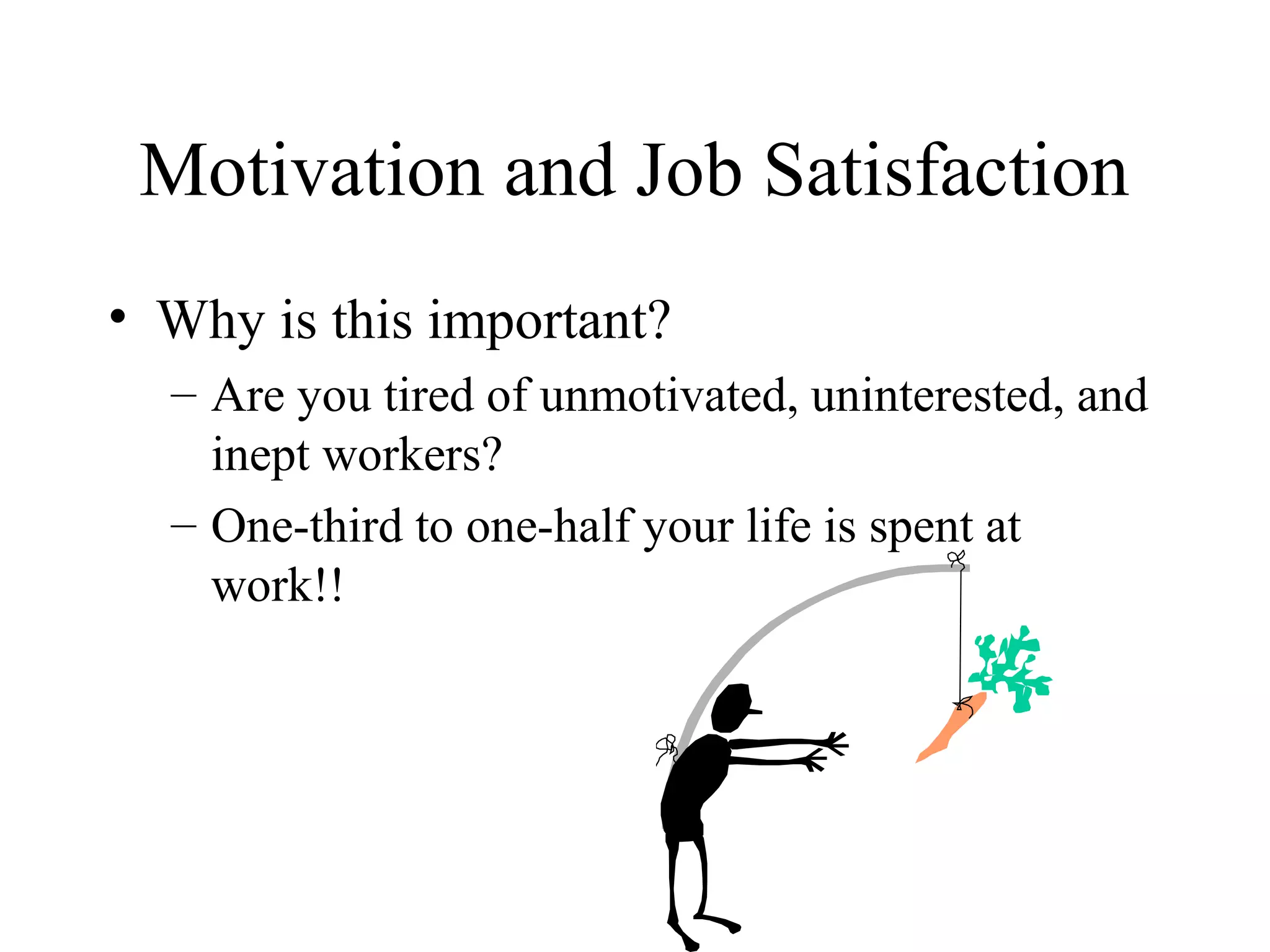
• Why is this important?
– Are you tired of unmotivated, uninterested, and
inept workers?
– One-third to one-half your life is spent at
work!!
Theories of Motivation
• Content Theories: Focus on the importance
of the work (e.g., challenges and
responsibilities)
– Specific needs that motivate human behavior
• Process Theories: Deal with the cognitive
processes used in making decisions about
our work
Content Theories
• Achievement Motivation Theory: David
McClelland. Emphasizes need to accomplish
something. Linked to successful managers
– Favor environment where they can assume
responsibility
– Take calculated risks and set attainable goals
– Need continuing recognition and feedback
• Managers high in achievement motivation
show more respect for subordinates and use
more participatory systems
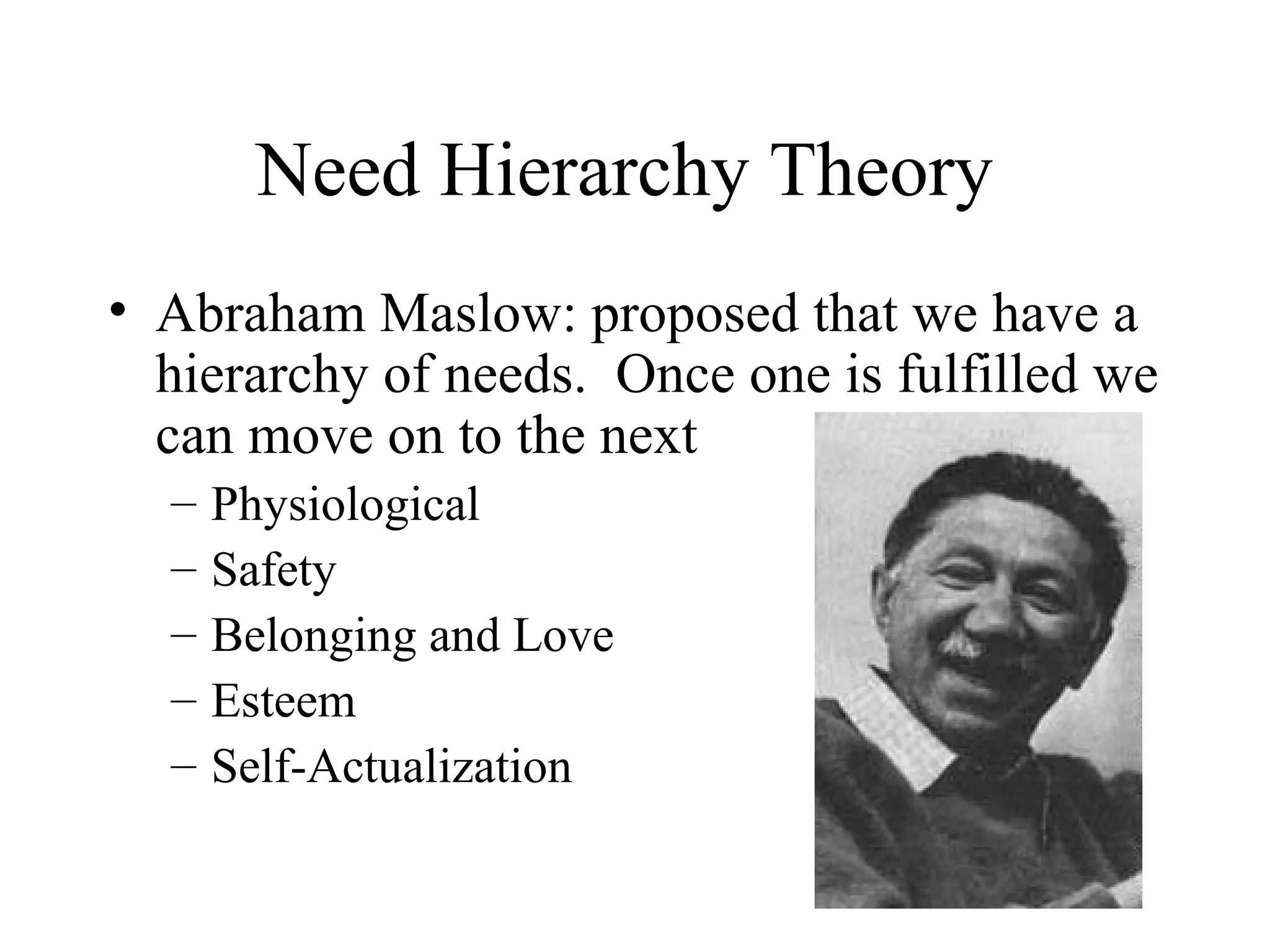
Need Hierarchy Theory
• Abraham Maslow: proposed that we have a
hierarchy of needs. Once one is fulfilled we
can move on to the next
– Physiological
– Safety
– Belonging and Love
– Esteem
– Self-Actualization
ERG Theory
• Alderfer
• Similar to Maslow. We have needs, but in
this case they are not hierarchically
arranged
• Satisfying a need may increase its strength
– Existence Needs
– Relatedness Needs
– Growth Needs
Motivator-Hygiene (Two Factor)
Theory
• Motivator Needs: internal to work itself. If
conditions are met, job satisfaction occurs
– Job enrichment: expand a job to give employee
a greater role in planning, performing, and
evaluating their work
• Hygiene Needs: Features of work
environment. If not met, job dissatisfaction
occurs
Job Characteristics Theory
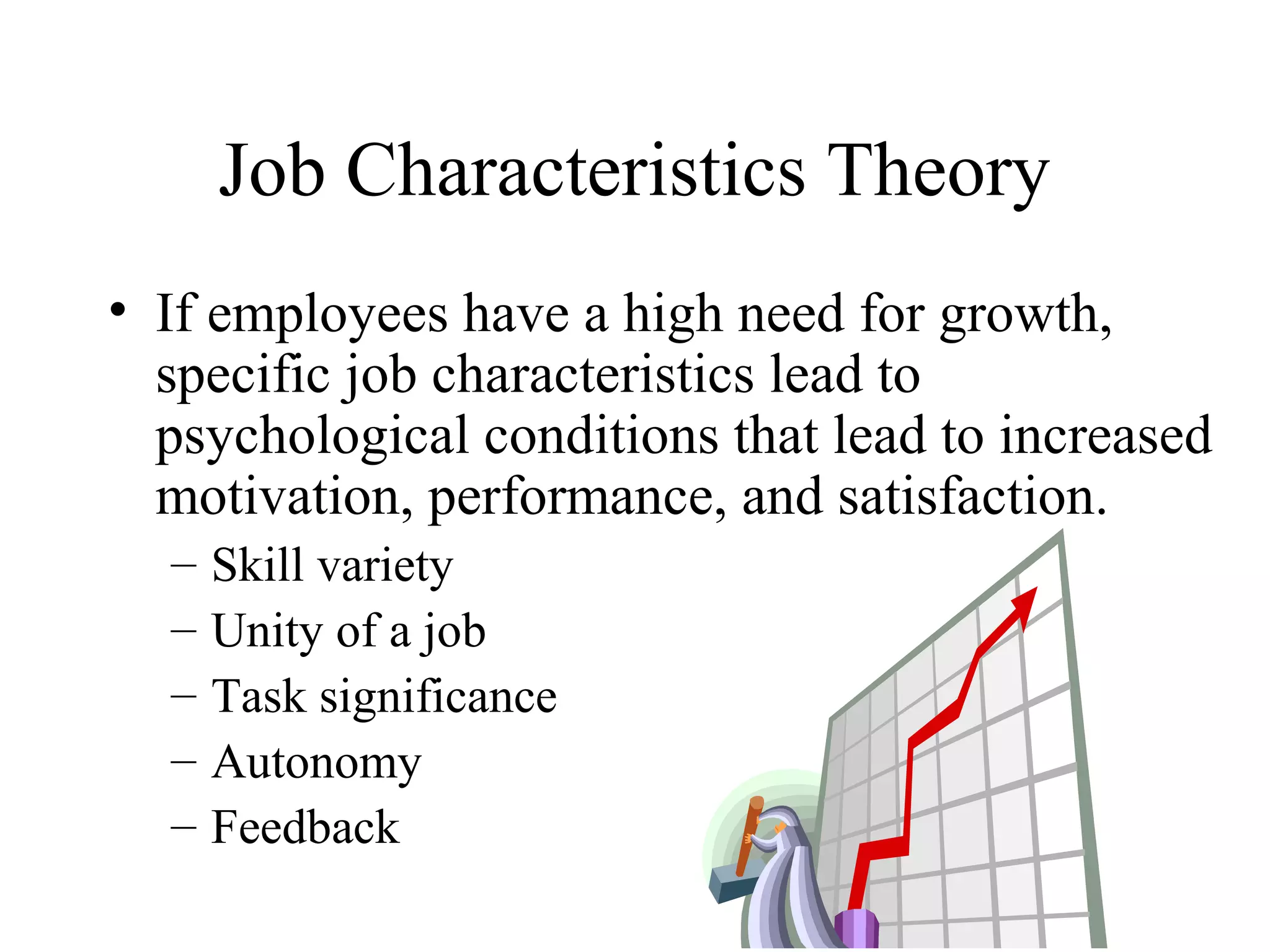
• If employees have a high need for growth,
specific job characteristics lead to
psychological conditions that lead to increased
motivation, performance, and satisfaction.
– Skill variety
– Unity of a job
– Task significance
– Autonomy
– Feedback
Process Theories
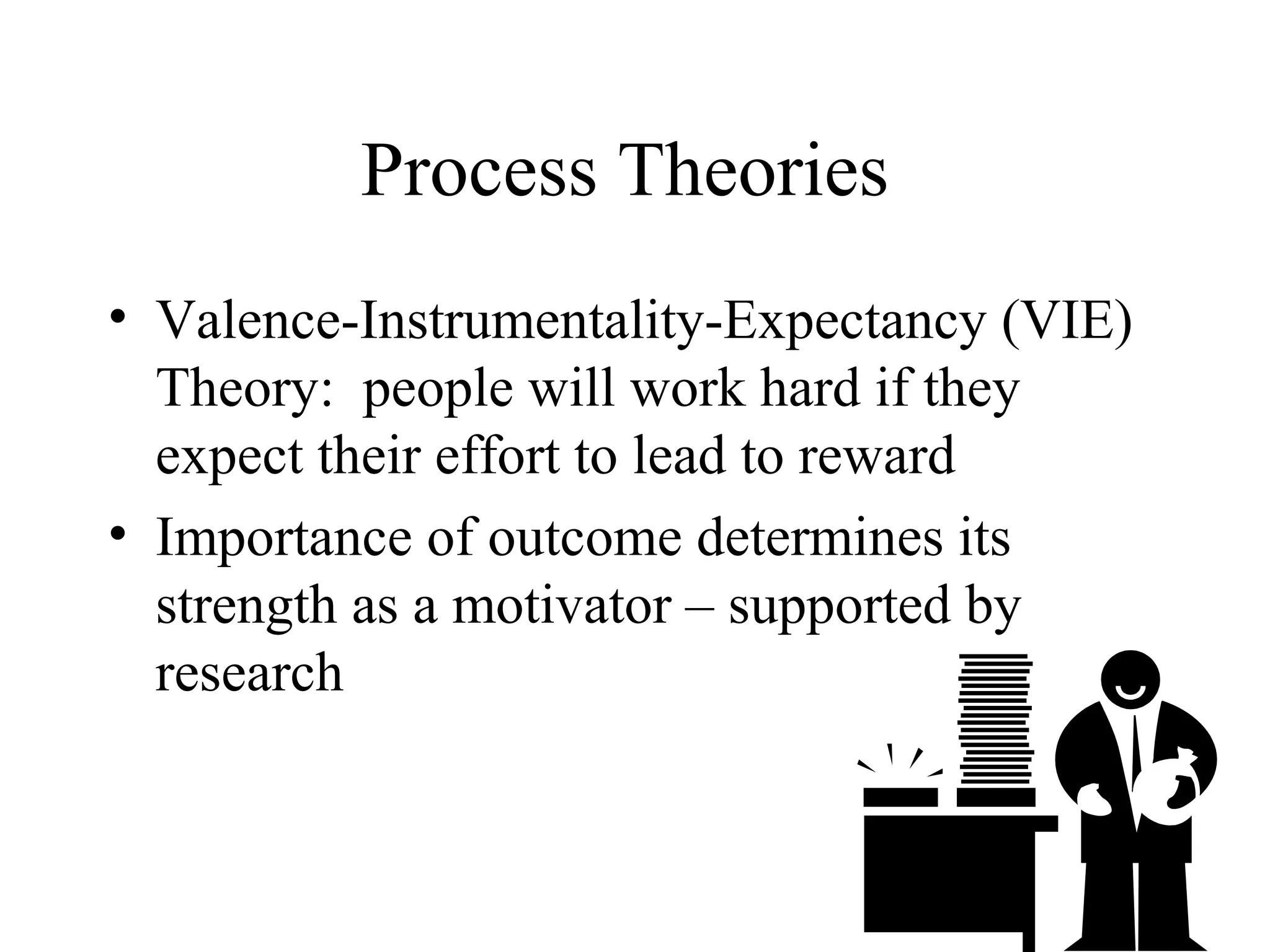
• Valence-Instrumentality-Expectancy (VIE)
Theory: people will work hard if they
expect their effort to lead to reward
• Importance of outcome determines its
strength as a motivator – supported by
research
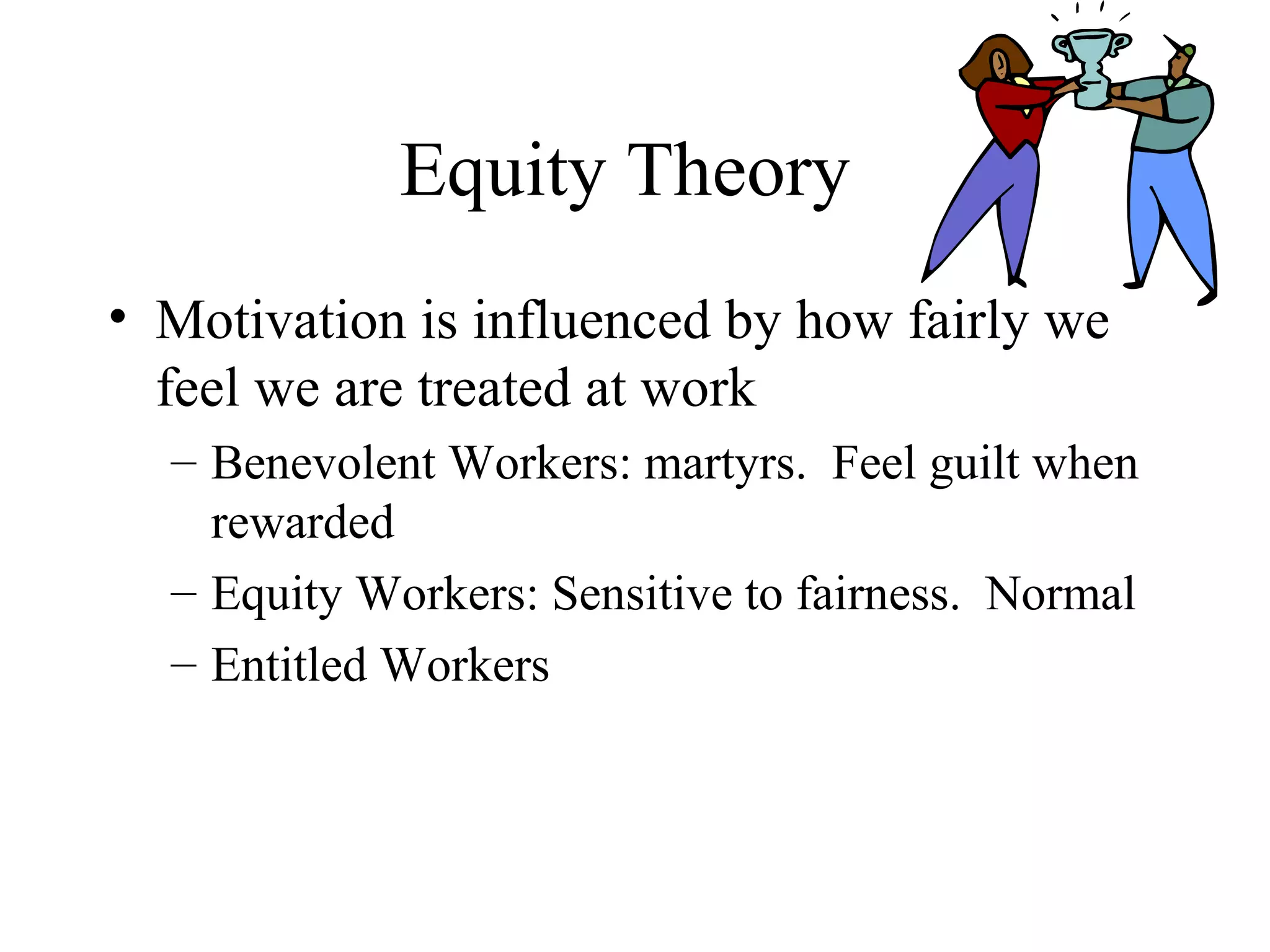
Equity Theory
• Motivation is influenced by how fairly we
feel we are treated at work
– Benevolent Workers: martyrs. Feel guilt when
rewarded
– Equity Workers: Sensitive to fairness. Normal
– Entitled Workers
Goal-Setting Theory
• Idea that our primary motivation on the job
is defined in terms of our desire to achieve a
particular goal
– Research shows that having goals leads to
better performance than not having goals
– Specific goals are more motivating than general
– Moderately difficult goals are most motivating
High Performance Cycle
• Expands on Goal Setting Theory
• Specific, attainable goals influenced by
• Moderators (commitment to goal, self-
efficacy, task difficulty, feedback) and
• Mediating Mechanisms (universal task
strategies such as direction of attention,
effort and persistence)
Job Satisfaction
• Overall measures of satisfaction may be too
broad: current measures address different
facets of job satisfaction
• Overall job satisfaction rate has remained the
same for over 50 years
• Rates are much lower for government workers
• When people say they are satisfied, they often
mean they are not dissatisfied!!
Personal Characteristics and Job
Satisfaction
• Age: in general, increases with age
– Malcontents have stopped working
– Older workers have greater chance of fulfillment
• Gender: inconclusive results
• Race: whites are happier
• Cognitive Ability: slight negative relationship
between level of education and satisfaction
Personal Characteristics, Cont.
• Use of Skills
• Job Congruence
• Personality: less alienation and internal
locus of control lead to higher satisfaction
• Occupational Level: the higher the status
level the greater the satisfaction
Low Satisfaction and Job Behavior
• Absenteeism: any given day 16-20% of
workers miss work. Costs businesses $30
billion dollars a year
– Younger have higher absence rates
– Rates are influenced by economic conditions
• Turnover: Not always a bad thing!
– Functional Turnover: when bad workers leave
– Dysfunctional Turnover

Motivation and job satisfaction

  • 1.
    Motivation and JobSatisfaction • Why is this important? – Are you tired of unmotivated, uninterested, and inept workers? – One-third to one-half your life is spent at work!!
  • 2.
    Theories of Motivation •Content Theories: Focus on the importance of the work (e.g., challenges and responsibilities) – Specific needs that motivate human behavior • Process Theories: Deal with the cognitive processes used in making decisions about our work
  • 3.
    Content Theories • AchievementMotivation Theory: David McClelland. Emphasizes need to accomplish something. Linked to successful managers – Favor environment where they can assume responsibility – Take calculated risks and set attainable goals – Need continuing recognition and feedback • Managers high in achievement motivation show more respect for subordinates and use more participatory systems
  • 4.
    Need Hierarchy Theory •Abraham Maslow: proposed that we have a hierarchy of needs. Once one is fulfilled we can move on to the next – Physiological – Safety – Belonging and Love – Esteem – Self-Actualization
  • 5.
    ERG Theory • Alderfer •Similar to Maslow. We have needs, but in this case they are not hierarchically arranged • Satisfying a need may increase its strength – Existence Needs – Relatedness Needs – Growth Needs
  • 6.
    Motivator-Hygiene (Two Factor) Theory •Motivator Needs: internal to work itself. If conditions are met, job satisfaction occurs – Job enrichment: expand a job to give employee a greater role in planning, performing, and evaluating their work • Hygiene Needs: Features of work environment. If not met, job dissatisfaction occurs
  • 7.
    Job Characteristics Theory •If employees have a high need for growth, specific job characteristics lead to psychological conditions that lead to increased motivation, performance, and satisfaction. – Skill variety – Unity of a job – Task significance – Autonomy – Feedback
  • 8.
    Process Theories • Valence-Instrumentality-Expectancy(VIE) Theory: people will work hard if they expect their effort to lead to reward • Importance of outcome determines its strength as a motivator – supported by research
  • 9.
    Equity Theory • Motivationis influenced by how fairly we feel we are treated at work – Benevolent Workers: martyrs. Feel guilt when rewarded – Equity Workers: Sensitive to fairness. Normal – Entitled Workers
  • 10.
    Goal-Setting Theory • Ideathat our primary motivation on the job is defined in terms of our desire to achieve a particular goal – Research shows that having goals leads to better performance than not having goals – Specific goals are more motivating than general – Moderately difficult goals are most motivating
  • 11.
    High Performance Cycle •Expands on Goal Setting Theory • Specific, attainable goals influenced by • Moderators (commitment to goal, self- efficacy, task difficulty, feedback) and • Mediating Mechanisms (universal task strategies such as direction of attention, effort and persistence)
  • 12.
    Job Satisfaction • Overallmeasures of satisfaction may be too broad: current measures address different facets of job satisfaction • Overall job satisfaction rate has remained the same for over 50 years • Rates are much lower for government workers • When people say they are satisfied, they often mean they are not dissatisfied!!
  • 13.
    Personal Characteristics andJob Satisfaction • Age: in general, increases with age – Malcontents have stopped working – Older workers have greater chance of fulfillment • Gender: inconclusive results • Race: whites are happier • Cognitive Ability: slight negative relationship between level of education and satisfaction
  • 14.
    Personal Characteristics, Cont. •Use of Skills • Job Congruence • Personality: less alienation and internal locus of control lead to higher satisfaction • Occupational Level: the higher the status level the greater the satisfaction
  • 15.
    Low Satisfaction andJob Behavior • Absenteeism: any given day 16-20% of workers miss work. Costs businesses $30 billion dollars a year – Younger have higher absence rates – Rates are influenced by economic conditions • Turnover: Not always a bad thing! – Functional Turnover: when bad workers leave – Dysfunctional Turnover