
Motivation
Defining Motivation
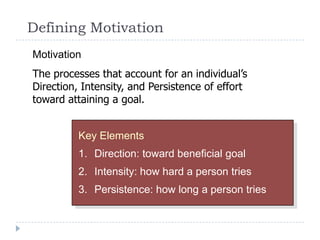
Key Elements
1. Direction: toward beneficial goal
2. Intensity: how hard a person tries
3. Persistence: how long a person tries
Motivation
The processes that account for an individual’s
Direction, Intensity, and Persistence of effort
toward attaining a goal.
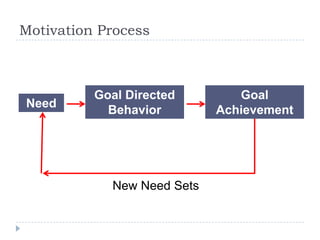
Motivation Process
Need
Goal Directed
Behavior
Goal
Achievement
New Need Sets
Importance
 Quality oriented employees
 Higher productivity
 Higher attraction and retention of Talent
 Responsible employees – ready to take additional
tasks, bigger challenges
 Ready to accept change
Theories of Motivation
Content Theories
 Maslow’s Hierarchy of Needs (Abraham Maslow)
 Theory X and Theory Y (Douglas McGregor)
 Two Factor Theory (Frederick Herzberg)
 McClelland’s Theory of Needs (David McClelland)
 ERG Theory (Clayton Alderfer)
Process Theories
 Equity Theory (J. Stacy Adams)
 Expectancy Theory (Victor Vroom)
 Goal Setting Theory (Edwin Locke)
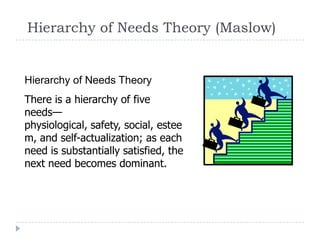
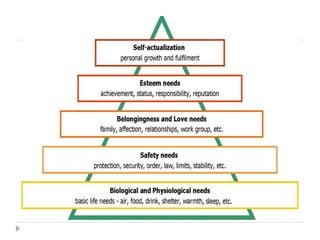
Hierarchy of Needs Theory (Maslow)
Hierarchy of Needs Theory
There is a hierarchy of five
needs—
physiological, safety, social, estee
m, and self-actualization; as each
need is substantially satisfied, the
next need becomes dominant.
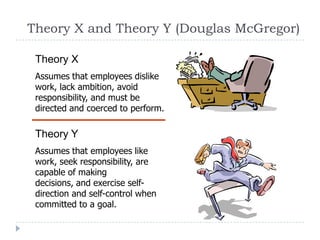
Theory X and Theory Y (Douglas McGregor)
Theory X
Assumes that employees dislike
work, lack ambition, avoid
responsibility, and must be
directed and coerced to perform.
Theory Y
Assumes that employees like
work, seek responsibility, are
capable of making
decisions, and exercise self-
direction and self-control when
committed to a goal.
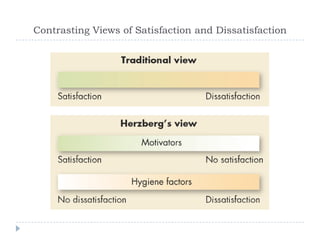
Two-Factor Theory (Frederick Herzberg)
Two-Factor (Motivators-Hygiene)
Theory
Intrinsic factors are related to
job satisfaction, while extrinsic
factors are associated with
dissatisfaction.
Factors leading to Job
satisfaction are separate and
distinct from those leading to
Job dissatisfaction.
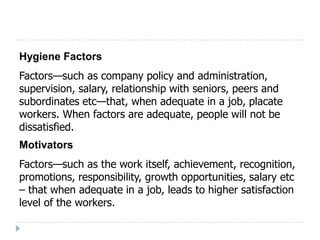
Hygiene Factors
Factors—such as company policy and administration,
supervision, salary, relationship with seniors, peers and
subordinates etc—that, when adequate in a job, placate
workers. When factors are adequate, people will not be
dissatisfied.
Motivators
Factors—such as the work itself, achievement, recognition,
promotions, responsibility, growth opportunities, salary etc
– that when adequate in a job, leads to higher satisfaction
level of the workers.
Contrasting Views of Satisfaction and Dissatisfaction
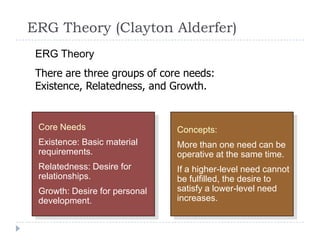
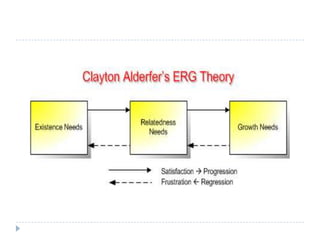
ERG Theory (Clayton Alderfer)
Core Needs
Existence: Basic material
requirements.
Relatedness: Desire for
relationships.
Growth: Desire for personal
development.
Concepts:
More than one need can be
operative at the same time.
If a higher-level need cannot
be fulfilled, the desire to
satisfy a lower-level need
increases.
ERG Theory
There are three groups of core needs:
Existence, Relatedness, and Growth.
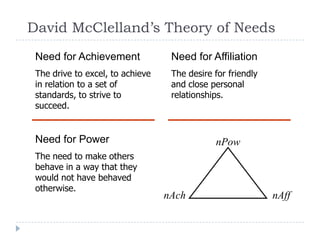
David McClelland’s Theory of Needs
nAch
nPow
nAff
Need for Achievement
The drive to excel, to achieve
in relation to a set of
standards, to strive to
succeed.
Need for Affiliation
The desire for friendly
and close personal
relationships.
Need for Power
The need to make others
behave in a way that they
would not have behaved
otherwise.
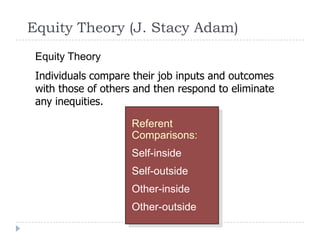
Equity Theory (J. Stacy Adam)
Referent
Comparisons:
Self-inside
Self-outside
Other-inside
Other-outside
Equity Theory
Individuals compare their job inputs and outcomes
with those of others and then respond to eliminate
any inequities.
 Inputs are Typically: Effort, Loyalty, Hard work,
Commitment, Skill, Flexibility, Tolerance,
Determination, Enthusiasm, Trust in our boss and
superiors, Support of colleagues and subordinates,
etc.
 Outputs are Typically - Salary, Benefits, Pension,
Bonus and Commission , Recognition, Reputation,
Praise, Responsibility, Training & Development,
Sense of Achievement and Advancement etc.
 Self-inside : An employee’s experience in a different
position inside his present organization.
 Self-outside : An employee’s experience in a
situation outside the present organization.
 Other-inside : Another employee or group of
employees inside the employee’s present
organization.
 Other-outside : Another employee or employees
outside the employee’s present organization.
Equity Theory (cont’d)
Choices for dealing with inequity:
1. Change inputs (slack off)
2. Change outcomes (increase output)
3. Distort/change perceptions of self
4. Distort/change perceptions of others
5. Choose a different referent person
6. Leave the field (quit the job)
Equity Theory (cont’d)
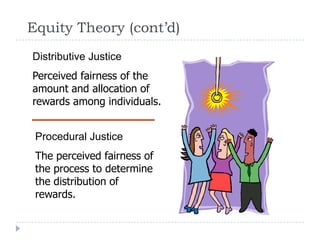
Distributive Justice
Perceived fairness of the
amount and allocation of
rewards among individuals.
Procedural Justice
The perceived fairness of
the process to determine
the distribution of
rewards.
Expectancy Theory
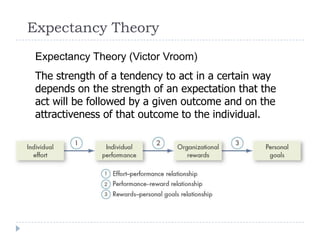
Expectancy Theory (Victor Vroom)
The strength of a tendency to act in a certain way
depends on the strength of an expectation that the
act will be followed by a given outcome and on the
attractiveness of that outcome to the individual.
Expectancy Theory Relationships
 Effort–Performance Relationship (Expectancy)
 The probability that exerting a given amount of effort
will lead to performance.
 Performance–Reward Relationship
(Instrumentality)
 The belief that performing at a particular level will lead
to the attainment of a desired outcome.
 Rewards–Personal Goals Relationship (Valence)
 The degree to which organizational rewards satisfy an
individual’s goals or needs and the attractiveness of
potential rewards for the individual.
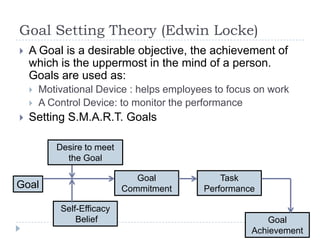
Goal Setting Theory (Edwin Locke)
 A Goal is a desirable objective, the achievement of
which is the uppermost in the mind of a person.
Goals are used as:
 Motivational Device : helps employees to focus on work
 A Control Device: to monitor the performance
 Setting S.M.A.R.T. Goals
Goal
Desire to meet
the Goal
Self-Efficacy
Belief
Goal
Commitment
Task
Performance
Goal
Achievement

Motivation

  • 1.
  • 2.
    Defining Motivation Key Elements 1.Direction: toward beneficial goal 2. Intensity: how hard a person tries 3. Persistence: how long a person tries Motivation The processes that account for an individual’s Direction, Intensity, and Persistence of effort toward attaining a goal.
  • 3.
  • 4.
    Importance  Quality orientedemployees  Higher productivity  Higher attraction and retention of Talent  Responsible employees – ready to take additional tasks, bigger challenges  Ready to accept change
  • 5.
    Theories of Motivation ContentTheories  Maslow’s Hierarchy of Needs (Abraham Maslow)  Theory X and Theory Y (Douglas McGregor)  Two Factor Theory (Frederick Herzberg)  McClelland’s Theory of Needs (David McClelland)  ERG Theory (Clayton Alderfer) Process Theories  Equity Theory (J. Stacy Adams)  Expectancy Theory (Victor Vroom)  Goal Setting Theory (Edwin Locke)
  • 6.
    Hierarchy of NeedsTheory (Maslow) Hierarchy of Needs Theory There is a hierarchy of five needs— physiological, safety, social, estee m, and self-actualization; as each need is substantially satisfied, the next need becomes dominant.
  • 8.
    Theory X andTheory Y (Douglas McGregor) Theory X Assumes that employees dislike work, lack ambition, avoid responsibility, and must be directed and coerced to perform. Theory Y Assumes that employees like work, seek responsibility, are capable of making decisions, and exercise self- direction and self-control when committed to a goal.
  • 9.
    Two-Factor Theory (FrederickHerzberg) Two-Factor (Motivators-Hygiene) Theory Intrinsic factors are related to job satisfaction, while extrinsic factors are associated with dissatisfaction. Factors leading to Job satisfaction are separate and distinct from those leading to Job dissatisfaction.
  • 10.
    Hygiene Factors Factors—such ascompany policy and administration, supervision, salary, relationship with seniors, peers and subordinates etc—that, when adequate in a job, placate workers. When factors are adequate, people will not be dissatisfied. Motivators Factors—such as the work itself, achievement, recognition, promotions, responsibility, growth opportunities, salary etc – that when adequate in a job, leads to higher satisfaction level of the workers.
  • 11.
    Contrasting Views ofSatisfaction and Dissatisfaction
  • 12.
    ERG Theory (ClaytonAlderfer) Core Needs Existence: Basic material requirements. Relatedness: Desire for relationships. Growth: Desire for personal development. Concepts: More than one need can be operative at the same time. If a higher-level need cannot be fulfilled, the desire to satisfy a lower-level need increases. ERG Theory There are three groups of core needs: Existence, Relatedness, and Growth.
  • 14.
    David McClelland’s Theoryof Needs nAch nPow nAff Need for Achievement The drive to excel, to achieve in relation to a set of standards, to strive to succeed. Need for Affiliation The desire for friendly and close personal relationships. Need for Power The need to make others behave in a way that they would not have behaved otherwise.
  • 15.
    Equity Theory (J.Stacy Adam) Referent Comparisons: Self-inside Self-outside Other-inside Other-outside Equity Theory Individuals compare their job inputs and outcomes with those of others and then respond to eliminate any inequities.
  • 16.
     Inputs areTypically: Effort, Loyalty, Hard work, Commitment, Skill, Flexibility, Tolerance, Determination, Enthusiasm, Trust in our boss and superiors, Support of colleagues and subordinates, etc.  Outputs are Typically - Salary, Benefits, Pension, Bonus and Commission , Recognition, Reputation, Praise, Responsibility, Training & Development, Sense of Achievement and Advancement etc.
  • 17.
     Self-inside :An employee’s experience in a different position inside his present organization.  Self-outside : An employee’s experience in a situation outside the present organization.  Other-inside : Another employee or group of employees inside the employee’s present organization.  Other-outside : Another employee or employees outside the employee’s present organization.
  • 18.
    Equity Theory (cont’d) Choicesfor dealing with inequity: 1. Change inputs (slack off) 2. Change outcomes (increase output) 3. Distort/change perceptions of self 4. Distort/change perceptions of others 5. Choose a different referent person 6. Leave the field (quit the job)
  • 19.
    Equity Theory (cont’d) DistributiveJustice Perceived fairness of the amount and allocation of rewards among individuals. Procedural Justice The perceived fairness of the process to determine the distribution of rewards.
  • 20.
    Expectancy Theory Expectancy Theory(Victor Vroom) The strength of a tendency to act in a certain way depends on the strength of an expectation that the act will be followed by a given outcome and on the attractiveness of that outcome to the individual.
  • 21.
    Expectancy Theory Relationships Effort–Performance Relationship (Expectancy)  The probability that exerting a given amount of effort will lead to performance.  Performance–Reward Relationship (Instrumentality)  The belief that performing at a particular level will lead to the attainment of a desired outcome.  Rewards–Personal Goals Relationship (Valence)  The degree to which organizational rewards satisfy an individual’s goals or needs and the attractiveness of potential rewards for the individual.
  • 22.
    Goal Setting Theory(Edwin Locke)  A Goal is a desirable objective, the achievement of which is the uppermost in the mind of a person. Goals are used as:  Motivational Device : helps employees to focus on work  A Control Device: to monitor the performance  Setting S.M.A.R.T. Goals Goal Desire to meet the Goal Self-Efficacy Belief Goal Commitment Task Performance Goal Achievement