







MOTIVATION
DEFINITION & NATURE
• It refers to a set of forces that energise people
to behave in certain ways.
• Motivation is necessary to accomplish tasks,
to produce quality goods, & for other related
purposes.
• Performance of an individual depends on his
or her ability backed by motivation.
IMPORTANCE OF MOTIVATION
Qualities of Motivation:
Energizes behavior
Directs behavior
Enables persistence towards a goal
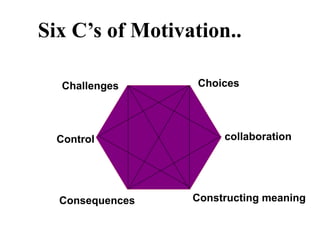
Six C’s of Motivation..
Choices
collaboration
Constructing meaningConsequences
Control
Challenges
THEORIES OF MOTIVATION
Early Theories – Scientific
Management
• It is the name given to a philosophy & set of
methods & techniques that stressed the
scientific study & organisation of work at the
operations level for the purpose of increasing
efficiency.
• Scientific Management is more associated
with F.W. Taylor who is remembered as the
“Father of Scientific Management”.
• Scientific Management had contributed
several techniques –
1. Planning the task
2. Standardisation
3. Specialisation & division of work
4. Mental Revolution
• Taylors theory stated that –
• Physical work could be scientifically studied to
determine the optimal method of performing a
job.
• Workers could thereafter be made more efficient
by being given prescriptions for how they were to
do their jobs.
• Workers would be willing to adhere to these
prescriptions if paid on a different piece work
basis.
Human Relations model
Contemporary Theories - Content
Theories
• Content Theories include -
a) Maslow’s Need Hierarchy Theory
b) Herzberg 2 factor theory
c) Alderfer’s ERG theory
d) Achievement Motivation Theory
Maslow’s Theory
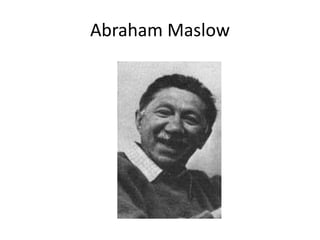
• Abraham Maslow is considered father of the
humanistic movement.
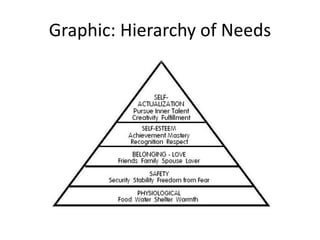
• Hierarchy of needs: the motivational
component of Maslow’s theory, in which our
innate needs, which motivate our actions, are
hierarchically arranged.
• Self-actualization: the fullest realization of a
person’s potential
Abraham Maslow
Graphic: Hierarchy of Needs
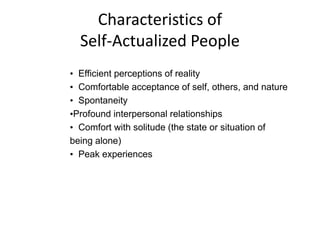
• Efficient perceptions of reality
• Comfortable acceptance of self, others, and nature
• Spontaneity
•Profound interpersonal relationships
• Comfort with solitude (the state or situation of
being alone)
• Peak experiences
Characteristics of
Self-Actualized People
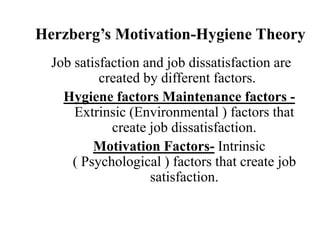
Herzberg’s Motivation-Hygiene Theory
Job satisfaction and job dissatisfaction are
created by different factors.
Hygiene factors Maintenance factors -
Extrinsic (Environmental ) factors that
create job dissatisfaction.
Motivation Factors- Intrinsic
( Psychological ) factors that create job
satisfaction.
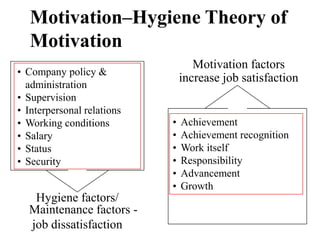
Motivation–Hygiene Theory of
Motivation
Hygiene factors/
Maintenance factors -
job dissatisfaction
• Company policy &
administration
• Supervision
• Interpersonal relations
• Working conditions
• Salary
• Status
• Security
• Achievement
• Achievement recognition
• Work itself
• Responsibility
• Advancement
• Growth
Motivation factors
increase job satisfaction
Alderfer’s ERG Theory
• Modification of Maslow’s need hierarchy was
proposed by Clay Alderfer.
• Alderfer’s views on motivation arose from the
results of questionnaires he gave to over 100
employees at several levels in a bank.
• Alderfer’s work led him to propose that there
are three (rather than maslow’s five) primary
categories of human needs. They are -
• Existence – The basic physiological needs
(hunger & thirst)& protection from physical
danger.
• Relatedness – Social & affiliation needs & the
need for respect & positive regard from others.
• Growth – The need to develop & realise one’s
potential.
Achievement Motivation Theory by
McClelland
According to David McClelland a person requires 3
types of needs as a result of one’s life experience.
They are –
• Need for Achievement (n Ach)– A drive to excel,
advance & grow
• Need for Power (nPow) - A drive to dominate or
influence others & situations
• Need for Affiliation (nAff) - A drive for friendly &
close inter-personal relationships
SUCCESSFUL
ENTREPRENEURS
McClelland states that people with high need for
achievement are characterized by the following –
• They set realistic & attainable goals for them
• They take calculated risks & look for challenging
tasks.
• They prefer situations wherein they can take personal
responsibility for solving problems.
• They need concrete feedback on how well they are
doing
• Their need for achievement exist not merely for the
sake of economic rewards or social recognition rather
personal accomplishment is intrinsically more
satisfying to them.
• Employees with a high need for achievement derive
satisfaction from achieving goals.
• Succeeding the task is important to the high achiever.
• Although people with a high need for achievement are often
wealthy, their wealth comes from their ability to achieve
goals.
• In most societies goal achievement is rewarded financially.
• High achievers are not motivated by money.
• High achievers prefer to work independently, so that
successful tasks performance (or failure) can be
related to their own efforts rather than to someone
else’s.
• Eg – Kakinada Project in 1970’s.
• Researchers attempted to raise the achievement
motivation of businessmen in Kakinada.
• The businessmen made plans that would help
them realise their goals to become successful
entrepreneurs & told each other about their goals
& their methods of reaching them.
• The businessmen became more productive as
entrepreneurs, they started several large
industries, enlarged their businesses & hired
more than five thousand of their villagers.
• In a ten year reassessment of the programme,
achievement motivational levels & results
were still exceptional.
Process - Theories
• Process-Based Theories
–Deals with how motivation occurs
–Rather than attempting to identify
motivational stimuli, process perspectives
focus on why people choose certain
behavioral options to satisfy their needs and
how they evaluate their satisfaction after
they have attained those goals.
Process - Theories
• Goal Setting Theory
• Vroom’s Expectancy Theory
• Adam’s Equity Theory
• Porter’s Performance Satisfaction Model
Goal Setting Theory
• Consists of 3 elements
1) Desire in an individual to attain his or her
goal. When individuals succeed in meeting a
goal, they feel competent & successful.
2) Acceptance by individuals of job &
organisational goals as personal goals. This is
the idea of goal commitment – the extent to
which people invest themselves in meeting a
goal.
3) Goal setting theory emphasizes that beliefs about self
efficiency & goal commitment influence task
performance.
Goals should be
S - Specific
M- Measurable
A – Attainable
R – Realistic
T – Time Bound
Equity Theory of Motivation
• Equity Theory
– Is the belief that one is being treated fairly in
relation to others; inequity is the belief that one is
being treated unfairly in relation to others.
• Social Comparisons
– Involves evaluating our own situation in terms of
others’ situations.
• Four Step Process
– People in organizations form perceptions about the
equity of their treatment through a four-step
process.
Forming Equity Perceptions
• Step 1: A person evaluates how he or she is being
treated by the firm.
• Step 2: The person forms a perception of how a
“comparison other” is being treated.
• Step 3: The person compares his or her own
circumstances with those of the comparison other to
form an impression of either equity or inequity.
• Step 4: On the strength of this feeling, the person may
choose to pursue one or more alternatives.
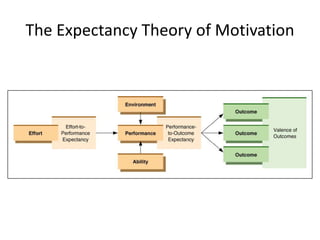
Expectancy Theory of Motivation
• The Basic Expectancy Model
– Suggests that people are motivated by how much
they want something and the likelihood they
perceive of getting it.
• Effort-to-Performance Expectancy
– A person’s perception of the probability that efforts
will lead to performance.
Expectancy Theory of Motivation
(continued)
• Performance-to-Outcome Expectancy
– An individual’s perception of the probability that
performance will lead to certain outcomes.
• Outcomes and Valences
– An outcome is anything that results from performing a
particular behavior.
– Valence is the degree of attractiveness or unattractiveness a
particular outcome has for a person.
The Expectancy Theory of Motivation
The Porter-Lawler Model
• Since its original conception, the expectancy
theory model has been refined and extended
many times.
• Although convention wisdom argues that
satisfaction leads to performance, Porter and
Lawler argued the reverse: If rewards are
adequate, high levels of performance may lead
to satisfaction.
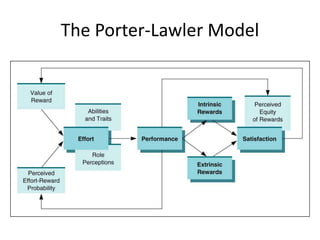
The Porter-Lawler Model (continued)
• According to the model, at the beginning of the
motivational cycle, effort is a function of the value of
the potential reward for the employee (its valence)
and the perceived effort-reward probability (an
expectancy).
• Effort then combines with abilities, traits, and role
perceptions to determine actual performance.
The Porter-Lawler Model
EXTRINSIC AND INTRINSIC
REWARDS
• Extrinsic rewards—usually financial—are the
tangible rewards given employees by
managers, such as pay raises, bonuses, and
benefits. They are called “extrinsic”
• In contrast, intrinsic rewards are psychological
rewards that employees get from doing
meaningful work and performing it well.
• Extrinsic rewards remain significant for workers.
• Pay is an important consideration for most
workers in accepting a job, and unfair pay can be
a strong de-motivator.
• However, after people have taken a job and issues
of unfairness have been settled, it is found that
extrinsic rewards are now less important, as day-
to-day motivation is more strongly driven by
intrinsic rewards.
JOB PERFORMANCE
Features of job performance
• Performance versus outcomes
• Organizational goal relevance
• Multidimensionality

Modul 2 --motivation

  • 1.
  • 2.
    DEFINITION & NATURE •It refers to a set of forces that energise people to behave in certain ways. • Motivation is necessary to accomplish tasks, to produce quality goods, & for other related purposes.
  • 3.
    • Performance ofan individual depends on his or her ability backed by motivation.
  • 5.
  • 6.
    Qualities of Motivation: Energizesbehavior Directs behavior Enables persistence towards a goal
  • 7.
    Six C’s ofMotivation.. Choices collaboration Constructing meaningConsequences Control Challenges
  • 8.
  • 9.
    Early Theories –Scientific Management • It is the name given to a philosophy & set of methods & techniques that stressed the scientific study & organisation of work at the operations level for the purpose of increasing efficiency. • Scientific Management is more associated with F.W. Taylor who is remembered as the “Father of Scientific Management”.
  • 10.
    • Scientific Managementhad contributed several techniques – 1. Planning the task 2. Standardisation 3. Specialisation & division of work 4. Mental Revolution
  • 11.
    • Taylors theorystated that – • Physical work could be scientifically studied to determine the optimal method of performing a job. • Workers could thereafter be made more efficient by being given prescriptions for how they were to do their jobs. • Workers would be willing to adhere to these prescriptions if paid on a different piece work basis.
  • 12.
  • 13.
    Contemporary Theories -Content Theories • Content Theories include - a) Maslow’s Need Hierarchy Theory b) Herzberg 2 factor theory c) Alderfer’s ERG theory d) Achievement Motivation Theory
  • 14.
    Maslow’s Theory • AbrahamMaslow is considered father of the humanistic movement. • Hierarchy of needs: the motivational component of Maslow’s theory, in which our innate needs, which motivate our actions, are hierarchically arranged. • Self-actualization: the fullest realization of a person’s potential
  • 15.
  • 16.
  • 17.
    • Efficient perceptionsof reality • Comfortable acceptance of self, others, and nature • Spontaneity •Profound interpersonal relationships • Comfort with solitude (the state or situation of being alone) • Peak experiences Characteristics of Self-Actualized People
  • 18.
    Herzberg’s Motivation-Hygiene Theory Jobsatisfaction and job dissatisfaction are created by different factors. Hygiene factors Maintenance factors - Extrinsic (Environmental ) factors that create job dissatisfaction. Motivation Factors- Intrinsic ( Psychological ) factors that create job satisfaction.
  • 19.
    Motivation–Hygiene Theory of Motivation Hygienefactors/ Maintenance factors - job dissatisfaction • Company policy & administration • Supervision • Interpersonal relations • Working conditions • Salary • Status • Security • Achievement • Achievement recognition • Work itself • Responsibility • Advancement • Growth Motivation factors increase job satisfaction
  • 20.
    Alderfer’s ERG Theory •Modification of Maslow’s need hierarchy was proposed by Clay Alderfer. • Alderfer’s views on motivation arose from the results of questionnaires he gave to over 100 employees at several levels in a bank. • Alderfer’s work led him to propose that there are three (rather than maslow’s five) primary categories of human needs. They are -
  • 21.
    • Existence –The basic physiological needs (hunger & thirst)& protection from physical danger. • Relatedness – Social & affiliation needs & the need for respect & positive regard from others. • Growth – The need to develop & realise one’s potential.
  • 22.
    Achievement Motivation Theoryby McClelland According to David McClelland a person requires 3 types of needs as a result of one’s life experience. They are – • Need for Achievement (n Ach)– A drive to excel, advance & grow • Need for Power (nPow) - A drive to dominate or influence others & situations • Need for Affiliation (nAff) - A drive for friendly & close inter-personal relationships
  • 23.
  • 24.
    McClelland states thatpeople with high need for achievement are characterized by the following – • They set realistic & attainable goals for them • They take calculated risks & look for challenging tasks. • They prefer situations wherein they can take personal responsibility for solving problems.
  • 25.
    • They needconcrete feedback on how well they are doing • Their need for achievement exist not merely for the sake of economic rewards or social recognition rather personal accomplishment is intrinsically more satisfying to them.
  • 26.
    • Employees witha high need for achievement derive satisfaction from achieving goals. • Succeeding the task is important to the high achiever. • Although people with a high need for achievement are often wealthy, their wealth comes from their ability to achieve goals. • In most societies goal achievement is rewarded financially.
  • 27.
    • High achieversare not motivated by money. • High achievers prefer to work independently, so that successful tasks performance (or failure) can be related to their own efforts rather than to someone else’s.
  • 28.
    • Eg –Kakinada Project in 1970’s. • Researchers attempted to raise the achievement motivation of businessmen in Kakinada. • The businessmen made plans that would help them realise their goals to become successful entrepreneurs & told each other about their goals & their methods of reaching them.
  • 29.
    • The businessmenbecame more productive as entrepreneurs, they started several large industries, enlarged their businesses & hired more than five thousand of their villagers. • In a ten year reassessment of the programme, achievement motivational levels & results were still exceptional.
  • 30.
    Process - Theories •Process-Based Theories –Deals with how motivation occurs –Rather than attempting to identify motivational stimuli, process perspectives focus on why people choose certain behavioral options to satisfy their needs and how they evaluate their satisfaction after they have attained those goals.
  • 31.
    Process - Theories •Goal Setting Theory • Vroom’s Expectancy Theory • Adam’s Equity Theory • Porter’s Performance Satisfaction Model
  • 32.
    Goal Setting Theory •Consists of 3 elements 1) Desire in an individual to attain his or her goal. When individuals succeed in meeting a goal, they feel competent & successful. 2) Acceptance by individuals of job & organisational goals as personal goals. This is the idea of goal commitment – the extent to which people invest themselves in meeting a goal.
  • 33.
    3) Goal settingtheory emphasizes that beliefs about self efficiency & goal commitment influence task performance. Goals should be S - Specific M- Measurable A – Attainable R – Realistic T – Time Bound
  • 34.
    Equity Theory ofMotivation • Equity Theory – Is the belief that one is being treated fairly in relation to others; inequity is the belief that one is being treated unfairly in relation to others. • Social Comparisons – Involves evaluating our own situation in terms of others’ situations. • Four Step Process – People in organizations form perceptions about the equity of their treatment through a four-step process.
  • 35.
    Forming Equity Perceptions •Step 1: A person evaluates how he or she is being treated by the firm. • Step 2: The person forms a perception of how a “comparison other” is being treated. • Step 3: The person compares his or her own circumstances with those of the comparison other to form an impression of either equity or inequity. • Step 4: On the strength of this feeling, the person may choose to pursue one or more alternatives.
  • 36.
    Expectancy Theory ofMotivation • The Basic Expectancy Model – Suggests that people are motivated by how much they want something and the likelihood they perceive of getting it. • Effort-to-Performance Expectancy – A person’s perception of the probability that efforts will lead to performance.
  • 37.
    Expectancy Theory ofMotivation (continued) • Performance-to-Outcome Expectancy – An individual’s perception of the probability that performance will lead to certain outcomes. • Outcomes and Valences – An outcome is anything that results from performing a particular behavior. – Valence is the degree of attractiveness or unattractiveness a particular outcome has for a person.
  • 38.
    The Expectancy Theoryof Motivation
  • 39.
    The Porter-Lawler Model •Since its original conception, the expectancy theory model has been refined and extended many times. • Although convention wisdom argues that satisfaction leads to performance, Porter and Lawler argued the reverse: If rewards are adequate, high levels of performance may lead to satisfaction.
  • 40.
    The Porter-Lawler Model(continued) • According to the model, at the beginning of the motivational cycle, effort is a function of the value of the potential reward for the employee (its valence) and the perceived effort-reward probability (an expectancy). • Effort then combines with abilities, traits, and role perceptions to determine actual performance.
  • 41.
  • 42.
    EXTRINSIC AND INTRINSIC REWARDS •Extrinsic rewards—usually financial—are the tangible rewards given employees by managers, such as pay raises, bonuses, and benefits. They are called “extrinsic” • In contrast, intrinsic rewards are psychological rewards that employees get from doing meaningful work and performing it well.
  • 43.
    • Extrinsic rewardsremain significant for workers. • Pay is an important consideration for most workers in accepting a job, and unfair pay can be a strong de-motivator. • However, after people have taken a job and issues of unfairness have been settled, it is found that extrinsic rewards are now less important, as day- to-day motivation is more strongly driven by intrinsic rewards.
  • 44.
  • 45.
    Features of jobperformance • Performance versus outcomes • Organizational goal relevance • Multidimensionality