By Hosam Dahb and Mahmoud Ibrahim
Motivation is the
Secret of Synergy
People will be more engaged
when they do things they
really like

2
What Is Motivation?
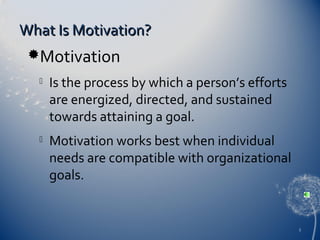
Motivation


Is the process by which a person’s efforts
are energized, directed, and sustained
towards attaining a goal.



Motivation works best when individual
needs are compatible with organizational
goals.

3
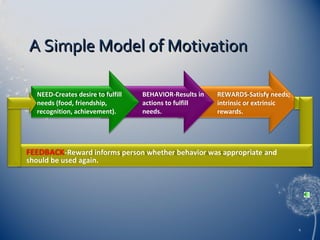
A Simple Model of Motivation
NEED-Creates desire to fulfill
needs (food, friendship,
recognition, achievement).

BEHAVIOR-Results in
actions to fulfill
needs.

REWARDS-Satisfy needs;
intrinsic or extrinsic
rewards.

FEEDBACK-Reward informs person whether behavior was appropriate and
should be used again.

4
5
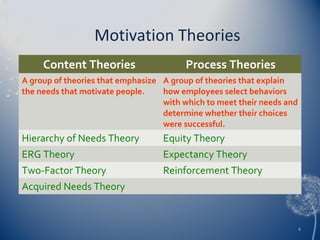
Motivation Theories
Content Theories

Process Theories

A group of theories that emphasize A group of theories that explain
the needs that motivate people.
how employees select behaviors
with which to meet their needs and
determine whether their choices
were successful.

Hierarchy of Needs Theory

Equity Theory

ERG Theory

Expectancy Theory

Two-Factor Theory

Reinforcement Theory

Acquired Needs Theory

6
Early Theories of Motivation


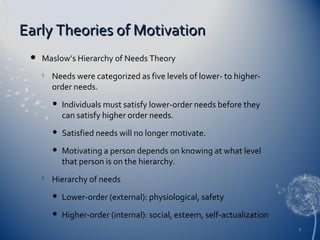
Maslow’s Hierarchy of Needs Theory


Needs were categorized as five levels of lower- to higherorder needs.




Satisfied needs will no longer motivate.





Individuals must satisfy lower-order needs before they
can satisfy higher order needs.

Motivating a person depends on knowing at what level
that person is on the hierarchy.

Hierarchy of needs


Lower-order (external): physiological, safety



Higher-order (internal): social, esteem, self-actualization
7
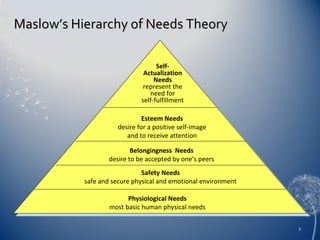
Maslow’s Hierarchy of Needs Theory
SelfActualization
Needs
represent the
need for
self-fulfillment
Esteem Needs
desire for a positive self-image
and to receive attention
Belongingness Needs
desire to be accepted by one’s peers
Safety Needs
safe and secure physical and emotional environment
Physiological Needs
most basic human physical needs
8
Early Theories of Motivation (cont’d)


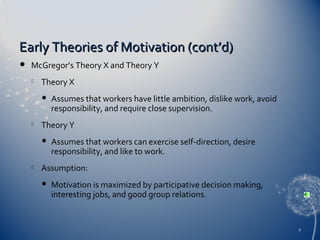
McGregor’s Theory X and Theory Y


Theory X




Theory Y




Assumes that workers have little ambition, dislike work, avoid
responsibility, and require close supervision.

Assumes that workers can exercise self-direction, desire
responsibility, and like to work.

Assumption:


Motivation is maximized by participative decision making,
interesting jobs, and good group relations.

9
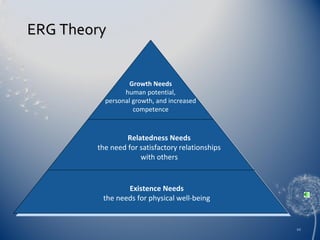
ERG Theory
Growth Needs
human potential,
personal growth, and increased
competence

Relatedness Needs
the need for satisfactory relationships
with others

Existence Needs
the needs for physical well-being

10
Early Theories of Motivation (cont’d)


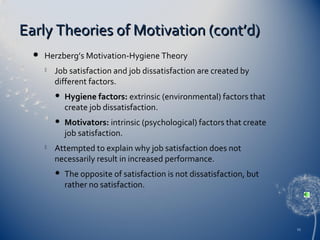
Herzberg’s Motivation-Hygiene Theory


Job satisfaction and job dissatisfaction are created by
different factors.






Hygiene factors: extrinsic (environmental) factors that
create job dissatisfaction.
Motivators: intrinsic (psychological) factors that create
job satisfaction.

Attempted to explain why job satisfaction does not
necessarily result in increased performance.


The opposite of satisfaction is not dissatisfaction, but
rather no satisfaction.

11
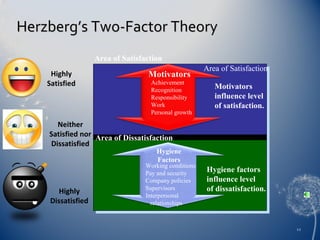
Herzberg’s Two-Factor Theory
Area of Satisfaction
Highly
Satisfied

Motivators
Achievement
Recognition
Responsibility
Work
Personal growth

Area of Satisfaction
Motivators
influence level
of satisfaction.

Neither
Satisfied nor Area of Dissatisfaction
Dissatisfied

Hygiene
Factors

Highly
Dissatisfied

Working conditions
Pay and security
Company policies
Supervisors
Interpersonal
relationships

Hygiene factors
influence level
of dissatisfaction.

12
Motivation and Needs
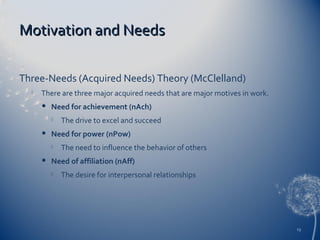
Three-Needs (Acquired Needs) Theory (McClelland)


There are three major acquired needs that are major motives in work.


Need for achievement (nAch)




Need for power (nPow)




The drive to excel and succeed
The need to influence the behavior of others

Need of affiliation (nAff)


The desire for interpersonal relationships

13
Process Theories
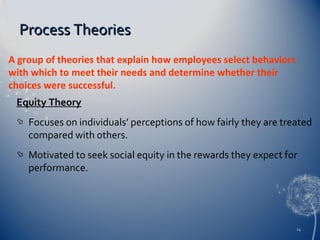
A group of theories that explain how employees select behaviors
with which to meet their needs and determine whether their
choices were successful.
Equity Theory


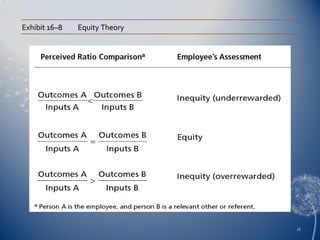
Focuses on individuals’ perceptions of how fairly they are treated
compared with others.



Motivated to seek social equity in the rewards they expect for
performance.

14
Motivation and Perception (cont’d)


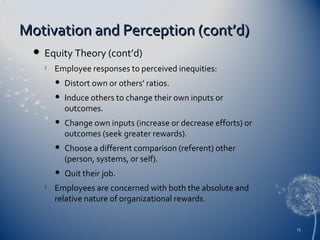
Equity Theory (cont’d)


Employee responses to perceived inequities:



Induce others to change their own inputs or
outcomes.



Change own inputs (increase or decrease efforts) or
outcomes (seek greater rewards).



Choose a different comparison (referent) other
(person, systems, or self).




Distort own or others’ ratios.

Quit their job.

Employees are concerned with both the absolute and
relative nature of organizational rewards.

15
Exhibit 16–8

Equity Theory

16
Process Theories (contd.)
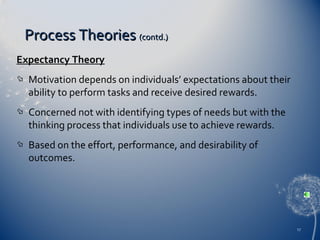
Expectancy Theory


Motivation depends on individuals’ expectations about their
ability to perform tasks and receive desired rewards.



Concerned not with identifying types of needs but with the
thinking process that individuals use to achieve rewards.



Based on the effort, performance, and desirability of
outcomes.

17
Motivation and Behavior


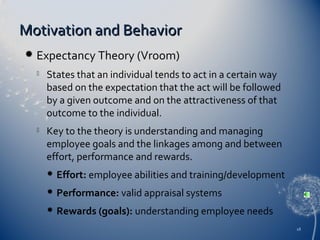
Expectancy Theory (Vroom)


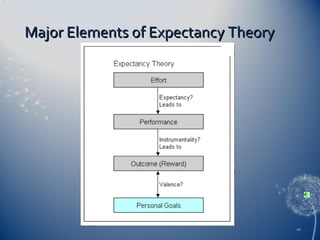
States that an individual tends to act in a certain way
based on the expectation that the act will be followed
by a given outcome and on the attractiveness of that
outcome to the individual.



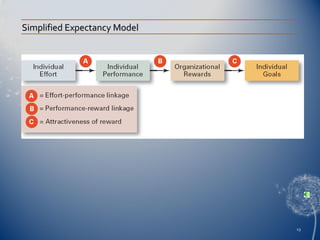
Key to the theory is understanding and managing
employee goals and the linkages among and between
effort, performance and rewards.


Effort: employee abilities and training/development



Performance: valid appraisal systems



Rewards (goals): understanding employee needs
18
Simplified Expectancy Model

19
Major Elements of Expectancy Theory

20
Motivation and Behavior


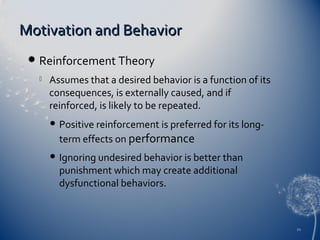
Reinforcement Theory


Assumes that a desired behavior is a function of its
consequences, is externally caused, and if
reinforced, is likely to be repeated.


Positive reinforcement is preferred for its longterm effects on performance



Ignoring undesired behavior is better than
punishment which may create additional
dysfunctional behaviors.

21
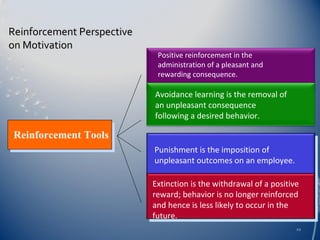
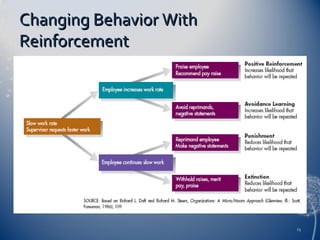
Reinforcement Perspective
on Motivation

Positive reinforcement in the
administration of a pleasant and
rewarding consequence.

Avoidance learning is the removal of
an unpleasant consequence
following a desired behavior.

Reinforcement Tools
Punishment is the imposition of
unpleasant outcomes on an employee.
Extinction is the withdrawal of a positive
reward; behavior is no longer reinforced
and hence is less likely to occur in the
future.
22
Changing Behavior With
Reinforcement

daft figure 12.6.CLP

23
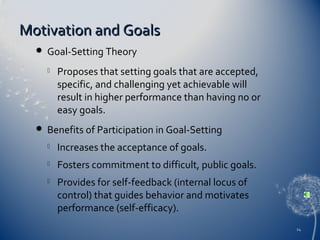
Motivation and Goals


Goal-Setting Theory




Proposes that setting goals that are accepted,
specific, and challenging yet achievable will
result in higher performance than having no or
easy goals.

Benefits of Participation in Goal-Setting


Increases the acceptance of goals.



Fosters commitment to difficult, public goals.



Provides for self-feedback (internal locus of
control) that guides behavior and motivates
performance (self-efficacy).
24
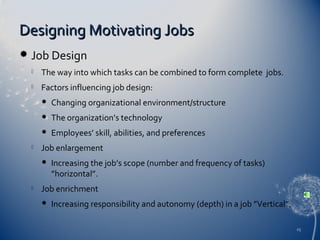
Designing Motivating Jobs


Job Design


The way into which tasks can be combined to form complete jobs.



Factors influencing job design:



The organization’s technology




Changing organizational environment/structure
Employees’ skill, abilities, and preferences

Job enlargement




Increasing the job’s scope (number and frequency of tasks)
”horizontal”.

Job enrichment


Increasing responsibility and autonomy (depth) in a job ”Vertical”.
25
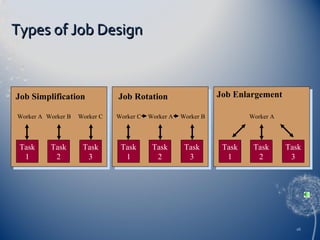
Types of Job Design

Job Simplification
Worker A Worker B

Task
1

Task
2

Job Enlargement

Job Rotation

Worker C

Worker C

Worker A

Worker B

Task
3

Task
1

Task
2

Task
3

Worker A

Task
1

Task
2

Task
3

26
Designing Motivating Jobs (cont’d)


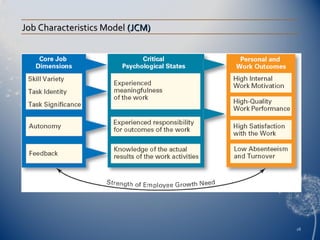
Job Characteristics Model (JCM)


A conceptual framework for designing motivating jobs that create
meaningful work experiences that satisfy employees’ growth needs.



Five primary job characteristics:


Skill variety: how many skills and talents are needed?



Task identity: does the job produce a complete work?



Task significance: how important is the job?



Autonomy: how much independence does the jobholder have?



Feedback: do workers know how well they are doing?

27
Job Characteristics Model (JCM)

28
Designing Motivating Jobs (cont’d)


Suggestions for Using the JCM


Combine tasks (job enlargement) to create
more meaningful work.



Create natural work units to make employees’
work important and whole.



Establish external and internal client
relationships to provide feedback.



Expand jobs vertically (job enrichment) by
giving employees more autonomy.



Open feedback channels to let employees
know how well they are doing.
29
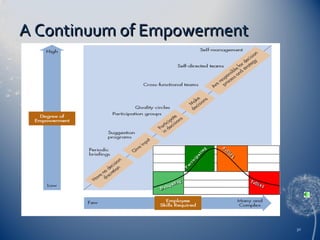
A Continuum of Empowerment

daft figure 12.11.CLP

30
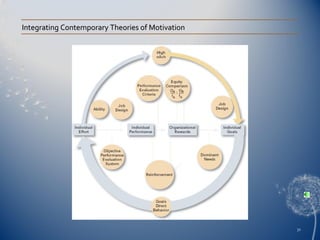
Integrating Contemporary Theories of Motivation

31

Motivation

  • 1.
    By Hosam Dahband Mahmoud Ibrahim
  • 2.
    Motivation is the Secretof Synergy People will be more engaged when they do things they really like 2
  • 3.
    What Is Motivation? Motivation  Isthe process by which a person’s efforts are energized, directed, and sustained towards attaining a goal.  Motivation works best when individual needs are compatible with organizational goals. 3
  • 4.
    A Simple Modelof Motivation NEED-Creates desire to fulfill needs (food, friendship, recognition, achievement). BEHAVIOR-Results in actions to fulfill needs. REWARDS-Satisfy needs; intrinsic or extrinsic rewards. FEEDBACK-Reward informs person whether behavior was appropriate and should be used again. 4
  • 5.
  • 6.
    Motivation Theories Content Theories ProcessTheories A group of theories that emphasize A group of theories that explain the needs that motivate people. how employees select behaviors with which to meet their needs and determine whether their choices were successful. Hierarchy of Needs Theory Equity Theory ERG Theory Expectancy Theory Two-Factor Theory Reinforcement Theory Acquired Needs Theory 6
  • 7.
    Early Theories ofMotivation  Maslow’s Hierarchy of Needs Theory  Needs were categorized as five levels of lower- to higherorder needs.   Satisfied needs will no longer motivate.   Individuals must satisfy lower-order needs before they can satisfy higher order needs. Motivating a person depends on knowing at what level that person is on the hierarchy. Hierarchy of needs  Lower-order (external): physiological, safety  Higher-order (internal): social, esteem, self-actualization 7
  • 8.
    Maslow’s Hierarchy ofNeeds Theory SelfActualization Needs represent the need for self-fulfillment Esteem Needs desire for a positive self-image and to receive attention Belongingness Needs desire to be accepted by one’s peers Safety Needs safe and secure physical and emotional environment Physiological Needs most basic human physical needs 8
  • 9.
    Early Theories ofMotivation (cont’d)  McGregor’s Theory X and Theory Y  Theory X   Theory Y   Assumes that workers have little ambition, dislike work, avoid responsibility, and require close supervision. Assumes that workers can exercise self-direction, desire responsibility, and like to work. Assumption:  Motivation is maximized by participative decision making, interesting jobs, and good group relations. 9
  • 10.
    ERG Theory Growth Needs humanpotential, personal growth, and increased competence Relatedness Needs the need for satisfactory relationships with others Existence Needs the needs for physical well-being 10
  • 11.
    Early Theories ofMotivation (cont’d)  Herzberg’s Motivation-Hygiene Theory  Job satisfaction and job dissatisfaction are created by different factors.    Hygiene factors: extrinsic (environmental) factors that create job dissatisfaction. Motivators: intrinsic (psychological) factors that create job satisfaction. Attempted to explain why job satisfaction does not necessarily result in increased performance.  The opposite of satisfaction is not dissatisfaction, but rather no satisfaction. 11
  • 12.
    Herzberg’s Two-Factor Theory Areaof Satisfaction Highly Satisfied Motivators Achievement Recognition Responsibility Work Personal growth Area of Satisfaction Motivators influence level of satisfaction. Neither Satisfied nor Area of Dissatisfaction Dissatisfied Hygiene Factors Highly Dissatisfied Working conditions Pay and security Company policies Supervisors Interpersonal relationships Hygiene factors influence level of dissatisfaction. 12
  • 13.
    Motivation and Needs Three-Needs(Acquired Needs) Theory (McClelland)  There are three major acquired needs that are major motives in work.  Need for achievement (nAch)   Need for power (nPow)   The drive to excel and succeed The need to influence the behavior of others Need of affiliation (nAff)  The desire for interpersonal relationships 13
  • 14.
    Process Theories A groupof theories that explain how employees select behaviors with which to meet their needs and determine whether their choices were successful. Equity Theory  Focuses on individuals’ perceptions of how fairly they are treated compared with others.  Motivated to seek social equity in the rewards they expect for performance. 14
  • 15.
    Motivation and Perception(cont’d)  Equity Theory (cont’d)  Employee responses to perceived inequities:   Induce others to change their own inputs or outcomes.  Change own inputs (increase or decrease efforts) or outcomes (seek greater rewards).  Choose a different comparison (referent) other (person, systems, or self).   Distort own or others’ ratios. Quit their job. Employees are concerned with both the absolute and relative nature of organizational rewards. 15
  • 16.
  • 17.
    Process Theories (contd.) ExpectancyTheory  Motivation depends on individuals’ expectations about their ability to perform tasks and receive desired rewards.  Concerned not with identifying types of needs but with the thinking process that individuals use to achieve rewards.  Based on the effort, performance, and desirability of outcomes. 17
  • 18.
    Motivation and Behavior  ExpectancyTheory (Vroom)  States that an individual tends to act in a certain way based on the expectation that the act will be followed by a given outcome and on the attractiveness of that outcome to the individual.  Key to the theory is understanding and managing employee goals and the linkages among and between effort, performance and rewards.  Effort: employee abilities and training/development  Performance: valid appraisal systems  Rewards (goals): understanding employee needs 18
  • 19.
  • 20.
    Major Elements ofExpectancy Theory 20
  • 21.
    Motivation and Behavior  ReinforcementTheory  Assumes that a desired behavior is a function of its consequences, is externally caused, and if reinforced, is likely to be repeated.  Positive reinforcement is preferred for its longterm effects on performance  Ignoring undesired behavior is better than punishment which may create additional dysfunctional behaviors. 21
  • 22.
    Reinforcement Perspective on Motivation Positivereinforcement in the administration of a pleasant and rewarding consequence. Avoidance learning is the removal of an unpleasant consequence following a desired behavior. Reinforcement Tools Punishment is the imposition of unpleasant outcomes on an employee. Extinction is the withdrawal of a positive reward; behavior is no longer reinforced and hence is less likely to occur in the future. 22
  • 23.
  • 24.
    Motivation and Goals  Goal-SettingTheory   Proposes that setting goals that are accepted, specific, and challenging yet achievable will result in higher performance than having no or easy goals. Benefits of Participation in Goal-Setting  Increases the acceptance of goals.  Fosters commitment to difficult, public goals.  Provides for self-feedback (internal locus of control) that guides behavior and motivates performance (self-efficacy). 24
  • 25.
    Designing Motivating Jobs  JobDesign  The way into which tasks can be combined to form complete jobs.  Factors influencing job design:   The organization’s technology   Changing organizational environment/structure Employees’ skill, abilities, and preferences Job enlargement   Increasing the job’s scope (number and frequency of tasks) ”horizontal”. Job enrichment  Increasing responsibility and autonomy (depth) in a job ”Vertical”. 25
  • 26.
    Types of JobDesign Job Simplification Worker A Worker B Task 1 Task 2 Job Enlargement Job Rotation Worker C Worker C Worker A Worker B Task 3 Task 1 Task 2 Task 3 Worker A Task 1 Task 2 Task 3 26
  • 27.
    Designing Motivating Jobs(cont’d)  Job Characteristics Model (JCM)  A conceptual framework for designing motivating jobs that create meaningful work experiences that satisfy employees’ growth needs.  Five primary job characteristics:  Skill variety: how many skills and talents are needed?  Task identity: does the job produce a complete work?  Task significance: how important is the job?  Autonomy: how much independence does the jobholder have?  Feedback: do workers know how well they are doing? 27
  • 28.
  • 29.
    Designing Motivating Jobs(cont’d)  Suggestions for Using the JCM  Combine tasks (job enlargement) to create more meaningful work.  Create natural work units to make employees’ work important and whole.  Establish external and internal client relationships to provide feedback.  Expand jobs vertically (job enrichment) by giving employees more autonomy.  Open feedback channels to let employees know how well they are doing. 29
  • 30.
    A Continuum ofEmpowerment daft figure 12.11.CLP 30
  • 31.

Editor's Notes