Job Satisfaction
Submitted by-
Abhishek Singh
IIT (ISM) DHANBAD
 Contents
1. What is Job Satisfaction..?
2. Theories of Job Satisfaction
3. Measuring Job Satisfaction
4. What determines Job Satisfaction..?
5. How employees can express dissatisfaction..?
6. Conclusion
1. What is Job Satisfaction…?
– Job satisfaction is in regard to one's state-of-mind or feelings
towards the nature of their work.
– A person with high job satisfaction holds positive feelings about
the work, while a person with low satisfaction holds negative
feelings.
2. Theories of Job Satisfaction
– Three prominent theories on Job Satisfaction are
 Content Theories
 Process Theories
 Situational Theories
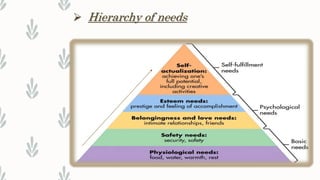
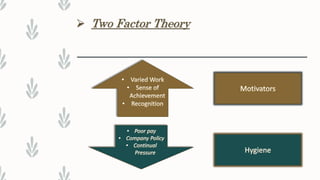
 Content Theories
– Content theory suggests that job satisfaction occurs when one’s
need for growth and self-actualization are met by individual’s jobs.
Two important theories under “Content Theories” are-
 Abraham Maslow’s “Hierarchy of needs”
 Frederick Herzberg “Two Factor Theory”
 Hierarchy of needs
 Two Factor Theory
 Process Theory
– Process theory attempts to explain job satisfaction by looking at
expectancies and values. This theory of job satisfaction suggest
that workers’ select their behaviours in order to meet their needs.
– Two most important theories under Process theory is :-
 Adams’ Equity Theory (1963)
 Victor Vroom’s Expectancy Theory (1982)
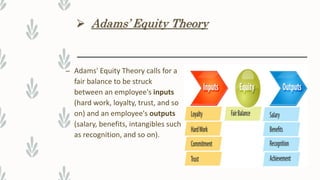
 Adams’ Equity Theory
– Adams' Equity Theory calls for a
fair balance to be struck
between an employee's inputs
(hard work, loyalty, trust, and so
on) and an employee's outputs
(salary, benefits, intangibles such
as recognition, and so on).
 Vrooms’ Expectancy Theory
– Victor Vroom's expectancy theory assumes that behaviour results
from conscious choices among alternatives whose purpose it is to
maximize pleasure and to minimize pain. Vroom realized that an
employee's performance is based on individual factors such as
personality, skills, knowledge, experience and abilities. He stated
that effort, performance and motivation are linked in a person's
motivation. He uses the variables Expectancy, Instrumentality and
Valence to account for this.
 Vrooms’ Expectancy Theory (Cont.)
Expectancy
• Belief that effort will
lead to acceptable
performance
Instrumentality
• Performance
reward
Valence
• Employee’s value
to the reward
Motivation
[Expectancy x
Instrumentality x
Valence]
 Situational Theory
– The situational occurrences theory emerged in 1992, when
Quarstein, McAfee and Glassman stated that job satisfaction is
determined by-
 Situational Characteristics &
 Situational Occurrences.
Situational Theory (Cont.)
– Situational characteristics are things such as pay, supervision,
working conditions, promotional opportunities, and company
policies that typically are considered by the employee before
accepting jobs.
– Situational occurrences are things that occur after taking a job
that may be tangible or intangible, positive or negative. Positive
occurrences might include extra vacation time.
3. Measuring Job Satisfaction
– Two approaches are popular- 1. Single Global Rating & 2. Summation of Job
Facets.
1. The single global rating is a response to one question, such as “All things
considered, how satisfied are you with your job?” Respondents circle a number
between 1 and 5 on a scale from “highly satisfied” to “highly dissatisfied.”
2. Summation of Job Facets identifies key elements in a job such as the type of
work, skills needed, supervision, present pay, promotion opportunities, culture,
and relationships with co-workers. Respondents rate these on a standardized
scale, and researchers add the ratings to create an overall job satisfaction score.
4. What determines Job
Satisfaction…?
– Some characteristics that likely influence job satisfaction are-
1. Job Conditions, 2. Personality, 3. Pay, 4. Corporate Social Responsibility (CSR)
& 5. Respect from Co-Workers.
 Job Conditions - Interesting jobs that provide training, variety, independence,
and control satisfy most employees. Feedback, social support, and interaction
with co-workers outside the workplace are also strongly related to job
satisfaction, even after accounting for characteristics of the work itself.
Managers also play a big role in employees’ job satisfaction. Employees who
feel empowered by their leaders experience higher job satisfaction, one study of a
large Hong Kong telecommunications corporation found.
What determines Job
Satisfaction…? (Cont.)
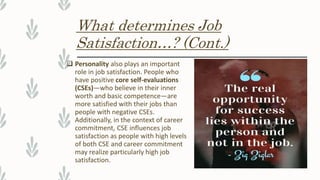
 Personality also plays an important
role in job satisfaction. People who
have positive core self-evaluations
(CSEs)—who believe in their inner
worth and basic competence—are
more satisfied with their jobs than
people with negative CSEs.
Additionally, in the context of career
commitment, CSE influences job
satisfaction as people with high levels
of both CSE and career commitment
may realize particularly high job
satisfaction.
What determines Job Satisfaction…?
(Cont.)
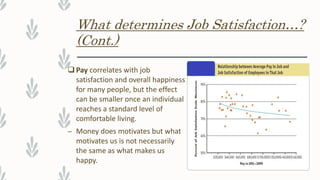
 Pay correlates with job
satisfaction and overall happiness
for many people, but the effect
can be smaller once an individual
reaches a standard level of
comfortable living.
– Money does motivates but what
motivates us is not necessarily
the same as what makes us
happy.
What determines Job Satisfaction…?
(Cont.)
 Corporate Social Responsibilities (CSR)- The relationship between
CSR and job satisfaction is particularly strong for Millennials. “The
next generation of employees is seeking out employers that are
focused on the triple bottom line: people, planet, and revenue,”
said Susan Cooney, founder of philanthropy firm ‘Givelocity’.
– CSR allows workers to serve a higher purpose or contribute to a
mission. According to researcher Amy Wrzesniewski, people who
view their work as part of a higher purpose often realize higher job
satisfaction.
What determines Job Satisfaction…?
(Cont.)
 Respect from Co-Workers- Employees seek to be treated with
respect by those they work with. A hostile work environment --
with rude or unpleasant coworkers -- is one that usually has lower
job satisfaction. Managers need to step in and mediate conflicts
before they escalate into more serious problems requiring
disciplinary action. Employees may need to be reminded what
behaviors are considered inappropriate when interacting with
coworkers.
5. How Employees can Express
Dissatisfaction…?
 Exit- The exit response directs behaviour toward leaving the
organization, including looking for a new position or resigning.
 Voice- The voice response includes actively and constructively
attempting to improve conditions, including suggesting improvements,
discussing problems with superiors, and undertaking union activity.
 Loyalty- The loyalty response means passively but optimistically waiting
for conditions to improve, including speaking up for the organization in
the face of external criticism and trusting the organization and its
management to “do the right thing.”
How Employees can Express
Dissatisfaction…? (Cont.)
 Neglect- The neglect response passively allows conditions to
worsen and includes chronic absenteeism or lateness, reduced
effort, and an increased error rate.
 Absenteeism- There exists a negative relationship between
satisfaction and absenteeism. When numerous alternative jobs are
available, dissatisfied employees have high absence rates, but
when there are few alternatives, dissatisfied employees have the
same (low) rate of absence as satisfied employees.
6. Conclusion
– Creating a satisfied workforce is hardly a guarantee of successful
organizational performance, but evidence strongly suggests
managers’ efforts to improve employee attitudes will likely result in
positive outcomes, including greater organizational effectiveness,
higher customer satisfaction, and increased profits.

Job satisfaction

  • 1.
  • 2.
     Contents 1. Whatis Job Satisfaction..? 2. Theories of Job Satisfaction 3. Measuring Job Satisfaction 4. What determines Job Satisfaction..? 5. How employees can express dissatisfaction..? 6. Conclusion
  • 3.
    1. What isJob Satisfaction…? – Job satisfaction is in regard to one's state-of-mind or feelings towards the nature of their work. – A person with high job satisfaction holds positive feelings about the work, while a person with low satisfaction holds negative feelings.
  • 4.
    2. Theories ofJob Satisfaction – Three prominent theories on Job Satisfaction are  Content Theories  Process Theories  Situational Theories
  • 5.
     Content Theories –Content theory suggests that job satisfaction occurs when one’s need for growth and self-actualization are met by individual’s jobs. Two important theories under “Content Theories” are-  Abraham Maslow’s “Hierarchy of needs”  Frederick Herzberg “Two Factor Theory”
  • 6.
  • 7.
  • 8.
     Process Theory –Process theory attempts to explain job satisfaction by looking at expectancies and values. This theory of job satisfaction suggest that workers’ select their behaviours in order to meet their needs. – Two most important theories under Process theory is :-  Adams’ Equity Theory (1963)  Victor Vroom’s Expectancy Theory (1982)
  • 9.
     Adams’ EquityTheory – Adams' Equity Theory calls for a fair balance to be struck between an employee's inputs (hard work, loyalty, trust, and so on) and an employee's outputs (salary, benefits, intangibles such as recognition, and so on).
  • 10.
     Vrooms’ ExpectancyTheory – Victor Vroom's expectancy theory assumes that behaviour results from conscious choices among alternatives whose purpose it is to maximize pleasure and to minimize pain. Vroom realized that an employee's performance is based on individual factors such as personality, skills, knowledge, experience and abilities. He stated that effort, performance and motivation are linked in a person's motivation. He uses the variables Expectancy, Instrumentality and Valence to account for this.
  • 11.
     Vrooms’ ExpectancyTheory (Cont.) Expectancy • Belief that effort will lead to acceptable performance Instrumentality • Performance reward Valence • Employee’s value to the reward Motivation [Expectancy x Instrumentality x Valence]
  • 12.
     Situational Theory –The situational occurrences theory emerged in 1992, when Quarstein, McAfee and Glassman stated that job satisfaction is determined by-  Situational Characteristics &  Situational Occurrences.
  • 13.
    Situational Theory (Cont.) –Situational characteristics are things such as pay, supervision, working conditions, promotional opportunities, and company policies that typically are considered by the employee before accepting jobs. – Situational occurrences are things that occur after taking a job that may be tangible or intangible, positive or negative. Positive occurrences might include extra vacation time.
  • 14.
    3. Measuring JobSatisfaction – Two approaches are popular- 1. Single Global Rating & 2. Summation of Job Facets. 1. The single global rating is a response to one question, such as “All things considered, how satisfied are you with your job?” Respondents circle a number between 1 and 5 on a scale from “highly satisfied” to “highly dissatisfied.” 2. Summation of Job Facets identifies key elements in a job such as the type of work, skills needed, supervision, present pay, promotion opportunities, culture, and relationships with co-workers. Respondents rate these on a standardized scale, and researchers add the ratings to create an overall job satisfaction score.
  • 15.
    4. What determinesJob Satisfaction…? – Some characteristics that likely influence job satisfaction are- 1. Job Conditions, 2. Personality, 3. Pay, 4. Corporate Social Responsibility (CSR) & 5. Respect from Co-Workers.  Job Conditions - Interesting jobs that provide training, variety, independence, and control satisfy most employees. Feedback, social support, and interaction with co-workers outside the workplace are also strongly related to job satisfaction, even after accounting for characteristics of the work itself. Managers also play a big role in employees’ job satisfaction. Employees who feel empowered by their leaders experience higher job satisfaction, one study of a large Hong Kong telecommunications corporation found.
  • 16.
    What determines Job Satisfaction…?(Cont.)  Personality also plays an important role in job satisfaction. People who have positive core self-evaluations (CSEs)—who believe in their inner worth and basic competence—are more satisfied with their jobs than people with negative CSEs. Additionally, in the context of career commitment, CSE influences job satisfaction as people with high levels of both CSE and career commitment may realize particularly high job satisfaction.
  • 17.
    What determines JobSatisfaction…? (Cont.)  Pay correlates with job satisfaction and overall happiness for many people, but the effect can be smaller once an individual reaches a standard level of comfortable living. – Money does motivates but what motivates us is not necessarily the same as what makes us happy.
  • 18.
    What determines JobSatisfaction…? (Cont.)  Corporate Social Responsibilities (CSR)- The relationship between CSR and job satisfaction is particularly strong for Millennials. “The next generation of employees is seeking out employers that are focused on the triple bottom line: people, planet, and revenue,” said Susan Cooney, founder of philanthropy firm ‘Givelocity’. – CSR allows workers to serve a higher purpose or contribute to a mission. According to researcher Amy Wrzesniewski, people who view their work as part of a higher purpose often realize higher job satisfaction.
  • 19.
    What determines JobSatisfaction…? (Cont.)  Respect from Co-Workers- Employees seek to be treated with respect by those they work with. A hostile work environment -- with rude or unpleasant coworkers -- is one that usually has lower job satisfaction. Managers need to step in and mediate conflicts before they escalate into more serious problems requiring disciplinary action. Employees may need to be reminded what behaviors are considered inappropriate when interacting with coworkers.
  • 20.
    5. How Employeescan Express Dissatisfaction…?  Exit- The exit response directs behaviour toward leaving the organization, including looking for a new position or resigning.  Voice- The voice response includes actively and constructively attempting to improve conditions, including suggesting improvements, discussing problems with superiors, and undertaking union activity.  Loyalty- The loyalty response means passively but optimistically waiting for conditions to improve, including speaking up for the organization in the face of external criticism and trusting the organization and its management to “do the right thing.”
  • 21.
    How Employees canExpress Dissatisfaction…? (Cont.)  Neglect- The neglect response passively allows conditions to worsen and includes chronic absenteeism or lateness, reduced effort, and an increased error rate.  Absenteeism- There exists a negative relationship between satisfaction and absenteeism. When numerous alternative jobs are available, dissatisfied employees have high absence rates, but when there are few alternatives, dissatisfied employees have the same (low) rate of absence as satisfied employees.
  • 22.
    6. Conclusion – Creatinga satisfied workforce is hardly a guarantee of successful organizational performance, but evidence strongly suggests managers’ efforts to improve employee attitudes will likely result in positive outcomes, including greater organizational effectiveness, higher customer satisfaction, and increased profits.

Editor's Notes

  • #4 Attitudes are evaluative statements—either favourable or unfavourable—about objects, people, or events. They reflect how we feel about something. When you say “I like my job,” you are expressing your attitude about your work.