MOTIVATION
What is Motivation?? Drive   to initiate an action. The  intensity of effort   in an action The   persistence of effort   over time.
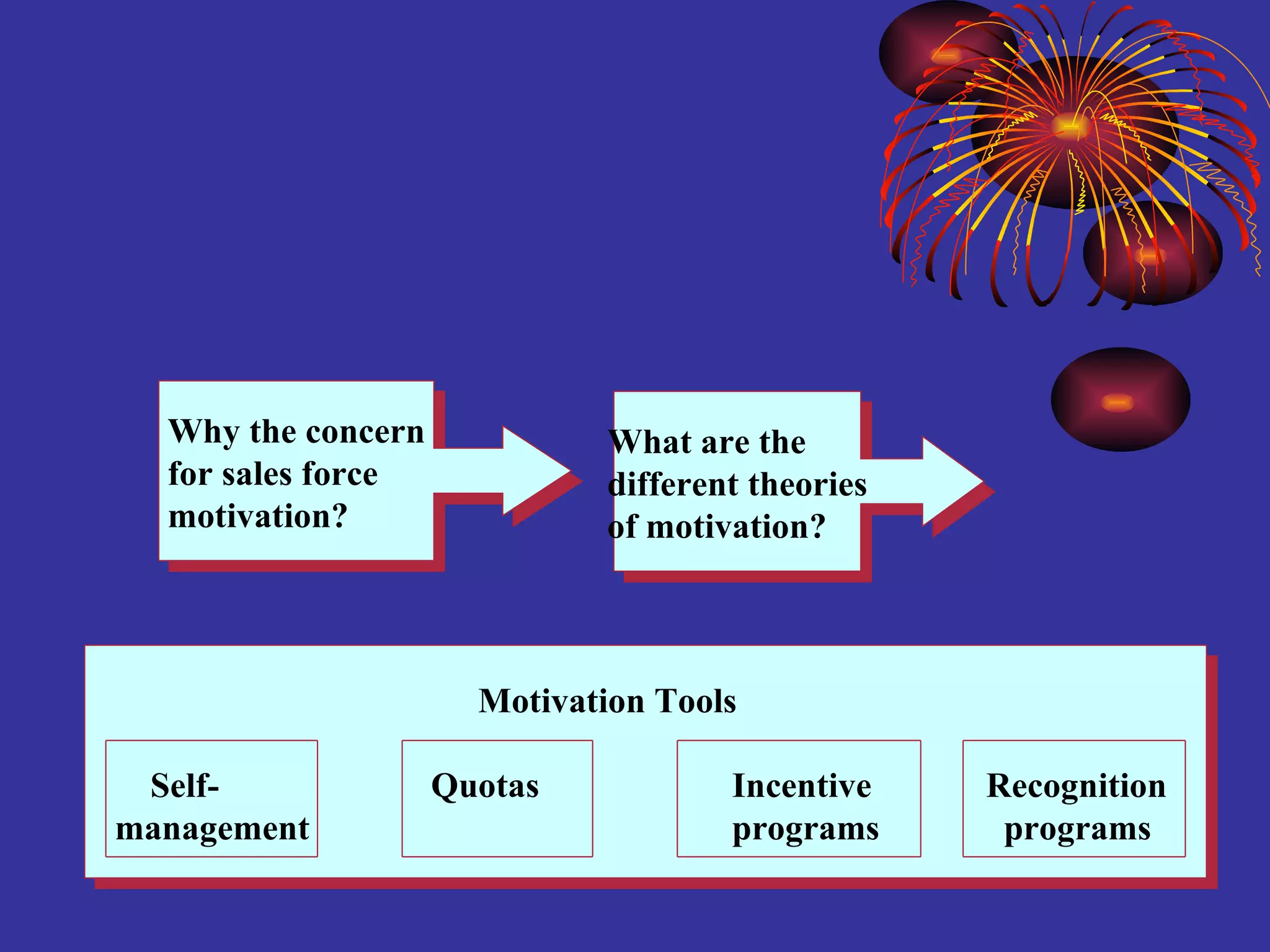
Why the concern for sales force motivation? What are the different theories of motivation? Motivation Tools Self-   Quotas Incentive Recognition management programs   programs
Frequent rejection Physical separation from  company support Direct influence on quality of sales presentation Indirect influence on performance Why is Motivation Important?
Steps to Greater  Personal Motivation 1. Define what you want. 2. Inform a special person of your  goals. 3. Do something. 4. Don’t let failure deter you. 5. Break down problems into pieces. 6. Set deadlines. 7. Turn work into play. 8. Associate with people who motivate  you.
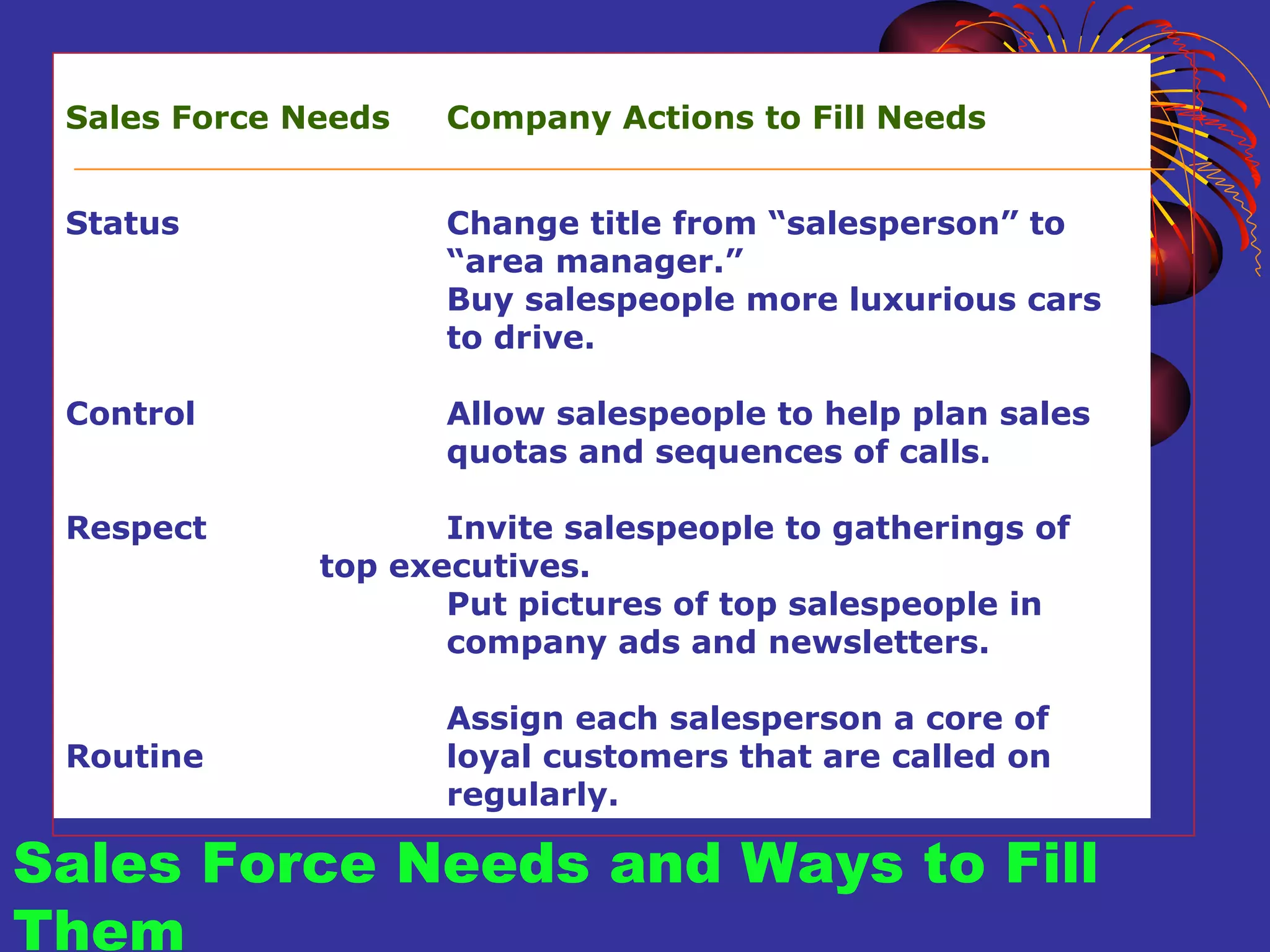
Sales Force Needs and Ways to Fill Them Sales Force Needs Company Actions to Fill Needs Status Change title from “salesperson” to  “area manager.” Buy salespeople more luxurious cars  to drive. Control Allow salespeople to help plan sales  quotas and sequences of calls. Respect Invite salespeople to gatherings of  top executives. Put pictures of top salespeople in  company ads and newsletters. Assign each salesperson a core of Routine  loyal customers that are called on  regularly.
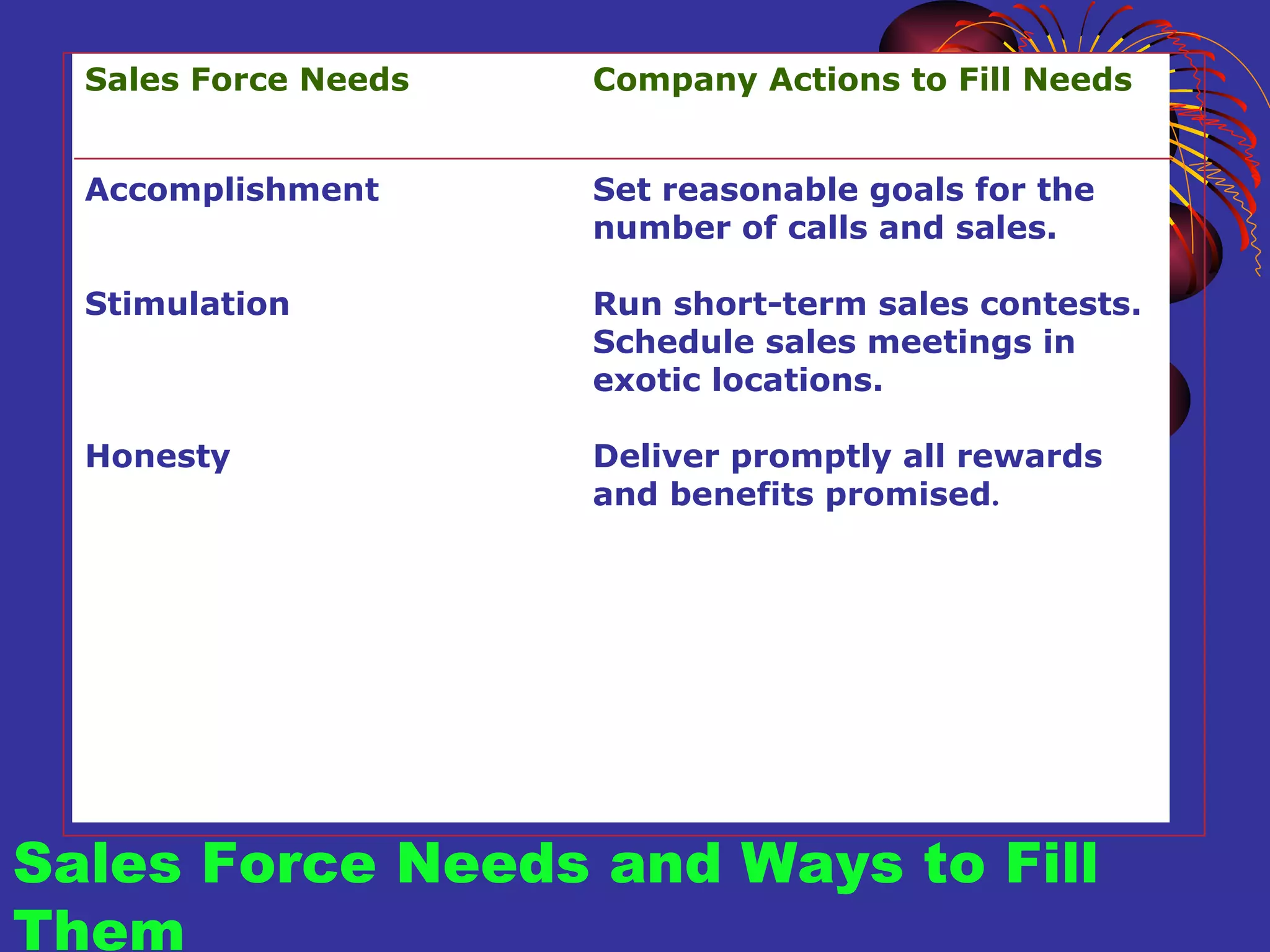
Sales Force Needs and Ways to Fill Them Sales Force Needs Company Actions to Fill Needs Accomplishment Set reasonable goals for the  number of calls and sales. Stimulation Run short-term sales contests. Schedule sales meetings in  exotic locations. Honesty Deliver promptly all rewards  and benefits promised .
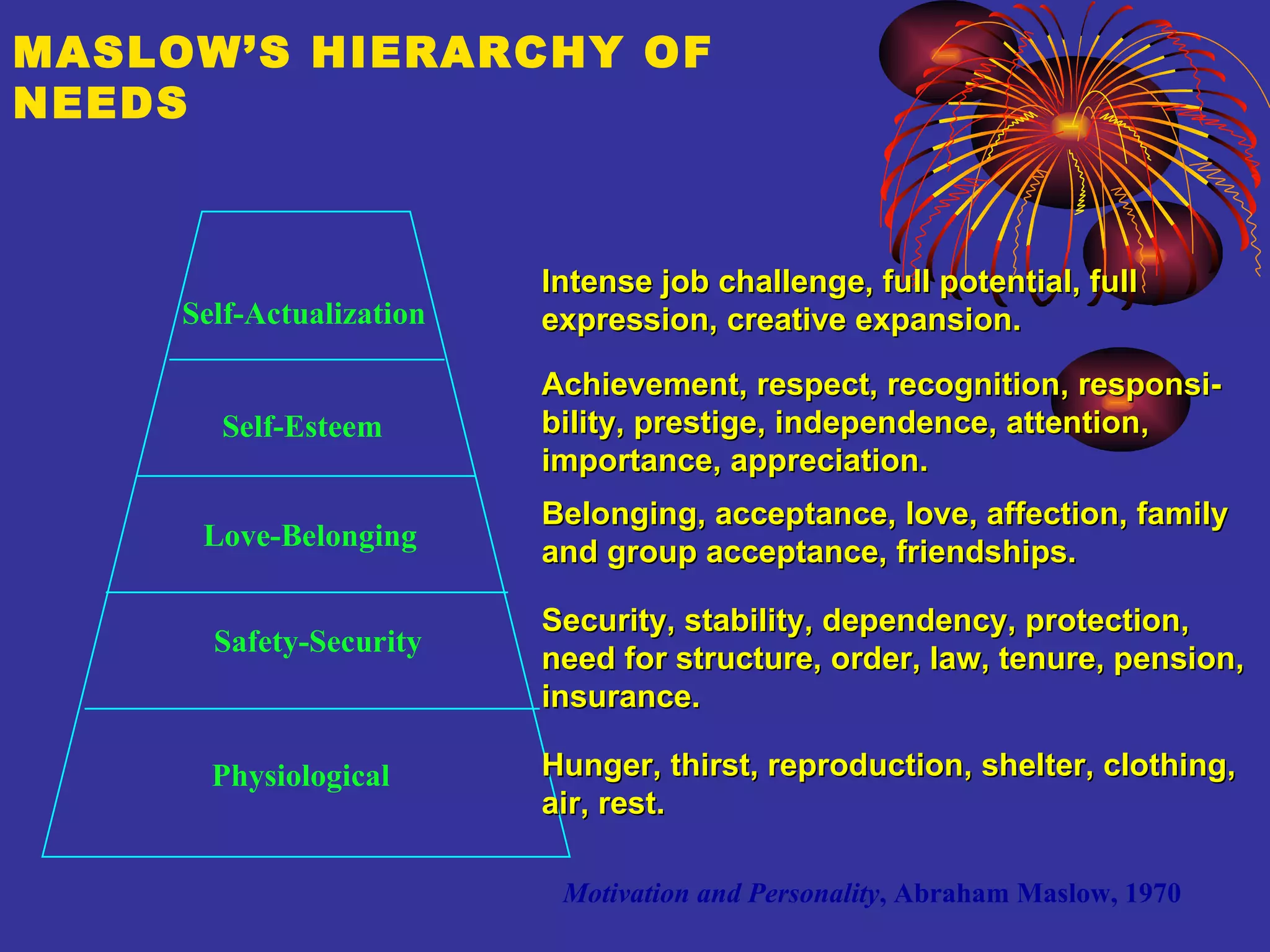
MASLOW’S HIERARCHY OF NEEDS Self-Actualization Self-Esteem Love-Belonging Safety-Security Physiological Intense job challenge, full potential, full  expression, creative expansion. Achievement, respect, recognition, responsi- bility, prestige, independence, attention,  importance, appreciation. Belonging, acceptance, love, affection, family and group acceptance, friendships. Security, stability, dependency, protection,  need for structure, order, law, tenure, pension,  insurance. Hunger, thirst, reproduction, shelter, clothing, air, rest. Motivation and Personality , Abraham Maslow, 1970
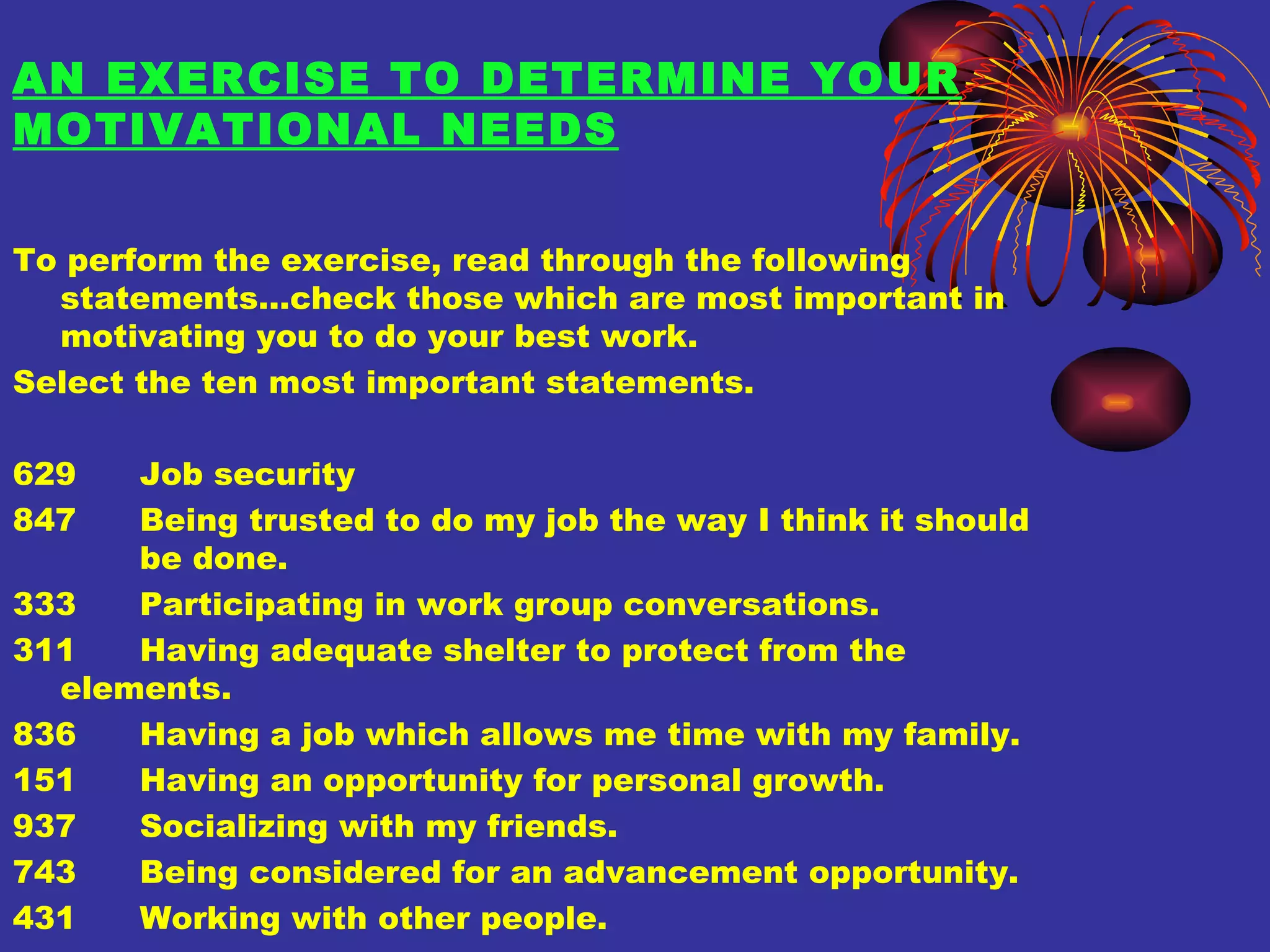
AN EXERCISE TO DETERMINE YOUR MOTIVATIONAL NEEDS To perform the exercise, read through the following statements…check those which are most important in motivating you to do your best work. Select the ten most important statements. 629 Job security 847 Being trusted to do my job the way I think it should  be done. 333 Participating in work group conversations. 311 Having adequate shelter to protect from the  elements. 836 Having a job which allows me time with my family. 151 Having an opportunity for personal growth. 937 Socializing with my friends. 743 Being considered for an advancement opportunity. 431 Working with other people.
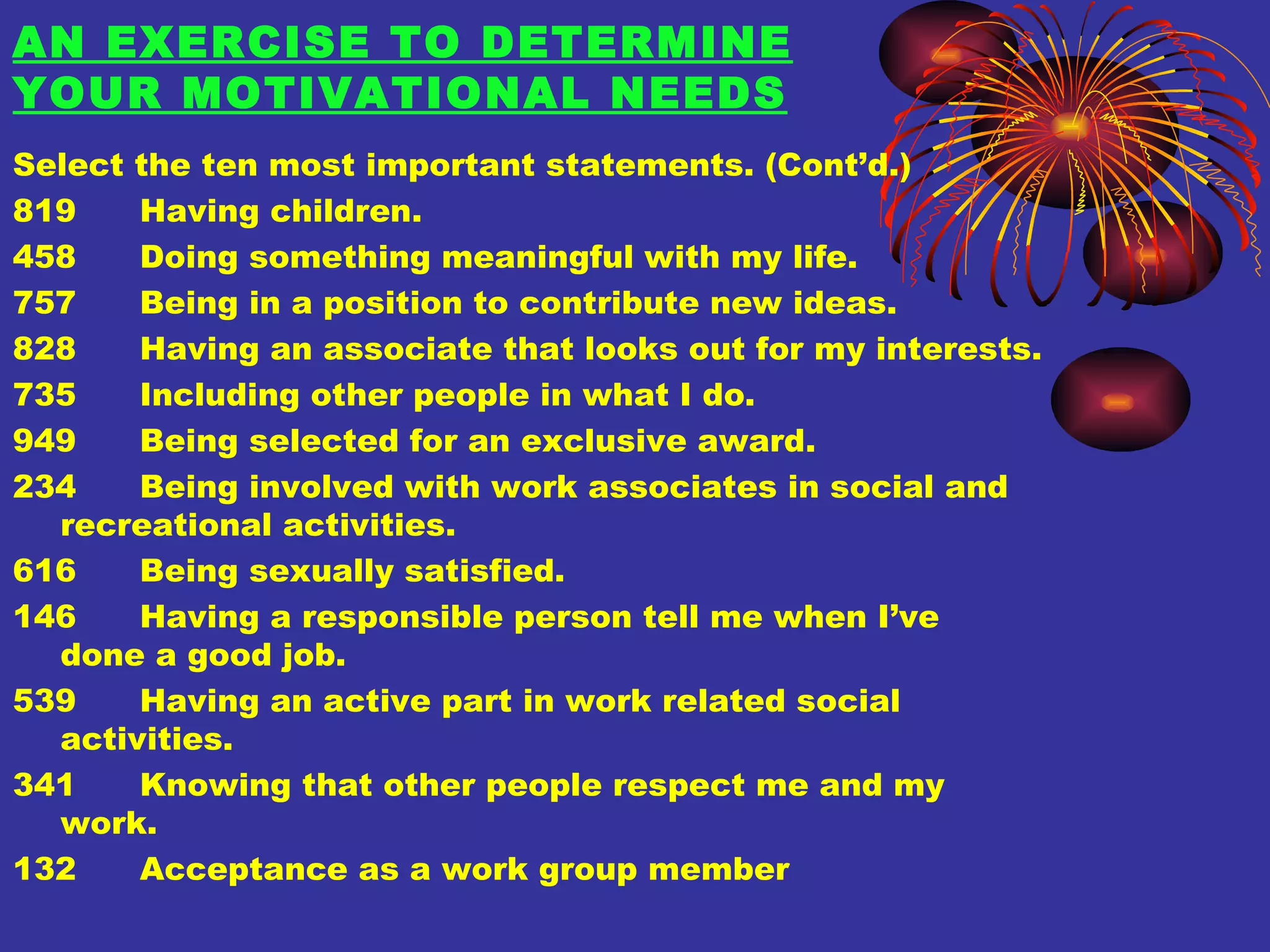
AN EXERCISE TO DETERMINE YOUR MOTIVATIONAL NEEDS Select the ten most important statements. (Cont’d.) 819 Having children. 458 Doing something meaningful with my life. 757 Being in a position to contribute new ideas. 828 Having an associate that looks out for my interests. 735 Including other people in what I do. 949 Being selected for an exclusive award. 234 Being involved with work associates in social and  recreational activities. 616 Being sexually satisfied. 146 Having a responsible person tell me when I’ve  done a good job. 539 Having an active part in work related social  activities. 341 Knowing that other people respect me and my  work. 132 Acceptance as a work group member
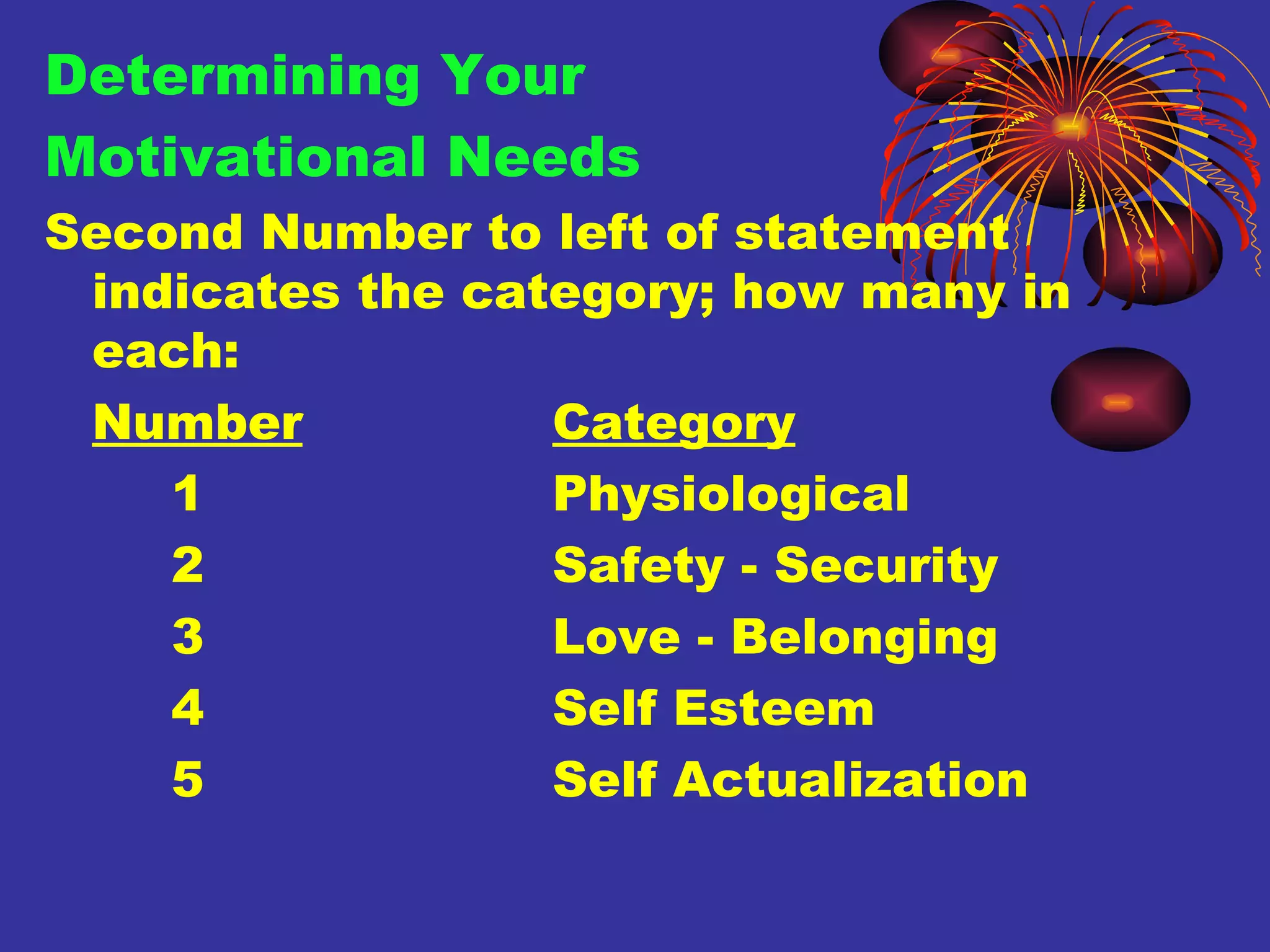
Determining Your  Motivational Needs Second Number to left of statement indicates the category; how many in each: Number Category 1 Physiological 2 Safety - Security 3 Love - Belonging 4 Self Esteem 5 Self Actualization
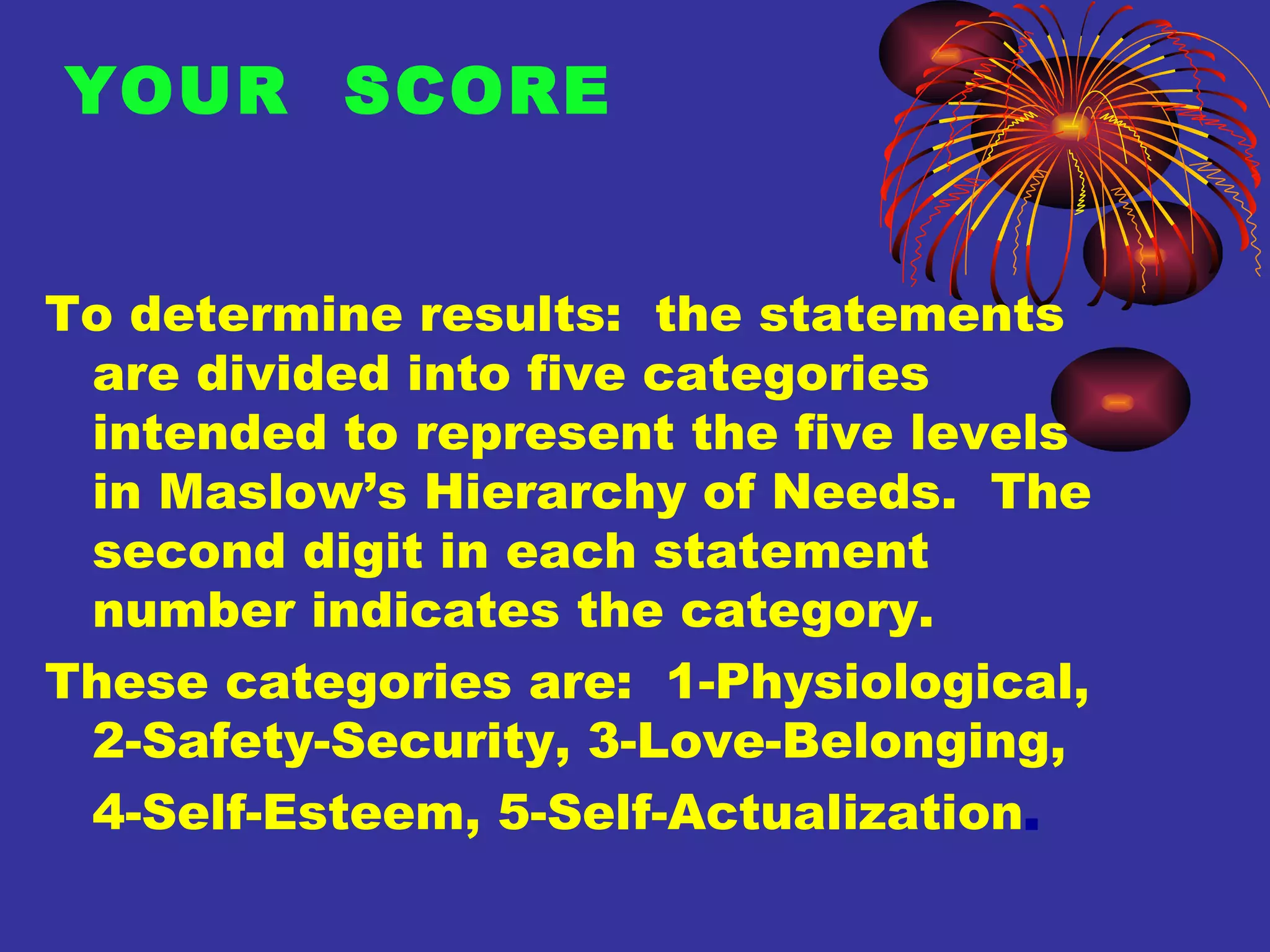
YOUR  SCORE To determine results:  the statements are divided into five categories intended to represent the five levels in Maslow’s Hierarchy of Needs.  The second digit in each statement number indicates the category.  These categories are:  1-Physiological, 2-Safety-Security, 3-Love-Belonging,  4-Self-Esteem, 5-Self-Actualization .
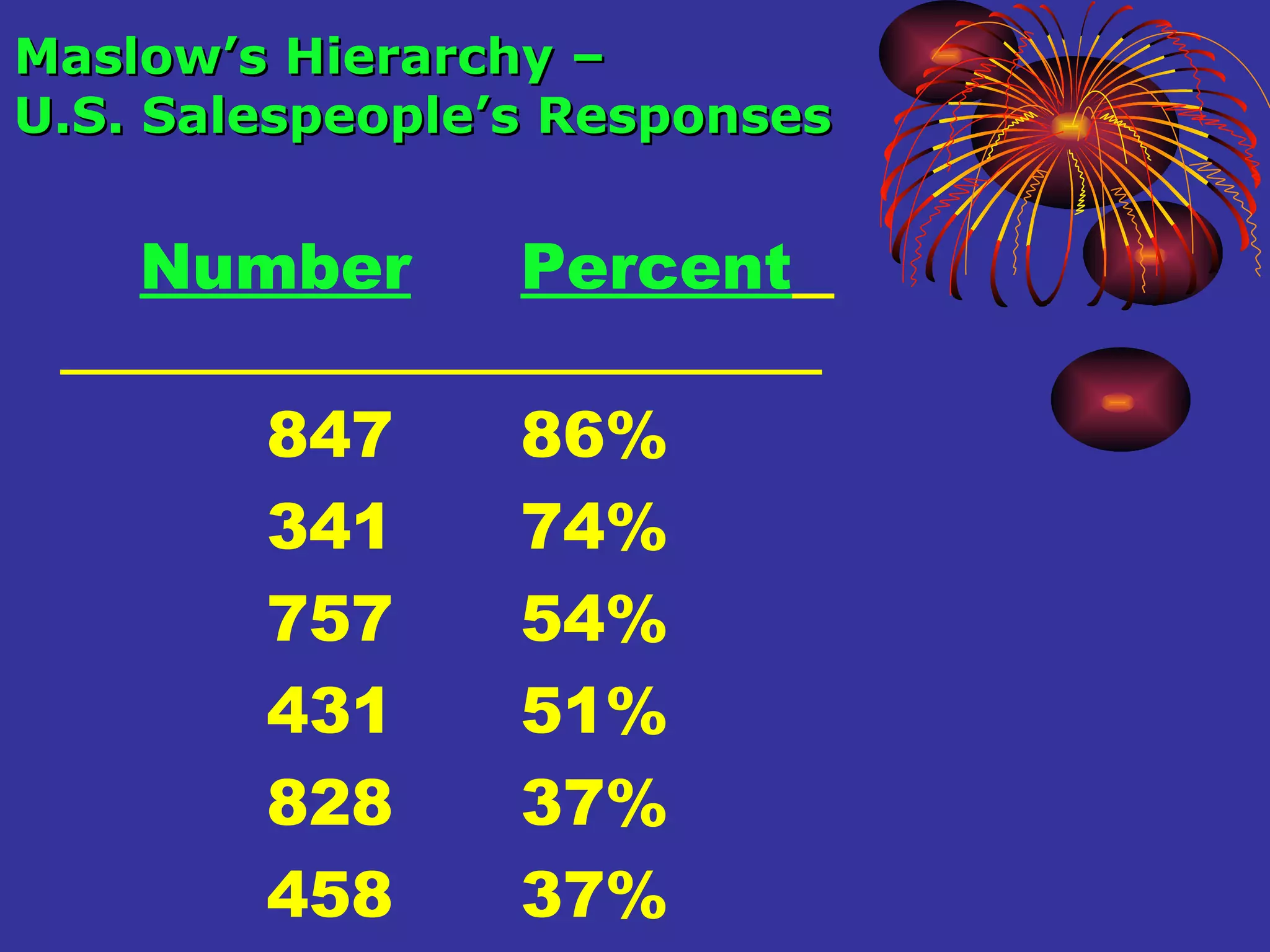
Number Percent   847 86% 341 74% 757 54%  431 51% 828 37% 458 37% 743 34%   Maslow’s Hierarchy –  U.S. Salespeople’s Responses
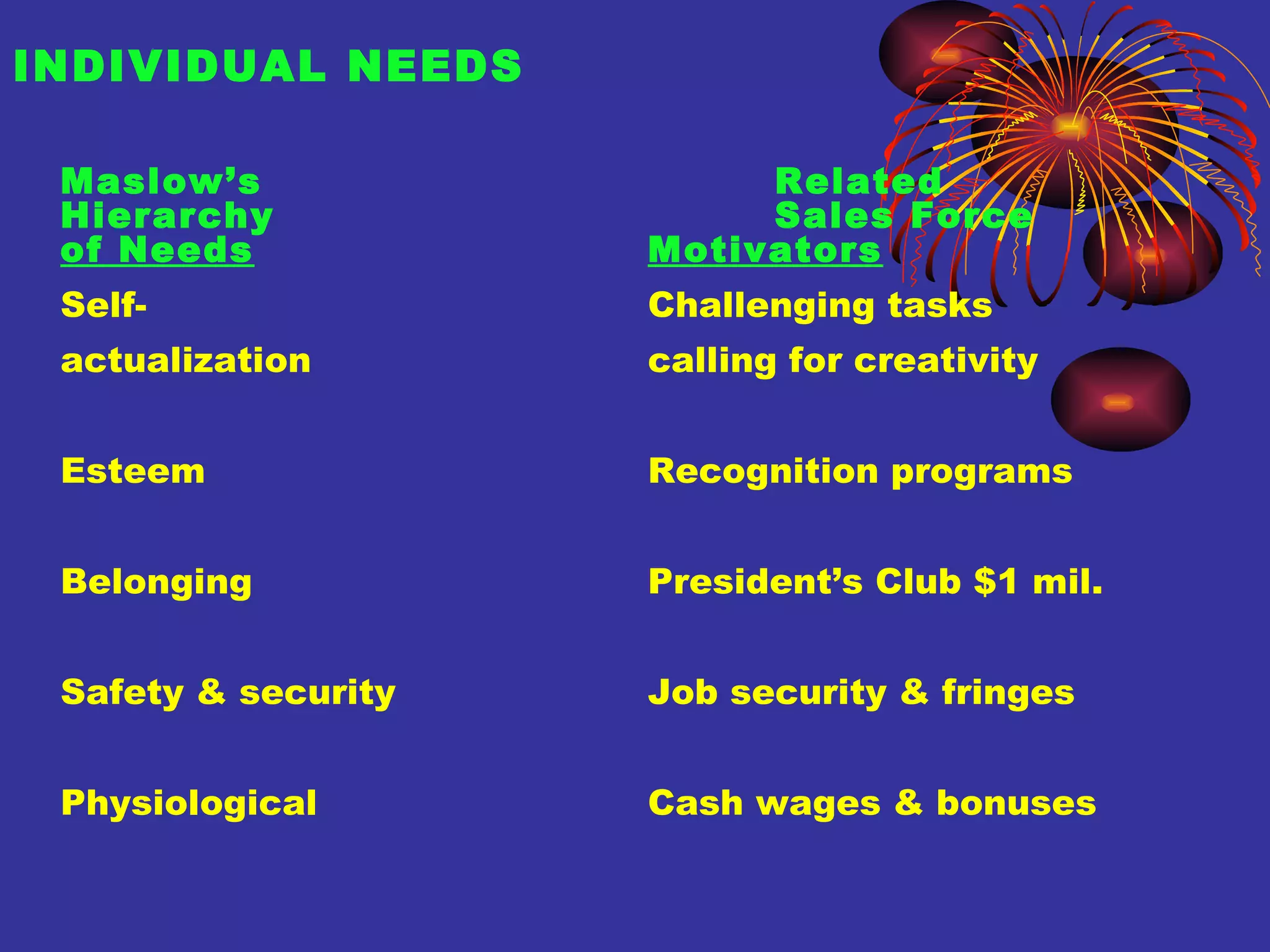
INDIVIDUAL NEEDS Maslow’s  Related Hierarchy  Sales Force of Needs Motivators Self- Challenging tasks  actualization calling for creativity Esteem Recognition programs Belonging President’s Club $1 mil. Safety & security Job security & fringes Physiological Cash wages & bonuses
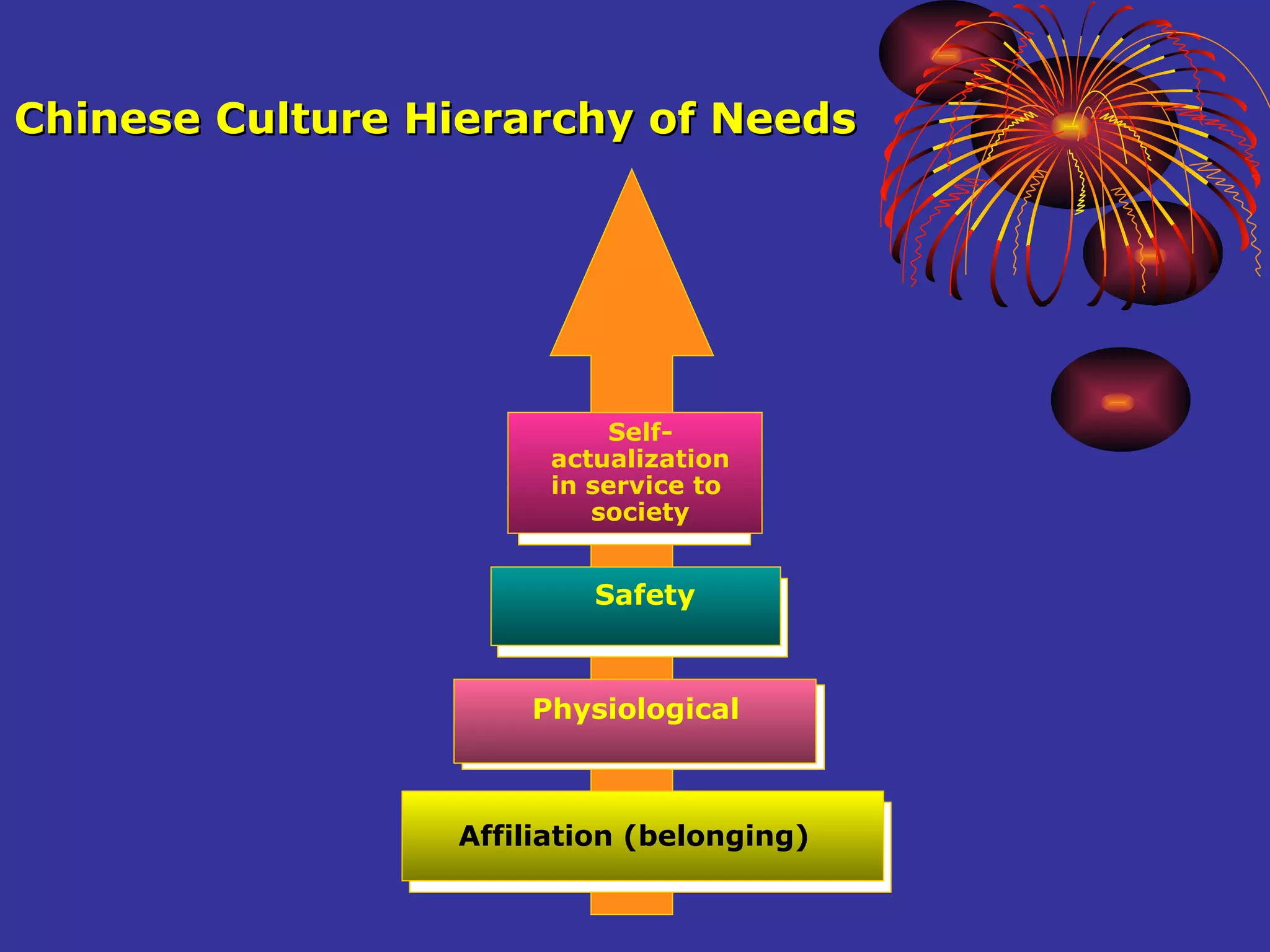
Self-actualization in service to  society Safety Physiological Affiliation (belonging) Chinese Culture Hierarchy of Needs
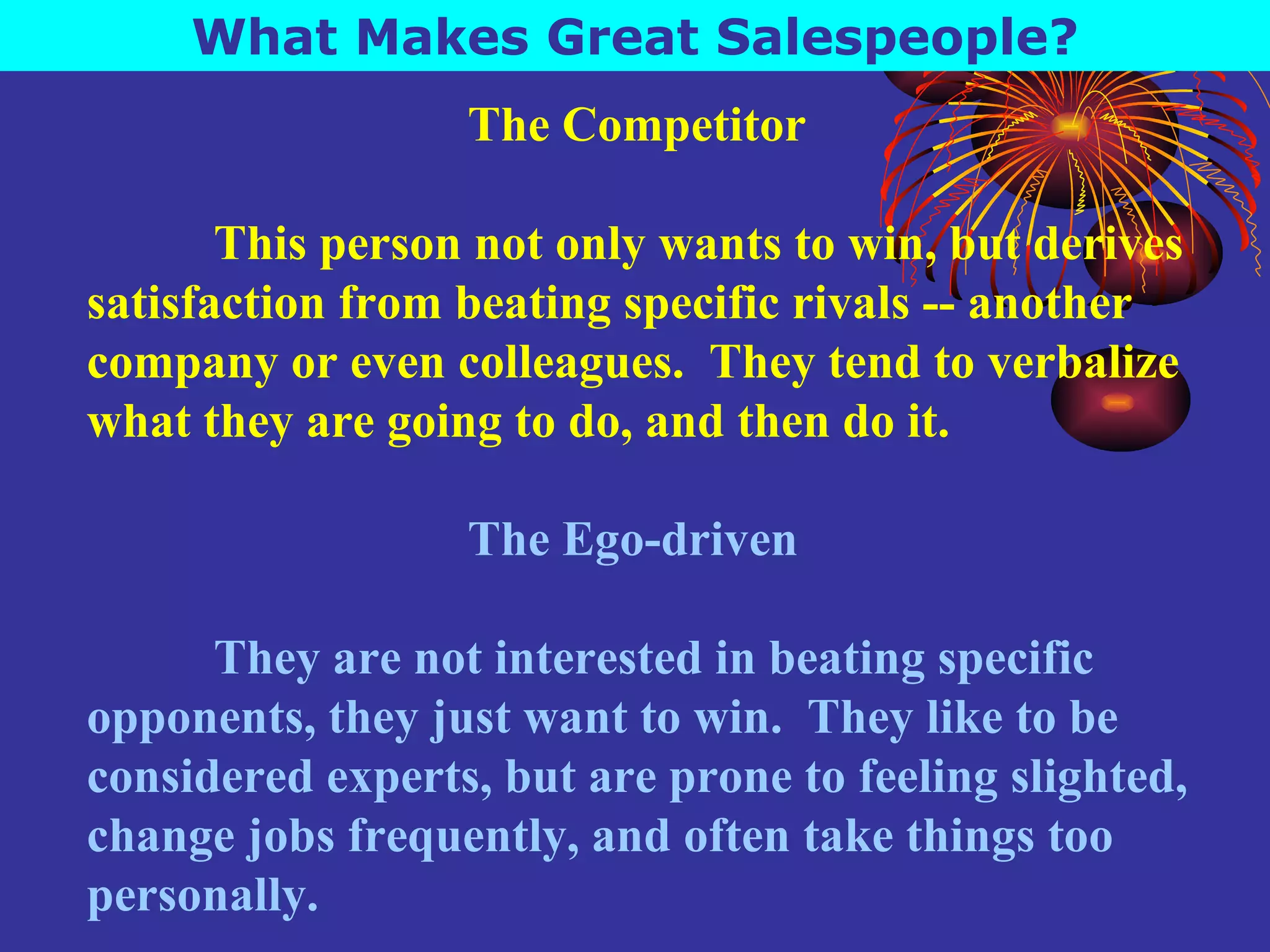
What Makes Great Salespeople? The Competitor This person not only wants to win, but derives satisfaction from beating specific rivals -- another company or even colleagues.  They tend to verbalize what they are going to do, and then do it. The Ego-driven They are not interested in beating specific opponents, they just want to win.  They like to be considered experts, but are prone to feeling slighted, change jobs frequently, and often take things too personally.
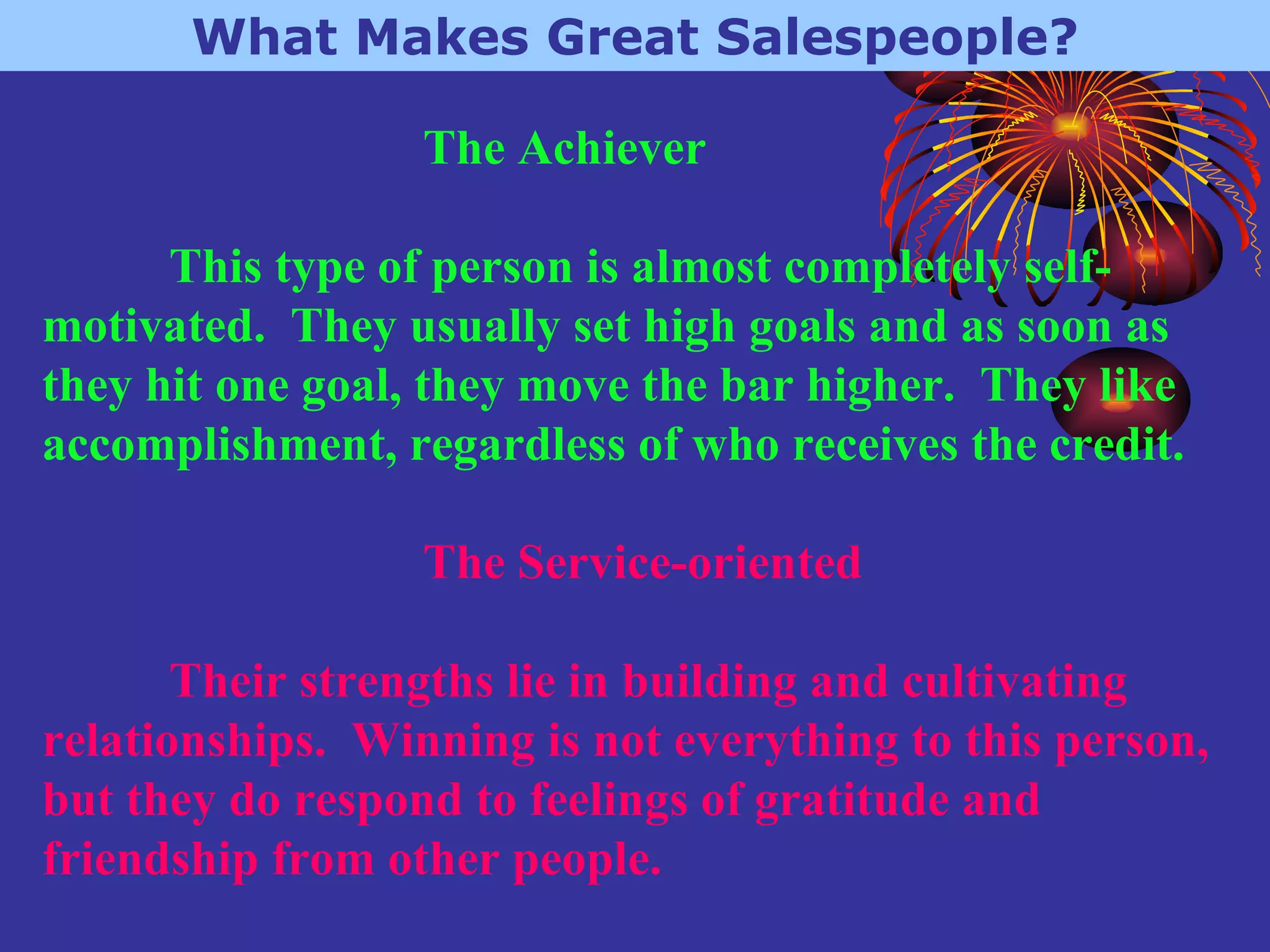
What Makes Great Salespeople? The Achiever This type of person is almost completely self-motivated.  They usually set high goals and as soon as they hit one goal, they move the bar higher.  They like accomplishment, regardless of who receives the credit. The Service-oriented Their strengths lie in building and cultivating relationships.  Winning is not everything to this person, but they do respond to feelings of gratitude and friendship from other people.
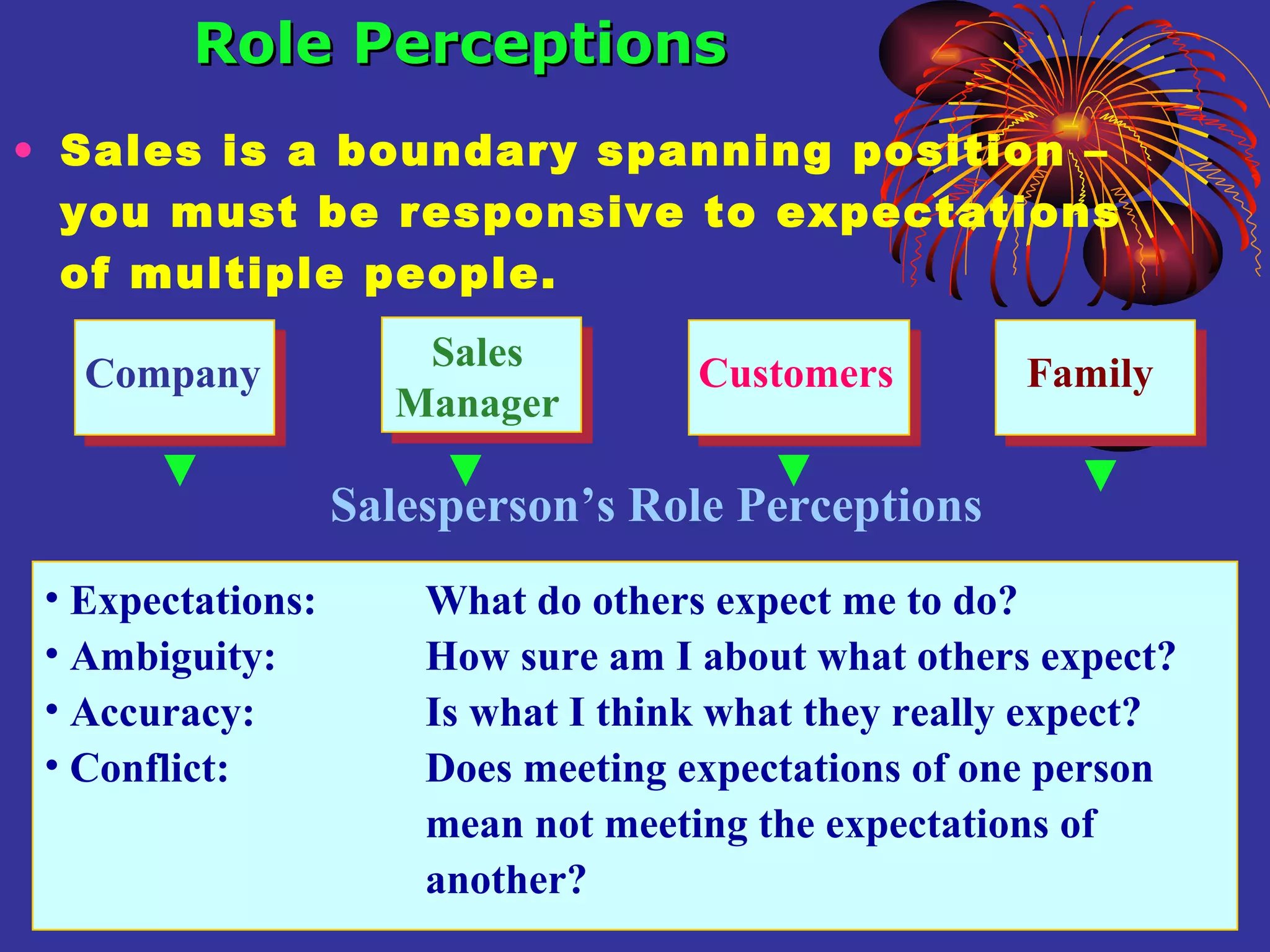
Sales is a boundary spanning position – you must be responsive to expectations  of multiple people. Company Sales Manager Customers Family Salesperson’s Role Perceptions Expectations: What do others expect me to do? Ambiguity: How sure am I about what others expect? Accuracy: Is what I think what they really expect? Conflict: Does meeting expectations of one person  mean not meeting the expectations of  another? Role Perceptions
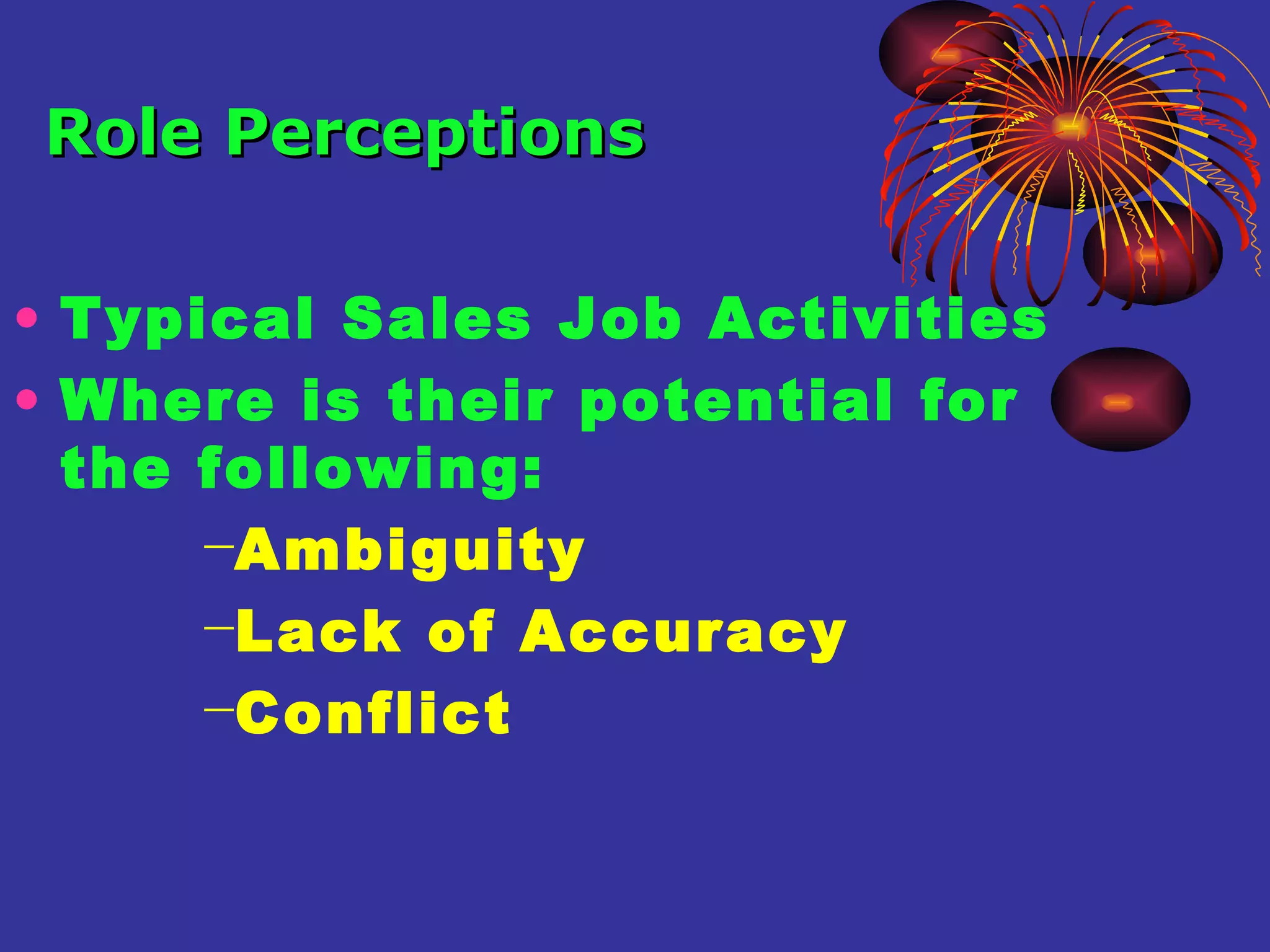
Typical Sales Job Activities Where is their potential for the following: Ambiguity Lack of Accuracy Conflict Role Perceptions
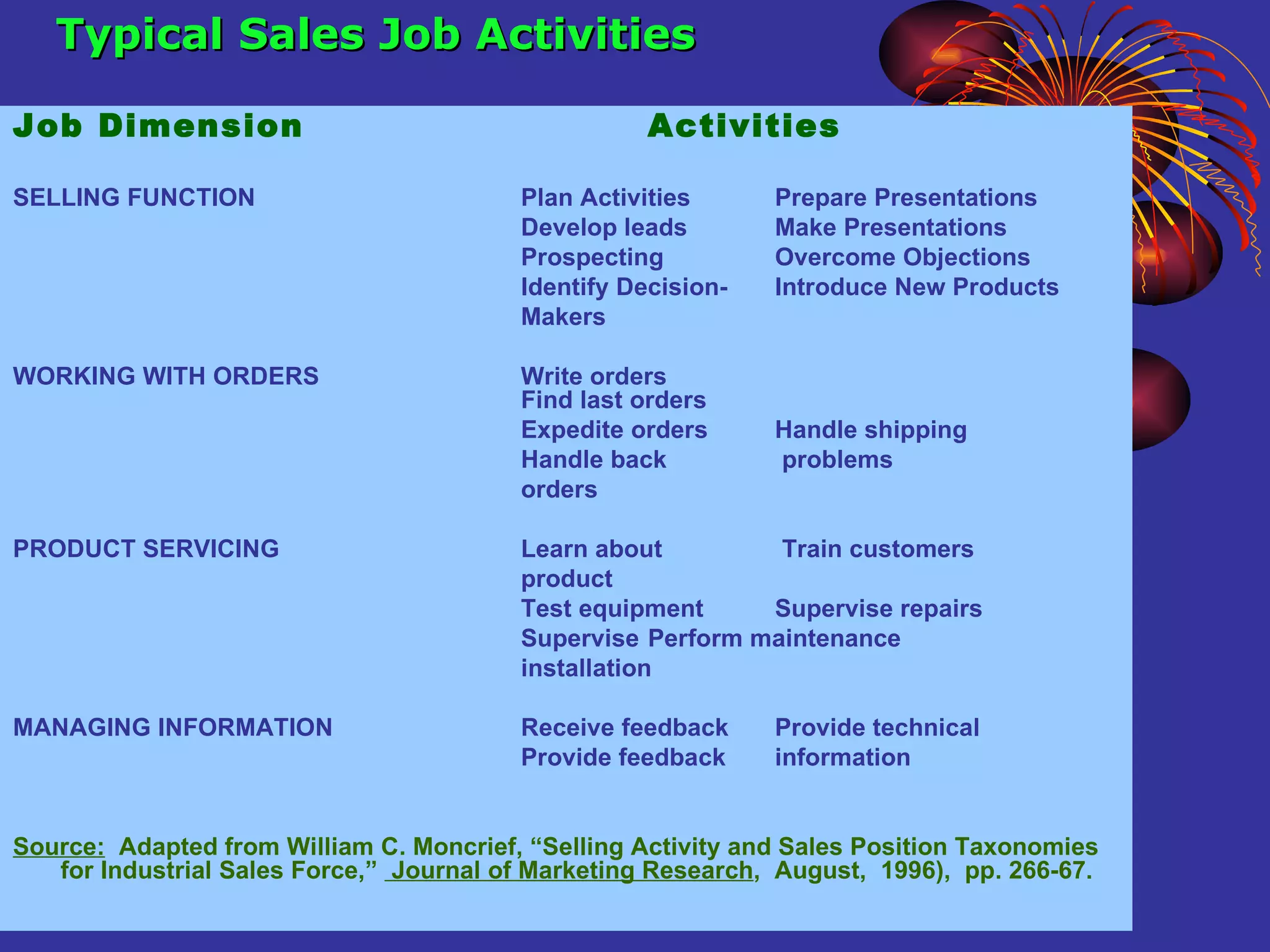
Job Dimension Activities SELLING FUNCTION Plan Activities Prepare Presentations Develop leads Make Presentations Prospecting Overcome Objections Identify Decision- Introduce New Products Makers WORKING WITH ORDERS Write orders Find last orders Expedite orders Handle shipping Handle back  problems  orders PRODUCT SERVICING Learn about   Train customers product Test equipment Supervise repairs Supervise  Perform maintenance installation MANAGING INFORMATION Receive feedback Provide technical Provide feedback information Source:   Adapted from William C. Moncrief, “Selling Activity and Sales Position Taxonomies for Industrial Sales Force,”  Journal of Marketing Research ,  August,  1996),  pp. 266-67. Typical Sales Job Activities
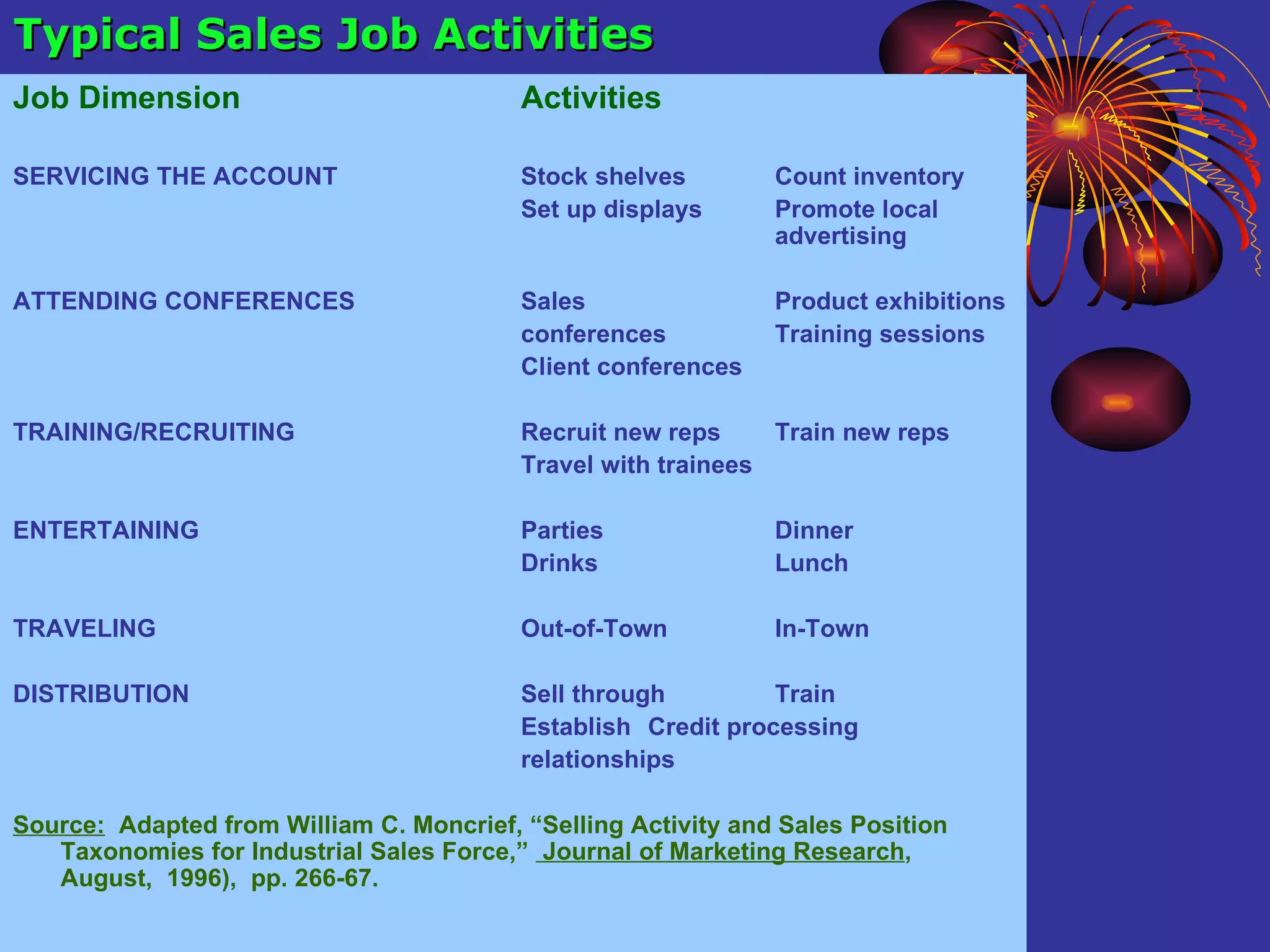
Job Dimension Activities SERVICING THE ACCOUNT Stock shelves Count inventory Set up displays Promote local  advertising ATTENDING CONFERENCES Sales  Product exhibitions conferences Training sessions Client conferences TRAINING/RECRUITING Recruit new reps Train new reps Travel with trainees ENTERTAINING Parties Dinner Drinks Lunch TRAVELING Out-of-Town In-Town DISTRIBUTION Sell through Train Establish  Credit processing relationships Source:   Adapted from William C. Moncrief, “Selling Activity and Sales Position Taxonomies for Industrial Sales Force,”  Journal of Marketing Research ,  August,  1996),  pp. 266-67. Typical Sales Job Activities
Career Stages Does everyone go through these stages?  What can be done to address the concerns of management at each stage? How can sales managers address the management concerns at each stage? Motivation
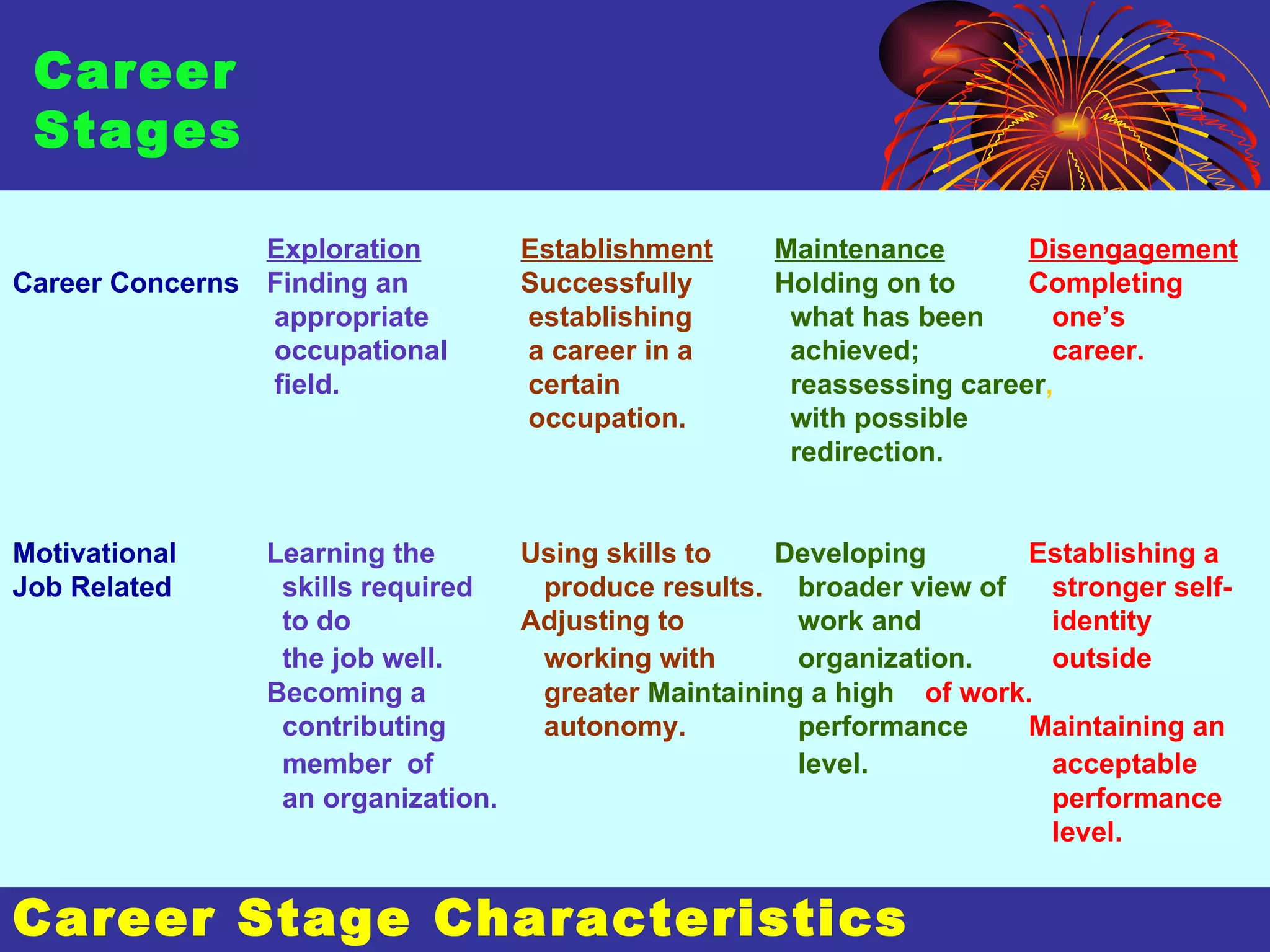
Career Stage Characteristics Exploration Establishment Maintenance Disengagement Career Concerns Finding an  Successfully  Holding on to  Completing   appropriate    establishing    what   has been   one’s   occupational    a career   in a     achieved;    career.     field.     certain    reassessing career ,   occupation.     with possible    redirection. Motivational Learning the  Using skills to  Developing Establishing a   Job Related   skills required    produce results.   broader view of   stronger self-   to do  Adjusting to    work and    identity   the job well.     working with    organization.   outside   Becoming a     greater  Maintaining a high   of work.   contributing     autonomy.     performance Maintaining an   member   of       level.     acceptable   an   organization.       performance       level. Career Stages
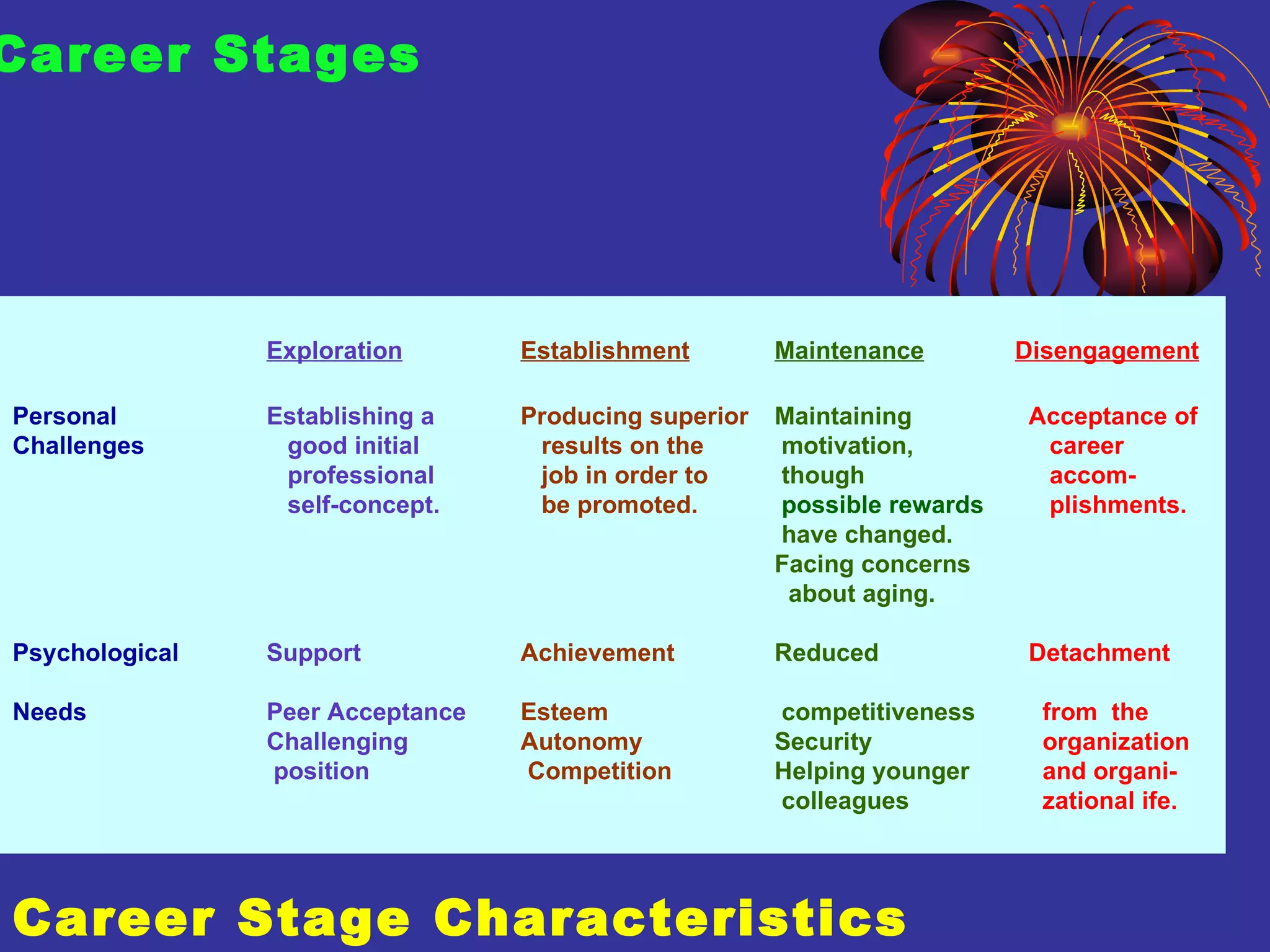
Career Stage Characteristics Exploration Establishment Maintenance   Disengagement Personal  Establishing a   Producing superior   Maintaining  Acceptance of Challenges   good initial    results on the   motivation,    career    professional    job in order to   though       accom-   self-concept.   be promoted.   possible rewards   plishments.       have changed. Facing concerns       about aging.   Psychological Support Achievement Reduced   Detachment  Needs Peer Acceptance Esteem       competitiveness     from  the  Challenging  Autonomy Security    organization     position     Competition Helping younger     and organi-       colleagues     zational ife. Career Stages
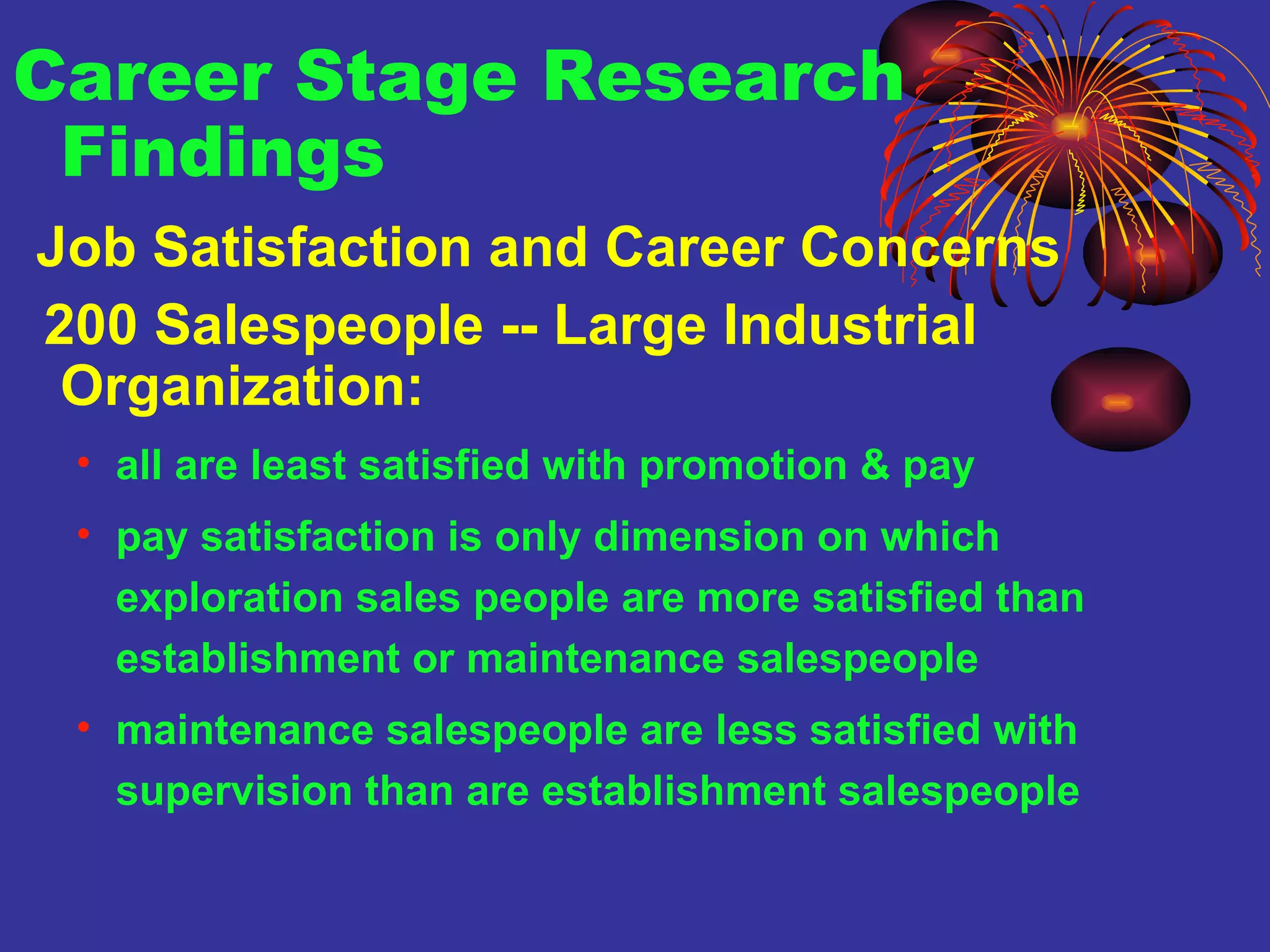
Career Stage Research Findings Job Satisfaction and Career Concerns 200 Salespeople -- Large Industrial Organization:   all are least satisfied with promotion & pay pay satisfaction is only dimension on which exploration sales people are more satisfied than establishment or maintenance salespeople maintenance salespeople are less satisfied with supervision than are establishment salespeople
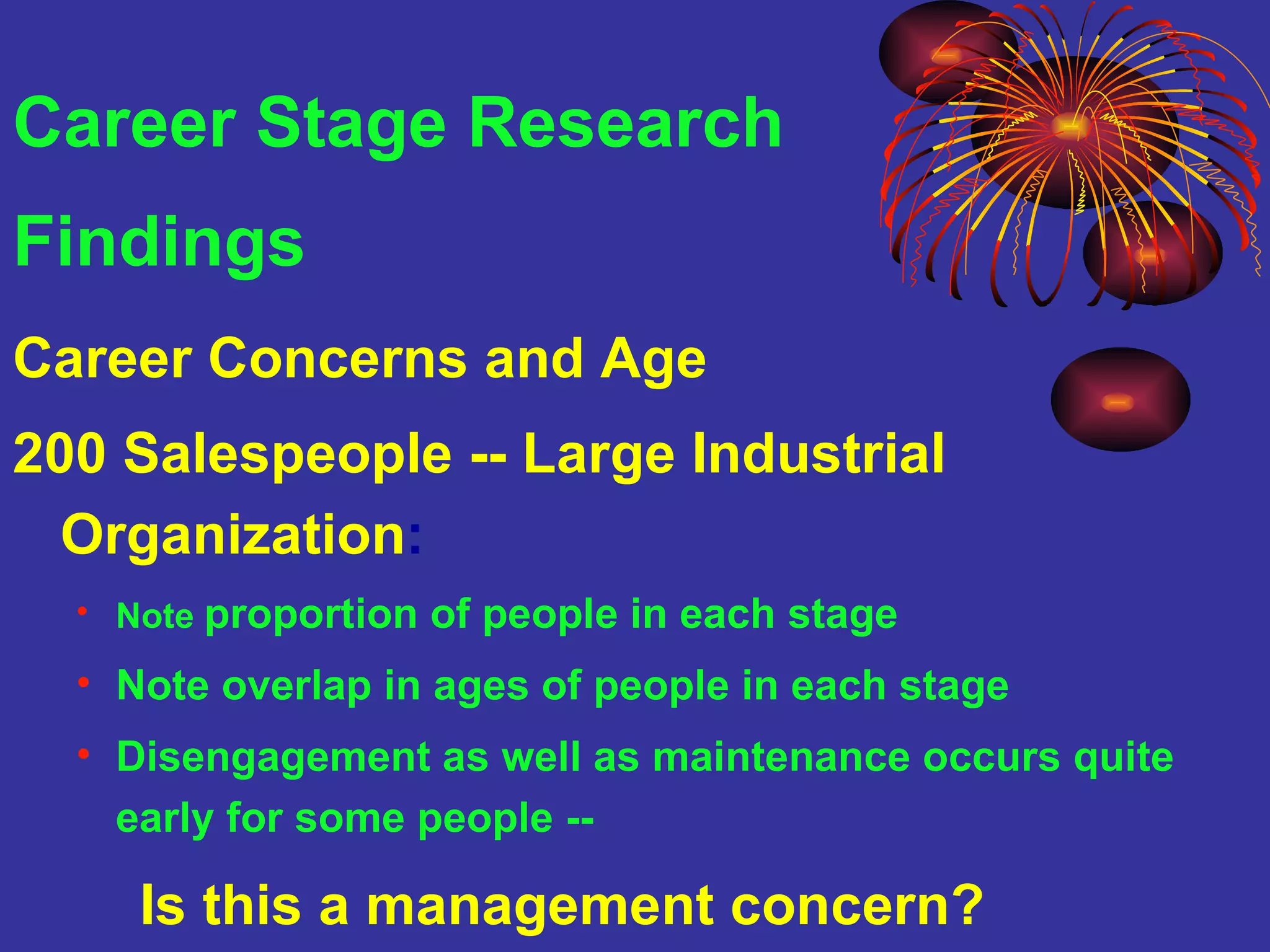
Career Stage Research  Findings Career Concerns and Age  200 Salespeople -- Large Industrial Organization : Note  proportion of people in each stage Note overlap in ages of people in each stage Disengagement as well as maintenance occurs quite early for some people --  Is this a management concern?
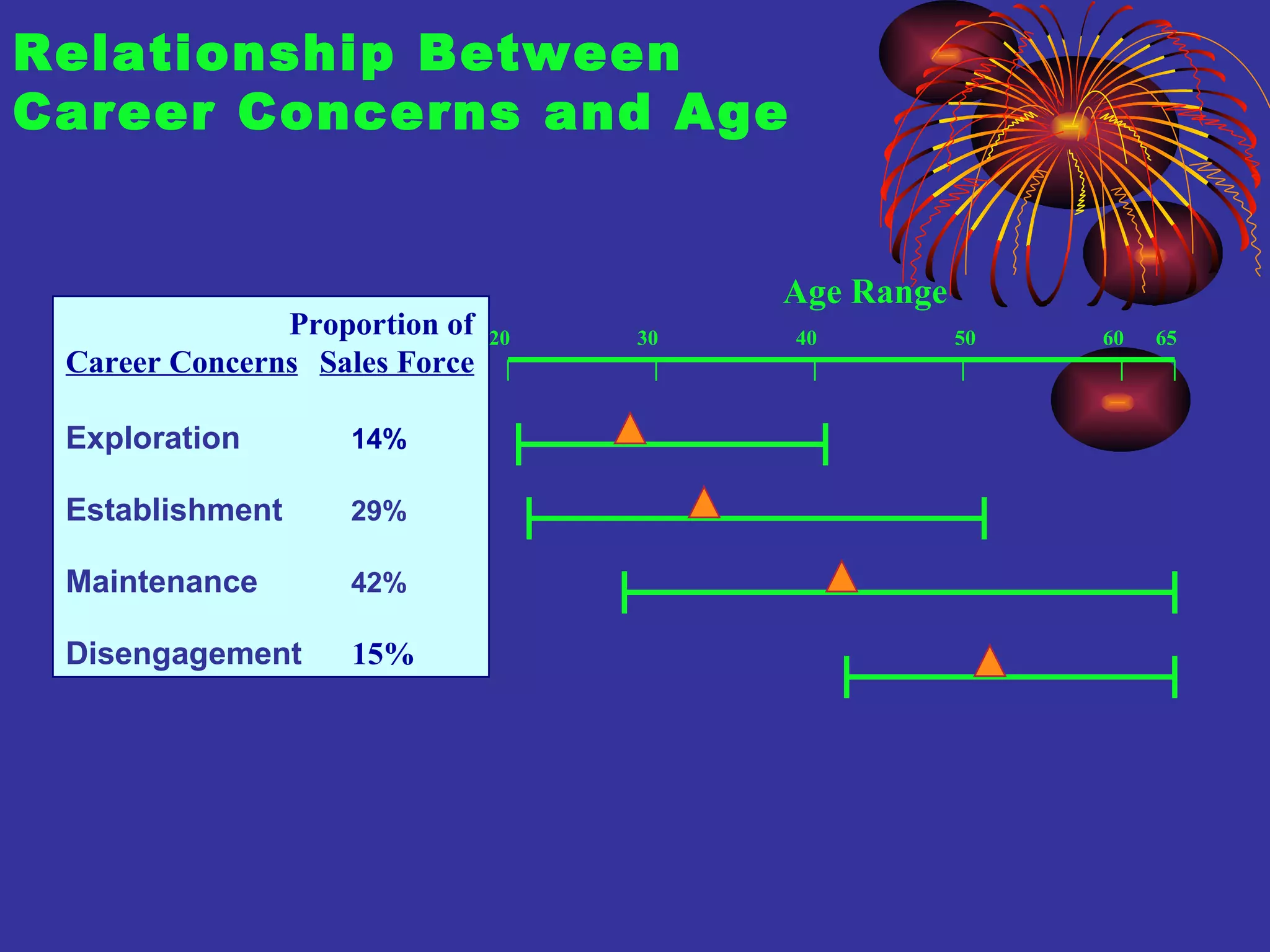
Relationship Between Career Concerns and Age   Proportion of Career Concerns Sales Force Exploration   14% Establishment   29% Maintenance   42% Disengagement   15% Age Range 20  30  40  50  60  65
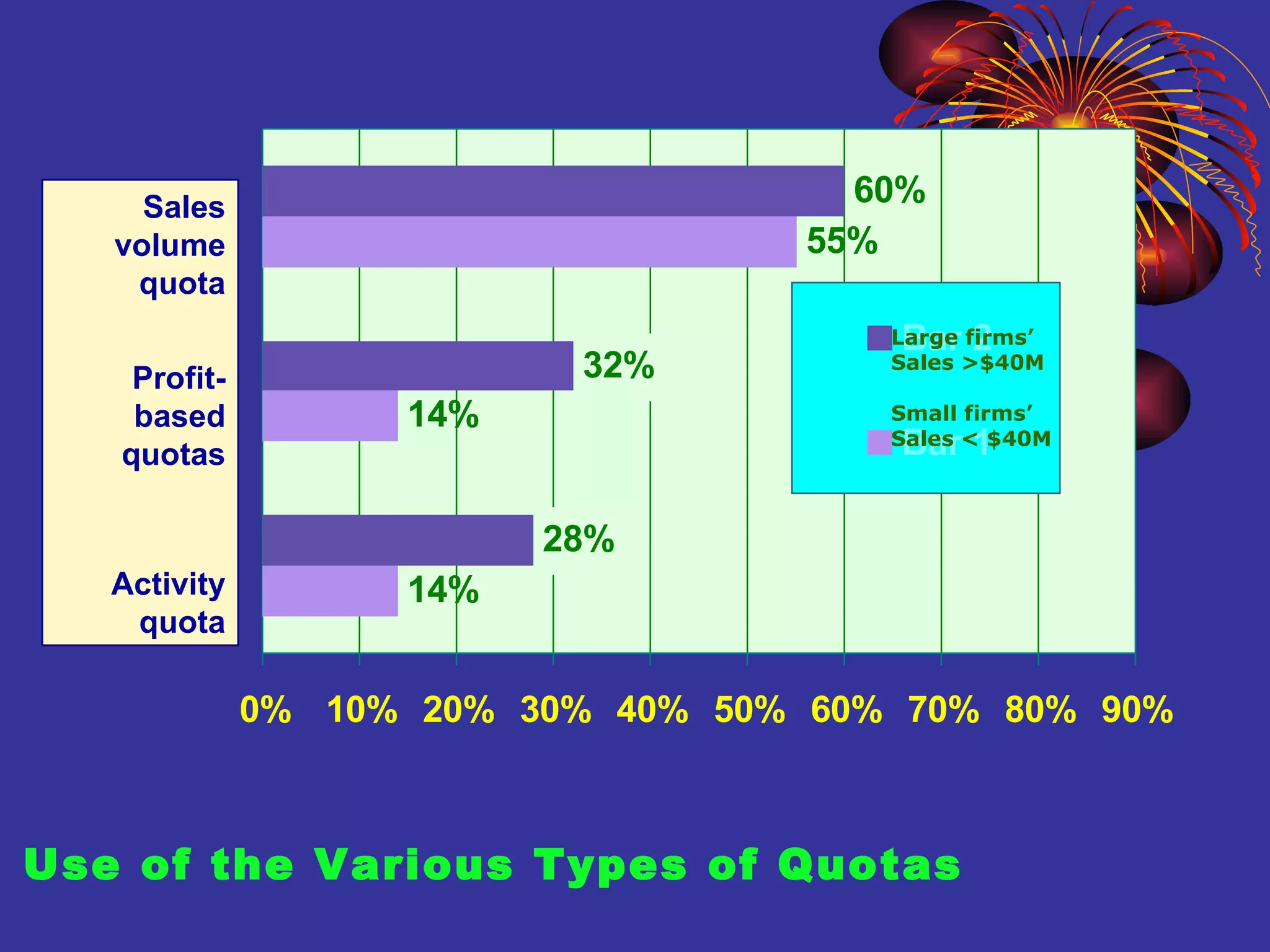
Use of the Various Types of Quotas Large firms’ Sales >$40M Small firms’ Sales < $40M Sales volume quota Profit-based quotas Activity quota
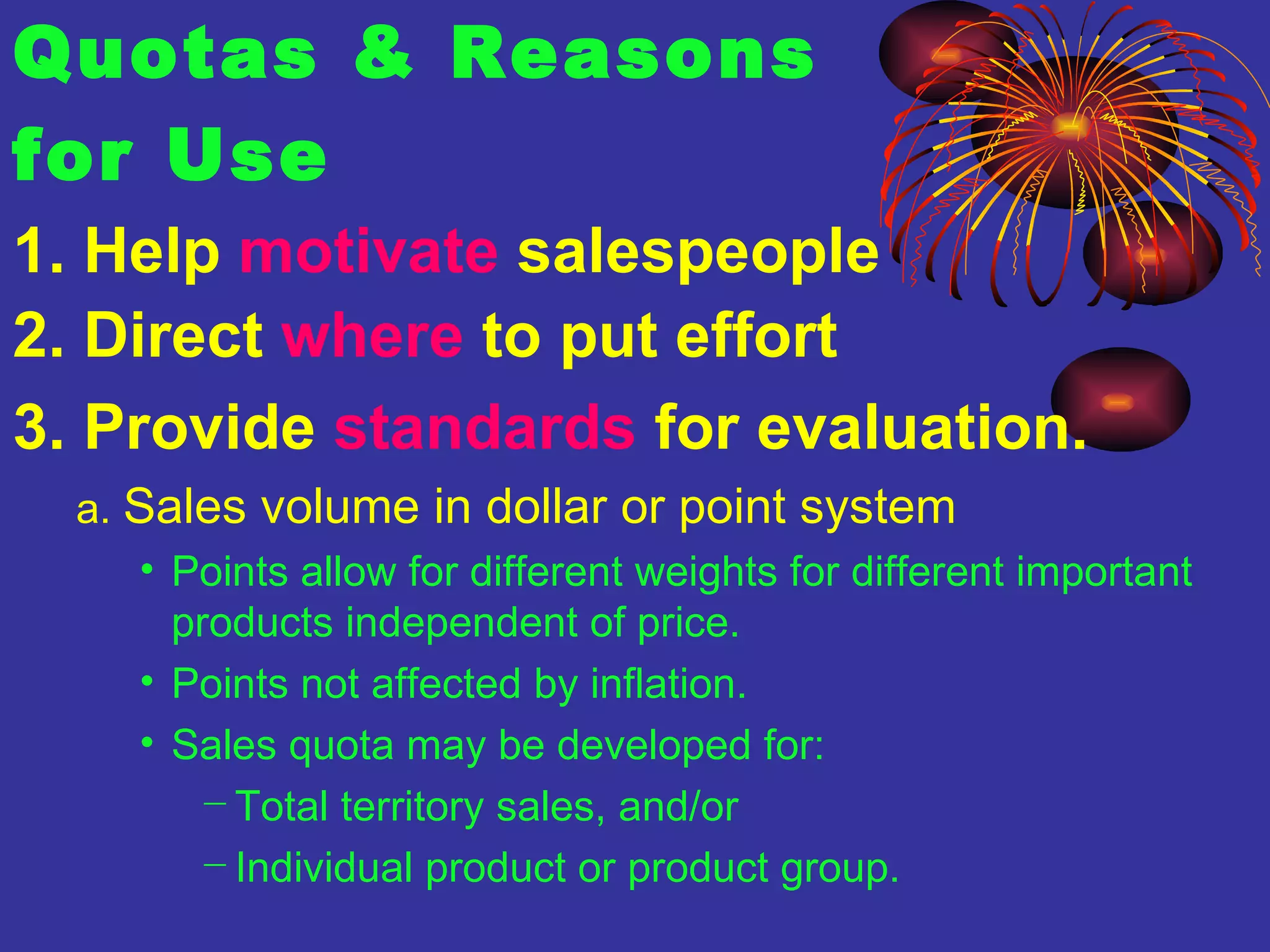
Quotas & Reasons  for Use 1. Help  motivate  salespeople 2. Direct  where  to put effort 3. Provide  standards  for evaluation. a.  Sales volume in dollar or point system  Points allow for different weights for different important products independent of price. Points not affected by inflation. Sales quota may be developed for:  Total territory sales, and/or Individual product or product group.
Quotas & Reasons  for Use 2. Profit-based quotas are rarely    based on bottom line profits   Difficult to account for indirect expenses Profits are usually configured as gross margins minus some load factor 3. Activity-based quotas are based on activities directly related to sales volume More directly under control of the salesperson Biggest problem is falsification of call reports Issue of quantity vs. quality of activity?
Incentive Programs What is difference from regular  compensation such as commission? Key decisions Goals --  Rules Timing --  Awards Participants --  Publicity Theme --  Cost What is difference between  Incentive and Recognition programs
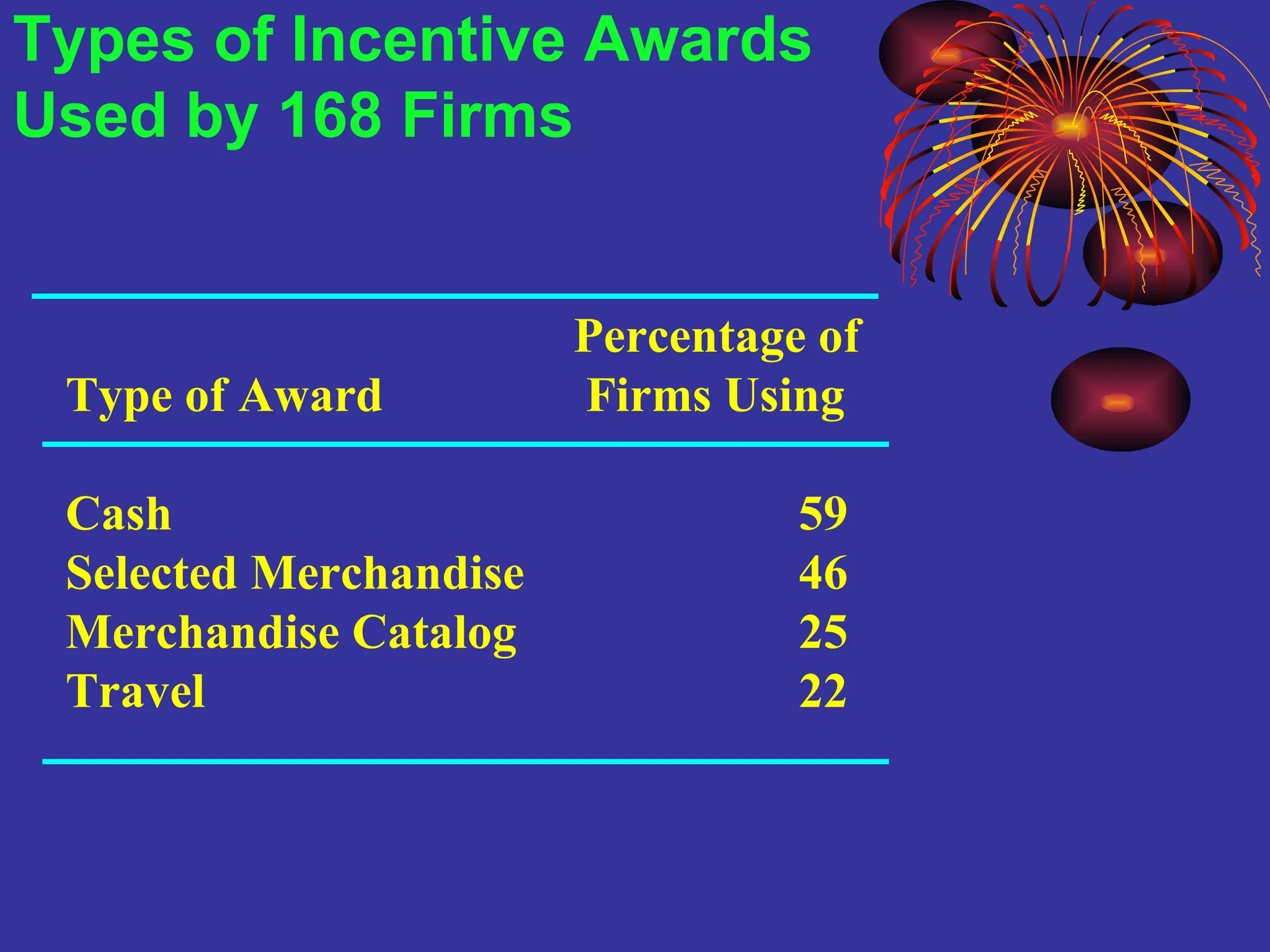
Types of Incentive Awards  Used by 168 Firms Percentage of Type of Award  Firms Using Cash     59 Selected Merchandise   46 Merchandise Catalog   25 Travel   22
Giving Status to  Salespeople 1. Compensation -- exceed first-line managers 2. Job Title -- no cost but considerable payback 3. Company Car Upgrade -- salespeople spend  much time in car - reminds them of their value. 4. Car Phone -- justified on a purely business basis 5. Field Sales Council -- meet president for 1/2 day open-ended discussion on field marketing conditions - report back to field meetings the results 6.Outside Secretarial Support -- or more exclusive central. 7. Published Success Stories -- high form of recognition 8. Task Force Assignments -- e.g., review of all paperwork.

Motivation

  • 1.
  • 2.
    What is Motivation??Drive to initiate an action. The intensity of effort in an action The persistence of effort over time.
  • 3.
    Why the concernfor sales force motivation? What are the different theories of motivation? Motivation Tools Self- Quotas Incentive Recognition management programs programs
  • 4.
    Frequent rejection Physicalseparation from company support Direct influence on quality of sales presentation Indirect influence on performance Why is Motivation Important?
  • 5.
    Steps to Greater Personal Motivation 1. Define what you want. 2. Inform a special person of your goals. 3. Do something. 4. Don’t let failure deter you. 5. Break down problems into pieces. 6. Set deadlines. 7. Turn work into play. 8. Associate with people who motivate you.
  • 6.
    Sales Force Needsand Ways to Fill Them Sales Force Needs Company Actions to Fill Needs Status Change title from “salesperson” to “area manager.” Buy salespeople more luxurious cars to drive. Control Allow salespeople to help plan sales quotas and sequences of calls. Respect Invite salespeople to gatherings of top executives. Put pictures of top salespeople in company ads and newsletters. Assign each salesperson a core of Routine loyal customers that are called on regularly.
  • 7.
    Sales Force Needsand Ways to Fill Them Sales Force Needs Company Actions to Fill Needs Accomplishment Set reasonable goals for the number of calls and sales. Stimulation Run short-term sales contests. Schedule sales meetings in exotic locations. Honesty Deliver promptly all rewards and benefits promised .
  • 8.
    MASLOW’S HIERARCHY OFNEEDS Self-Actualization Self-Esteem Love-Belonging Safety-Security Physiological Intense job challenge, full potential, full expression, creative expansion. Achievement, respect, recognition, responsi- bility, prestige, independence, attention, importance, appreciation. Belonging, acceptance, love, affection, family and group acceptance, friendships. Security, stability, dependency, protection, need for structure, order, law, tenure, pension, insurance. Hunger, thirst, reproduction, shelter, clothing, air, rest. Motivation and Personality , Abraham Maslow, 1970
  • 9.
    AN EXERCISE TODETERMINE YOUR MOTIVATIONAL NEEDS To perform the exercise, read through the following statements…check those which are most important in motivating you to do your best work. Select the ten most important statements. 629 Job security 847 Being trusted to do my job the way I think it should be done. 333 Participating in work group conversations. 311 Having adequate shelter to protect from the elements. 836 Having a job which allows me time with my family. 151 Having an opportunity for personal growth. 937 Socializing with my friends. 743 Being considered for an advancement opportunity. 431 Working with other people.
  • 10.
    AN EXERCISE TODETERMINE YOUR MOTIVATIONAL NEEDS Select the ten most important statements. (Cont’d.) 819 Having children. 458 Doing something meaningful with my life. 757 Being in a position to contribute new ideas. 828 Having an associate that looks out for my interests. 735 Including other people in what I do. 949 Being selected for an exclusive award. 234 Being involved with work associates in social and recreational activities. 616 Being sexually satisfied. 146 Having a responsible person tell me when I’ve done a good job. 539 Having an active part in work related social activities. 341 Knowing that other people respect me and my work. 132 Acceptance as a work group member
  • 11.
    Determining Your Motivational Needs Second Number to left of statement indicates the category; how many in each: Number Category 1 Physiological 2 Safety - Security 3 Love - Belonging 4 Self Esteem 5 Self Actualization
  • 12.
    YOUR SCORETo determine results: the statements are divided into five categories intended to represent the five levels in Maslow’s Hierarchy of Needs. The second digit in each statement number indicates the category. These categories are: 1-Physiological, 2-Safety-Security, 3-Love-Belonging, 4-Self-Esteem, 5-Self-Actualization .
  • 13.
    Number Percent 847 86% 341 74% 757 54% 431 51% 828 37% 458 37% 743 34% Maslow’s Hierarchy – U.S. Salespeople’s Responses
  • 14.
    INDIVIDUAL NEEDS Maslow’s Related Hierarchy Sales Force of Needs Motivators Self- Challenging tasks actualization calling for creativity Esteem Recognition programs Belonging President’s Club $1 mil. Safety & security Job security & fringes Physiological Cash wages & bonuses
  • 15.
    Self-actualization in serviceto society Safety Physiological Affiliation (belonging) Chinese Culture Hierarchy of Needs
  • 16.
    What Makes GreatSalespeople? The Competitor This person not only wants to win, but derives satisfaction from beating specific rivals -- another company or even colleagues. They tend to verbalize what they are going to do, and then do it. The Ego-driven They are not interested in beating specific opponents, they just want to win. They like to be considered experts, but are prone to feeling slighted, change jobs frequently, and often take things too personally.
  • 17.
    What Makes GreatSalespeople? The Achiever This type of person is almost completely self-motivated. They usually set high goals and as soon as they hit one goal, they move the bar higher. They like accomplishment, regardless of who receives the credit. The Service-oriented Their strengths lie in building and cultivating relationships. Winning is not everything to this person, but they do respond to feelings of gratitude and friendship from other people.
  • 18.
    Sales is aboundary spanning position – you must be responsive to expectations of multiple people. Company Sales Manager Customers Family Salesperson’s Role Perceptions Expectations: What do others expect me to do? Ambiguity: How sure am I about what others expect? Accuracy: Is what I think what they really expect? Conflict: Does meeting expectations of one person mean not meeting the expectations of another? Role Perceptions
  • 19.
    Typical Sales JobActivities Where is their potential for the following: Ambiguity Lack of Accuracy Conflict Role Perceptions
  • 20.
    Job Dimension ActivitiesSELLING FUNCTION Plan Activities Prepare Presentations Develop leads Make Presentations Prospecting Overcome Objections Identify Decision- Introduce New Products Makers WORKING WITH ORDERS Write orders Find last orders Expedite orders Handle shipping Handle back problems orders PRODUCT SERVICING Learn about Train customers product Test equipment Supervise repairs Supervise Perform maintenance installation MANAGING INFORMATION Receive feedback Provide technical Provide feedback information Source: Adapted from William C. Moncrief, “Selling Activity and Sales Position Taxonomies for Industrial Sales Force,” Journal of Marketing Research , August, 1996), pp. 266-67. Typical Sales Job Activities
  • 21.
    Job Dimension ActivitiesSERVICING THE ACCOUNT Stock shelves Count inventory Set up displays Promote local advertising ATTENDING CONFERENCES Sales Product exhibitions conferences Training sessions Client conferences TRAINING/RECRUITING Recruit new reps Train new reps Travel with trainees ENTERTAINING Parties Dinner Drinks Lunch TRAVELING Out-of-Town In-Town DISTRIBUTION Sell through Train Establish Credit processing relationships Source: Adapted from William C. Moncrief, “Selling Activity and Sales Position Taxonomies for Industrial Sales Force,” Journal of Marketing Research , August, 1996), pp. 266-67. Typical Sales Job Activities
  • 22.
    Career Stages Doeseveryone go through these stages? What can be done to address the concerns of management at each stage? How can sales managers address the management concerns at each stage? Motivation
  • 23.
    Career Stage CharacteristicsExploration Establishment Maintenance Disengagement Career Concerns Finding an Successfully Holding on to Completing appropriate establishing what has been one’s occupational a career in a achieved; career. field. certain reassessing career , occupation. with possible redirection. Motivational Learning the Using skills to Developing Establishing a Job Related skills required produce results. broader view of stronger self- to do Adjusting to work and identity the job well. working with organization. outside Becoming a greater Maintaining a high of work. contributing autonomy. performance Maintaining an member of level. acceptable an organization. performance level. Career Stages
  • 24.
    Career Stage CharacteristicsExploration Establishment Maintenance Disengagement Personal Establishing a Producing superior Maintaining Acceptance of Challenges good initial results on the motivation, career professional job in order to though accom- self-concept. be promoted. possible rewards plishments. have changed. Facing concerns about aging. Psychological Support Achievement Reduced Detachment Needs Peer Acceptance Esteem competitiveness from the Challenging Autonomy Security organization position Competition Helping younger and organi- colleagues zational ife. Career Stages
  • 25.
    Career Stage ResearchFindings Job Satisfaction and Career Concerns 200 Salespeople -- Large Industrial Organization: all are least satisfied with promotion & pay pay satisfaction is only dimension on which exploration sales people are more satisfied than establishment or maintenance salespeople maintenance salespeople are less satisfied with supervision than are establishment salespeople
  • 26.
    Career Stage Research Findings Career Concerns and Age 200 Salespeople -- Large Industrial Organization : Note proportion of people in each stage Note overlap in ages of people in each stage Disengagement as well as maintenance occurs quite early for some people -- Is this a management concern?
  • 27.
    Relationship Between CareerConcerns and Age Proportion of Career Concerns Sales Force Exploration 14% Establishment 29% Maintenance 42% Disengagement 15% Age Range 20 30 40 50 60 65
  • 28.
    Use of theVarious Types of Quotas Large firms’ Sales >$40M Small firms’ Sales < $40M Sales volume quota Profit-based quotas Activity quota
  • 29.
    Quotas & Reasons for Use 1. Help motivate salespeople 2. Direct where to put effort 3. Provide standards for evaluation. a. Sales volume in dollar or point system Points allow for different weights for different important products independent of price. Points not affected by inflation. Sales quota may be developed for: Total territory sales, and/or Individual product or product group.
  • 30.
    Quotas & Reasons for Use 2. Profit-based quotas are rarely based on bottom line profits Difficult to account for indirect expenses Profits are usually configured as gross margins minus some load factor 3. Activity-based quotas are based on activities directly related to sales volume More directly under control of the salesperson Biggest problem is falsification of call reports Issue of quantity vs. quality of activity?
  • 31.
    Incentive Programs Whatis difference from regular compensation such as commission? Key decisions Goals -- Rules Timing -- Awards Participants -- Publicity Theme -- Cost What is difference between Incentive and Recognition programs
  • 32.
    Types of IncentiveAwards Used by 168 Firms Percentage of Type of Award Firms Using Cash 59 Selected Merchandise 46 Merchandise Catalog 25 Travel 22
  • 33.
    Giving Status to Salespeople 1. Compensation -- exceed first-line managers 2. Job Title -- no cost but considerable payback 3. Company Car Upgrade -- salespeople spend much time in car - reminds them of their value. 4. Car Phone -- justified on a purely business basis 5. Field Sales Council -- meet president for 1/2 day open-ended discussion on field marketing conditions - report back to field meetings the results 6.Outside Secretarial Support -- or more exclusive central. 7. Published Success Stories -- high form of recognition 8. Task Force Assignments -- e.g., review of all paperwork.